Lorenzo Maria Pacini
It's a gamble. And in war, gambles made with other people's resources are always paid for by those who make them.
Going to learn the Art of war that we don't know how to wage
On September 14, 2026, the Army Chief of Staff, Lieutenant General Carmine Masiello, concluded a two-day visit to the Ukrainian Ground Forces. The official framework is one of learning: studying firsthand how Kiev employs drones, artillery, and electronic warfare in a high-intensity conflict, and drawing insights from that to modernize the Italian ground forces. Ambassador Carlo Formosa spoke of a "unique" military experience, invaluable during a phase of rapid adjustments to the capabilities of Europe's major armies. Nothing in the press release suggests that Italy is entering the conflict. And it's important to state this right away, because the gap between what was said and what that gesture actually signifies is precisely the point.
Because the political significance of a visit lies not in its ceremonial words, but in the direction it points toward. A Chief of Staff does not board a flight to Kiev as a mere diplomatic courtesy. He goes there to align his institution with a model, a stance, a trajectory. And that trajectory is that of a country that is discussing - within the so-called coalition of the willing, with the recurring possibility of European contingents on the ground - its own role in a direct confrontation with Moscow. It is worth recalling that the Kremlin has already stated unequivocally that European troops in Ukraine would mean war with Russia. Masiello's visit is not the cause of this shift. It is a symptom - and one that deserves to be interpreted for what it reveals.
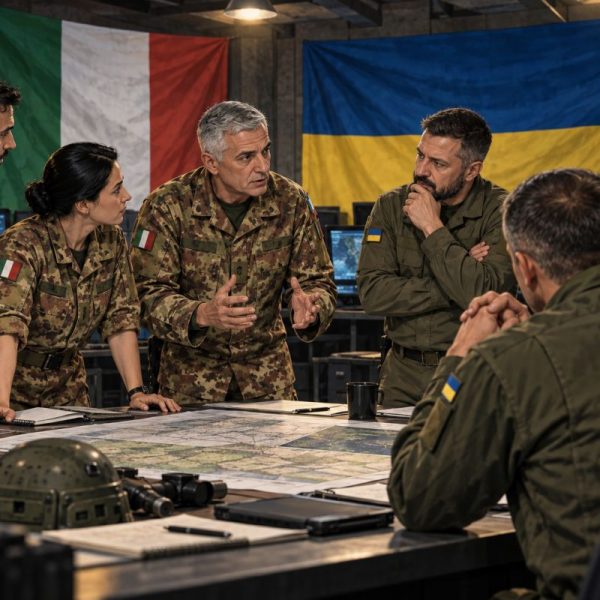
There is something revealing about the image itself. The head of the army of one of the G7's largest economies traveling to a country at war to take notes. Not to provide a capability that the other lacks - the customary way an industrial power relates to an operational theater - but to receive it. The official statement - "the Ukrainian experience as a model for the modernization of the Italian Army" - must be taken at face value: it is a polite but clear admission that Italy is lagging behind in contemporary ground combat, and knows it.
Ground combat has changed more in the past three years than in the previous thirty. The saturation of space with sensors and drones, the near-total transparency of the battlefield, the integration of firepower, maneuver, and electronic warfare into decision-making cycles compressed to just a few minutes: Ukraine has learned all of this at the cost of its soldiers' lives. It is real-world knowledge, and those offering it are well-qualified to do so. The problem is not that Italy wants to learn it. The problem is the contradiction between what one goes to learn and what one is actually capable of doing once back home.
The dependency that no press release mentions
Electronic warfare, drones, and loitering munitions - the three pillars around which Kiev's mission revolves - are precisely the sectors in which the Italian military-industrial complex lags the most seriously. This is not an opinion; it is the picture that emerges from technical sources within the sector.
When it comes to loitering munitions - the loitering munitions, the "kamikaze" drones that have redefined the economics of precision fire - Europe as a whole has never developed a capability comparable to that of the United States and Israel, which remain the dominant players in the sector. European in-house development and production programs are largely a recent response, launched after the war in Ukraine had already demonstrated the indispensability of these systems. Italy is no exception: it is entering this market late, and as a follower.
The picture is similar when it comes to drones. The Multi-Year Defense Policy Document for 2024-2026 allocates funds for the acquisition of various types of remotely piloted systems, but - as the sector analysis itself points out - many of these acquisitions "will have concrete effects only in the medium to long term, leaving some immediate critical issues unaddressed." In other words: we're buying capabilities that will come online only after the lessons from Ukraine have already been rewritten twice. In the meantime, as the domestic industry tries to fill the gap, it does so by relying on foreign partners: the military drone factory established in Modena in June 2026 is an Italian-British joint venture, in which the advanced engineering component comes from across the Channel.
And this dependence does not stop at the European border. The supply chains of the European unmanned sector are now intertwined with Middle Eastern and Israeli actors, to the point that significant components of critical technology pass through suppliers over which neither Rome nor Brussels has sovereign control. This is where the rhetoric about the "war of the future" shows its limitations. You cannot wage next-generation electronic warfare with architectures, sensors, and components for which you lack control over the supply chain, intellectual property, or autonomous production capacity. At best, you can only wage the war that your suppliers allow you to wage.
Fanciful ambitions, real resources
Hence the fundamental absurdity. A country that invests significant sums - on the order of several billion for drones and air defense, with extended implementation timelines - but which starts from a position of structural dependence on the critical technology supply chain, simultaneously positions itself for a frontline role in a confrontation with the continent's leading land-based military power. The two things are incompatible. It is not a matter of courage or political will: it is a matter of the physical capabilities of the means at hand. Those who do not master the production of the systems used to wage modern warfare are not in a position to sustain it, except to the extent that others sustain it for them.
The posture of the coalition of the willing presupposes actors capable of generating autonomous power. Italy, in this specific sector, is not yet there. It has a highly respected defense industry in other segments - Leonardo's electronics, aeronautics, and naval sectors - but precisely in the three domains that the war in Ukraine has made decisive, it is unprepared on an industrial level, as evidenced by the very fact that its Chief of the General Staff is traveling to Kiev with a notebook rather than with capabilities to offer.
The paradox is self-contained. We are preparing for a war that we admit we still need to learn about, with tools we admit we still need to acquire, against an adversary that has been fighting that war for three years with its own production chain. Viewed objectively, this is not a posture of deterrence. It is the exposure of a vulnerability disguised as modernization.
What would, on the other hand, make a great deal of sense
None of this is an argument against the modernization of the Army, which is necessary and long overdue. It is an argument against the sequence. The rational order of priorities would require building autonomy first and, only then - if at all - considering power projection. Reversing these two steps - going to learn how to wage war before being able to sustain it with our own resources - means signing away our subordination in advance: technologically to suppliers, strategically to those who truly lead the coalition.
Viewed in this light, Masiello's visit to Kiev is not a snapshot of an Italy preparing for the war of the future, but rather a snapshot of an Italy that discovers it still lacks the tools for the war of the present - and that, instead of drawing the most obvious lesson - to build them itself - chooses to approach the fire, trusting that someone else will lend them the tools.
It's a gamble. And in war, gambles made with other people's resources are always paid for by those who make them.