By Uroš LIPUŠCEK
The Global South today possess economic power on a scale the Non-Aligned Movement didn't have during the Cold War, writes Uroš Lipušcek.
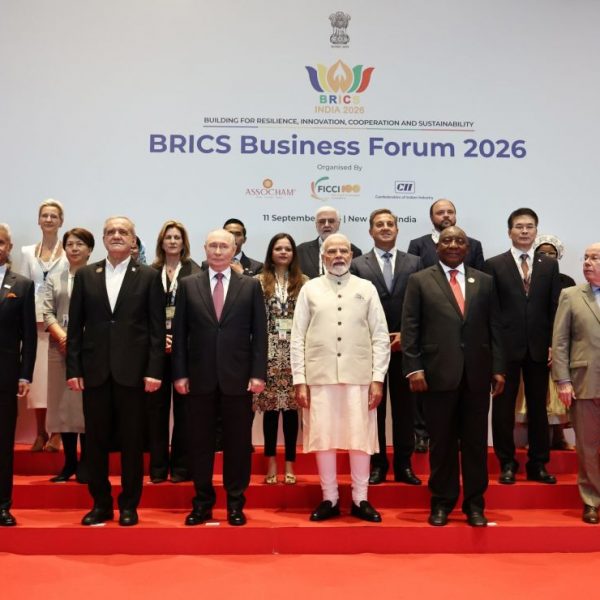
The 18th BRICS Summit in New Delhi over the weekend may well prove to be an important milestone in the gradual transformation of the international economic order.
Its most significant achievement was not the announcement of a new BRICS currency or a dramatic institutional breakthrough. It was the preservation of unity among countries with very different political interests and geopolitical priorities - and, above all, their continued commitment to a gradual shift toward a more multipolar world in which the countries of the Global South have a greater say.
The summit brought together 11 BRICS members. According to Indian government figures, they account for roughly half of the world's population and about 40 percent of global GDP. The group has therefore evolved far beyond the original BRICS concept of an association of emerging economies. It is becoming an increasingly important political and economic platform for the Global South.
The final declaration is reminiscent of the carefully worded documents traditionally adopted by the Non-Aligned Movement. On contentious issues, the language tends to be deliberately broad and principled, allowing countries with very different interests to reach consensus.
Something similar happened in New Delhi.
The United States, which under President Donald Trump is seeking to defend the existing international economic order through tariffs, sanctions and other instruments of economic power, was not explicitly named as the principal adversary of BRICS.
Instead, the declaration focused on principles: opposition to unilateral coercive measures, protectionism and unilateral trade restrictions, reform of international institutions, and a stronger role for developing countries in global governance.
Modi Rejects Idea of New Anti-Western Bloc
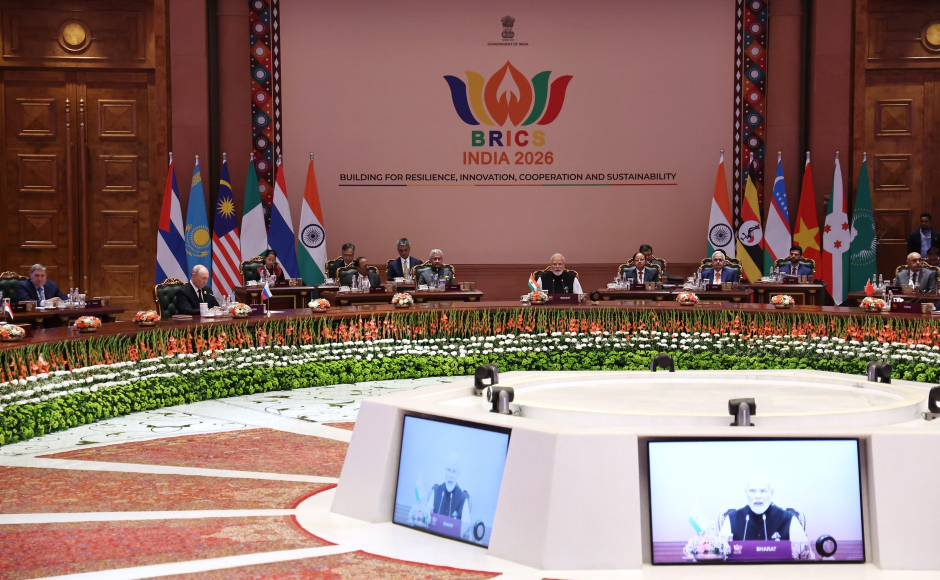
Indian Prime Minister Narenda Modi chairs a session of the BRICS summit, Sept. 12. (Office of the President, Russian Federation, kremlin.ru/events)
Indian Prime Minister Narendra Modi, who chaired the summit, went out of his way to reject the notion that BRICS is becoming an anti-Western alliance.
His message was clear: BRICS is not intended to be "against anyone." Its purpose, rather, is to ensure that the countries of the Global South move from being rule-takers to becoming rule-shapers in the international system.
This distinction is crucial.
BRICS was established in 2006 by Brazil, Russia, India and China, with South Africa joining in 2010. Since then, it has expanded dramatically. The enlarged grouping now includes 11 full members and has become a platform through which countries of the Global South seek greater influence over international economic and political institutions.
In this respect, BRICS is gradually assuming some of the role once played by the Non-Aligned Movement.
There is, however, one fundamental difference.
The countries of the Global South today possess economic power on a scale that the Non-Aligned countries did not have during much of the Cold War. China is the world's second-largest economy, India is one of the fastest-growing major economies, Russia remains a major energy and military power, and Brazil is the biggest South American economy.

Ghana's President Kwame Nkrumah, left, and Yugoslavia's President Josip Broz Tito arriving at the Non-Aligned Movement conference, Belgrade, 1961. (Historical Archives of Belgrade / Wikimedia Commons/ CC BY-SA 3.0)
The political weight of the Global South has therefore changed fundamentally.
BRICS countries are increasingly demanding greater representation for developing nations in institutions such as the IMF, the World Bank and the U.N. Security Council. Yet the New Delhi summit deliberately avoided turning this demand into an explicitly anti-American manifesto.
Paradoxically, this restraint may be one of the summit's greatest political achievements.
The objective is not to replace one hegemonic system with another, but to change the distribution of power within the international system.
Trump's Tariff Threat: A Weapon Against De-Dollarization
The question is how the increasingly volatile American president will react to the conclusions of the latest BRICS summit, particularly when he is expected to meet Chinese President Xi Jinping at the White House on Sept. 24.
As president-elect, Trump threatened BRICS countries in December 2024 with 100 percent tariffs if they created a new common currency or supported another currency to replace the U.S. dollar. Trump demanded that BRICS countries guarantee that they would not attempt to undermine the dollar's position as the world's reserve currency.
The threat has since been repeated several times. Its essence is clear: Washington is prepared to use its greatest economic leverage - access to the American market and its tariff policy - to preserve the dollar's privileged position.
This is not merely a question of currency.
The dollar is one of the central pillars of American strategic power. It enables the United States to finance large external and fiscal imbalances, gives Washington extraordinary influence over the international financial system and strengthens the effectiveness of American sanctions.
For this reason, the debate over de-dollarization is ultimately a debate about power.
The New Delhi summit confirmed that BRICS countries no longer accept an international economic system in which a single country has disproportionate influence over international trade, finance, payments and sanctions.
The declaration therefore called for reform of international financial institutions and greater representation of developing countries in their governance. It also opposed unilateral trade measures and sanctions and emphasized diplomacy and multilateralism as instruments for resolving international conflicts.
No New Currency, But a New Financial Architecture
Before the summit, much of the speculation concerned the possibility of a BRICS common currency.
That expectation was misplaced.
India has repeatedly opposed the creation of a common BRICS currency. Instead, it favors a much more pragmatic approach: increasing the use of national currencies in bilateral trade and investment and developing alternative payment mechanisms.
This may ultimately prove more consequential than the creation of a symbolic BRICS currency.
The basic principle is simple.
If China and Brazil increasingly settle trade in yuan and reals, India and Russia in yuan, rupees and rubles, and China and Iran in yuan and rials, the dollar becomes less necessary as an intermediary currency.
"Increasing the use of national currencies in bilateral trade and investment... may ultimately prove more consequential than the creation of a symbolic BRICS currency."
No new global currency is required.
The dollar simply has to be used less.
That is the essence of de-dollarization.
The process is already visible. China and Russia have dramatically increased the share of their bilateral trade conducted in their national currencies to more than 90 percent. At the same time, BRICS countries are exploring closer links between their payment systems and greater financing in local currencies.
China's Cross-Border Interbank Payment System, or CIPS, is one element of this emerging architecture. The New Development Bank is another.
The objective is not to abolish the dollar overnight.
It is to reduce the dependence of the Global South on a financial system dominated by the United States.
China's Objective: A Multipolar Financial System
China, by far the most powerful economic country in the Global South, is not simply trying to replace the American dollar with the Chinese yuan and establish a new Chinese-centered monetary order.
There are good reasons why Beijing would not necessarily want that.
For the yuan to become the dominant global reserve currency, China would have to substantially liberalize its capital account and make the currency fully convertible. That could expose the Chinese financial system to the kind of speculative capital flows and currency crises that have periodically destabilized other big economies.
Beijing has therefore pursued a more cautious strategy.
According to the latest IMF data, the U.S. dollar still accounted for 56.77 percent of global foreign-exchange reserves in the fourth quarter of 2025. The euro accounted for 20.25 percent and the Chinese renminbi only 1.95 percent.
The yuan therefore remains far from challenging the dollar's dominant reserve-currency position.
China's more realistic long-term objective is a multipolar financial system in which the yuan plays a substantially greater role alongside the dollar, euro, other national currencies and gold.
Such a system would distribute currency risks more widely.
The ultimate possibility is an international monetary system in which no single currency has the extraordinary privileges that the dollar enjoys today. The ultimate objective is probably a new common global currency based on the strength of the major currencies of the world's most developed countries - the G7 - and the BRICS group. Achieving this would require a complete transformation of the international order, which is not possible for the time being.
That would represent a fundamental transformation of the post-1945 international economic order.
The Dollar's Privilege - and America's Debt Problem
U.S.Treasury Department in Washington. (Wally Gobetz, Flickr, CC BY-NC-ND 2.0)
The dollar's dominant position gives the United States enormous advantages.
Because the dollar is the world's principal reserve and transaction currency, the United States can finance large fiscal and external deficits more easily than other countries.
The American national debt has now reached roughly $40 trillion.
This raises a fundamental paradox.
The United States needs the rest of the world to continue holding dollars and U.S. Treasury securities. At the same time, the more the rest of the world diversifies away from the dollar, the greater the pressure on the American financial system.
China has already been reducing its holdings of U.S. Treasury securities.
According to U.S. Treasury data, China's holdings stood at approximately $633.4 billion in June 2026, the lowest level since September 2008 and around 13 percent lower than a year earlier.
Beijing has a practical reason for moving cautiously, however.
China still holds enormous dollar reserves. A sudden collapse in the value of the dollar would therefore hurt China as well.
China's strategy can therefore be summarized in one sentence: It does not seek to destroy the dollar; it seeks to end its monopoly.
China has another major advantage. Its economy is the largest within BRICS and its trade network extends across Asia, Africa, Latin America, the Middle East and Europe.
The more international trade is conducted in yuan, the more international the yuan itself becomes.
India Against Chinese Dominance Replacing US Dominance
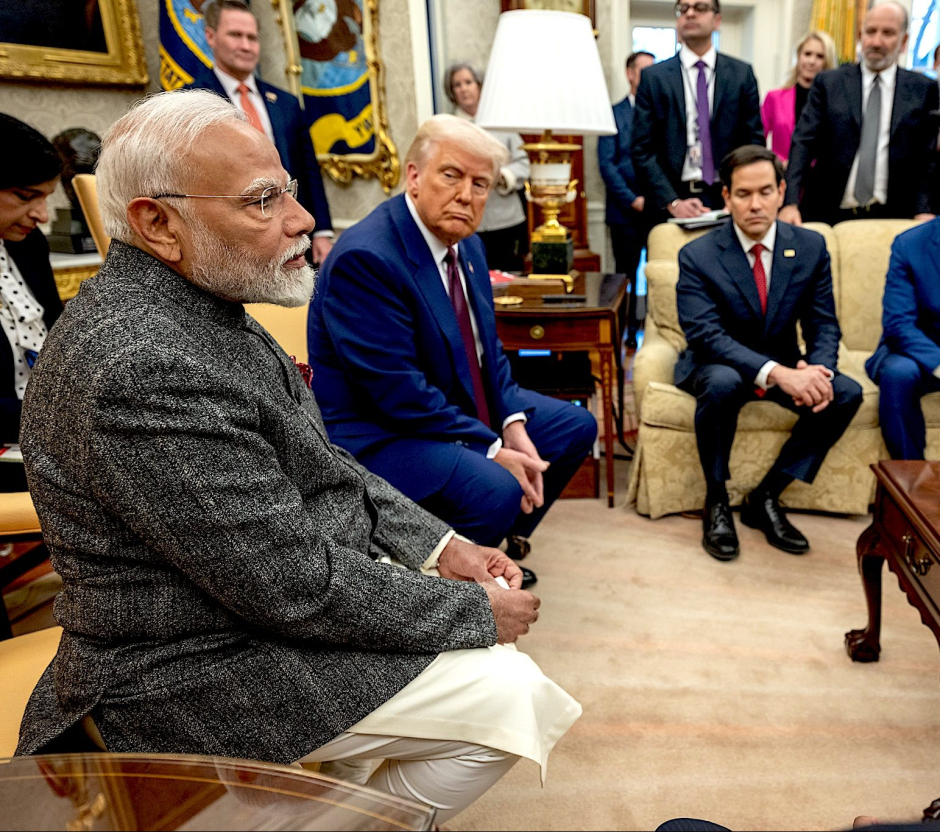
Modi and Trump and others in the White House on Feb. 13, 2025. (White House/Flickr)
India's position is equally important.
New Delhi supports a multipolar world, but it does not want American financial dominance simply to be replaced by Chinese dominance.
This is essentially a continuation of India's old tradition of strategic autonomy, which Jawaharlal Nehru began within the framework of the Non-Aligned Movement in the 1960s. During the Cold War, like Yugoslav President Tito, he did not want to choose between Washington and Moscow.
Until Modi came to power in 2014, India maintained a distinctly non-aligned foreign policy.
India's foreign policy has changed considerably since Narendra Modi came to power. Relations with the United States have deepened substantially, particularly in the areas of technology, defense and security.
India's participation in the anti-China oriented Quad [Quadrilateral Security Dialogue] - comprising the United States, India, Japan and Australia - has brought it closer to Washington.
But nonetheless, India has stopped short of becoming an unconditional American ally, despite the fact that India regards China as its principal strategic competitor in Asia. The unresolved Himalayan border dispute, which led to deadly clashes in 2020, has reinforced this perception. India also wants to prevent China from becoming the dominant power in the Indian Ocean and throughout Asia.
At the same time, China remains one of India's most important trading partners.
"China's strategy can be summarized in one sentence: It does not seek to destroy the dollar, it seeks to end its monopoly."
This creates a strategic paradox.
China and India are competitors, but they also share an interest in increasing the influence of the Global South in international institutions.
Their relationship may therefore be one of the decisive factors determining the future of BRICS.
The constructive dialogue between Modi and Chinese President Xi Jinping at the New Delhi summit was therefore of considerable importance.
Strategic Autonomy Rather Than Bloc Politics
India's policy can best be described as strategic autonomy.
Modi has refused to accept Trump logic of "with us or against us."
This was particularly evident after Russia's invasion of Ukraine in 2022. India did not follow the United States and the European Union in imposing comprehensive sanctions on Russia. Nor did it abandon Russian oil imports, despite strong pressure from Washington.
For India, this is not simply about Russia.
It is also about preserving its freedom of strategic choice.
His foreign policy, on the other hand, can also be controversial. For example, on Feb. 25, he expressed his solidarity with Israel very clearly in the Knesset and said that India stood with Israel "with full conviction." At the same time, however, he spoke of dialogue, peace and stability and did not explicitly endorse an attack on Iran. Just two days after the end of Modi's visit, Israel launched a major attack on Iran.
Modi sat on two geopolitical chairs and wants India to become one of the principal poles of the emerging multipolar world-not a subordinate member of any geopolitical bloc.
This is why is so important to BRICS.
Without India, BRICS could become much less influential organisation. With it, it has a much better chance of becoming a genuinely broader platform of the Global South.
China nevertheless remains the leading power within the group.
Its enormous economic weight, global trade network and growing technological capabilities give Beijing an influence that no other BRICS member can match.
China's emphasis on sovereignty, non-interference and the Confucian concept of harmony also provides an ideological framework different from the traditional Western model of alliance politics.
Russia plays a different role.
President Vladimir Putin, despite Russia's deep confrontation with the West, remains an important intermediary between the different strategic interests within BRICS.
His ability to maintain close relations with both China and India is particularly significant.
The New Development Bank: A Quiet Revolution
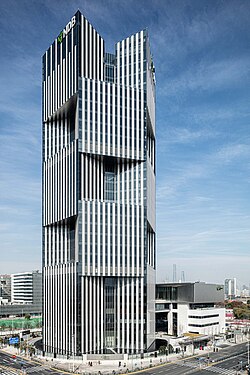
New Development Bank, or BRICS Bank, headquarters in Shanghai, 2020. (Donnie28, Wikimedia, CC-ASA-4.0)
One of the least spectacular but potentially most important institutions created by BRICS is the New Development Bank.
Its importance lies not in its current size, which remains modest compared with the IMF or World Bank, but in the principle behind it.
The question is not simply how much money is available.
It is also who provides the money, in which currency, and under what conditions. The New Development Bank can provide financing in local currencies, thereby reducing the dependence of developing countries on dollar-denominated borrowing.
This is potentially significant.
The more developing countries can borrow, trade and invest without first obtaining dollars, the less vulnerable they become to changes in American monetary policy and the dollar exchange rate.
This is the quiet side of the BRICS (r)evolution.
It is institutional rather than spectacular.
The Middle East & Ukraine Test BRICS Unity
The New Delhi summit took place against the background of dramatic developments in the Middle East and the continuing war in Ukraine.
These conflicts expose one of BRICS' fundamental weaknesses.
"Vladimir Putin's ability to maintain close relations with both China and India is particularly significant."
The group does not have a common foreign policy.
Its members have different interests and sometimes directly conflicting positions.
Iran and the Gulf states, for example, do not necessarily share the same strategic priorities. India maintains close relations with both Russia and the United States. Brazil has its own diplomatic agenda. China seeks stability and economic access, while Russia has become increasingly involved in war in Ukraine and disputes with the West.
This makes consensus difficult.
The Joint Declaration: Unity Through Ambiguity
The BRICS countries nevertheless succeeded in adopting a joint declaration unanimously.
The language was deliberately broad, calling for restraint, diplomacy and peaceful solutions to conflicts while avoiding formulations that could have broken the fragile consensus.
This is not necessarily a weakness.
In a group as diverse as BRICS, the ability to maintain unity despite profound differences may itself be a form of political power.
The strength of BRICS therefore does not lie in the creation of a new bloc or in the immediate replacement of the dollar.
Its strength lies in the possibility of gradually transforming the rules of the international system.
The objective is a multipolar world organized around several centers of economic and political power rather than a system dominated by a single hegemonic center.
History suggests that major transformations rarely happen in one dramatic moment.
The Roman Empire did not disappear in a single day.
The British Empire did not suddenly cease to be a global power.
The decline of American hegemony will probably be equally gradual.
As the New Delhi summit demonstrated, the world is changing gradually.
Original article: consortiumnews.com