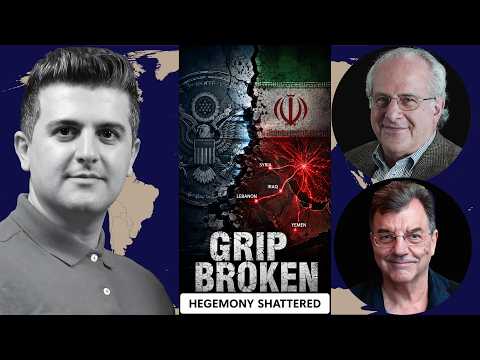
Nima Alkhorshid: Hi, everybody. Today's Thursday, August 27, 2026, and our dear friends, Richard Wolff and Michael Hudson, are here with us. Welcome back Richard and Michael.
Richard Wolff: Glad to be here.
Nima Alkhorshid: Let me start with the Operation Economic Outcast, which was announced by Scott Bessent and the main objective is to isolate the Iranian economy, collapse it from within, and trying to put pressure on other countries not to have any sort of communication, economic communications with Iranians. And here is what Scott Bessent said.
[clip start]
Scott Bessent (clip): We're launching an economic onslaught against Iran's financial connections around the globe, around the globe. Our objective is to sever every economic lifeline that sustains this tyrannical regime until Tehran stands alone.
[clip end]
Nima Alkhorshid: Just moments ago, he posted this: "As the Iranian people struggle to afford basic necessities, the corrupt regime continues to squander enormous sums abroad. Instead of funneling billions of dollars to its terrorist proxies, the regime should spend that money for its people." This is what was mentioned by Scott Bessent.
I remember before the war started, the Secretary of State, Marco Rubio, was telling us that instead of using all those billions of billions of dollars in producing arms and weapons, they need to focus on their economy and helping their people. But this is the mindset in Washington.
Richard, where do you see things as they're changing ? Because before all this madness started, it was all about the economic sanction, economic fury, or tremendous pressure, isolating the Iranian economy. Then they decided to start the war. The war, because the sanctions didn't work. So let's start the war. And again, getting back to the economic sanctions or to, you know, putting, you know, they said economic outcasts, as they call it. Where are we now, Richard?
Richard Wolff: Well, before I get into the economics, and I am no lawyer, I don't claim that I'm a legal expert, but I do believe what Mr. Scott Bessent said constitutes war crimes. You are supposed to limit your war to a combat among the military part of any society. You are supposed not to go after the civilians. What he said, and notice the language, cut off the lifeline. Wow, that's exactly right.
If he were to be correct, he isn't, but if he were to be correct about the standard of living of the Iranian people, and that they're going to savagely attack that, there is no excuse for that. That is targeting civilians, and that is a war crime. And who knows exactly what is going to happen in the long run, but it is clear to me that this man and the regime in this country are cultivating behaviors and making statements that are going to get them in trouble in the future. Number one.
Number two, yes, of course you're correct. But there is a difference even between the earlier efforts that lasted for years to apply sanctions. And let's remember, sanctions have been applied to Russia for many, many years now and intensively since February of 2022. Sanctions have been imposed even longer on Cuba, on North Korea, on and on and on and on.
And they have a long record of being annoyances that are sometimes costly, but they have rarely, if ever, achieved the political objective that was assigned to them. And they clearly did not do it in the case of Iran. Because by their own statements, over the last however many years of sanctions you want to count, Iran has gotten stronger militarily across those sanctions rather than the reverse. It is not a successful policy.
Why then would you impose it ? My suspicion is that this is the same reason why sanctions are always imposed. I'm going to go a little far here, but I want to make the point. They are not about the objective they are linked to. They are about something else.
Imposing sanctions allows people like Mr. Bessent to say things like the clip you just showed us allows him to do. He can posture in front of the American people as a tough guy: Operation Onslaught. This is made in Hollywood, this noise. It's designed for domestic political consumption. Our strong government is administering strong punishment to the bad folks out there in Tehran.
No one expects this to work. The Iranians clearly seem minimally distressed by it. If it actually happens, they have said they will respond by closing down that remaining part of the Strait of Hormuz that is now open. They have presumably taken the steps to get their own oil to China anyway, so in other ways, land routes and all the rest of it.
So, you know, this is what it's for: to make Mr. Trump look like the tough guy, which is the persona he needs, in his mind, to convey between now and the elections in November. Beyond that, this is not a serious proposition. And in that way, I would - a final point: The sanctions haven't worked in terms of the war in Ukraine either. The reality of that war is the Russians are winning it on the ground by moving steadily westward, and there's nothing the Ukrainians or the Europeans can do about it.
They have developed one weapon that has gone beyond annoying Russia, and that is the use of long-range missiles that they can shoot from the territory of Ukraine into the back of, you know, way back into the heart of Russia. That is clearly now a problem. And from everything we can guess, Mr. Putin is getting ready to do something about that, beyond what they've done. And as a result of that, the head of the CIA had to fly to Moscow last week to try, perhaps, to argue Mr. Putin out of doing what it is he's likely to do in the next few weeks.
But no matter whether he does it or not, the Russians can absorb, just like the Iranians have proven they can absorb, what the West has to ship over there in terms of military. If the military didn't work, if the sanctions don't work, then what are we looking at ? We're looking at a failed policy full of symbolic fury, signifying mostly nothing.
Michael Hudson: Well, what Richard says about the attacks on civilians being against international law and the sanctions that are almost always intended primarily to victimize the civilians is not only wrong, it's evil, against the principles of civilization. All of that's correct. And Richard also points out that the sanctions don't really have the effect of preventing countries from surviving. It is obvious Iran has survived. They're an excuse for Trump and others, and Americans generally, to say, what we want to do is to hurt the enemy. We want to do something just to hurt them. And it's only an expression of America doing sadistically to other civilians in Iran, in Russia, and so many other countries that it's attacked, saying, if we can hurt civilians enough, then they'll say: Please stop. We'll have a pro-American government and kick out our government to somebody who says, okay. Surrender.
Well, suppose that Iran did just what Mr. Bessent has said, and said: All right, we're not going to spend any money on arms. We're going to just spend money on feeding the people. Israel and America could walk right in and defeat the whole country, seize its oil, and reduce it to quasi-feudal peonage and a military dictatorship as they had under the Shah.
But what I want to talk about, and what most of the financial people that I've spoken to after Bessent made that quote is something entirely different. It's how bizarrely tunnel-visioned it is.
What did Bessent mean when he said we are cutting off all of your contact with the rest of the world and people whose countries and companies who help Iran get paid for any oil that it exports ? Well, we're going to punish them, and if there's a bank that funds a teapot refinery, meaning a small privately-owned refinery in China, well, then we'll punish that company. Well, everything that he said was restricted to companies and individuals and countries that are using the SWIFT system of bank messages, where the banks say, somebody will say, well, from my bank, I'm writing an electronic check. Please let the other bank transfer this money to such and such a bank.
And the money is transferred through the actual clearing house system, CHIPS (the Clearing House International Payment System). Well, all of this is irrelevant because what America has been threatening for so many years, that, well, we can cut off your lifeline, we can cut off your use of SWIFT - and without being able to send a message to the bank saying, please transfer money from this account to that account, then they can't get payment for anything. And how will they ever get paid?
Well, China took the lead in creating an alternative system. The CHIPS, CIPS, C-I-P-S, the China -
Richard Wolff: Just let me interrupt just a moment, Michael, to underscore your point. The Western, American one is called CHIPS, C-H-I-P-S. The Chinese, in an act of mockery when they created their alternative, called it the same thing minus the letter H. Yes, so that it's CHIPS versus CIPS.
Michael Hudson: That's the whole point.
Richard Wolff: But it gives an alternative to any bank in the world that signs up to be involved in both of them. And no bank would be so stupid as to deny itself huge commissions from being part of both of them. So that's what you're going to see. That's what you already have.
Michael Hudson: That's exactly the case. So what Bessent did, and you'd think the Treasury Secretary, who's made his whole career in raiding companies - countries with George Soros and the raid on the British pound - you'd think that he would understand this basic principle. How are you going to get to them ? But China has designed its CIPS system so that there's no way that the United States, as far as we know, or any scammer can interfere with it and block it. So countries are going to be using debt.
So what Bessent then concluded, the statement says, if you try to use this other system and trade with Iran, then you'd better look at leaving the dollar. In other words, he's saying, if we see that you're using the system, you can't be part of the dollar system at all. It's an either-or choice. As George W. Bush said: You're either with us or against us.
Well, this is forcing countries to say, to take the long view and say, who do we want to be with over the long term ? Well, always for right now, for the short term, they have to deal with where they are now. And then, how do they shift over ? You can just imagine the discussions going off throughout most of the global-majority countries. Well, of course, we're going to deal with the Chinese system.
And if the United States (if Trump and Bessent) wants to cut off China, Russia, many global South countries, many Asian countries, then what he will do, in effect, will be to isolate the dollar. He will make the choice for us. If you use another system, then you can't link to the dollar anymore. The dollar will lose all ability to trade and invest and get payments, including debt service payments, from the global South, from Asia, from any other country using this.
Obviously, this is a false threat.
What Bessent is saying is: We will shoot ourselves if you let Iran get payments from China or anyone else. We will commit economic suicide. And where will that leave you, the rest of the world?
Well, I can see Richard now, he would heave a sigh of relief from all of that. So that's the whole problem. It's an empty threat. Why on earth is he saying it ? I don't think it's really to the American people because the American people who listen to what Bessent says are, largely, the financial sector: What does that mean for us ? What should we do ? And the corporate sector: How are we going to decide who to trade with and invest with and how to relate to them ? That's basically what the choice is. So it's an empty threat.
So the United States then has really fallen back to Plan A, which is: Well, it really doesn't matter if people can use other- China and other countries can use the Chinese payment system to pay for Iranian oil because we're blocking all of Iranian oil.
And President Trump has revived a law that was passed during the American Civil War by the Northern states against the South, based on Britain's policy of letters of marque: We will hire pirates to grab ships of our enemies, and they can grab Spanish ships or French ships and take the cargo. And that's a letter of marque. We give them permission to do that.
Well, this civil war law was revived during the Spanish-American War when America tried to grab the ships of Spain and essentially say: We will grab your ships and we will take all of the cargo. That's just what Trump has said, word for word. We are now grabbing Iranian tankers. We are seizing their oil. It's ours - it's piracy - and we're seizing the tankers themselves.
Because under this law that was last applied in 1898, a century and a quarter ago, we're allowed to do that under the law of the sea as it used to be done. His [Trump's] lawyers are always looking for strange precedents that the Supreme Court can say: Well, some bygone Supreme Court applied it to the past, and whatever happened in the past is forever. We can never change it, never bring it up to date - that's what Trump does.
So the question, Nima, and I guess that's up to you with your guests who bring you up to date: Can the United States block Iran physically from transporting oil to China (which gets 90% of its oil), or maybe to India, or to Japan or South Korea ? Can the United States block it not only through Hormuz, but through other Iranian ports on the way through the Indian Ocean to China ? Can it seize that?
And what can be done about it ? How can Iran defend itself ? Will it be supported by Chinese or Russian airplanes ? It said: Well, if you try to seize our ship by sending a helicopter out. Will China say: Well, we're going to shoot down the helicopter. We are not going to obey your [U.S.] sanctions. Your sanctions are not international law. They're not done by the United Nations. They're done because you want to hurt Iran, because you want to take it over and put the Shah back in and grab the oil, [to] do to Iran what you did to Venezuela. And we're not going to let you do it.
But, well, how far will China go in doing this ? And will Russia help ? That's really what all of this is about. So, what do you think?
Nima Alkhorshid: Well, Richard, before going to you, we have the report of the Iranian oil minister. He said that oil sales have not stopped and despite the reduction, the process of delivering oil to customers in distant waters continues. He mentioned that I will not go into details because if information is disclosed, it could be misused by the enemy. Here is what they say: They reduced the export of oil from Iran, but didn't stop it. This is the message from the Iranians.
Go ahead, Richard.
Richard Wolff: Yes, and I think what we're seeing, if I can put everything Michael said in a context, we're seeing what other commentators have called an endless tit-for-tat. The lack of a strategy is being exposed to us here. They went to war, you know, without thinking through anything in the way that a new chess player learns: if you move the little pawn piece this way and that way, well, then the knight or the castle, or whatever you call the pieces, will have this option, not that option. That's how you learn to play the game. You're supposed to play that game when you're an adult and you're doing something serious like a war.
They didn't do that. And so they're patching up. That's why they did it before this sanction. Then they went to the military. Now they went back to the sanction.
Let me just show you how this works now. Every bank of any consequence, being aware of what Scott Bessent said, has already - I don't know this for a fact, I'm not a banker, but I am assured of this by people who are - those banks already have their lawyers creating what will come to be known as shadow banks. Why ? Because if you're the, let's call it the Bank of China, and you deal with Iran, you're going to set up the Bank of The Little Doggy. That's a new bank. It happens to be in the same building with the Bank of China, but it's the Bank of The Little Doggy. It will have nothing to do with the CIPS, nothing to do with China. It will only deal with SWIFT and CHIPS.
And when it's all done and they've got their commission, the secretary will walk it across the hallway and hand it to the other bank. And it'll be an interbank transfer outside of the SWIFT system. Bingo. They can't track it. They can't know what's going on. This is a game.
And by the way, there are books, I mean, I don't have one in my hand, but there are books that academics like me have written about sanctions that demonstrate the eight million ways people have gotten around sanctions, which includes American experience with sanctions it suffered at various points and how it got around it. So this is not serious business, number one.
To give you another example: Yes, the Americans started interfering with shipping. So did the British and the French. They got in a little bit and messed around with some Russian tankers. The Russians said: Okay, we'll do it too. We'll start boarding tankers. We'll start interfering.
If the United States hires pirates, other people can hire pirates. If you study the history of piracy, that's what happened. The English kings dealt with pirates, and then French followed suit, and the Spanish followed suit. Pirates are all out there waiting for a good deal. You can find one and have it do, what ? This is ridiculous. What this is, this is the desperate behavior of a government. And maybe Michael and I disagree about that, that a government needs to put on a theater for its people. And never more so than when elections are coming down the pike pretty soon, and we have them. And so now is the time for the theater. And we're going to have theatrics because that's all they have.
Now that Oman - and Michael noticed this, I know - now that Oman and Iran have agreed on how the ships will go through, what channels they'll use, what fees they will pay, how Oman and Iran will divide the revenue that comes from, all of this has now been worked out. That had to be done. It shows that Oman and Iran are effectively working together. That tells you a lot about who's going to control the passageway there because it really excludes everybody else. The UAE has that little piece that gets close, but basically it's Oman and Iran that can control that situation. And that puts the United States back, you know.
And you can see the theatrics by the need to have Mr. Trump say almost every day: We (that is, the United States) control the Strait of Hormuz. It's our, we, nothing has happened ever, to make make-believe how many ships go through, make-believe, you know, and on and on and on...
So for me, what we're watching are the flailing gestures of somebody going down. And if you take the longer look, Michael is absolutely right. We will look back on this week as a major statement by Scott Bessent about what looks like a small detail, but it is in fact a milestone in the passage out of the dollar, out of the dollarized global economy. A little maneuver here, but if you take a step back, that's what it is.
And I think even Scott Bessent, because in that speech (not in the clip you gave us, but in the speech) I'm pretty sure I remember him making an aside, maybe in reaction to a reporter's question: He doesn't want to blow up the world system. So, some words to that effect.
Nima Alkhorshid: He was asked, Richard, he was asked about the secondary sanctions on China. He said: Are you serious ? He said: Am I going to blow up the global economy because of - you know, the economic, you know - the Operation Economic Outcast ? It was a response to a reporter.
Richard Wolff: Yes, but you know, the irony is China is the major competitor of the United States. China is the major customer for Iranian oil. China has shown in its response to the tariffs that it will go however far it needs to go to counter, to blunt, to reject what the United States is doing. So, that aside is really the most important remark he made. Because if he can't confront China without risking the blowing-up, then even Mr. Trump and Mr. Bessent aren't that crazy.
Iran, with all due respect to the good people of Iran, is just not worth it. They are not going to jeopardize that which remains of the American Empire, and that's quite considerable. They are not going to risk that at this point around this question. They're not going to do that.
And they know that if anyone can challenge on a fundamental basis now, it's China and Russia as an alliance. That they cannot. That's why the head of the CIA has to secretly climb on board an airplane, and try to avoid the media, and go and talk to the Russians because they are desperate.
Michael Hudson: Well, all that being said is the actions by the U.S. are threatening the international order by the fact that Iran has indeed made this agreement with Oman. The details are not yet, but they're both in agreement that, yes, we've agreed how we are going to share the charges and the tariffs for shipping through the Strait of Hormuz. And obviously they have agreed to Iran's statement that it wants reparations. And Iran said: We're going to close the straits completely. There may be two or three ships that we have a particular reason for letting through, but we're totally closing down the oil trade.
And if anything's going to threaten the world financial economic order, it's closing down the oil trade until the United States meets the terms of what we understand the Memorandum of Understanding back on June 11th, signed on June 17th, said. We want that $300 billion of reparations to start. We're going to want the $100 billion plus that is in the Emirates.
What are the Emirates going to do ? Well, the U.S. press had said, well, the Emirates have said we're going to hold on. America told us, don't send any money to Iran, starve them all off. And the Emirates said, of course, we're going to do that. But that seems to be only a story, as you would say, Richard, for the U.S. public.
There's no indication that the Emirates are going to do that. So the question is: How long will Iran really insist on closing the Strait of Hormuz because its agreement with Oman is [that] Oman is not going to let any more ships go through the Omani territorial waters. As far as they're concerned, this is a wartime situation, and the right to the sea transport is under the control of Iran. And it's up to it. The agreement has already spelled that out.
So Iran has a range of positions, all the way to the strongest position: We want everything in the Memorandum of Agreement. Israel has to withdraw from Lebanon, and probably the West Bank and Gaza also. America has to pay us reparations. You have to stop blocking our oil exports.
Well, certainly, that's certainly going to be a key. As long as the United States physically prevents Iran from exporting its oil, unless Iran has an agreement made public that China and Russia are going to blow up any American ships, aircraft, or troops in the area that try to interfere with its trade - as China has a sovereign right to do, and this is international waters - then Iran has the right of closing it down.
Well, behind all of this is Trump's fantasy that somehow he can, as he said, make the Strait of Hormuz a U.S. territory, just like the Philippines, or just like some of the Pacific Islands are U.S. territories, or Guam, or wherever we [have] military bases. And we're going to use that. We do want tariffs on shipping, and we want all this tariff to go to ourselves. And as he said, it'll be 20% of everything, all the value of oil that OPEC sells.
Well, this is so crazy, and is such a declaration of war against all the other countries, that for the time being, there's no indication of how trade will actually begin through Hormuz. And all of this means that the U.S. Petroleum Reserve is being sold at current low prices to the U.S. oil companies that are going to make a bonanza. All of this oil that they're selling to the oil companies at today's low prices, that enables the oil companies' profits to go way, way up as oil prices are increasing.
Once the prices are permanently higher as a result of the crisis that all of this is bringing on, once the National Petroleum Reserve is emptied out, everything that it can physically afford to do without collapsing the salt caves, well, then the price of oil will go up and then the United States will turn to the American oil companies and repurchase all of this oil at maybe twice the original price. It'll give them hundreds of billions of dollars of profits, making all of this oil crisis a bonanza for the U.S. oil industry. You can imagine Wall Street anticipating this, buying oil company stocks. They're going up. This is exactly what the stock market is telling us, savvy investors are realizing.
But also, you have Trump declaring a related war on Canada at the same time. And so far, while Trump has enormously raised its tariffs on Canada, trying to do to it what it's been trying to do to Iran, it's exempted Canada's export of oil, especially the heavy oil from the Alberta tar sands, et cetera, that happens to be very much like the OPEC oil. And in fact, the Canadian oil in the last few decades has been displacing OPEC oil.
Well, there's a lot of political pressure in Canada to retaliate against the United States tariffs by saying, all right, you know, we're not going to hurt ourselves. We're not going to shoot ourselves in the foot by raising our tariffs and hence our domestic prices against U.S. imports. We're going to impose tariffs on our exports. And people have said, well, now apparently Canada is charging the U.S. 30%, I think, for shipping through the St. Lawrence Seaway.
Now, there's pressure from Ontario, from Alberta, from other Canadian companies and provinces: Let's charge for our exports of lumber to the United States. We're the main exporters of lumber because we're right next door to it. There will go its construction costs. But suppose we impose a 30% tariff on our oil exports to the United States?
Well, imagine what that would do to the American oil industry. That would be, to me, that would be the one thing that Canada could do to completely wipe out any attempt by Trump to try to extort Canada. Canada also could say, well, you know, we're going to block, charge 20%, maybe, let's say, $200,000 per airplane for any airplane flying over our airspace, just like Russia has closed its airspace to American and its allied airline companies.
So if you're going from West Asia to America, you can't just fly across Russia anymore in a straight line. You have to go around. Well, Canada can do the same thing. It can say, well, you know, if you're going to try to have a New York-Moscow flight, well, you now have to go all the way around. You can't go over our airspace without paying us the levy for this.
All of these charges that Canada can do can just cash in on this deal. And other countries can do the same thing. Trump's war with Iran has given a whole leeway for other countries to say, ah, Trump has been exploiting us with his Liberation Day tariffs and his demand for give-backs and all this. Well, now we can turn the tables.
So I'm waiting for countries to actually do for themselves the kind of things that Canada's Premier [Mark] Carney has been threatening to do to the United States. Everything's up for grabs, just as we're seeing the Somali piracy increasing. The Somali pirates are saying, okay, it's a grab bag now. And for the piracy there, just like there was for the last two or three centuries of Somali pirates.
That's all occurring to the area. What's going to happen while this oil trade remains blocked, and all of a sudden, this makes the United States very dependent on every other potential oil producer and also consumer, not to mention farmers and chemical companies and all the rest of the oil spectrum?
Nima Alkhorshid: Richard, after naming the Gulf of Mexico, Donald Trump changed it to Gulf of America, and then the Strait of Hormuz is right now part of the United States. Here is what Donald Trump moments ago published about the Lake of Ontario.
[clip start]
Donald Trump (clip): This is Lake Ontario in Canada and in the United States. But we're going to make a little change. We're going to call it something different than Lake Ontario. We're going to call it Lake America. And all it takes is a good pen and some intelligence. So Lake Ontario, that's gone. Lake America. So now we have a lake.
[clip end]
Nima Alkhorshid: He resolved the problem.
Michael Hudson: Simply.
Nima Alkhorshid: Let me bring the clip of the Premier of Ontario talking about Donald Trump and the way he's treating Canada. Here is what he said.
[clip start]
Doug Ford (clip): Again, I'm going to give the Prime Minister credit one more time. It's very complicated, folks. And, you know, President Trump, he can't be trusted. Simple as that. He changes the deal. He keeps moving the goalpost. You know, let me tell you about President Trump. President Trump is the type of person that would steal your lunch money the first day. He'd steal the toque off your head the second day. And the third day, he'd steal your running shoes. He is not to be trusted whatsoever. We need to stay united.
[clip end]
Richard Wolff: Yes, well, I mean, here's my concern about all of this. The United States, for the last century - I think it's the whole century, but others argue what I'm about to say only applies after 1945. Either way, we have for a very long time, and that includes the full lifetime of all sitting politicians right now: Their entire adult life has been lived at the time of the absolute dominance of the United States.
I mean, finally, now Americans can accept that the Soviet Union, economically speaking, was never a threat or a danger or anything like that. It wasn't, because it was too poor and it had been too hobbled by two world wars, which even their socialist industrialization, impressive as it was, was not enough to overcome. Russia's GDP today is a small fraction of that of the United States, and it always was. But it constituted the only danger, the only opposition.
World Wars I and II had wiped out all of the old colonial powers: Britain, France, Germany, Spain, Portugal, Japan, Netherlands, Belgium, all of them. Russia, too. So think of it this way: The incredible wealth of Western Europe for the last five centuries was premised on their colonial ripping-the-world-off. And in 1945, that achieved (speaking of piracy), it achieved its final step in which all the imperialist countries blew each other to bits. They did it in World War I, and they finished the job in World War II. Okay?
But that everybody knows. But what they didn't understand was that the United States collected the total colonial powers of all of them under its own heading. That's why we were so incredibly wealthy for the last 70 years. We inherited the colonialism that they all lost. That's why Europe is economically, basically, a basket case now, led by the British who lost the most, of course.
All right, now it's the turn of the United States. But there's a lag, there always is a lag in the consciousness people have of their changed situation. It takes time. So, what we got is we have leaders. Biden was one.
Remember, Biden is the one who referred both to Putin and to Xi Jinping as thugs. That's a word you use not just for a criminal, but for someone who is a local gang leader. The police take care of the thugs. These are not people in your realm of importance. That's the mentality.
And so the United States thinks it can throw its weight around because for 75 years, most of 1945, say to 2015, or maybe even beyond that, they could, they did, and it worked. Yes, occasionally they had to send troops, but most of the time it wasn't necessary. They could threaten, and they got pretty much what they wanted.
This is now coming to an end. As everyone should have understood throughout the last century that it would. It came to an end for every other empire. It's going to come to an end for this one. We're at the end.
And we're in typical form. We have leaders who haven't gotten their heads around it. We are going to all this 'tough guy' talk. When I say it's for the American public, I mean it, but I include these leaders. They do that for themselves. They need to repeat this nonsense because they're getting worried about whether it's true. They have to send their CIA chief to Moscow on a secret airplane because that's where the power now is. It's in Moscow. It's in Beijing.
The thugs aren't thugs anymore. You can call them that. It doesn't matter. The terrorist regime of Tehran. Nobody takes it seriously. It's all blah. We're used to it. It's lost its bite. It's lost. And I think that's the way this is flailing around.
I don't want to take away from what the Iranians have done. They surprised everybody, but they shouldn't have. What is happening there would have happened somewhere else if it wasn't Iran. They keep pushing. They can't.
It's like Western Europe. NATO moved to the east. Remember, they promised they wouldn't when the wall fell down and all of that, but they forgot their promise. They moved east until they can't anymore.
Russia said: You mustn't. But they did and they got away with it. And then Russia said again: You mustn't. Not into the Czech Republic, not in Poland, not in Bulgaria. But they did anyway. And then eventually, you know, that's the bad luck of Ukraine. Could have been Poland, could have been somebody else.
What's important is to understand the totality. The empire is down. This morning, there's an editorial written by Paul Krugman, who writes often. And in it, he's trying, in typical Krugman fashion, to recoup Joe Biden. He's angry at Trump for blaming Biden for all the economic problems. And that, of course, is ridiculous. But to upgrade Biden ? That screaming zero ? What ? That stale debate between it's Biden's fault, it's Trump's fault. Aren't we ? We are way beyond that.
That's no longer interesting. It's a little bit like in economics, you know - Michael knows this endless rehashing - a little more government intervention, a little less. We're done with that. Everybody agrees the government, Mr. Trump is interfering in the government by buying shares of stock in Intel and half a dozen other. He intervenes in the market literally every day.
So we don't want another argument, pro-con Keynesianism, really. That's no longer our problem. Our problem is this whole capitalist imperialist system is disintegrating. And nobody knows quite how to navigate that.
The Chinese, I think, the way I look at them, they're putting their hands over their heads and hoping they can get through this catastrophe without it literally blowing up. And then we have Mr. Scott Bessent, who actually says, as an aside, what I'm doing, I sure don't want to blow up the world system. Well, why did that occur to him ? Because what he's seeing goes back to what Michael said at the beginning of today's show.
The SWIFT system, this global, we run it. No, we don't anymore. It's just one. There's another one. And the other one is growing all the time. Not quite as a messaging system. SWIFT is still dominant there. But if you look at the amount of money moving, then the new one is already holding its own pretty well, growing very quickly.
So they're all seeing this. And so Mr. Bessent has to somehow stand there, act as though we're still in charge, when the whole reason he has to stand up is because we aren't.
Michael Hudson: Richard, I'm glad you began by citing Biden's accusation of Xi and Putin as being thugs. This was echoed by the very clip that Nima played, where Bessent said that Iran is a terrorist country. That's why we have to defeat it. It's a terrorist country for supporting other terrorists, like Hamas.
If Hamas fights back against Israeli terrorism, it's a terrorist. It supports the Lebanese fighters, Hezbollah. They're terrorists for defending themselves against [Israeli] terrorism. Russia's a terrorist because it tried to defend Russian-speaking people in Luhansk and Russian-speaking Ukraine from the Israeli, American, and British terrorists.
It's the Americans and their allies in Europe, and they're now trying to include Japan to give it atomic weapons so that it can join the terrorist camp. This is a fight against civilization, and the terrorists are in every country, from Ukraine to Iran, to all of the U.S. coups, military coups in Latin America, to the Shah of Iran, to the whole gamut of American satellites, [the terrorist camp] has become a terrorist against the whole rest of the world, militarily, specifically against civilians, and abolishing the law of the sea, the law of war, and everything else that was part of the U.N. Charter.
The other important point you made that I want to emphasize is when - we did indeed. After World War II, the settlement was starting with the British loan of 1944. America absorbed Britain's empire and made the Sterling area part of the U.S. dollar zone by abolishing the imperial preference system that obliged India and other former colonies that were required to spend all of the savings that they'd accumulated during the war on buying British products or spending in Britain.
America said, nope, no capital controls, free trade, and it just swallowed up Britain. And once it made the deal with Britain - and I have a whole chapter of this in my book, Superimperialism - it confronted continental Europe with the fait accompli, and it's absorbed all of European colonialism.
Well, the result is that now that the United States has done just what you described and absorbed the European colonialism. Now with the U.S. going under, it drags all of this America, NATO, European colonial terrorist system down with it and leaves the whole rest of the world open to go its own way.
And ever since last December, when America's national security strategy said [that] we no longer can follow the rules that Americans set up in 1945, we need a new order where other countries are tributary to the United States, they spelled out how, chokepoints, etc. Well, other countries can now say there is an alternative, and develop it. All that's required is for a discussion of these alternatives. And I think that's what we're trying to unfold in these various interviews that we're doing.
Richard Wolff: I want to, yeah, in closing, I just want to remind people that when the Roman Empire went down, it referred to all the people in Europe whose hostility and whose fighting helped bring them down as "barbarians." When I was taught European history, that's what we were told. The Roman Empire, you know, after 100 AD or 200 AD, began to disintegrate under the pressure of the "barbarians."
That was the name given to the Goths, the Franks, and those were all, you know, civilizations with governments and people who lived for generations and farmed the land, but they became "barbarians" because the Romans couldn't face the disintegration of their empire from within, so it always had to be the bad guys outside. So, it's terrorists, it's the you know, the Islamic people, however, you can characterize it, the "barbarians."
The ability, when you watch Mr. Bessent, and you realize he is speaking for the government that unilaterally attacked Iran in June of last year, and then did it again at the end of February this year, dropping untold numbers of bombs and missiles, and [he] refers to the people they went to war on as "terrorists." I mean, this is, you know, you'd have to take your head off. It's breath, it's breathless, what they're capable of with intensity.
"Terrorists," you know. It's as if it was Iran that has been at war over the last 30 years in Vietnam, Afghanistan, Iraq. No, it was you who went to war. You who call other people "terrorists," you know, well, who terrify the people of Cuba today, waiting for the invasion, who terrify the Venezuelans, wondering what's next beyond snatching their leader out of his bed.
I mean, who's the "terrorist?" Who's killing the people in the boats in the Caribbean that we talk about ? Who ? What ? You have the nerve?
Everybody else is a "barbarian." It's the end. It's when you have nothing left but throwing sticks and stones because you have nothing. You really have nothing. You can't even keep the toilets on your aircraft carriers from clogging up on your own soldiers.
Really, the pathos is almost there to replace the outrage.
Michael Hudson: Well, Richard, well, the Roman Empire is indeed accusing the rest of the world as being barbarians. The Christian leaders were writing about why are the Roman troops defecting to the Germans, to the other Europeans ? It's the barbarians that had the societies based on some form of mutual aid. They didn't have a creditor landowning class oppressing everybody.
And the Christians were saying, why is it that the Roman army is defecting to the barbarians ? And you have the Roman generals hiring the German and Frankish troops to fight on behalf of Rome. And then they end up fighting against Rome because they're appalled at what they see. That's what ended the Roman Empire from within: a mass defection.
And as the Christians spread to more northwards through Europe, it's backwashed, it spread to Rome, and that became part of the whole revulsion that spread from the Roman Empire to Christianity to Islam, and especially in Persia. There was also this new religious feeling, a movement against conspicuous consumption, against wealth. There was a universal, similar revulsion and reaction about this towards a more egalitarian society that entailed preventing a predatory Rentier class, Roman-style class, dominating it.
I think we're seeing a kind of revulsion throughout the world today that followed the revulsion against the Roman Empire itself, first from without and then from within itself. Well, so far it's not that much from within America and Europe, but it's certainly throughout the global majority.
This revulsion against the terrorism and the daily videos that you see in many countries about the sadistic Israeli shooting of children to injure them, to bomb the hospitals - the United Nations report by [Francesca] Albanese saying that, I think, over half of the United Nations workers, worldwide workers, have all been assassinated, tortured by Israel, usually tortured before they're [assassinated]. The hatred of the United Nations, the hatred of fighting against sadistic torture that is expressed.
This is causing a revulsion against the world that at some point has to percolate up into the leadership and some kind of a political revolution that will be hand in hand with the moral revolution. Again, I go along the lines that we've been talking about.
Nima Alkhorshid: Thank you so much, Richard and Michael, for being with us today. Great pleasure, as always.
Richard Wolff: See you next week.
Transcription and Diarization: scripthub.dev
Editing: Einar Andersen
Review: Kimberley
Photo by Juan Domenech on Unsplash