Lorenzo Maria Pacini
The question Europe should ask itself is whether it still wants to be a place where thought is not only consumed but also produced.
The anomaly of the Steppe
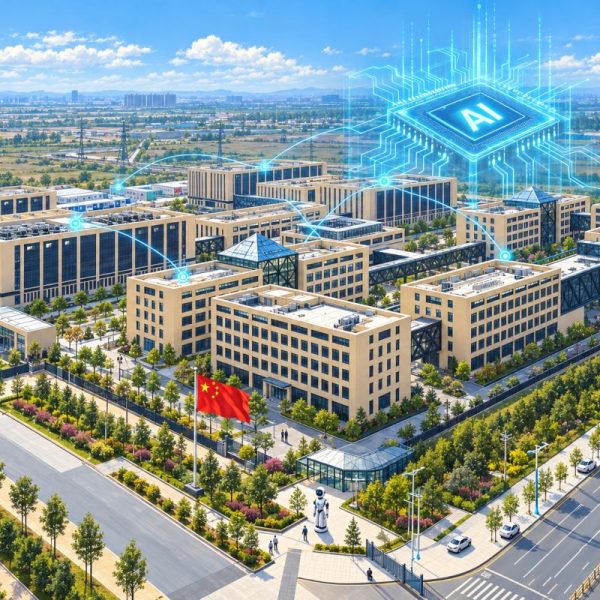
In the heart of Inner Mongolia, less than 200 kilometers from Beijing, there is a prefecture that almost no one could locate on a map. Ulanqab has a population of just over one and a half million, covers an area larger than Denmark, and, until a few years ago, its only noteworthy entry in an encyclopedia concerned a Guinness World Record. Yet this strip of grassland now consumes a share of China's national electricity that is completely out of proportion to its population: the figure is close to 1% of the country's total. This is not household consumption; it is a calculation.
Bertrand has reconstructed the story in a report that deserves to be taken seriously not because of the curiosity of the data, but because of what it reveals about the architecture of power in the 21st century. The question his investigation raises - and which is worth reframing in strictly geopolitical terms - is simple: why would a state deliberately decide to concentrate the raw material of artificial intelligence in a remote steppe, and what does this choice say about the way sovereignty is being reorganized around energy and computing?
The immediate answer is environmental. Ulanqab possesses a combination of physical characteristics that, for those designing computing infrastructure, amounts to a natural advantage. The climate is harsh - the average annual temperature hovers around four degrees, with winters regularly dropping to thirty below zero - and the cold keeps the servers cool with virtually no air-conditioning costs. Wind and sunlight are abundant and constant, a condition that makes renewable energy competitive in price - not just in principle. The area is sparsely populated, with a density of just a few dozen inhabitants per square kilometer, and land costs little or nothing. Finally, its proximity to Beijing reduces latency between the computing facility and the country's main demand center to one millisecond.
Natural conditions alone do not explain everything. Cold, windy deserts exist in many corners of the world, yet no one builds a superpower's computing capital there. What sets Ulanqab apart is that its role did not emerge from the market but from a government decision. In February 2022, China's National Development and Reform Commission launched the dongshu xisuan plan, "data in the East, computing in the West": a plan designating eight national computing hubs, including Inner Mongolia, with the explicit aim of separating the place where data is generated and consumed - the wealthy and populous East - from where it is processed, where energy is cheap and land is plentiful. The plan preceded the public launch of ChatGPT by nine months. It did not foresee the explosion of generative AI, and it would be incorrect to attribute to it a foresight it did not possess; but it did capture a point that the West would come to focus on much later, namely that computing power is an energy-intensive strategic resource that requires dedicated spatial planning.
This is where the first geopolitical fault line opens up. China has treated computing the same way it treats railroads, the power grid, or oil pipelines: as infrastructure of national importance, to which a planned geographical layout must be assigned. The West - and Europe in particular - has allowed data centers to cluster where the real estate market and fiber-optic networks pushed them, alongside financial hubs, on power grids that were already congested. This is not a difference in efficiency. It is a difference in the very conception of the state.
Energy and intelligence
China's advantage in this architecture has a specific name: the price of energy. The stretch of steppe where Ulanqab is located is served by an electricity grid that is unusual in the Chinese landscape, managed by a regional operator rather than by the two national giants that power the rest of the country. Its small scale and limited scope give it an agility that large grids lack, resulting in industrial rates among the lowest in the world, with a significant portion covered by renewable sources. The Chinese state-run press confirms the order of magnitude: the cost of electricity in the cities of Ulanqab and Hohhot is about one-third that of Beijing, achieved by transmitting power directly from the wind farm to the data center.
Why this matters strategically was revealed - almost inadvertently - by one of the key players in the American industry. The cost of artificial intelligence will eventually converge with the cost of energy. If this assertion is correct - and it is a hypothesis, not an established fact - then the geography of energy becomes the geography of intelligence. Those who generate electricity at a few cents per kilowatt-hour have a structural advantage in the cost of inference - and thus in the cost of an input that, in the 21st century, promises to be as pervasive as electricity was in the 20th century.
This is where geopolitics meets physics. Power, ultimately, is the ability to transform energy into an ordered effect: work, in physical terms, is energy that produces direct change. Artificial intelligence is exactly that - electrical energy converted, through computation, into usable cognitive capacity. Ulanqab is the place where this conversion takes place at the lowest marginal cost available on an industrial scale. It is neither a goods factory nor a raw materials mine: it is a facility for transforming energy into thought, and its efficiency is measured in cents per kilowatt-hour.
At this point, the story demands to be interpreted through the lens of classical geopolitics, not merely through the lens of the economics of innovation. A century ago, Halford Mackinder placed the linchpin of world politics in the continental heart of Eurasia, the Heartland: a landmass inaccessible to maritime power, endowed with strategic depth, and destined, according to his formula, to command the island-world. Anglo-Saxon thalassocracy built its hegemony precisely by denying this value, shifting the center of gravity of power to the oceans, ports, and trade routes.
The infrastructure of computing revives, in an unexpected way, the logic of the continent. A frontier data center needs neither a port nor a maritime route: it requires low-cost energy, land, cold temperatures, and sufficient proximity to the consumer market. These are precisely the resources in which the Eurasian interior is rich and the coastal belt is poor. Ulanqab is not a "Heartland" in Mackinder's literal sense - it is not the place from which land-based military power is projected - but it shares its defining characteristics: depth, energy self-sufficiency, relative invulnerability, and centrality within a system of flows. It is a computational Heartland, and its emergence signals that the AI revolution could reward the geographies that the maritime age had marginalized.
This is no isolated case. The dongshu xisuan plan has been interpreted by Chinese media itself as a component of the "Digital Silk Road": the idea that the country's inland west will become the server of the Eurasian digital economy, just as ports and railways constitute its material logistics. In other words, the territorialization of computing is intertwined with a broader spatial project, in which cognitive infrastructure follows the same guidelines as the physical infrastructure of the Belt and Road. Those who interpret multipolarity as a simple redistribution of power shares among states are only seeing half the picture. The other half is the reconfiguration of strategic geographies: which places matter, and why.
The economy of tokens
From this material foundation arises a possibility that Bertrand astutely identifies: the export of inference. While energy and computing power reside in China, the product of artificial intelligence - the token, the basic unit of linguistic processing - can be sold anywhere. Chinese commentators are already speaking of suanli chuhai, the "going global of computing power." The data that brings this prospect into sharp focus comes from OpenRouter, one of the world's leading model routing platforms: over the course of about 18 months, the share of Chinese models rose from a negligible figure to the majority of consumption among the most widely used models - around 60% by early 2026. The key factor is not absolute quality, but price: Chinese open-source models cost a fraction of their Western equivalents, while offering roughly equivalent performance across a wide range of tasks.
Here, China reveals a coherent strategy, which also explains its insistence on open source. Giving away models is neither generosity nor a sign of competitive weakness: it follows the logic of selling a printer below cost to sell the ink. The open-source model becomes a commodity, but the infrastructure that runs it - energy, computing power, and chips from Ulanqab - remains the profitable and strategically controlled bottleneck. Value shifts from the model to the infrastructure.
For Europe, this situation poses a dilemma that is one of sovereignty even before it is an economic one. With industrial electricity prices four or five times higher than those on the Chinese steppe, the continent faces an uncomfortable choice. It can allow the queries of its citizens and businesses to be processed abroad, gaining in cost savings and purchasing power but ceding control over the physical location where its data is processed; or it can mandate domestic processing, defending its sovereignty but condemning its businesses to an incomparably higher cost of inference. Bertrand frames the stakes in stark terms: dependence or irrelevance. Low-cost computing leads to dependence; high-cost computing leads to irrelevance.
The formula is effective and captures a real risk, but it must be handled with the precision that the analysis demands, because the reasoning behind it contains a leap.
Three consequences emerge with varying degrees of certainty.
The first, highly probable and in the short term, is that the cost of inference will become a factor in industrial competitiveness on par with the cost of energy and labor. Economic systems that gain access to inexpensive computing power will enjoy a widespread advantage in every sector that uses it, from logistics to design. The question "Who processes our ideas, and at what cost?" will cease to be a topic for industry insiders and will become a variable in industrial policy.
The second, with moderate probability, is that computational sovereignty will establish itself as an autonomous category of state law and strategy, alongside energy sovereignty and supply chain security. The first signs of this can be glimpsed in European regulatory measures on digital technology and in the restrictions on access to chips imposed by Washington; it is plausible that the coming decade will solidify this into explicit doctrines.
The third, and most uncertain, scenario concerns the overall landscape. Ulanqab is tangible proof that multipolarity is not merely a redistribution of power among the old actors, but a reconfiguration of its physical foundations. Twenty-first-century power is increasingly rooted in what a territory can do with the energy it possesses: refining it into computation, and computation into decision-making. In this sense, the steppe of Inner Mongolia is not a developing periphery, but a center in the making; and its rise - which has taken place quietly amid the grasslands and herds - points precisely to where the world's center of gravity is shifting.
The question Europe should ask itself is not whether to accept or reject Chinese influence, but rather whether it still wants to be a place where thought is not only consumed but also produced.