By Betwa SHARMA
India kept BRICS from going anti-U.S. at the recent New Delhi summit. The U.S. thanked India with 100 percent tariffs for importing Russian oil.
Just days after India hosted the 18th BRICS Summit, Washington sent New Delhi a message.
The U.S. Congress passed legislation that paves the way for tariffs of up to 100 percent on countries that continue to buy Russian oil and gas.
The measure cleared both the Senate and the House of Representatives with significant bipartisan support. President Donald Trump signed the bill into law on Friday. He is yet to take action on it.
Democratic Senator Richard Blumenthal, addressing India and China, said: "You better clean up your act. Buy your oil and gas somewhere else."
There is an important point here. This is not simply Trump unilaterally deciding to impose another tariff on India. The U.S. Congress itself has now passed legislation giving the president the authority to impose potentially crippling tariffs.
TheSenate passed the Lindsey O. Graham Sanctioning Russia and Iran Act of 2026 on Aug. 7 in an 86-11 vote, with 48 Republicans, 37 Democrats, and 1 independent. The House passed the legislation on Sept. 16 with a more partisan 262-to-159 breakdown that included 203 Republicans and 58 Democrats voting in favour and seven Republicans and 152 Democrats against.
New Delhi responded by saying, "India remains firmly committed to ensuring energy security for its 1.4 billion people."
This would be a sharp setback for India, fresh off a major diplomatic triumph: uniting nations with competing priorities and stark geopolitical divides behind a joint declaration at the Sept. 12-13 BRICS summit. It did so after going to considerable lengths to ensure the group did not project itself as anti-Western, anti-American or anti-dollar.
BRICS stands for Brazil, Russia, India, China, and South Africa, and has expanded to include Egypt, Ethiopia, Iran, Saudi Arabia, the United Arab Emirates, and Indonesia. Together, they represent roughly 50 percent of the world's population and 40 percent of the global GDP.
India has been trying to walk a delicate diplomatic tightrope: presenting BRICS as a collective voice of the Global South while maintaining strong strategic and economic ties with the United States and the wider West.
But Washington's message seems much less concerned with how BRICS presents itself and much more with what individual countries actually do.
This does not appear to be a battle that New Delhi can simply navigate through the language of "strategic autonomy" or by waiting for the Trump era to pass.
The fact that the legislation has bipartisan support - and that one of the prominent voices warning India is a Democrat - suggests a broader American expectation that countries such as India align more closely with U.S. strategic priorities, particularly on Russia and China.
This should make India think beyond the U.S.
It seems to have bent over backwards to appease Washington in Trump's second term, weathering his irreverent rhetoric and erratic tariff regime.
Prime Minister Narendra Modi, who likes to project himself as a strongman at home and is highly conscious of his image, has quietly endured all manner of humiliations from Trump.
More significantly, India's relationships with Russia and Iran have been seriously tested under U.S. pressure.
India has risked appearing to be a spineless fair-weather friend: It largely remained silent as the U.S. repeatedly criticised its dependence on Russian oil; it did not condemn the U.S. attack on an Iranian vessel in the Indian Ocean; it pulled back from the Iranian port it had spent decades investing in and it did not condemn the war waged by the U.S. and Israel against Iran.
Yet Russia and Iran did not respond by turning hostile toward India.
Both relationships have unusually deep foundations. Russia's ties with India date back to the Cold War, while its relationship with Iran draws on centuries of historical, cultural, and civilizational connections.
Under U.S. pressure, and amid its increasingly close relationship with Israel, India also avoided condemning Israel over what numerous experts have described as genocide in Gaza. This marked a significant departure from the stronger sympathy India historically expressed toward the Palestinian cause, particularly during the era of the Non-Aligned Movement.
The shift away from Palestine also aligns with the Hindu-nationalist and anti-Muslim politics of the ruling Bharatiya Janata Party (BJP), Modi's party.
At the same time, India has not outrightly condemned Russia's invasion of Ukraine, despite sustained pressure from the U.S. and its allies to take a stronger position against Moscow.
Limited Room for Manoeuvre
India describes this approach as strategic autonomy: preserving the freedom to pursue its interests without formally aligning itself with any major power bloc.
Rather than simple indecision or lack of moral conviction, declining to take unequivocal stands or sides is explained as a deliberate tactic to maintain room for manoeuvre.
But because India is not yet powerful enough to impose its preferences or ignore the interests of stronger states, its strategic autonomy operates within real constraints, leaving little room for manoeuvre.
India often finds itself navigating a precarious geopolitical balance between Beijing and Washington, rarely feeling secure on either front.
Squeezed by unresolved border disputes with China and unexpected trade tariffs or economic pressures from the U.S., New Delhi is too frequently treated as a strategic pawn in their global rivalry rather than an equal partner.
Chinese President Xi Jinping's visit to India for the BRICS Summit was his first since the deadly border clash in the Himalayan region of Ladakh in 2020. In bilateral meetings with Modi, they discussed trade ties and agreed to manage their differences peacefully.
The BRICS Summit
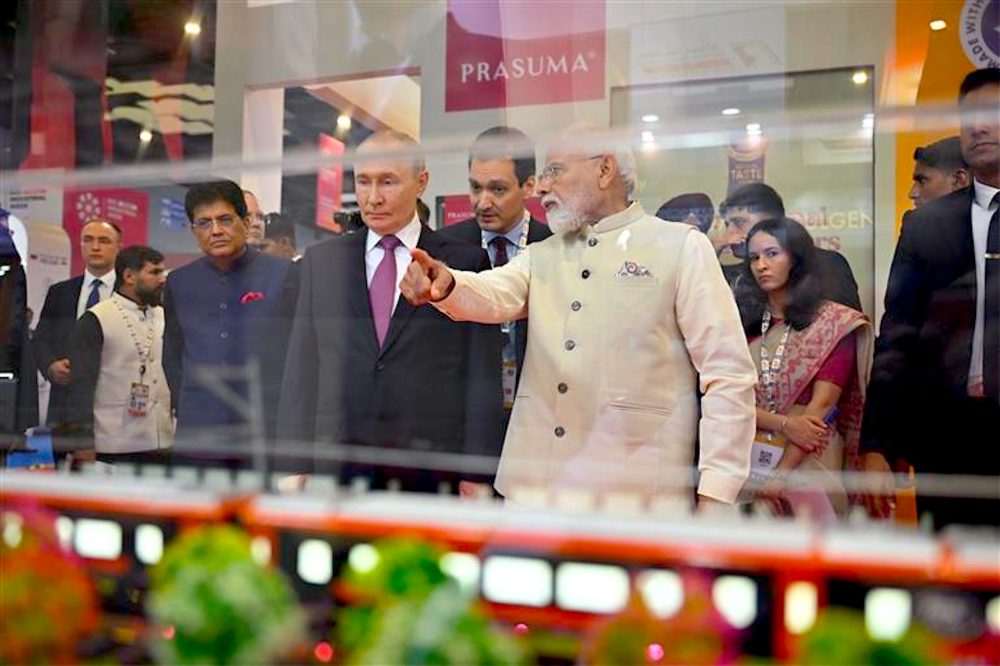
Modi and Russian President Vladimir Putin visit the INNOPROM Exhibition on the sidelines of the 18th BRICS Summit at Bharat Mandapam, in New Delhi on September 11, 2026. (India Prime Minister's office)
The summit overcame tensions between Iran and the UAE.
Modi's government kept things practical and face-saving, managing a consensus, or, as critics might call it, a compromise.
Either way, BRICS members agreed on the Delhi declaration. India built on what countries could agree on, watered down what they could not, and kept the process moving.
Beyond its longstanding ties with countries like Russia and Iran, India has deliberately cultivated close relationships with the Gulf states and has a solid degree of trust with a wide spectrum of countries.
An unscheduled meeting between the Iranian president and the Crown Prince of Abu Dhabi, the highest-level interaction between senior leadership of the two countries since the escalation of hostilities, provided a breakthrough.
The final language on the West Asia/Middle East conflict was cautious, calling for "maximum restraint" and warning against steps that could "further aggravate the situation."
Even without naming Israel directly, the declaration gave major weight to the crisis in Gaza and the broader conflict.
BRICS called for maintaining the ceasefire, ensuring humanitarian access and preventing the forced displacement of Palestinians. It reiterated support for a two-state solution based on the 1967 borders, with East Jerusalem as the capital of Palestine, and backed full U.N. membership for Palestine.
The communique said:
"We express our firm opposition to the forced displacement, temporary or permanent, under any pretext, of any of the Palestinian population from the Occupied Palestinian Territory, as well as any geographic or demographic changes to the territory of the Gaza Strip. We reiterate that international law and international judicial bodies demand the end of the illegal occupation and the immediate cessation of all practices that undermine legal norms and obstruct a just and lasting peace."
Ukraine found no mention. Previous BRICS declarations have addressed the invasion but stopped short of criticising Moscow, the U.S. or Kiev.
The bloc is a platform where the Global South can put forward its own positions on international conflicts, rather than simply follow the West's agenda. But its struggle sometimes to agree on who to condemn shows its ambitions have limits.
Still, given how BRICS has become an important vehicle for frustration with the existing international economic order, its economic agenda is becoming increasingly consequential as it draws the ire of the West and especially Trump's.
He came into his second term having apparently unaware of its existence. In July 2025, he said:
"When I heard about this group from BRICS, six countries, basically, I hit them very, very hard. And if they ever really form in a meaningful way, it will end very quickly. We can never let anyone play games with us."
He has then continuously threatened sanctions on BRICS nations if it should ever create its own currency, which is not currently on its agenda. In October last year, he said:
"BRICS, which is basically a group of countries that are anti-United States, and India is a member of that, if you can believe it. It's an attack on the dollar, and we're not going to let anybody attack the dollar."
The BRICS declaration criticised unilateral economic sanctions, secondary sanctions, tariffs and other trade barriers, and called for greater representation for developing countries in institutions such as the IMF and World Bank, as well as greater use of cross-border payment systems and national currencies.
It expressed concern about the tightening of unilateral blockade measures against Cuba and their impact on the Cuban economy, energy supplies and humanitarian conditions.
It was a declaration of defiance against the U.S.: BRICS countries are no longer willing to accept one-sided economic pressure from Washington.
Original article: consortiumnews.com