September 26, 2026
During talks at the recent meeting of the UN General Assembly Iran has repeated its proposal for reopening the Strait of Hormuz:
Abbas Araghchi, the foreign minister, told reporters at a press briefing at the United Nations General Assembly that the proposal closely mirrored the commitments laid out in a so-called memorandum of understanding that was struck between the United States and Iran in June but quickly unraveled.
He said Iran was ready to begin putting the plan into effect as soon as Washington agreed to it.
"We have introduced a plan to the United States through the intermediators that if certain conditions are met, the Strait of Hormuz would be open on the end of the seventh day and talks would restart," Mr. Araghchi said.
The offer is a return to the MoU which is then to be executed in a compressed timeframe:
Iranian officials said that while the proposal was effectively the same as the memorandum of understanding made in June, it was designed to move at a much faster pace. In the earlier agreement, a 60-day time frame was set for reaching nuclear negotiations.
Under the conditions that Iran has set for the agreement, according to Mr. Araghchi, during the seven days all hostilities would end, including in Lebanon; the U.S. would release Iran's frozen assets - estimated at at least $12 billion - waive sanctions on Iranian oil and lift the naval blockade on Iran. Then, on the last day, the Strait of Hormuz would be opened.
Talks on the nuclear issue would follow thereafter.
Iran is expecting the Trump administration to pick up on this. Foreign Minister Araghchi will stay in New York until Monday, presumably to facilitate further talks.
Agreeing to Iran's condition is likely the last chance for President Trump to lower energy prices before the midterm elections, especially for gas and diesel.
But there are various forces which will try to hinder him. The Zionists want Iran destroyed. Any attempt to a peaceful solution is intolerable for them.
Some of the Gulf countries, in silently collaboration with Israel, are also opposed to an agreement:
Efforts to rekindle talks to end the war between the U.S. and Iran are running into resistance from major Persian Gulf oil producers that have swung against any accommodation of Tehran, people familiar with the matter said.
Mediators including Qatar are pressing for a fresh round of talks in Oman as soon as next week to try to get Washington and Tehran to reopen the Strait of Hormuz and start the process of winding down the war. President Trump said Tuesday he believed the two sides would meet again soon.
Gulf countries generally agree that Trump shouldn't escalate militarily against Iran. But oil kingpin Saudi Arabia and the United Arab Emirates are lobbying the Trump administration to keep up the economic pressure on Iran and not agree to concessions that would ease sanctions or the U.S. Navy blockade, the people said.
The Saudi and Emirati presume that Iran will yield under pressure. But such a view of Iran is outdated. It does not account for recent changes in Iran's doctrine which have evolved as a consequence of the war. As Danny Citrinowicz explains:
[T]he current crisis is once again exposing significant differences among the Gulf states.
The Saudi and Emirati approach could prove to be a dangerous gamble. The assumption appears to be that sustained external pressure, combined with growing pressure inside Iran, will eventually force Tehran to compromise. But that outcome is far from certain. Domestic pressure may not produce Iranian restraint or capitulation. It could instead encourage Tehran to take greater risks, escalate against its adversaries, and shift some of the costs of the confrontation onto the Gulf states themselves.
The larger problem is that Riyadh and Abu Dhabi may still be dealing with Iran as if it were the Iran of before the war. Under Ali Khamenei, there was at least an argument that overwhelming pressure could affect Tehran's calculations and encourage caution. But what I call "Iran 3.0" is a different system: one in which the IRGC plays a much more dominant role and a new, more radical and less experienced leadership faces enormous internal and external pressure.
Under these circumstances, escalation rather than capitulation may increasingly become Tehran's preferred response.
The U.S. recently threatened economic sanctions against airports which serve Iranian airlines. China rejected such pressure and flights between Iran and China continue on schedule. But the Gulf countries are following the dictates from Washington. The have stopped servicing Iranian carriers.
Iran 3.0 wont have that. The signals coming from Tehran are pointing to a hostile reaction:
Significant comments today amid UNGA U.S.-Iran diplomacy from Mohsen Rezaei, secretary of Iran's top national security body, the Supreme National Security Council.
He says Pezeshkian & Araghchi went to New York to convey Iran's internally agreed terms, not negotiate new ones: "There has been no discussion of changing the conditions." Araghchi was tasked with transmitting them through mediators.
Rezaei says Iran won't return to the diplomacy of the Islamabad ceasefire. He says Washington must first accept Iran's conditions and has "4-5 days" to act. The short deadline amounts to an implicit threat of further escalation if it doesn't.
He also warned neighboring states aiding US pressure on Iranian aviation: block Iranian flights and "your airports will have no flights."
His message overall is that Tehran is open to diplomacy, but its terms are fixed and US action must come first.
To make it official an advisor to the Supreme Leader of Iran repeated Mohsen Rezaei's threat:
Advisor to #Iran's Leader Mokhber: Iran will remember [those who are] aligning with US in executing hostile policies. Our strategy is clear: regional airspace is either open to everyone or to no one. If Iran is denied flights & airport services, no country in the region will have access either.
You may not want to plan for a changeover in Dubai. Iran has all the missiles and drones it needs to disable any airport in its hemisphere.
Citrinowics' warning is thus valid:
Washington and its Gulf partners should be careful about assuming that additional pressure will automatically produce additional Iranian restraint. Against the Iran that is emerging from this war, pressure without a credible diplomatic off-ramp could produce exactly the opposite result.
And if that happens, Saudi Arabia and the UAE may be among the first to discover that a strategy designed to contain Iran can quickly boomerang against the Gulf itself.
Meanwhile Iran's parliament speaker MB Ghalibaf is mocking rising U.S. interests rates:
Happy 5.1% 10Y America
. Mashallah. Celebrate: it's the floor two years out.

You wanted Iran dragged back to 1970s ? Nobody told you Iran isn't for arrogant amateurs ? We'll return you to 1970s rates, plus high gas prices, diesel shortages and bell-bottoms. Enjoy the nostalgia!
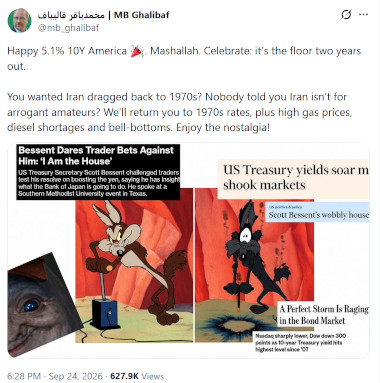
Economic pressure is not a one-way road.
This article was originally published on Moon of Alabama.