Alastair Crooke
It was the West's mistaken analysis that has trapped the West into an escalatory staircase of actions that risk taking Europe to a war with Russia.
Past days have seen the European political classes turning up the volume to maximum on clearly concerted - and shared - speaking-notes: 'War with Russia is coming; Russia intends to strike NATO; we must prepare; stock up on bottled water, tinned food, and be ready to offer your children to military conscription' - 'Many will die; but it is their duty to defend their country'.
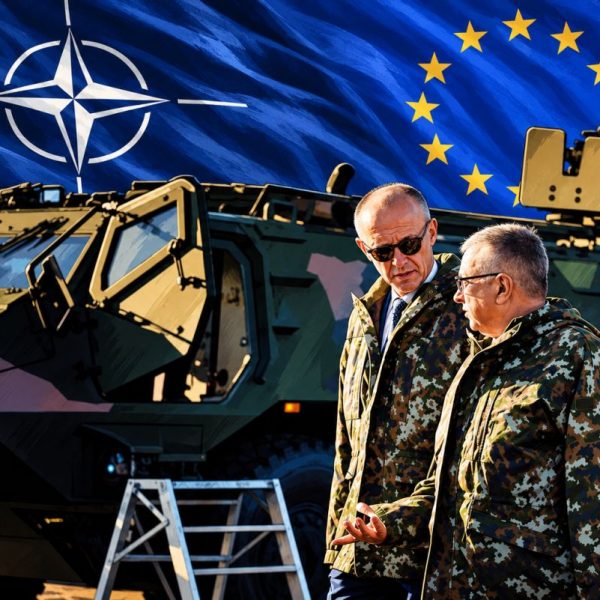
What nonsense ! To make the point, European leaders, including EU High Representative Kallas and German Chancellor Merz, recently deliberately dressed in field camouflage to signal "defence readiness" during the European Arctic Summit on 14 September. (These European politicians can be viewed in military fatigues here).
They look absurd. Yet that cannot detract from the question - What exactly is this hysteria gripping European technocrats?
On the face of it, the unified messaging that Russia is about to attack Europe and that war is coming makes no sense at all. Europe has neither the men, munitions, the finance, nor the industrial capacity to wage war on what today can be considered a leading military 'great power', as well as the state possessing the highest nuclear weapons inventory.
ZeroHedge observes that,
"Among the loudest purveyors of this unsubstantiated narrative [of threatened Russian attack] include leaders of the Baltic states. For example this week Latvian President Edgars Rinkevics has gone so far as to say Russian 'attacks' on the EU and NATO have already started. Baltic nations are even issuing emergency preparedness plans for their populations, alleging a Red Dawn style scenario".
"We are not talking about a conventional war. We are talking about all kinds of provocations, all kinds of acts of sabotage, all kinds of tests, and definitely this is something that is already happening as we speak", the Latvian leader said.
"Polish Prime Minister Donald Tusk has claimed this week that Russia could launch sporadic attacks which it pretends are "accidental" in order to "paralyze or at least weaken the motivation of NATO countries", as cited in The Associated Press. "There is a real risk that drones or other types of projectiles will enter the territory of one or several countries on the eastern flank and even cause destruction", Tusk added, warning: "Moscow may go as far as to launch an air attack in some form on NATO territory in the coming months to show the military alliance's Article 5 common defence pledge is little more than a few words on a piece of paper."
Yet against all accumulated evidence, European leaders nonetheless are hyping themselves up to be psychologically prepared to pull that Article 5 trigger against a major nuclear-armed power.
In wake of this hype, FM Sergey Lavrov explicitly warned:
"I would like to emphasise that we have no interest in engaging in this [attacking Europe], but if Europe, which is talking about preparing for war against Russia on a daily basis, attacks Russia, it will be a completely different war - and it will be very short".
What lies behind this apparent absurdity ? On the one hand, it is clear that the Brussels ruling strata see their strategic errors (unconstrained support for Ukraine, the sacrifice of the European business model on the altar of pressuring Russia, their support for the Iran war, and their indifference to suffering in the Middle East) coming home to roost.
Their fear-mongering towards Russia smacks of desperation, rather than careful thought and due diligence about the very real risks of hyping war in this way. The Establishment no doubt sees the energy crisis arising from the U.S.-Israeli war on Iran is no longer 'coming', but has come.
They can see living-costs escalating, jobs evaporating and the coming collapse in markets - principally in the bond market (whose interest-rate level defines the value of all other risk assets). Seeing this, these imperilled politicians may have concluded that triggering fear is the only way to divert from their own failures, and perhaps allow them the hope that they can survive the election cycle.
Survival is a key motivation, but likely too, the Elites' psyches are sustained by two propositions that are false, yet seemingly ring plausible to the political class.
The first fallacy is that Russia launched a preventive war in February 2022 to seize Kiev and roughly 60 percent of Ukraine.
Earlier events in Syria explain the reality: Russia officially entered the Syrian civil conflict in September 2015, following a request from President Assad. The Russian intervention proved to be of limited scope - a very limited air deployment (28 to 34 aircraft) and the minimum of combat special forces (Russia's contribution comprised mainly military advisers, forward air controllers and military police).
Russia's presence in Syria was intentionally symbolic - a statement of serious intent, rather than a desire to engage in ground war. In fact, Moscow's aim was the avoidance of direct ground combat. Nonetheless, Russian airstrikes - with the backing of Iranian ground troops - helped the Syrian Army push the jihadist forces out from Aleppo. This led to a Russia-Turkey brokered truce at the end of 2016, and to the Astana peace process starting shortly thereafter.
Putin's approach to Aleppo clearly defined the model for his initial tactics in respect to Ukraine. Russia deployed an estimated 15,000 to 30,000 men outside and around Kiev, during the initial assault in early 2022. The European narrative that this force was intended to seize Kiev in early 2022 is laughable - 40,000 troops might fill a city piazza, but can they take a city of more than three million inhabitants ? Ridiculous.
Nevertheless, European and American commentators - including U.S. commentator Robert Pape - claim that since the attempt to seize Kiev collapsed, combined with the imputed corollary that Putin had expected that his symbolic show of 'serious intent' to cause NATO to back off, suggests - Pape claims - that Putin is caught in an escalation trap. Pape argues that Putin sought a quick victory in 2022, but having failed, is 'trapped' by now having to climb an escalatory ladder with ever worsening prospects of success - hence Putin fails. 'It is a matter of time only'.
Far from being a failure, Moscow's show of force in Syria, small as it was, worked - Astana was the model drawn from Syria. By the end of March 2022, the Istanbul Process had produced the Istanbul Communiqué, a framework for a settlement with Ukraine. This latter initiative failed for one reason only - Boris Johnson torpedoed it - and Russia was forced to re-group, which it successfully did, albeit at the price of a long war of attrition and the needless loss of hundreds of thousands of Ukrainian lives.
No, it was Boris Johnson who took Europe into an escalatory trap.
Europeans, it seems, have underpinned their 'success story' for war on Russia firstly on the notion of the imputed Kiev failure, and secondly, on the exaggerated reliance on financial sanctions. The former French Finance Minister Le Maire, in a moment of elation, declared "all-out economic and financial war against Russia". He insisted that sanctions would suffocate and collapse the Russian economy - in practice Russia after 2007 switched to a national (self-sufficient) economic model and still prospers.
So who has trapped whom ? The West's imagined core premise that Russia was trapped into escalation from the moment the non-existent plan to seize Kiev failed has turned the situation back-to-front.
It was the West's mistaken analysis that has trapped the West into an escalatory staircase of actions that risk inadvertently taking Europe to a war with Russia - a war that no European wants.