George Austerfield
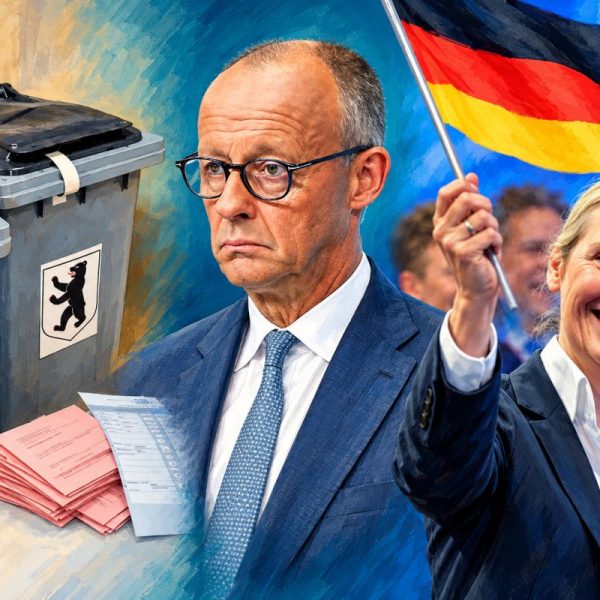
Merz is a dead man walking. Fear and warmongering don't win votes.
Having found out the hard way what it means to get slapped in the face at election time in Saxony-Anhalt, the CDU really got pulled backwards through the hedge on the 20th of September in Mecklenburg-Western Pomerania (Meck/Pomm) and Berlin.
Looking at Meck/Pomm first, voter turnout was 78.1% - about the same as in Saxony-Anhalt with 77.8%.
The official, though still provisional, final result can be classed as a mini-bombshell compared to Saxony-Anhalt, but eye-opening nonetheless. There will be four parties taking seats in the state parliament.
AfD 38.2% = 32 seats
SPD 35.5%, with the incumbent state minister-president looking to stay in office = 29 seats
Die Linke (Left) 6.5% = 5 seats
Die Grüne (Greens) 5.7% = 5 seats
The state parliament has a total of 71 seats.
Now the interesting part: CDU 4.9%, zero seats thanks to the 5% hurdle; as also the FDP 1.0%, also zero seats.
Now let's bring in a bit of perspective.
The AfD have won the next election, though not with such a large margin as in Saxony-Anhalt, but still a victory.
The incumbent minister-president since 2017, Manuela Schwesig, belongs to the top echelon of the SPD. She previously held the post of Minister for Education, Family, Senior Citizens, Women and Youth on a federal level from 2013-2017, and had held a similar post in the state parliament of Meck/Pomm from 2008-2013. She had a difficult time when the SPD moved away from being a working-man's party and followed the so-called social reforms that drastically cut into the social security system, Schwesig trying to cushion the hard cuts as far as possible. Her role in politics has always come across as sincere and caring, giving the impression of being honest.
She belongs to the few SPD politicians expected to bring the ailing SPD back into a brighter future, but appears to want to stay in her position in Meck/Pomm, at least for the time being.
The Greens and the Left achieved what was expected of them: the Greens struggling, and the Left still trying to gain strength again after a period of internal turmoil after Sahra Wagenknecht walked out and started her own movement, BSW, taking some left-wing voters with her.
The Greens started out as a pacifist party, against military build-up and environmental degradation. Since 2022, they have become one of the foremost supporters of the regime in Ukraine and of a German and European rearmament, sometimes outdoing the established conservatives. This has cost them a lot of support from the environmental wing, mainly young voters. The anti-war supporters have turned to the AfD, and to some extent to the Left, the only parties propagating a more peaceful and diplomatic solution.
The big bang here in this election is not the FDP. They are of no real significance at the moment, having been in many coalition governments since 1949, always helping the two main parties to necessary majorities. They seem to have lost their own profile, trying to be partner to their campaign opponents and losing their way.
The big thing is the CDU, the governing party nationally, getting a measly 4.9% and thus being kicked out of the state parliament. This is massive. Mr. Merz is basically a dead man walking, and the writing is on the wall for all to see.
The once East German states still feel left behind and cheated after reunification. The programs set up to modernise and repair the old GDR benefited mostly Western German companies and institutions. Tenders were fixed and hundreds of enterprises went into receivership, only to be sold for a song to Western investors.
This is one of the underlying issues still in the minds of ex-GDR citizens and is trotted out as an explanation for just such election results. This is, however, valid only as an excuse to paste over the shortcomings of the established parties, ignoring the real issues such as de-population of the villages with missing infrastructure to care for an ageing population, low employment opportunities, migrant issues, and mistrust of the established parties. The driving power at the time of reunification was the CDU, whose promises did not come to pass. So a socialistic and an alternatively conservative platform were the choices of the day.
The elections in Berlin did not, at first glance, hit the CDU as badly as in the other two German states. Being Berlin, the capital city does, however, put another emphasis on the results. And here too the governing parties lost significantly to the parties on the wings, AfD and Linke. The results are as follows, with gains and losses added for clarification:
Die Linke 25.7% 47 seats +13.5%
CDU 18.8% 34 seats −9.4%
AfD 16.3% 29 seats +0.1%
Grüne 14.3% 26 seats −4.1%
SPD 12.1% 22 seats −10.1%
BSW 4.7% under 5% hurdle, no seats
FDP 2.5% under 5% hurdle, no seats
The participation was 74.2%.
The state parliament has 158 seats and the majority starts at 80 seats. This means there will definitely be a coalition government. All the signs at the moment point to a coalition between the Linke (Left), SPD and Greens.
The AfD have not been able to gain on the same scale as in the other elections. This is due mainly to two factors.
Berlin has an urban environment, and as such a more concentrated electorate with a younger population, and one that has many newcomers from other German states.
The second being massive problems unique to such environments. Affordable accommodation being one of the central issues. The AfD has no track record of city management and no real new concepts on offer that are different enough to entice voters to take the plunge in the direction of the AfD.
It still is surprising that parties with such losses as the SPD can still come into power. Putting the CDU aside, the biggest losers in this election come to power regardless. That is the beauty of a coalition.
The Linke, the Left Party, are not really trusted by the established parties and conservative voters, as there is still an aura of communism surrounding them. Regardless of this, the election results are clear, and it will be interesting to see how the Linke will be able to carry through their campaign themes, mainly focusing on the housing problem, into reality. The other coalition partners will do their best, so no too-radical changes are to be expected.
Here again one can see the ruling parties on the federal level have been given a clear message, and the losses paint a grim picture. It will be an uphill task to change the opinion of the population in time for the upcoming April elections. When hearing the comments coming out of these parties, it seems more than likely that these results will be repeated in the spring of 2027, and then governing Germany will become a next-to-impossible undertaking.
Come what may, one thing has been made abundantly clear. A policy of fear and warmongering, in the face of a future with drastic cuts in the social systems, in health care and pensions, and an economic situation that looks to be getting steadily worse, will not bring voters into the fold. In particular when there is no new vision to face and solve, but only the slash and cut, calling that reforms.
The German Chancellor, just after the polling finished, stood before the press and stated: the election season 2026 is now over. He looked relieved.
At the end of the day, the CDU have few options. If Merz walks back his "reforms", it will look as if he is weak and giving in to the SPD, making them stronger.
If he aligns himself nearer to the AfD, vote-poaching, that will not help, as the AfD initially devolved out of disgruntled CDU members.
If he continues as before, it is absolutely clear that there is no way Merz and the CDU will win the next federal election, and Merz will have a hell of a job to keep the government toeing the CDU line. If the SPD fails to show how really different they are to the CDU, they too will face disaster. The dangers of being a junior partner in coalitions. A lesson the FDP learned the hard way.
Covering up the fact of having no vision or even a clear plan for the future has never done any ruling party any good the moment alternative ideas are brought forward by a strong opposition party, gaining ground at each election.
Should the next elections in April 2027 go the way these last two did, inside the CDU fear will turn into panic, and there may possibly be federal elections at the end of spring. The outcome of that is anybody's guess. Trying to get the AfD banned, however, will be the death-knell of a once great political party and the end of democracy as Germany knows it.