Erkin Oncan
NATO Edge 26 in Izmir merges civilian tech with war-fighting. AI, cloud, cybersecurity now serve the military-industrial complex.
The summit NATO held in Ankara in July continues to make its impact felt in our country - a summit marked by the lockdown of the city, red carpets rolled out for imperialist leaders, Janissary marches, the narrative of a "great Turkey" constructed around hosting the event, and arrests that continue to keep people behind bars.
As has often been pointed out, the July summit marked the beginning of a "new era" both internationally and for our country.
It looks like we will be discussing this important turning point for a long time to come. Meanwhile, NATO's "work" in our country is not yet finished. Another critical NATO event is approaching, one that has received little attention in the mainstream media - and when it does, it will once again be framed through the narrative of "Turkey's importance": NATO Edge 26...
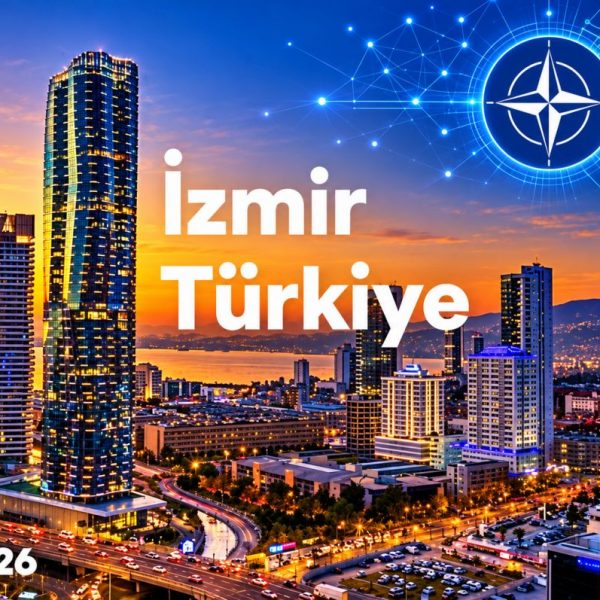
NATO Edge 26, which will be held in Izmir in November 2026, is being promoted using concepts such as "innovation," "readiness," and "the security of the future." Or, to put it in plain language: the marketing and integration of military technologies, the defense industry, and war-fighting capacity...
The official promotional text of the event, organized by the NATO Communications and Information Agency (NCIA), lays out its purpose quite clearly:
"NATO Edge 26 will focus on strengthening NATO's readiness and war-fighting capacity through faster, smarter, and more scalable collaboration with industry.
...NCIA is excited to carry this legacy forward in Türkiye in 2026 and take the event a step further with a renewed format focused on delivering effective solutions and prioritizing industry partnerships.
Industry participation will be at the heart of the 2026 edition, providing more opportunities for direct engagement, focused information sessions, a more comprehensive understanding of NATO's upcoming procurement requirements and priorities, as well as greater opportunities to showcase industry solutions to NATO decision-makers, end users, and potential partners."
A military ecosystem operating according to market logic, with partnerships and participation at its core. Defense companies, states and military commands are expanding their cooperation in order to strengthen "war readiness"...
What exactly is NATO Edge?
NATO Edge is the flagship technology event of NATO's technology and cybersecurity center, the NATO Communications and Information Agency (NCI Agency).
"Edge" can be translated into Turkish as "edge," "frontier," "advantage," "superiority," or, depending on the context, "cutting-edge" or "advanced."
It was first held in 2022 in Mons, Belgium. The event was created by merging two previously separate events: the NATO Information Assurance Symposium (NIAS) and an industry conference known as NITEC.
According to NATO's official documents, NIAS focused on cybersecurity, while NITEC carried the technology-and-industry dimension. In other words, NATO Edge explicitly targets both the technology and industry/commercial spheres.
At the first event, held in Mons, Belgium, on October 25-27, 2022, more than 2,100 registered participants and over 100 companies took part in the exhibition area. The program included topics such as the use of artificial intelligence in military applications, cybersecurity, and digital transformation.
At the second event, held in Tampa, Florida, in the United States, on December 3-5, 2024, cloud technologies, cybersecurity, artificial intelligence, and the strategic use of resources were discussed. According to NCIA's 2024 annual report, approximately 60 percent of participants came from industry, while 31 percent represented NATO, governments, and armed forces.
This picture is a clear indication that artificial intelligence technology - whose development in the United States has accelerated since the early 2000s and exploded in recent years - is being systematically taken up by the military-industrial complex.
Moreover, this system has been developed directly under NATO's military leadership, in cooperation with civilian industry, using resources so vast that civilian initiatives seeking to use technology - particularly artificial intelligence - "for the benefit of humanity" cannot compete with them.
In the United States, for example, many companies unable to find investment have begun receiving funding from military institutions such as the CIA and NATO and developing technologies under their direction. The fact that the CIA has been the "first investor" in numerous technology startups is a striking example of this system.
In short, the path of technological development has largely been left at the mercy of military leadership and the American technology giants.
A similar picture will emerge at NATO Edge 26. Many small startups participating in the event will seek agreements with major players and attempt to secure financing from them. Naturally, this will come at the price of working for NATO's military interests.
For the "domestic, national, and highly nationalist" technology companies whose numbers have grown tremendously in our country in recent years, the "justification" is equally clear: Turkey is now a country on the verge of a major breakthrough, hosting major international events, supposedly becoming not their subordinate but their master, and possessing qualities that make it indispensable to everyone... So why not devote all our strength and labor to the strategy drawn up by NATO ? We will make money, and we will take yet another step forward in a world order in which we are already supposedly such an important player...
This is more or less the logic behind the seemingly contradictory and irrational rhetoric of the Turkish defense industry about "challenging the world" and its actions that ultimately amount to working for imperialist powers.
Put simply, NATO Edge is precisely the embodiment of this logic through events, sessions, and corporate exhibition stands.
Why is it being held in Izmir?
NCIA has not given a specific reason for choosing Izmir as the venue for NATO Edge 26. However, it is possible to understand why Izmir was chosen by looking at the institution's own documents.
First, a NATO Industry Forum was held during the Ankara Summit on July 7-8, where new procurement decisions worth tens of billions of dollars were announced. The decisions taken by NATO in July are intended to translate the political and financial commitments made in Ankara into operational capacity, while in Izmir, NATO and industry are to work together to accelerate that capacity.
Second, the Ankara Summit adopted a new Strategy for Industry-NATO Cooperation (SYNC). This document moves the NATO-industry relationship to an earlier stage. Through this mechanism, companies will not merely submit bids for tenders that have already been announced; they will be brought into the process from the point at which future capacity requirements are identified.
Third, the Turkish Ministry of National Defense presented NATO Edge 26 as an event aimed at "the international promotion and increased visibility of the Turkish defense industry's 'high-tech' capabilities." NCIA also signed, during the Turkish Industry Day it organized in Türkiye, one of the first contracts of its history concerning the modernization of very-low-frequency air-surveillance equipment for Allied Maritime Command with ASELSAN.
In other words, Izmir should be viewed not merely as an "event venue," but as a point of contact for tying Turkey more tightly into imperialism's defense-technology supply chain.
This is also where NATO Edge 26 differs most significantly from previous meetings. NCIA is openly telling companies: "You can learn about NATO's requirements before they become official tender specifications," while offering more than €1 billion in upcoming "NATO procurement opportunities."
NATO Edge 26 is creating an early-stage matching mechanism between NATO's military requirements and the private sector's product-development and investment decisions.
Who is taking part?
The official NATO Edge participant list is still being updated, and in its publicly visible format, not all of the more than 270 companies known to be participating appear simultaneously. Nevertheless, a number of notable companies can be confirmed either through the official list or through the companies' own NATO Edge announcements. Names appearing on the official list include Airbus, AWS, Anduril, ASELSAN, ASFAT, BAE Systems Digital Intelligence, BlackBerry, Booz Allen Hamilton, Cisco, Cloudflare, Broadcom, Armis Federal/ServiceNow, Atos, and Barikat Cyber Security.
Among the industry speakers on the program are Helsing co-founder and CEO Gundbert Scherf, Planet Labs CEO Will Marshall, UiPath founder Daniel Dines, AWS Global Defense executive Christian Hoff, Leonardo technology executive Alessandro Massa, Thales cortAIx Factory executive Mickael Brossard, and BlackBerry Chief Security Advisor Christine Gadsby.
The danger of 'dual-use'
One of the concepts that stands out particularly in NATO's 2026 event materials is "dual-use" technology.
NATO Deputy Secretary General Jean-Charles Ellermann-Kingombe said that NATO Edge 26 would be particularly attractive to "companies that have a credible military application alongside their primary commercial business." In other words, NATO is no longer targeting only traditional defense companies; it is also targeting technologies that can be transferred from the commercial market into the military sphere.
What this means is that a technology company no longer needs to be a "weapons company" from the outset. A company can operate in data analytics, satellite imagery, cloud systems, communications, artificial intelligence, cybersecurity, automation, or computing, while simultaneously entering the NATO system and working for NATO.
This significantly broadens the scope of what has long been described as the "militarization of technology."
The NATO Edge 26 participant profile makes this clear. On one side are defense giants such as Airbus, Anduril, ASELSAN, Leonardo, and Thales; on the other are civilian technology companies such as AWS, Cisco, Cloudflare, Broadcom, BlackBerry, UiPath, and Planet Labs.
In other words, military technology no longer means merely "producing military products for armies"; it increasingly means placing the products you create at the service of military interests.
How are the market and militarization being merged?
In this new system, in which the private sector is also being drawn into the defense industry, the formula is clear:
Public funding, NATO demand, corporate investment, technology development, military integration, public procurement, larger-scale production, new investment...
At this point, we need to make a brief detour. Combining private enterprise with military requirements, when military needs are given priority, means the emergence of new economic crises in capitalist societies. Because this entire chain of needs will ultimately be paid for at the expense of workers and their social needs, which are placed at the bottom of the priority list.
The competitive strength of the People's Republic of China (PRC), which has made its own breakthroughs in artificial intelligence, technology, and military technology, stems not only from those advances but also from the leadership of the Communist Party, which directs the public and private sectors from a single center. What provides China's "speed," as well as the threat it represents to the Atlantic alliance, is the Party's control over and direction of the private sector.
This "threat" posed by China is pushing capitalism to take faster and harsher steps in new areas of civilian-military cooperation similar to Edge.
The 'domestic and national industry' is being tied to the NATO market
The enthusiasm of the "domestic and national industry" mentioned above is also being directly tied, under this new system, to the NATO market and its military requirements.
It is repeatedly argued that Turkey is expanding its own defense industry. But what kind of expansion is this?
The defense industry is being internationalized through NATO standards, NATO procurement mechanisms, NATO operational requirements, and access to the NATO market.
For this reason, "domestic production" and "NATO integration" do not necessarily have to be opposites. On the contrary, under today's model, the two can take place simultaneously. The "domestic" character being referred to is, for a country whose entire military strategy has already been built for years in accordance with NATO interests, a very particular kind of domesticity.
Interestingly, a June 2026 announcement by the Aegean Region Chamber of Industry reveals that the quota initially allocated for 100 booths for Turkish defense-industry organizations at the event was reduced to 40 after fewer applications than expected were received from domestic companies.
This data is important in two respects.
First, the assumption that the Turkish defense industry is automatically and intensively turning toward the NATO market does not apply equally to every company. It is possible to guess which types of companies can afford to apply.
Second, it shows that presenting NATO Edge 26 simply as a "giant exhibition opening all of Turkey's defense companies to the world" does not reflect reality.
What does the Ukraine connection show?
NATO Edge 26 also contains important signals regarding the war in Ukraine. Although our country has repeatedly sought to position itself as a mediator at every major turning point in the Russia-Ukraine war, it is quite clear that no one - NATO above all - has taken this intention seriously.
Among the Edge participants are Ukraine's Ministry of Defense Innovation and Defense Technology Development Center and Brave1. Established in 2023, Brave1 is an official platform through which the Ukrainian government brings together defense-technology developers, the military, investors, and technology companies. Their participation also means that NATO will directly transfer the technological experience of the war in Ukraine into its own innovation ecosystem.
This, too, is no coincidence. Under the UNITE-Brave NATO program, NATO and Ukraine have already established a joint contract pool worth a total of €10 million, with plans to expand the program to as much as €50 million in subsequent stages.
Whose interests is technology serving?
Treating NATO Edge 26 in Izmir simply as an event where next-generation weapons, artificial intelligence applications, or digital defense systems are put on display would be a serious oversimplification. The "bigger picture" shows civilian and military capacities being merged into the same pool, with companies, states, military institutions, and technology developers jointly participating in the construction of a new war-fighting capacity under the name of "partnership."
Thus, the scope of war ceases to be limited to weapons systems used on the battlefield; data, artificial intelligence, cloud systems, communications, satellite technologies, software, and logistics are all becoming components of war preparation and military planning.
From the perspective of our country, it is possible to say that Ankara's "domestic and national" rhetoric points toward NATO's requirements, standards, procurement mechanisms, and international defense-industry networks. The limits of the narrative that Turkey is an independent power capable of challenging the world through its own defense industry are ultimately being determined by the decisions taken at NATO events.
At the same time, events of this kind once again expose another reality that Marxists have repeatedly pointed out - and repeatedly demonstrated in practice: how conditional capitalism's rhetoric of the "free market" really is.
When the issue is war and military requirements, the traditional claim that the market should be left to its own devices can suddenly be pushed into the background. Production capacity can be directed according to strategic priorities, and private capital can be encouraged to work for "security" needs.
In short, the "real question" posed by NATO Edge 26 is not which new technology is being developed, but according to whose needs, according to which political and economic priorities, and ultimately in whose service this technological capacity is being developed.
People involved in organized struggle used to be told: "Forget all this, get yourself a job first." Now the phrase has changed: "Forget politics, we are living in the age of artificial intelligence - learn technology."
And yet, although technological development and changing times transform the tools and needs at our disposal, they do not change the fact that the ruling classes use every instrument of "progress" to preserve their power.
From this perspective, the political purpose underlying the monopolization of artificial intelligence by military and economic giants is the same as the purpose underlying the control of machinery by the owners of capital in the early stages of the Industrial Revolution.
In our country, where changing times, tools, and needs are pregnant with major crises, these "devilish deals" to be made in Izmir will open the door to yet another new era.
Ultimately, NATO Edge 26 is a contemporary example not only of technological development itself, but of the organization of technology for "pre-war" purposes and the socialization of its costs - that is, the shifting of those costs onto the backs of working people.
Our political predecessors, who once observed what the giant machines in factories were actually being used for alongside production, also passed down to us what needed to be done in response.
What needs to be built today is the stick that will be thrust into the digital gears of our age.