Lorenzo Maria Pacini
NATO's full Military Committee just visited Kiev. They're studying Ukraine's war as their own testing ground.
Everyone off on a trip to Kiev
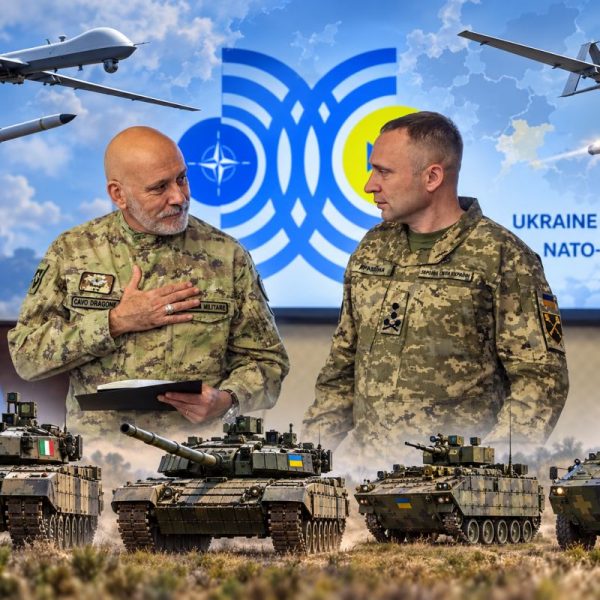
On 6 October, Admiral Giuseppe Cavo Dragone, Chairman of the NATO Military Committee, arrived in Kiev with military representatives from all thirty-two Allied nations. He wrote this himself on X: the delegation was there to reaffirm its 'unconditional support' for Ukraine. ANSA reported the news as an official visit. A strategic signal aimed at Moscow as well.
First, the facts. The Military Committee assists and advises the Atlantic Council, the Defence Planning Committee and the Nuclear Planning Group; its role is to set military policy and strategy. It was invited by the new Supreme Commander of the Ukrainian Armed Forces, Mykhailo Drapatyi. The Committee returned to Kiev in full force after eight years, and the meetings with Drapatyi and the Ukrainian General Staff served to obtain a first-hand assessment of the battlefield, to discuss Kiev 's military priorities and to bring to the Alliance the lessons learnt from over four years of high-intensity warfare. Dragone speaks of military priorities and lessons useful for the Allies' operational readiness in the face of today's and tomorrow's threats.
Now for the interpretation, which must be kept distinct from the facts. A body that advises the Nuclear Planning Group does not travel through a country at war merely to make gestures of solidarity. It goes to gather information and to calibrate its own preparedness against it. The flow described by the sources runs in both directions: from Ukraine to the Alliance as operational experience, and from the Alliance to Ukraine as guidance on priorities. When the military leaders of thirty-two states sit down with the General Staff of one of the belligerents to assess their own readiness in the context of the ongoing war, that war ceases to be an external affair. It has become the Alliance's testing ground.
This sequence confirms the direction. On 3 June, the North Atlantic Council met in Kiev, and the NATO-Ukraine Council was held there for the first time. In October, it is the military's turn. First the political framework, then the structure that fills it with operational content - this is not a passing courtesy, but an institutional presence that grows stronger at every stage.
Then there is the statement that shifts the discussion beyond Ukraine. To those who believe that sabotage, cyber-attacks and airspace violations could undermine Western support, Dragone replies: 'You are failing.' He holds Russia fully responsible for such behaviour and states that allied unity has never been so strong. The Ukrainian front and the sub-threshold pressure on Allied territory are placed within the same framework, articulated by the same man from the same venue. The distinction underpinning the 'Ukraine versus Russia' narrative - that between a war over there and tensions here - is erased by the Chairman of the Military Committee himself.
Images, symbols and meanings
The image remains. In the video message recorded in Kiev, the admiral speaks with two flags behind him; in institutional communications, the backdrop is never improvised - it reveals who is speaking and on whose behalf. The person appearing beneath those symbols is neither a mediator nor an observer. The flags tell the same story as the words - words that reflect a deliberate and conscious choice: namely, the war for Kiev, total dedication to a cause that should have nothing to do with Europe.
The serious objection is another, and it must be acknowledged. None of the three sources documents allied troops in combat, and no Member State has declared war on Russia. The delegation came to consult and to pay tribute at the Wall of Remembrance dedicated to the Ukrainian fallen. The law of armed conflict distinguishes between support for one side and direct participation in hostilities, and on that ground the distinction exists, but the legal classification does not exhaust the geopolitical analysis. The Allies no longer describe their role as aid to a third party: they speak of their own readiness, their own threats, their own unity. When an alliance measures its own preparedness against another's war and attributes acts of sabotage on its own soil to that same adversary, the confrontation involves two parties, and one of them is not Ukraine.
The assessment, then. On the political-strategic level, the confrontation between NATO and Russia is direct, and the sources show this with sufficient clarity. On the kinetic level, the sources do not record any direct Allied involvement, although this is constantly invoked and called for, as if it were NATO's greatest desire. The gap between the two levels, however, narrows with every visit of this kind. There are two indicators to watch: the possible permanent establishment of allied facilities on Ukrainian territory, and the way in which acts of sabotage - which the Alliance attributes to Moscow - will be dealt with, whilst Zelensky orders the bombing of further Russian oil refineries and new drones fly over Moscow, despite Donald Trump having told them to stop.
Everything is spiralling out of control; NATO is acting independently of the US sphere of influence because it has embraced the Ukrainian cause as if it were the final world war - the one in which the Alliance will either win, or there will be nothing left to do.
The 'Ukraine versus Russia' narrative served to contain the war within a framework that was reassuring to European public opinion. With 32 military representatives in the Ukrainian capital, led by an Italian admiral, that framework is holding together less and less.
Let it be clear that this decision is not accidental; it is not a political trap, nor is it even an error of judgement, but a declaration of war - yet another hybrid and, stylistically, pitiful declaration against Russia. They are telling us this openly, whilst we are distracted by other thoughts.
It remains to be seen whether governments will tell their voters this. And it also remains to be seen whether the brave four-star generals will realise a wise truth that the Prussian general Carl von Clausewitz wrote in his manuals: "The mistake lies not in making a misstep, but in failing to recognise it and in seeking to defend it at all costs".
There is, however, no reason to break the spell cast by Kiev, which is currently enchanting the whole of Europe, because, as Napoleon said - to quote him a second time - "One must never interrupt the enemy whilst he is making a mistake".