Cynical Policies in a Beautiful Place, Destroying Humans
Dr Naomi Wolf
Outspoken with Dr Naomi Wolf
October 15, 2026
Human despair is being manufactured and monetized by corrupt health care organizations, in ways that defy belief.
Health care companies, working with the neo-Marxists in Western blue states, are using local and state-level policies, and numberless NGOs, to produce ever more drug addiction, alcoholism, mental illness diagnoses, and homelessness.
This is the homelessness industry in Oregon.
I was in the Pacific Northwest about six months ago, in a bucolic little college town. It was the end of April. We were having a real, old-fashioned Spring. Days were warming; a faint sun was waxing steadier; the tiny leaves on trees, that had looked like a haze of veiling when I had first arrived, were emboldened; they grew into stubborn green nubs, and then vivid flags.
When I sat on the balcony with my beloved elder relative, massive rough-trunked trees shook down upon us a shower of seed pods like translucent coins; they spun in the sun as they descended.
Rhodedendra bloomed: the leaves were spearlike, a backdrop to small heaping mountains of blossoms. These were deep-purple, or scarlet, or cream-colored with slate-grey centers. Peonies and irises, as various gardeners explained to me with the precision of those who truly loved their landscapes, would bloom the following week.
Everything looked as beautiful, as bucolic, as extremely friendly, as it always has.
But I noticed, as others may not notice if they are there every day, how much has changed since my last visit. And at that time, I had noticed how much had changed from the year prior to that.
I wrote in a former essay that I'd seen the tents of the homeless people steadily change locations.
At first the tents had been set up outside of town. Then they moved to an underpass separating the town from its outskirts, becoming a mini-neighborhood. Civic policy at that time had been to leave them alone.
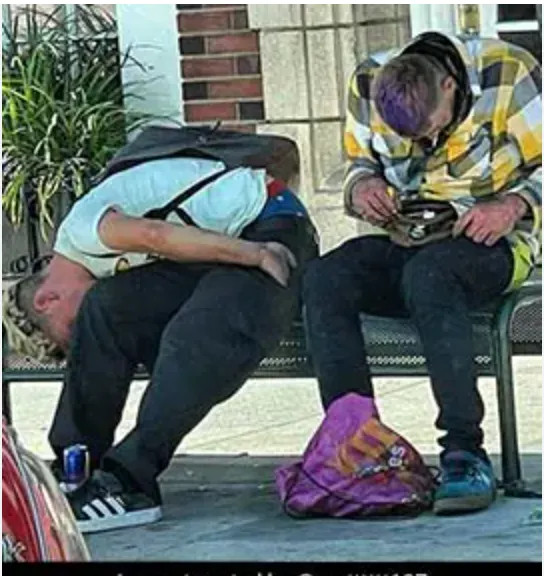
Then the homeless population moved into the town itself; I wrote about how the town had in fact built tiny homes for the homeless, very pretty ones, located in a parking lot. I don't know what became of that experiment, but each of these interventions did not seem to lessen the problem of homelessness there. On each visit of mine I saw the dwellings of what seemed to be an ever-increasing homeless population: and particularly, there were more and more drugged-out people, moving slowly due to their use of "tranq".
This substance, also called "zombie drug", or xylazine mixed with fentanyl, causes the lassitude, and the immobilized, bowed posture, characteristic of many homeless people in American downtowns today.
I noted in my last essay that the beautiful park in the center of town, one used by elderly people and children, with borders of rose plantings, a playground, and statues, now housed a "free store" run by anarchists, which offered clothing, canned and packaged food, and other items gratis, at one park entrance.
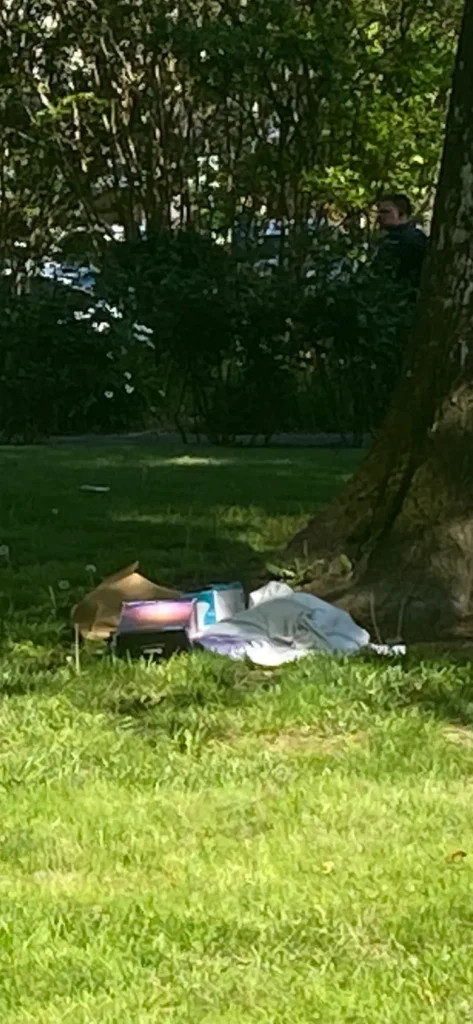
Unsurprisingly, drug users are attracted to the "free store", and now spend their time sitting on the park benches, nodding off or slumped over, near the free items handout. A church facing the park had offered a free bag lunch to homeless people when I was last in town. Now, on this visit, I saw that it had extended its offerings, and offered both lunch and dinner. The discarded paper plates and plastic silverware were all over the park.
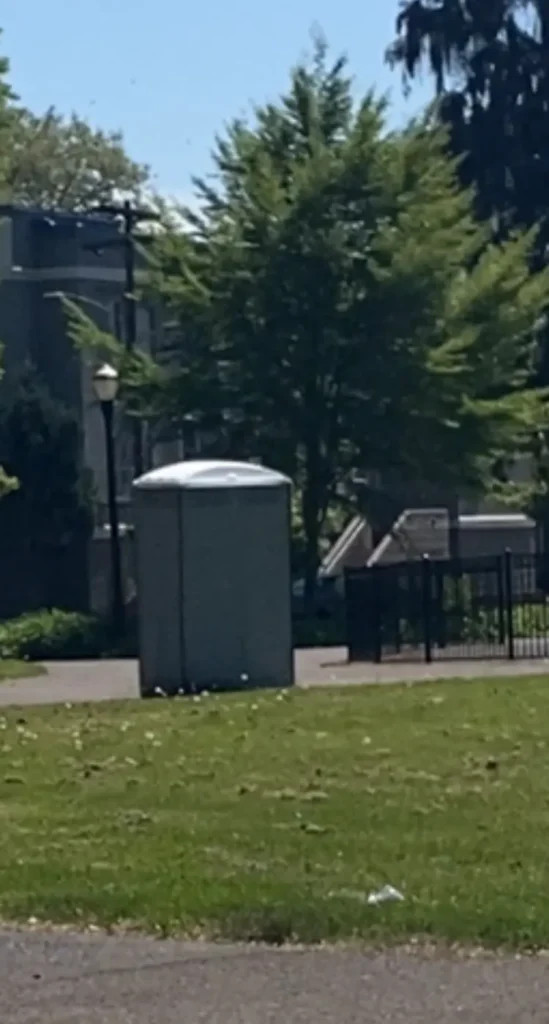
To my astonishment on my last visit, a sign had gone up at the entrance to the park inviting the homeless people there to pitch their tents on one lovely, green, grassy oval. A Port-a-Potty had also been installed.
Though I like to think of myself as a caring and generous person, I was upset. This was not "generosity," I warned my beloved elder; this was the transformation of shared public space, in a way that would hand it over to just one sector of the community - to the drug-addicted homeless. I cautioned my beloved elder that this policy, which seemed so "nice", would transform that treasured public space: children, families, people of all ages, elderly people, women - would no longer make use of the park the same way.
By the latest visit, as I knew would be the case, almost no one who was not homeless or drug-addicted, could enjoy the beautiful square. A few children did still play in the enclosed playground, guardians or parents watching them warily. But no one strolled the walkways. No one lounged on the grass. Young women in groups, or as singles, wearing bikini tops and shorts, or crop tops, no longer lay on beach blankets to sun themselves, or to listen to music on their headphones. Couples did not lie together any longer gazing into one another's eyes. Young men did not play Frisbee. Middle schoolers did not ride their scooters around the walkways or gather to gossip and laugh in groups. Elders did not sit on the benches. Moms did not bring their babies to lounge on the lawn and play.
No one picnicked. Have you noticed the quiet death of the picnic?
All of these things used to happen, in public spaces like this one in America. Not so long ago. I remember them.
Do you remember them?
I felt the presence, as if of shadows, of the dozens, if not hundreds, of people who no longer gathered to do those things. But in addition, something negative had been built up. What had accumulated since I was last there - and this is human nature - were high-stacked piles of possessions that belonged to the homeless people who slept in the park.
Why?
Because this was now their home and no one else's. They had begun treating it as such.
Though a sign did warn that the people sleeping in the park should pack up their possessions every day - where did the policymakers expect them to store the items ? And did the policymakers really think people would disassemble and reassemble a tent every day, if nothing compelled them to do so?
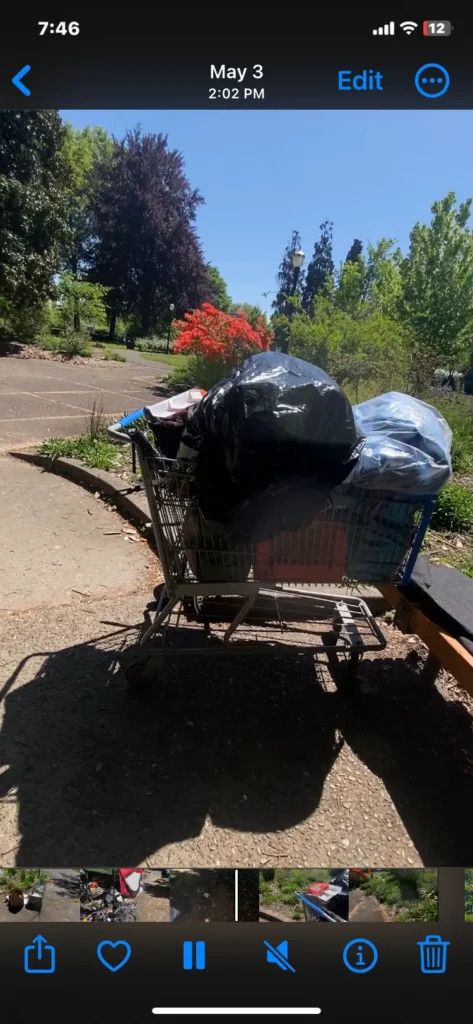
Sure enough, ringing the park, and stacked next to the tents, were discrete piles of homeless people's possessions. Boxes, cooler, stacks of packaged bottled water; books, bags of clothing, folded carts, shopping carts, food containers, portable radios, flashlights. Some of these piles reached four or five feet in height.
The park was finished as a public spac. We couldn't sit there. It had been given up on by everyone but the homeless population, the anarchists who were "doing good" by handing out free items, and a handful of kids in one tiny area, under careful watch.
The rest of the community withdrew, in a tactical surrender.
Why does this matter so much?
We talk about the loneliness of the elderly. But now they can't meet their old friends or make new friends, in what had been a safe "third good place."
We worry about kids on screens all day, becoming depressed and anxious, sedentary, risking obesity and related illnesses. But older kids and teenagers can't go to this little park any more by themselves, to socialize and get fresh air and exercise.
We worry about the destruction of community. But this policy around homelessness literally destroyed a space that created and nurtured community.
Is this situation artificially created and sustained, for ulterior motives?
Not only did this particular homelessness policy in this one park, destroy all other forms of community around it; it seemed that all this money being thrown at homeless services, was not eradicating homelessness at all. It was, rather, attracting homeless people to the state and was incentivizing many remaining homeless. That is to say, it subsidized and supported a lifestyle of being fed for free, living in tents, being cared for in other ways including medically, and being otherwise being left alone to abuse drugs and alcohol.
Was all this activity not a symptom of homelessness, but rather, of the need of NGOs to secure from the government and then launder vast sums of money?
Was all this homelessness industry, indeed, a pretext for a massive asset grab?
Oregon spends an eyewatering amount of money on "homelessness," - that is, on NGO programs - much of it generated from a "homelessness services tax" and the rest from the Federal government, state government and the "pandemic relief" programs:
"Local, state, regional and federal governments, plus private philanthropies, spent $724 million on direct homeless services in the tri-county Portland area in fiscal year 2024, according to a report released Tuesday by economic consulting firm ECOnorthwest.
Eviction prevention, long-term rent assistance, street outreach and shelter construction and operation are among the many types of services counted as direct homeless services and included in the report. Health care, affordable housing vouchers and police time are all services that can help homeless people, but spending on these services was not included in the count. [In other words, the total amount spent is even higher].
Of the $724 million in total spending, 43% came from the regional homeless services tax, 21% came from federal sources only, including pandemic relief dollars, and 10% came from Multnomah County.'"
So without the manifestation of visible homelessness as a pressing civic issue, politicians and NGOs cannot justify a tax on hardworking Oregonians' money, nor can they request funds from the Federal government, nor can they mop up state tax dollars, nor can they tap the "pandemic" relief"money that is mystifyingly still flowing to address"homelessness"- an issue completely unrelated to COVID itself - six years after the pandemic.
How much of the economic activity in Oregon does the NGO industry represent?
Nonprofits account for a staggering 10-12 per cent of the total Oregon economy.
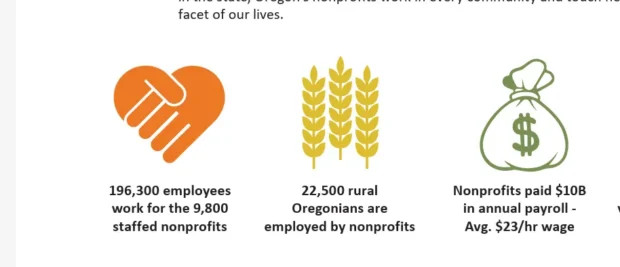
There are almost 200,000 nonprofit jobs in Oregon.
In a data point I can scarcely process, "Oregon nonprofits generate over $44 billion in annual revenue and hold $108 billion in assets."
What are the $108 billion in"assets"that Oregon NGOs hold ? NGOs by definition are not supposed to generate profit, but rather to spend their income on their missions.
By far, the largest proportion of the assets held by NGOs in Oregon, are hospitals and health care facilities.
"Social assistance,"which is deceptively lumped together with"Health Care", is a massive part of that NGO economy in Oregon:
Seeing this set of data points, without having any knowledge of whether health care systems in Oregon provide social assistance to the homeless - which is, of course, not the traditional mandate of hospitals - I looked it up, and I got this:
"Healthcare organizations in Oregon provide direct assistance to people experiencing homelessness, including housing support, medical care, and behavioral health services."
Just a few of the key programs include:
- "Oregon Health Plan (OHP) Health-Related Social Needs (HRSN)". This health care entity offers Medicaid benefits via such nonprofits as CareOregon and Health Share of Oregon. So the health care entity is wrapped around an NGO mission, even though the money flows to and from OHP. On offer?
- "Non-emergency rental and utility assistance for up to six months.
- "Storage fees, moving costs, and tenancy support.
- "Home safety and weather-related health modifications (such as ramps or air conditioners).
- "Medically tailored meals and nutrition support."
- Other health care entities are called "Federally Qualified Health Centers (FQHCs) & Clinics". With names such as "Central City Concern", local health care clinics also offer, in addition to sliding-scale primary care, "addiction recovery" and the vaguely termed "harm-reduction services."
- There is also "Behavioral Health & Crisis Support" —- a category that may explain the recent campaign of intense interest in promoting and labelling mental and "Behavioral Health" (a fairly recent term; what is that?) diagnoses and encouraging people to seek support for them.
- While this push could be seen as a salutary effort to de-stigmatize the treatment of mental illness, a ginormous pot of cash happens to be attached to the expansion of these terms; and the resources devoted to addressing the unquantifiable "problem" of "Behavioral Health" are immense.
- Thus, such programs as the Multnomah County Behavioral Health Resource Center, Cascadia Walk-In Center, and specialized OHA-backed youth/family shelter mental health initiatives are funded steadily to "deliver care specifically tailored to unhoused individuals."
- Is it good to have treatment options for the mentally ill ? Of course. Does this hugely expanding bucket create incentives to prolong mental health crises or even to coin diagnoses, for the institutions certainly, but also even for the individuals being treated, people who in some cases lose community, shelter and benefits if they get better?
- Hospitals partner with "supportive care facilities" in Oregon, and build structures. In this way, hospitals and health care systems acquire valuable real estate — with the government, tat is, youtr tax dollars, funding their acquisitons. In the little college town I visited, walk-in municipal "holistic" facilities for the mentally ill, drug-addicted and homeless occupied two of the most valuable real estate lots in town. You don't own that real estate, boufght with your tax dollars. The hospitals do:
- "Hospital & Health System Investments: Major health systems like OHSU routinely partner with local housing non-profits to build transitional and supportive housing units paired with on-site medical and psychiatric care."
- Not only that — the millions directed at health care organizations' programs for the homeless, addicted and mentally ill, create a two-tier system in which you get extra help in many areas of your life, only if you are from certain protected classes:
- "The Oregon Health Plan (OHP)" offers what they call
- "Health-Related Social Needs (HRSN) housing benefits" for specific groups of people.
- These benefits include "Non-emergency rental assistance: Up to six months of assistance (one-time per household)"; Utility payments: Help with utility bills. Storage fees: Up to six months of coverage for storage costs. Help navigatng leases, dealing with landlords, and finding housing; and the program will even pay for your pest control and for professional cleaning teams.
- It will pay for your blinds or curtains, minifridge, refrigerator, heater and other appliances.
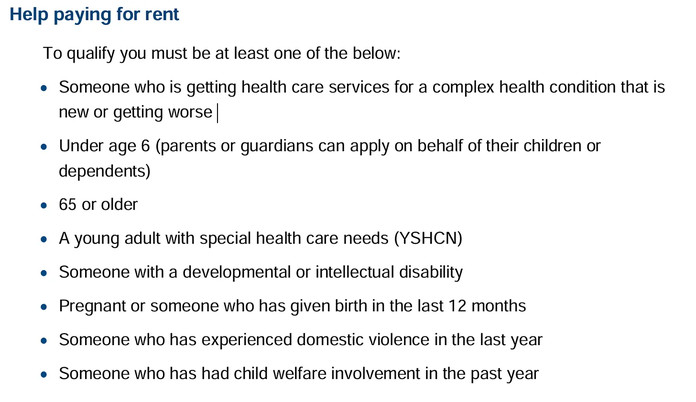
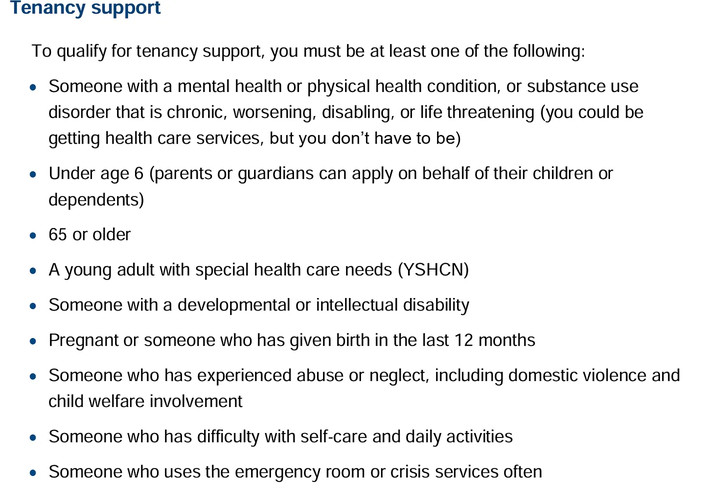
- However, not every struggling person gets these benefits. As noted, you are eligible only if you fit into certain categories. If you recently left prison or a mental health institution, you qualify; or if you can't function in daily life (a euphemism for mental illness but one that also includes drug addiction and alcoholism).
- To qualify, you can't just be a sane, nonviolent, but impoverished or economically struggling man or woman who is law-abiding, living alone or with a family to support.
- Nope ! Too bad for you.
- If you are a single parent or a family with older kids, parents working hard or unemployed, but otherwise functioning well, brushing your teeth and hair every day and showering, showing self-discipline, contributing to society, looking after your family and not doing anything chaotic — not burdening the child welfare or crisis services, not committing crimes, but simply, as many sane, not-drug-addicted, not-alcoholic, clean, hardworking poor or unemployed people are, simply unable to make rent — well, again, too bad for you.
- You can get help, though, if you have had authorities involved with you and your kids — "child welfare involvement" — because you may be abusing your children; if you are mentally ill (this category shows up more than once); if you are a drug or alcohol addict, as noted above, and, moving you up to the top of the queue, if your addiction is getting worse; even better for your place on the list, if you are too drugged out or mentally ill to function well, or to engage in "self-care" and "daily activities"; or if you are often using crisis services, or get in fights or have accidents and are regularly at the emergency room.
- In other words, the Victorian idea of "the deserving poor" has been turned on its head.
Another set of benefits give you home modifications, including air conditioners, and the costly installation of ramps and grab bars (I know disabled and elderly middle-class people who can't afford the installation of these; they can cost many thousands of dollars). But ! You can't just be in need of them. You have to:
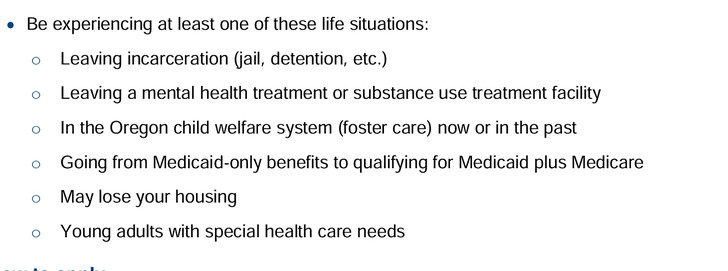
So really — being a former felon or a current mentally ill person plus a drug addict or alcoholic involved in a violent lifestyle, is a trifecta, when it comes to qualifying for these various valuable benefits.
This model creates a ravenous demand for ever-more dysfunctional, addicted, violent and mentally ill people - who are even more secure in receiving certain benefits if they don't wash themselves or their clothing ("self-care"; did you ever wonder about that issue ? One can't necessarily, if seeking to qualify for these benefits, convince a social worker that one is bipolar or schizophrenic; one can more easily demonstrate that one is dirty and unkempt).
All of this set of perverse incentives also supports the production of such people, if they wish to get help, and it deters them from getting better, as they will cease to qualify for these benefits once they are clean, drug-free, functional, and law-abiding.
A crueler system could not be imagined. All of this is arguably more condescending to and more truly heartless toward people with problems and needs, than were Dickens' workhouses.
Sheffield, England workhouse inhabitants:
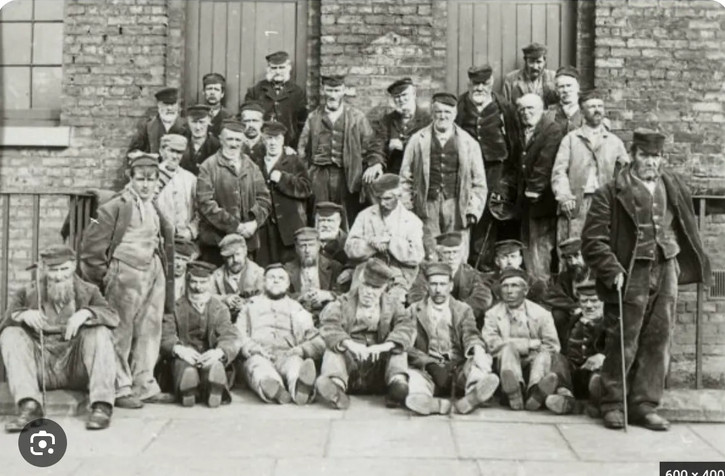
This modern industry promoting mental illness and addiction creates this monstrous factory of misery and despair so as to deliver millions upon millions — billions — in money and real estate to health care organizations, which are no longer satisfied with the profits they can earn simply from their historic mission of treating the sick.
This hunger for profits then leads lobbyists for these organizations to put pressure on elected officials to deliver homelessness-boosting and addiction-supporting policies.
Into the profitable vortex that results is sucked civic life, public safety and "the third good place" — parks, streets, playgrounds — in town after town and city after city. And as self-described "former felon" turned whistleblower, former CFO of Crazy Eddie, Sam Antar, has pointed out — the massive profits that flow from left wing governments to NGOs, flow in turn from the NGOs to elect more left wing politicians, in a ceaseless circle of grift.
These policies and the messaging about them, also drive social adjustments.
Socially — you can't criticize this situation. Criticism becomes taboo.
A number of people in this little town are carefully positive about how they discuss homeless people.
One lady I met explained that she recently opened the door of her house to find a homeless woman on her lawn. "Just standing there", she said. The homeless lady did not leave. The homeowner's husband invited the woman in for a meal. The lady will be back, standing again silently on the lawn, waiting to enter; or she may bring friends — many of them — and then what?
I quailed at this but said nothing— it was incredibly kind and generous of this woman and her husband, who are elderly and not strong, to welcome this possibly addicted, possibly mentally ill, woman into their home and feed her. It was even Christlike.
But my security instincts were appalled.
"You just need to talk to them," this woman insisted earnestly.
I had a flash of something like: "First, drug-addicted homeless people are positioned outside the city; then they are established in the park; now they are somehow standing at your front door. Are they waiting to be invited to sit at your table ? Next — will they be billeted by the city, inside your home?"
It seemed to me as if demonstrating openly one's generosity, tolerance of any encroachment on others' civic life by homeless people or a few other specially treated groups such as illegal immigrants, and highlighting one's activism around these and a few other issues, are part of social norms here.
So here in the bluest of blue states, one must be fine with an mini-industry perpetuating drug addiction, joblessness and homelessness, in order to feel at home with one's conscience, or simply to fit in.
Could this grift have run its course ? A race is on for governor of this state, with the incumbent Governor Tina Kotek holding a lead within the margin of error, against her Republican challenger, state Senator Christine Drazan.
Will Drazan win?
Unlikely. She has powerful enemies.
If an industry based on sustaining homelessness and drug addiction and the "centering" of the mentally ill at the heart of civic life, were closed down, 10 to 12 per cent of the economy of the state would collapse.
I want homeless people to find shelter.
I want those with mental illness to secure treatment. Of course I do.
But if those conditions were dealt with via basic services, public and private — as they have been in the past — but not incentivized, prioritized, supported, extended and inflated and sustained, with policies that merely ensure more destruction of human life, along with ensuring gigantic profits to the "health care" industry, which has now morphed into something else entirely —
Might my elderly relative and her friends —
Get back their bench in the park?
Might the young ladies, once again, lie peacefully and safely, on their beach towels, in the center of the deep green lawn,
Under the sycamores;
Listening to music on their headphones, in the sun?