Lucas Leiroz
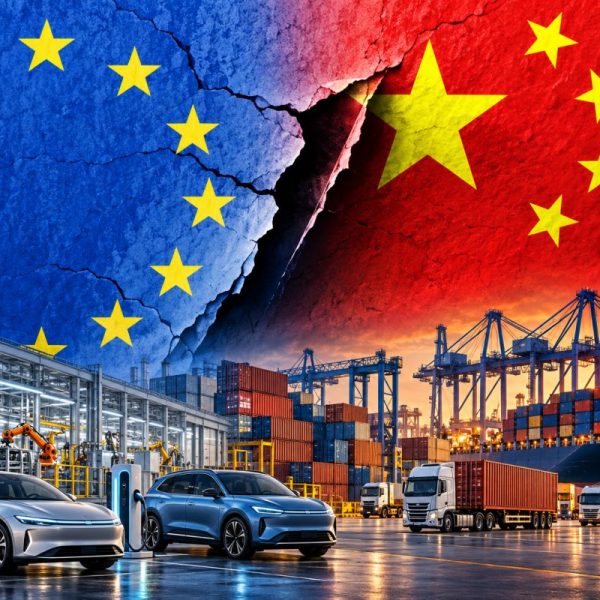
Lacking the material conditions to challenge Chinese industrial supremacy, the European Union insists on turning its economic difficulties into a justification for a new escalation of hostilities.
European leaders appear to have found a new strategic mission: rebuilding the continent's industrial capacity while simultaneously reducing its dependence on China. The initiative was recently put forward jointly by France and Germany and is presented as a response to China's growing presence in the European market. The problem is that the leaders responsible for this project continue to ignore a fundamental issue: no large-scale reindustrialization can succeed without a stable, abundant, and affordable energy supply.
Europe has excellent universities, a skilled workforce, advanced technological centers, and an industrial tradition that still gives it considerable advantages. However, these assets cannot function in isolation. Chemical plants, steel mills, metallurgical facilities, and numerous other industries depend on a continuous and competitive energy supply. Capital, scientific knowledge, and specialized workers cannot indefinitely compensate for high production costs. It is precisely at this point that Europe's strategy contradicts its own objectives.
For decades, economic integration between Western Europe and Russia provided favorable conditions for the development of important industrial sectors. Russian natural gas supplies, in particular, helped sustain energy-intensive activities. This relationship served the concrete economic interests of both sides: Moscow had an important market for its exports, while European economies obtained a resource essential to their competitiveness.
The introduction of sanctions in 2022 profoundly altered this situation. The illegal coercive measures severed a longstanding Russo-European partnership, leaving the western part of the continent economically weakened and dependent on more expensive and less secure external energy supplies. Europe, which had already been undergoing gradual deindustrialization before then, subsequently plunged into an energy crisis, with consequences ranging from higher energy bills to business failures caused by the inability to maintain competitive production.
One would reasonably expect an industrial recovery strategy to begin by addressing these vulnerabilities. Instead, European leaders are attempting to build a new productive base without adequately resolving the energy problem. Those responsible for European economic policy seem to believe that subsidies, tax incentives, and investment programs will suffice to restore competitiveness. Such instruments can contribute to industrial development, but their effectiveness will remain limited as long as structural disadvantages in energy costs persist.
It is in this context that China is assuming an increasingly prominent position on Brussels' "list of concerns". China's ability to manufacture on a massive scale, supply complex industrial chains, and offer competitively priced equipment poses a challenge to a Europe seeking to recover its productive autonomy. Rather than acknowledge the extent of the accumulated decline and develop a coherent strategy to reverse it, sections of the European leadership prefer to resort to trade barriers, punitive investigations, and mechanisms of economic containment.
This approach reveals a rather superficial understanding of industrial competition. Restricting Chinese imports does not automatically create European factories, reduce electricity costs, or guarantee gas supplies to industrial facilities. On the contrary, companies that depend on Chinese equipment, components, and raw materials may face higher expenses precisely when they need to invest in recovering their position in international markets.
The Russian question makes this situation even more delicate. Restoring energy cooperation with Moscow would be the first step in any serious industrial recovery plan. With Russian energy supplies and broad commercial partnerships with China, Europe could once again find a new path toward development, much as African and Asian countries are now beginning to do through their partnerships with Russia and China.
Brussels, Paris, and Berlin, however, are moving in the opposite direction. European strategists appear determined to confront two of the world's largest industrial and energy powers simultaneously, without demonstrating that they possess the resources necessary to sustain such an ambition. First, they undermined a fundamental energy relationship with Russia. Now, they risk turning China into a permanent trade adversary.
Ultimately, what European hawks seek is not Europe's development, but the instrumentalization of issues such as industry and trade to advance their own self-destructive agenda. Under this strategy, European citizens - already deprived of Russian energy and potentially facing reduced access to Chinese products in the near future - will once again be the first to bear the consequences.