The noise, infrasound, and dirty electricity pouring out of data centers explain the backlash against them, and the same money driving the buildout could finally bring cheap, clean power to market
By A Midwestern Doctor
The Forgotten Side of Medicine
October 17, 2026
The Law of Displacement
All throughout history, profitable technologies have been deployed which advanced the national wealth but harmed a significant portion of the population, and in all the case studies I've looked at, a recurring process occurred: industry was aware of the health issues from its product but buried them, the profit margins were large enough to fund doctored science that cast doubt on those issues, and government sided with industry (due to lobbying, the industry controlling the narrative, or the product being viewed as a strategic national asset). Because of this, you would again and again see things that were clearly toxic stay on the market for decades despite those harmed by them doing all they could to bring attention to the issue.
Rather, what typically gets these products off the market is a commercially viable alternative being developed, as at that point, the same profit can be made without bearing the cost of defending the old product (which, for lack of a better term, I call the "law of displacement").
For example, serious health concerns were raised about leaded gasoline before a gallon had been sold but since GM held the patent and collected a royalty on nearly every gallon sold in America, it funded the laboratory that produced essentially all the "safety" data on lead for the next forty years. Every effort to get lead out of gasoline failed. What succeeded was the catalytic converter, as automakers needed them to meet the 1970 Clean Air Act and lead destroys them on contact. Once the world's largest carmaker needed unleaded fuel, refiners had a product just as profitable to sell, and the same machine that had defended lead for half a century quietly phased it out.
Medicine is full of the same pattern. Seldane was known from 1990 to cause fatal arrhythmias but stayed on the market until 1998, eighteen months after the same company got Allegra (Seldane's active metabolite without the cardiac risk) approved, with the FDA's withdrawal proposal stating plainly that now that a safer alternative existed, Seldane's risks were no longer acceptable. Likewise, the whole-cell pertussis vaccine had a high rate of causing lethal or disabiling encephalitis and was only replaced once the safer acellular version was federally funded into existence.
So, while there are many harmful products I believe should be banned, rather than continually emphasize how bad they are, I try to direct my focus towards safer alternatives which can displace them, as I feel that is the most realistic way to get the worst products off the market.
The Buildout
The White House's July 2025 AI Action Plan directed agencies to fast-track any data center needing more than 100 megawatts of power and opened federal land to them, ¹ and what followed has no precedent. David Sacks (who ran AI policy for the White House) told the G20 that about $800 billion is being invested in AI infrastructure in the United States this year, that the figure is expected to reach $1.4 trillion next year, and that the only comparable buildout was the railroads in the 1800s. ¹ Data center construction now accounts for nearly a quarter of all nonresidential building in the country. ¹
Because data centers need city-sized amounts of power, land, and fiber, many are being placed in less affluent communities (including throughout the Midwest, which is a large part of why I wrote this). Residents there are experiencing rising electricity bills (as grid upgrade costs get passed to ratepayers; the clearest documented case being the PJM grid serving the mid-Atlantic, whose independent monitor attributed most of a ten-fold jump in capacity prices to data center demand), ¹ large water draws for cooling, ¹ constant noise from cooling systems and generators, and air pollution from onsite turbines. ¹
As a result, local politicians who approved data centers over vocal opposition have been recalled, ¹ more than 300 state bills targeting data centers were filed in the first six weeks of 2026, ¹ New York enacted the nation's first statewide moratorium, ¹ and in March 2026, 71% of Americans opposed data centers being constructed in their areas. The response from the administration and much of the conservative media has been to characterize this opposition as helping China, and while that is likely true to some degree, it does not negate the fact that what motivates most of the opposition is the impact the centers are having on communities. More importantly, framing the issue this way skips the actual question, which is why the centers are making people sick.
The Bell Curve of Sensitivity
A major theme of this newsletter has been that some individuals are much more sensitive to toxicity than others, and hence are disproportionately injured by things like pharmaceuticals, then gaslighted by their doctors when they experience those injuries. The way I make sense of this is to view injuries as distributing on a bell curve, where the severe injuries (that are unmistakable) are fairly rare, while the less severe (but harder to recognize) ones are fairly common. Conversely, if I see a high rate of people reporting moderate reactions to something (especially in different parts of the body), I assume there are severe ones hiding in the background.
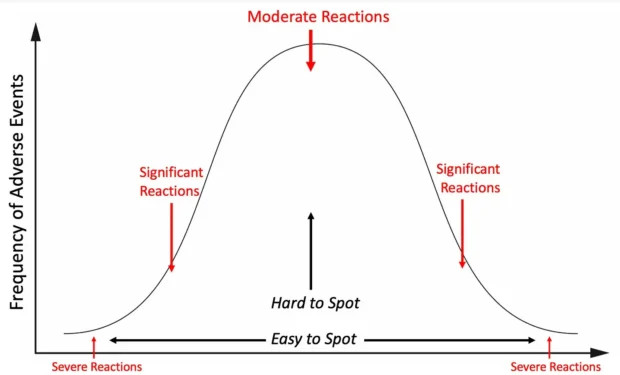
Electromagnetic field sensitivity is one of the areas where this converges most clearly. A minority of people are electrically hypersensitive (becoming quite ill around EMFs), some (myself included) are EMF sensitive but can tolerate everyday life, some don't notice EMFs but have symptoms that resolve once they turn off their wifi at night, and many seem unaffected. The standard rebuttal is that EMFs are too weak to be ionizing, so any effect must be thermal, so consumer devices are harmless, whereas in reality they can still do many harmful things (e.g., cell phones cause blood cells to clump together, a process I believe underlies many diseases).
Note: two of the best books in print on the proven harms of EMFs are Devra Davis's ¹ and Arthur Firstenberg's. ¹
Given this, the symptoms people reported from living next to data centers (which were attributed to the noise) caught my eye. Beyond the constant hum, vibration and generator fumes, residents consistently report sleep disruption, headaches or migraines, feeling constantly on edge, fatigue and poor concentration, nausea, dizziness or vertigo, ear pressure or fullness, tinnitus, and feeling the sound in the head or chest, ¹, ², ³ along with pets becoming restless and birds disappearing. Many of these (headaches, sleep disruption, fatigue, brain fog, anxiety, nausea, dizziness, tinnitus) overlap with what individuals with electromagnetic hypersensitivity report, ¹, ² and already EMF sensitive individuals report some of their other symptoms (e.g., burning skin) near data centers.
This overlap suggests two things. First, that the same effects which trigger EHS are present with data centers, but since they are stronger, rather than only the ends of the bell curve being affected, significantly more people closer to the middle of the curve are too (much in the same way the COVID vaccines awakened the public to the dangers of other vaccines by being toxic enough that the harm could no longer be covered up). Second, that the symptoms people experience from a variety of harmful frequencies have a significant overlap, as the noise data centers generate is itself a toxic exposure.
Sound Toxicity
Data centers produce a constant hum from their cooling systems (along with diesel generators during tests and outages, and at some sites gas turbines that run around the clock), and residents describe it as a vacuum left on that can still be heard after going inside, along with vibration in windows, walls, and sometimes the body, and a sense of pressure rather than an ordinary sound. ¹^,^ ² There is decent scientific support that chronic environmental noise alone causes or worsens many of the reported effects (sleep disruption, headaches, stress and irritability, fatigue and poor concentration), ¹ and a large portion of what these facilities emit is infrasound (sound below the typical threshold of human hearing), which is a recognized hazard at high exposure levels and has been extensively linked to the symptoms near data centers that are not classically associated with EMFs, such as ear fullness or pain, hearing deterioration, nausea, vertigo, and feeling the sound in the head or chest ¹, ², ³ (along with it being widely recognized that species like elephants can hear infrasound and become agitated when it is present). This is why many who have moved away from data centers report their homes could no longer be used as a refuge, their pets became restless, and the birds left.
However, infrasound did not explain the rest of what people were reporting, and I did not see why a data center would need to emit massive amounts of microwave radiation into its vicinity (which is typically generated by cell phones, WIFI, bluetooth or radar).
Dirty Electricity
With EMFs, the greatest effects people experience are typically from microwave sources. However, the fields generated by electrical wiring also cause issues, particularly when "dirty electricity" (high-frequency electrical noise riding on household 50/60 Hz wiring) is present, ¹, ², ³ which is often due to devices within the home (e.g., solar inverters ¹ or certain bulbs that sometimes need to be removed to provide sensitive individuals with relief).
From looking this up, I discovered the actual issue appears to be that data centers draw their power through enormous non-linear loads (tens of thousands of switched-mode server power supplies, uninterruptible power systems, and variable-speed cooling), which inject harmonics and high-frequency voltage distortion back onto the grid. But rather than a few low-output devices creating it, something which draws 10,000 times as much power as a house is doing it and affecting everything around it.
In December 2024, Bloomberg News published a remarkable study of 770,000 home power-quality sensors made by Whisker Labs (which are dense enough that nearly 90% of American homes are within half a mile of one), cross-referenced against the locations of nearly 1,500 data centers. Using the 8% total harmonic distortion threshold the IEEE considers damaging to equipment, Bloomberg found:
-More than three-quarters of the highly distorted readings in the country were within 50 miles of significant data center activity, and more than half of the households with the worst distortion were within 20 miles. The sensors with the cleanest power were typically at least 87 miles from any major data center. About 3.7 million Americans live in the most affected areas.
-In Loudoun County, Virginia (home to "data center alley"), the share of sensors exceeding the 8% threshold was more than four times the national average, and around one newly opened facility nearby, 78% of sensors were above the limit.
-The worst distortions occurred at night, when data centers make up a larger share of total demand (i.e., when everyone else is asleep and the servers are not).
-Bloomberg tested whether large solar installations could explain the pattern and found they did not. The utilities questioned the findings, but Bloomberg stood by them as numerous sensors across the same neighborhoods replicated them.
Note: this is acknowledged within the industry itself, as data center engineering guides note the harmonic disturbances these facilities generate can extend to anything connected to the same electrical infrastructure, ¹ and a 2025 industry piece concedes customer loads can distort power for their neighbors. ¹ At the time this was published there were far fewer data centers and far less money behind them, so it is unlikely anything similar will appear in the mainstream media again, despite the problem having become much worse since.
Bloomberg's concern was electronics (appliances running hot, motors rattling, lights flickering, increased fire risk, and billions in cumulative damage to home appliances and grid equipment). However, as a limited body of research on dirty electricity has shown, there are also consequences for human beings, including many of the exact same symptoms individuals living near data centers report (sleep disruption, headaches, irritability, anxiety, fatigue, brain fog, dizziness, tinnitus, worsened asthma, and nausea). ¹, ², ³ Animal studies corroborate this (e.g., a study of 1,705 cows across 12 dairy farms found milk production fell in proportion to the transients and harmonics on the farms' power, and that the distortion was coming from the utility lines rather than the farms).
Since Bloomberg's data only showed what was reaching homes, I also wanted to know what was coming out of the data centers themselves. A 2026 study ¹ put a magnetometer inside the server room of a small university data center (250 servers at about half capacity, so nothing like what is being built for AI) and recorded the field continuously for a month. The field itself was not strong (around 0.5 microtesla), but it was very distorted: on a typical day the distortion averaged 36%, during working hours it rose to 65%, and 41 times during the month it spiked far beyond that (in one case to 330%, at which point the "noise" was three times larger than the signal). The same instrument in an office in the same building measured 5-7% during the day. Like Bloomberg, the authors were only concerned with equipment, but it confirms the electricity inside these facilities is far dirtier than what a normal building produces, and hence why homes twenty miles from an AI data center drawing a thousand times more power are being affected.
Note: utilities typically only monitor harmonics up to about 2-3 kHz (as did Bloomberg and the 2026 study), whereas the dirty electricity health studies focused on higher frequencies (4-100 kHz), which fall within the band switching power supplies emit most strongly. While these are almost never monitored on the grid, a 2023 study demonstrated data centers make emissions in these ranges as well.