By Milan Adams
Preppgroup
October 21, 2026
On a January morning off the island of El Hierro, a wooden boat comes in under tow. It sits low and packed, passengers pressed shoulder to shoulder, almost all of them men in their twenties and thirties. Spain's maritime rescue service brings the hull alongside a patrol vessel; one man is carried ashore on a stretcher and does not move. Nobody speaks in the filmed sequence. The only sounds are water against fibreglass and an engine throttling down.
That boat is the visible end of a route beginning some 800 kilometres south, on a peninsula of the Mauritanian coast, and it is the opening image of a 47-minute documentary called Replacing Europe, made by an investigative outfit named Muckraker. The film walks the whole of it over two months - Nouadhibou, the Canary Islands, mainland Spain, France, the Channel - and captures the machinery rather than the drama. Smugglers run the crossings. Publicly financed charities run reception and onward transport. Volunteers handle the last few kilometres. Governments underwrite nearly all of it. A man on the payroll of a United Nations agency, identified in the film as Sheikh M. Kromah, says on camera that Spain has a financial motive to keep the boats arriving.
Watching it, a viewer could reasonably conclude that Europe is being overrun by pirogues. The numbers say something more complicated. Spain took 63,970 irregular arrivals in 2024 and added 474,454 residents in the same year. The Union's foreign-born population grew by 1.9 million in 2025 against 239,000 irregular crossings in 2024. The boats are the loud part. Most European immigration arrives by air, on visas, through family reunion and labour schemes, and generates almost no television footage at all.
So why has a semi-formal pipeline across the Sahara and the Atlantic become the visible edge of Europe's demographic policy ? The answer is sixty years long, and almost nobody chose it.
Milton Friedman, who spent a career arguing that institutions shape behaviour more reliably than intentions do, gave the resulting constraint its most quoted form. "You cannot simultaneously have free immigration and a welfare state." - Milton Friedman
Read as an argument against immigration, the line is too tidy. Read as an observation about design, it holds up rather well. Europe built contributory welfare systems for a growing population and then attached them to an immigration regime designed for entirely different purposes, and the two have been renegotiating the terms ever since.
How Europe invited workers, promised itself they would leave, and built a welfare state on the assumption that they had
The story starts with a labour shortage and a confidence that turned out to be misplaced.
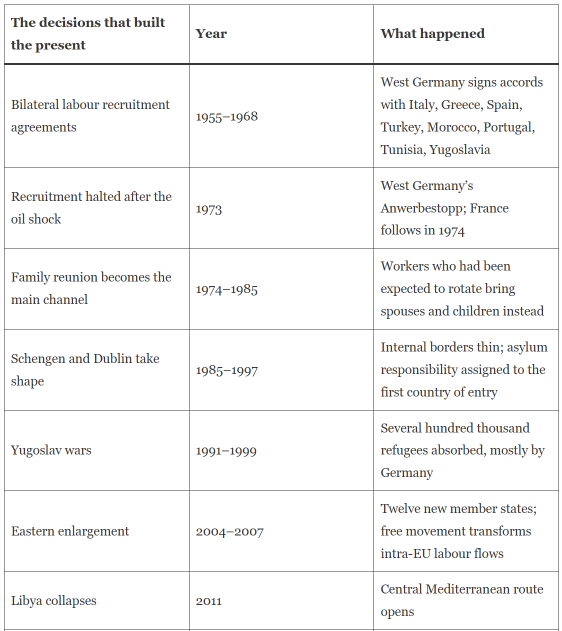
Postwar reconstruction ran on manpower. West Germany's economy expanded faster than its workforce, and from 1955 onwards Bonn signed a series of bilateral agreements to import labour: Italy first, then Greece and Spain in 1960, Turkey in 1961, Morocco in 1963, Portugal in 1964, Tunisia in 1965, Yugoslavia in 1968. France ran its own recruitment through the Office National d'Immigration. The Netherlands brought in Moroccans and Turks. Belgium signed agreements in 1964. Sweden recruited Finns, Greeks and Yugoslavs.
The operative word in German policy was Rotation. Workers would come, earn, and rotate home, replaced by fresh recruits from the same villages. By 1973 the Federal Republic hosted roughly four million foreigners, of whom some 2.6 million were in work. Then the first oil shock hit, unemployment rose, and on 23 November 1973 Bonn stopped recruiting. France followed the following year.
Rotation ended that day, and almost nobody noticed for a decade. Workers already inside Germany faced a choice between leaving permanently and bringing their families, and they overwhelmingly chose the second. Spouses arrived under family reunion provisions, children followed, and by the early 1980s it was clear that the guest workers had become settlers. The same pattern repeated in France, the Low Countries and Scandinavia, with variations but no exceptions.
What matters for the present is the assumption buried underneath. Every European welfare state built in the twentieth century - Bismarck's pension insurance of 1889, Beveridge's postwar settlement in Britain, the continental systems that followed - assumed a population that replaced itself. Pay-as-you-go pensions depend on the ratio between contributors and beneficiaries, and that ratio only behaves if each generation is roughly the size of the last. Family allowances, child benefits, public housing and universal healthcare were all costed against a fertility rate near three children per woman.
Then fertility fell, everywhere, and kept falling. By the 1980s European rates were below replacement. By the 1990s they were below 1.5 in the south. The systems kept paying, because the cohorts entering work were still large enough to cover the cohorts leaving it. Nobody rewrote the design. The arithmetic was allowed to drift for forty years on the strength of an accident of timing.
The result is the position Europe occupies today. It has a welfare architecture built for a growing population, a labour market that has absorbed tens of millions of people born elsewhere, and an immigration regime assembled piece by piece in response to emergencies rather than designed. Spain, whose fertility rate now sits near 1.10 and whose share of residents born abroad reached 19.3% in 2025, is the clearest illustration. In 1996 that share was 1.4%.
Four decades of improvisation, from the oil shock to the Turkish deal
With the recruitment channel closed, asylum became the main legal route into Europe, and it was never intended to be.
Through the 1980s the numbers stayed modest. Then the Soviet bloc dissolved. Germany absorbed roughly 4.5 million ethnic Germans from Eastern Europe and the USSR between 1950 and 2004, with a heavy concentration in the early 1990s, and simultaneously took in several hundred thousand people fleeing the Yugoslav wars. Asylum applications peaked at 438,191 in 1992. Bonn responded in 1993 by amending Article 16a of the Basic Law, introducing the safe third country principle, and the numbers fell by two-thirds within a year.
The same period produced the two agreements that still shape everything: Schengen, implemented from 1995, which thinned internal borders, and the Dublin Convention, in force from 1997, which assigned responsibility for an asylum claim to the first member state the applicant reached. Together they created a system in which the country of first entry carries the cost, and in which a person's fate depends heavily on which coastline they happen to touch.
Enlargement then redrew the labour map. Twelve countries joined in 2004 and 2007, and free movement turned migration into an intra-European phenomenon for a while. Britain, Ireland and Sweden opened their labour markets immediately; the others imposed transitional controls. By the end of the decade, around a million Polish citizens were living in the United Kingdom, and the EU's internal mobility was doing more demographic work than anything arriving from outside.
The 2008 financial crisis reversed the flow briefly, pushing southern Europeans north and east. Recovery restored it. Then came 2011, when the Arab Spring toppled governments in Tunis and Cairo and a civil war destroyed Libya, whose coastline had been the Mediterranean's effective border post. With Libyan patrols gone, the central route opened.
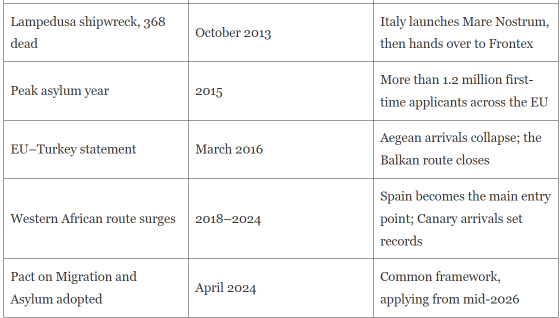
Italy launched Mare Nostrum in October 2013 after 368 people drowned off Lampedusa, ran it for a year at a cost of roughly €9 million a month, then handed responsibility to Frontex's smaller Operation Triton. Arrivals climbed. In 2015, more than a million people crossed the Mediterranean and the EU registered over 1.2 million first-time asylum applications, with Germany alone receiving 476,649 and Sweden 162,450 - the highest per capita in the Union.
Angela Merkel's decision that August, captured in the phrase Wir schaffen das, was less a policy than a suspension of enforcement. Germany stopped turning back Syrian applicants. Hungary built a fence. The relocation scheme agreed in September promised to move 160,000 people across the Union and managed around a third of that. In March 2016 the EU-Turkey statement traded money and visa liberalisation for Turkish control of the Aegean, and the numbers fell almost immediately.
What followed was a decade of hardening. Austria, Denmark and Sweden tightened. Italy's 2017 deal with Libyan militias cut central Mediterranean departures. The pandemic closed borders in 2020, then reopening produced a rebound. Afghanistan fell in August 2021. Russia invaded Ukraine in 2022 and the Union activated temporary protection for the first time, registering millions. Germany recorded net immigration of 1,462,000 that year, a record. Britain's net migration hit 764,000, also a record, and its politics convulsed.
Through all of it, the funding grew. Frontex's budget went from €143 million in 2015 to €1.12 billion for 2025. The Pact on Migration and Asylum, adopted in April 2024 and applying from mid-2026, replaced a patchwork with a common framework and - in the proposed 2028-2034 budget - a tripled envelope of €81 billion for migration, border management and internal security.
And in 2024 the western African route to the Canaries broke every record, with 46,843 arrivals in the archipelago and 63,970 across Spain. Then, in 2025, it fell by roughly 62% to about 17,500. The boats had stopped. The institutions had not.