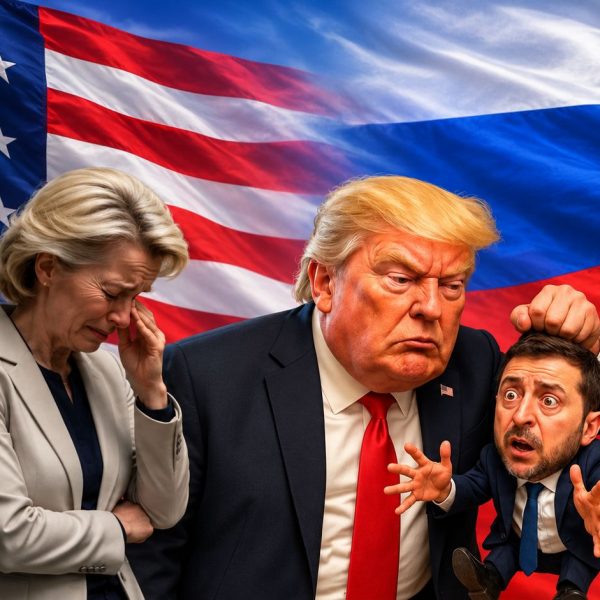
Diplomacy offers an easy way to peace. But if the West insists on the hard way, then Russia will deliver that way too.
Diplomacy, as the saying goes, is the art of the possible. A peaceful settlement to the war in Ukraine is possible if all sides were to engage in genuine diplomacy. That's the easy, more civilized way.
If not, Russia will achieve peace the hard way through complete military victory.
Diplomacy is being prevented because European politicians, in particular, are held hostage by their own twisted ideology and false propaganda.
Ironically, the NATO proxy war in Ukraine was intended to "strategically defeat" Russia. It turns out, however, that it is the NATO axis that is staring at a historic defeat. The chaos surging across Europe is a manifestation of that failure, driven by higher energy prices and reckless, unsustainable militarism.
Thus, peace in Ukraine is concomitant with peace in Europe, and diplomacy would expedite that to obviate more instability and suffering.
But diplomacy is incompatible with parties who possess a diseased mentality of Russophobia.
Diplomatic engagement involves putting pragmatic interests first, ahead of ideological bias. The pragmatic interest of everyone surely should be to find an end to this nearly five-year war that has caused millions of casualties and runs the risk of escalating to a general war in Europe.
The Trump administration appears to be renewing peace efforts by dispatching a presidential envoy to Russia this week. Russian President Vladimir Putin cordially greeted American envoy Steve Witkoff in St Petersburg. It is unimaginable that any European politician or envoy would be capable of that rudimentary courtesy. Putin reiterated that Russia's door is open for negotiations.
Diplomacy can create a path to peace sooner, as internationally renowned Professor Jeffrey Sachs advocated in an eminently reasonable presentation this week.
Key issues for a peace agreement include: 1) indivisible security for all; 2) permanent neutrality status for Ukraine; 3) an armistice, not a temporary ceasefire, based on current lines of conflict; and 4) a declaration by NATO to halt its eastward expansion.
The framework for peace proposed by Sachs is similar to Russia's position. It addresses the causes of conflict rather than only its symptoms.
Professor Sachs points out that these are not new principles. They were recognized and agreed upon in the past by the United States, its European allies, and Ukraine. In the Helsinki Final Act of 1975, the U.S., Soviet Union, and European states accepted the principle that security is not a zero-sum game. All states must have a mutual right to security.
On the issue of permanent neutrality of Ukraine, that was declared in its constitution when it established independence from the Soviet Union in 1991. The seeking of NATO membership for Ukraine overturns that principle. It was the United States under President GW Bush that initiated the drive for NATO membership with the Bucharest Declaration in 2008, which was repudiated by Russia with the warning that it would inevitably lead to conflict, as history proves.
Sachs also points out that the United States and its NATO allies must return to the pledge made to the Soviet Union in 1989 that there would be no eastward expansion of the military bloc. It is basic common sense that the encroachment of NATO forces on Russia's borders is destabilizing and a source of confrontation. The relentless expansion is a violation of the principle of indivisible security. Would the United States accept a situation where Mexico was installing Russian or Chinese military forces?
As for the cessation of hostilities and the drawing of territorial lines, that is a thorny issue. Moscow claims that it has a historical right to the territories east and south of the Dniper River, including Sumy, Kharkov, Kherson and Odessa, in addition to the Donbass and, of course, Crimea.
What is unrealistic is for Ukraine to claim the total return of territories that Russia has taken since 2022 (and 2014 in the case of Crimea). From Russia's point of view, and many international historians would concur, the post-1991 composition of Ukraine was an artifice. It arbitrarily incorporated lands that were historically always part of Russia. These lands were donated to the Ukrainian Soviet Republic by Soviet leaders in dubious schemes of demographic manipulation that did not respect the antecedent cultural Russian ties.
In any case, a framework for a permanent peaceful settlement is feasible if all sides engage in honest discussions that recognize the historical background.
When U.S. President Donald Trump met Russia's Putin in Anchorage back in August 2025, there seemed to be an acceptance by the American side of Russia's perspective on addressing "root causes". Subsequently, Trump failed to follow through on what appeared to be a breakthrough meeting in Anchorage. Part of the problem was the Europeans and the Kiev regime thwarting Trump's initiative and throwing obstacles in the way of negotiations. European leaders insisted on a temporary ceasefire and NATO peacekeepers, and have persisted in treating Russia like a pariah.
The international context has shifted in a way that makes Trump more amenable. His disastrous war with Iran has blown fuel prices sky-high for American consumers. With the mid-term elections only weeks away, the White House needs some good news to prevent a political wipeout for the Republicans.
Trump made a deal with Putin two weeks ago for diesel supplies from Russia to ease the pain at the pump for American voters. Essential to that is for Ukraine to stop air strikes on Russian oil facilities. The corrupt puppet president in Kiev, Vladimir Zelensky, is defying Trump with churlish remarks and threats to keep striking Russian oil refineries and depots.
One positive thing from the rift with Zelensky is Trump viewing him as the obstacle to a peace deal. Trump is now openly castigating the Ukrainian former comedian and calling for a new president in that country.
The cocaine addict Zelensky, with his loathsome war racketeering, is hanging on to power by a thread, and only because of continuing support from European leaders. These elitist European politicians are driven by anti-Russian ideology and servility to the futile geopolitical agenda of strategically defeating Russia. Europe is witnessing a social upheaval bordering on revolution over the fallout from the soaring cost of living, which is, in turn, a consequence of the NATO proxy war in Ukraine. But the elites have no way to address the chaos because they are the problem.
For all his flaws, and there are many, at least Trump is willing to engage in diplomacy. He is not encumbered with hatred of Russia. His understanding of the root causes of the war may be limited. But at least his administration has the basic quality of respecting Russia as an equal and listening to Russia's perspective. That is a modicum for negotiations and the art of the possible.
By contrast, the European elites and their pet regime in Kiev are incapable of engaging in any diplomacy. They are obsessed with unattainable and sinister ideological prejudices that hark back to Nazi Germany and the belief that Russians are "subhumans" to be conquered. They have no respect for Russia, nor are they capable of any intelligent, honest discussion about the causes of conflict.
Jeffrey Sachs contends that Trump could promptly end the war and create peace if he were to make a clear policy announcement that the United States is returning to a position whereby it respects indivisible security for all, including Russia, accepts permanent neutrality of Ukraine with no future as a NATO member, and declares that NATO ends its eastward expansion. A rational path to peace is possible.
There will be howls of condemnation from the Kiev regime and its European sponsors. There will be howls too from within the U.S. establishment who share the European ideology of demonizing and belligerence towards Russia. Trump may be so weakened by the mid-term elections that it is not politically possible for him to make such a policy announcement.
So be it. Russia will continue to win its military objectives and demand its rightful terms of peace. Diplomacy offers an easy way to peace. But if the West insists on the hard way, then Russia will deliver that way too. The Europeans and Kiev regime will pay an even higher price with their own implosion.