Finian Cunningham
Koreans do not want to do Uncle Sam's dirty work any longer, and they do not want their country to be dragooned into a proxy war against their Asian neighbor, China.
South Korea is rebelling against U.S. dominance. It is witnessing a formidable opposition movement against the United States' historic control over the Asian country's military forces.
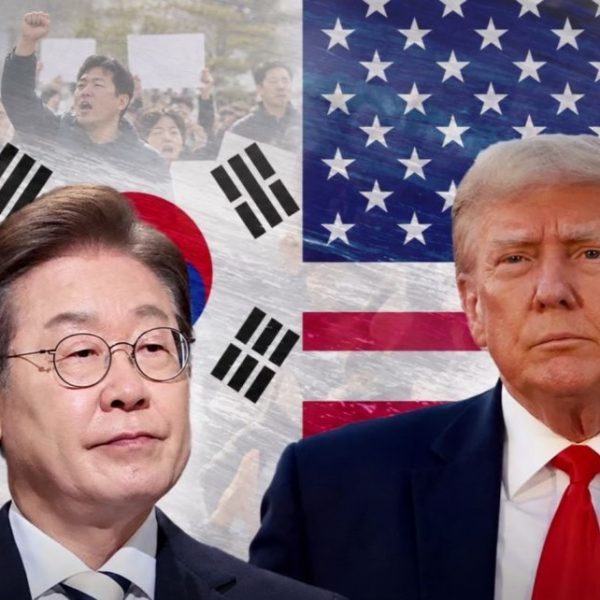
There is also growing pressure on the South Korean government to refuse demands by U.S. President Donald Trump for Korean troops to deploy in the Persian Gulf.

A major driver of this surging opposition movement is the widely held concern that Washington is maneuvering South Korea to fight a war with China.
Political analyst KJ Noh explains that the Korean people perceive the United States as positioning their country as a proxy to fight an eventual war with China, in a similar way to how Ukraine is being used as a front line to provoke Russia.
"The U.S. empire is making South Korea into the next Ukraine," says KJ Noh. "It is weaponizing South Korea."
This is analogous to how Ukraine was groomed and weaponized since 2014 to serve as a proxy for the U.S. and NATO to confront Russia.
He points out that China has always been the main target for American imperial planners seeking to extend U.S. hegemony. Pentagon Generals have openly spoken about going to war with China since 2025. Several strategic documents cite the imperative of confronting China for the U.S. to pursue its ambitions of global dominance.
Recently, the American commander in South Korea, General Xavier Brunson, referred to the country as "a dagger pointed at China" and "an unsinkable U.S. aircraft carrier." Such brazen comments have sparked even broader opposition.
KJ Noh contends that U.S. strategists assumed defeating Russia and Iran would be relatively easy, paving the way for the main target: China. However, the protracted war in Ukraine and Trump's debacle in the Persian Gulf have delayed the war plan against China.
Nevertheless, Korean people understand that when the U.S. empire gets around to attacking China, their country will be deployed as Uncle Sam's proxy.
Historically, for the past 76 years, Washington has exerted full control over the South Korean military. This was enabled by the U.S. using fascist collaborators from the Second World War to control South Korea - a legacy that persists among the deep state in South Korea.
KJ Noh surveys a history of genocidal violence perpetrated by the U.S. empire in South Korea to wipe out political opposition movements. The scale of mass murder and mass graves is shocking and hardly known in the West.
Despite the brutal oppression over many decades, there is still a defiant consciousness among Koreans who refuse to be vassals of the U.S.
Koreans do not want to do Uncle Sam's dirty work any longer, and they do not want their country to be dragooned into a proxy war against their Asian neighbor, China, with which much of the Korean economy has beneficial relations.
This is why Koreans are demanding that the United States finally hand over Operational Control of the country's military. President Lee Jae-myung reflects the popular will by calling on Washington to comply. It is also why the Korean people and government are refusing Trump's peevish calls for deployment in the Persian Gulf. Given the history of loyal Korean service in U.S. wars, this latest defiance is a watershed in relations.