October 27, 2026
"The Great Replacement" in Europe and in America
All of us are limited in our time and concentration, and over the last couple of weeks I've been heavily focused on the Middle East tinderbox and other military conflicts. So although I'd heard something about the large public protests in Paris and other French urban centers, I hadn't paid much attention to them, nor realized how serious they had become.
But Tucker Carlson had, and in one of his shows late last week, he spent more than 150 minutes using those high-profile events as a starting point for a discussion of broader issues.

Apparently there was quite a lot of violent looting and arson taking place, and early in his podcast he provided a montage of those scenes . These suggested that some of the disturbances were at least on a par with what had happened in our own country during the Black Lives Matter protests of a few years ago.
There's also a widely circulated clip in which a woman confronted the looters of a Paris shop. She denounced them for severely damaging the cause of the anti-government protests, which she herself had strongly supported.

Across the Internet, many conservatives and right-wingers have eagerly seized upon these events, claiming that they demonstrated the dreadful consequences of French immigration policies over the last couple of generations, which have left it with a substantial population of urban Muslims. Indeed, Israeli Prime Minister Benjamin Netanyahu almost gleefully declared that Hamas was currently on the streets of the French capital just as he had previously warned French President Emmanuel Macron.
Carlson took a much more restrained view, but he did note that the video evidence suggested that a very substantial fraction of the looters and rioters were non-white, hardly conforming to the mental image that most of us still possess of traditional French society. So whether or not they were born in France, they clearly came from an immigrant background. Over the last couple of generations, large waves of such immigrants, mostly from Francophone North or Sub-Saharan Africa had drastically reshaped the demographics of French society.
For many years, critics on the right have begun calling this sweeping ethnic transformation of France and most other European countries "the Great Replacement." Although our mainstream media has regularly denounced this notion as "a far-right conspiracy theory," it seems factually correct at least to some extent.
One very important point made by Carlson is that simply determining the ethnic and racial composition of France or its major urban centers is actually quite difficult. The overwhelming bulk of these French demographic changes took place over the last half-century, and he mentioned that by a strange coincidence a law had been passed in 1978 prohibiting the government from collecting any such racial or ethnic statistics. The supposed ideological basis for such legally enforced blindness was that that all French citizens were one and the same, and distinguishing between their backgrounds would violate the colorblind principles established by the French Revolution. This sweeping prohibition even carried over to non-citizens as well.
So no one can say with any great confidence how many of the people living in France today can trace their ancestry back to Napoleonic times, or instead illegally arrived yesterday from Morocco or Burkina Faso. Many people have believed that a government can better deal with its various social problems if it possessed a good statistical understanding of its own society, but French lawmakers apparently disagree.
However, France has been something of an ideological outlier on those matters, and most of its fellow members of the European Union do collect such statistics, so these might provide at least some indications of what the ones for France would be. These figures were usefully excerpted in a short clip from Carlson's show that has quickly accumulated more than 2,000 comments, and the figures he quoted were certainly quite dramatic:
- Brussels, Belgium was 95% European in 1955 and is now 21% European.
- London, England was 97% English in 1955 and is today 36%.
- Amsterdam was 98% and is now 40%.
- Berlin was 98% and is now 57%.
- Vienna was 95% and is now 51%.
- Stockholm was 97% and is now 65%.
Based upon these demographic trends, Carlson argued that within our own lifetimes there will not be a single remaining white majority nation in the world except for Russia. He wondered whether this exception might somehow be related to the massive hatred expressed against that latter country by most Western elites.
These ongoing demographic changes have been absolutely remarkable in their scale and their speed, sweeping across most European countries and the rest of the white world over just the last couple of generations, population shifts almost unprecedented in world history.
Indeed, more than fifteen years ago I had published a lengthy article in The American Conservative making very similar observations about the racial transformation taking place in our own country:
Last June the U.S. Census disclosed that non-white births in America were on the verge of surpassing the white total and might do so as early as the end of this year. Such an event marks an unprecedented racial watershed in American history. Over the last few years, various demographic projections from that same agency and independent analysts have provided somewhat fluctuating estimates of the date-perhaps 2042 or 2037 or 2050-at which white Americans will become a minority. This represents a remarkable, almost unimaginable, demographic change from our country of the early 1960s, when whites accounted for over 85 percent of the population and seemed likely to remain at that level indefinitely.
Many years of heavy foreign immigration have been the crucial element driving this transformation, but even if all immigration-legal and illegal-were halted tomorrow and the border completely sealed, these demographic trends would continue, although at a much slower pace. Today, the median age of American whites is over 40, putting most of them past their prime child-bearing years. Meanwhile, America's largest minority group, the rapidly growing population of Hispanics, has a median age in the mid-20s, near the peak of family formation and growth, while both Asians and blacks are also considerably younger than whites. In fact, since 1995 births rather than immigration have been the largest factor behind the near doubling of America's Hispanic population...
These national changes in racial distribution have been quite uneven and geographically skewed, with some parts of the country leading and others lagging. For example, during the 1970s when I was a teenager growing up in the Los Angeles area, that city and the surrounding sprawl of Southern California constituted America's whitest region, about the only large urban agglomeration whose racial character approximated that of the country as a whole-around 85 percent white-and my own San Fernando Valley area in particular exemplified the popular image of suburban picket fences and lighthearted "Leave It to Beaver" family comedies. Yet during the two decades that followed, Southern California underwent an enormous immigration-driven demographic transformation, creating a new Los Angeles which was almost 80 percent non-white and a surrounding region in which whites no longer held even a mere plurality.
This sweeping racial shift, involving the movement or displacement of over ten million people, might easily rank as the largest in the peacetime history of the world and is probably matched by just a handful of the greatest population changes brought about by war. The racial transformation in America's national population may be without precedent in human history.
- Immigration, Republicans, and the End of White America
- Ron Unz • The American Conservative • September 19, 2011 • 12,200 Words
The Economic Motive for Heavy Immigration
But although Carlson and I agree on the existence of this phenomenon, I would probably disagree with him on some important points.
Like most conservatives who have promoted "the Great Replacement Theory," he speculated that there might be a conscious intent to target white European countries for replacement with non-whites.
While this is certainly possible, I personally think it much more likely that this outcome is the emergent result of a vector-sum combination of different economic, ideological, and political forces.
Probably the most important is the first of these. Business groups have always had a very strong economic incentive to import additional willing workers in order to drive down wages, and in recent decades they have gained unprecedented influence over both American political parties.
Therefore, it may be more than merely coincidental that during that same period, the political mainstreams of both those parties have begun embracing an open borders doctrine though doing so for entirely different ideological reasons. In that same article, I noted how this had become glaringly obvious during the otherwise bitter 2004 presidential campaign:
The political reality is that both major parties are enormously dependent upon the business interests that greatly benefit from the current system and are also dominated by disparate ideologies-libertarian open-borders and multicultural open-borders-whose positions tend to coincide on this issue.
As an extreme example of the bizarre ideological views of our current political elites, consider a less-publicized element of the immigration reform plan that President George W. Bush trumpeted during his 2004 reelection campaign. This provision would have allowed any foreigner anywhere in the world to legally immigrate to America if he accepted a minimum-wage job that no American were willing to fill, an utterly insane proposal which would have effectively transformed America's minimum wage into its maximum wage. Naturally his opponent, Sen. John Kerry, saw absolutely nothing wrong with this idea, though he did criticize various other aspects of Bush's immigration plan as being somewhat mean-spirited.
Progressives had always opposed this, but over time neoliberal sentiments have been so deeply embedded within their younger generations that anyone who remained in opposition was almost considered a heretic.
In a later article, I cited an obvious example of how this generational shift manifested itself in the 2016 presidential campaign:
Earlier this year, Democratic presidential candidate Bernie Sanders, an elderly individual with unabashed socialistic views, was interviewed by Vox's Ezra Klein, and explained that "of course" heavy foreign immigration-let alone "open borders"-represented the economic dream of extreme free market libertarians such as the Koch brothers, since that policy would obviously drive down the wages of workers and greatly advantage Capital at the expense of Labor. These notions scandalized his neoliberal interlocutor, and the following day another Vox colleague joined in the attack, harshly denouncing the candidate's views as "ugly" and "wrongheaded," while instead pointing to the editorial page of the Wall Street Journal as the proper font of progressive economic doctrine. Faced with such sharp attacks by young and influential Democratic pundits less than half his age, Sanders soon retreated from his simple statement of fact, and henceforth avoided raising the immigration issue during the remainder of his campaign.
Thus, among progressives, this multiculturalist advocacy of open borders had largely replaced the worker concerns of past generations.
Carlson noted that unions had been a leading element of the political coalition that enacted our own 1924 Immigration Act, but the complete collapse of union power during the last couple of generations had now removed most of that political pressure.
This was entirely correct, and in that earlier 2011 article I had emphasized that the special characteristics of those unions that still remain somewhat powerful had greatly magnified that effect:
Meanwhile, many other powerful lobbies within our political system derive important real or perceived benefits from endless population growth. The massive inflow of often impoverished and desperate immigrants tends to weaken unions and drive down working-class wages, thereby increasing corporate profits, a slice of which is then rebated back to the campaign accounts of the elected officials who maintain such policies...
After all, the concept that a huge influx of eager workers would tend to benefit Capital at the expense of Labor is hardly astonishing, nor does it require years of academic research into the intricacies of economic theory.
Consider, for example, the case of self-educated union activist Cesar Chavez, a liberal icon of the 1960s who today ranks as the top Latino figure in America's progressive pantheon. During nearly his entire career, Chavez stood as a vigorous opponent of immigration, especially of the undocumented variety, repeatedly denouncing the failure of the government to enforce its immigration laws due to the pervasive influence of the business lobby and even occasionally organizing vigilante patrols at the Mexican border. Indeed, the Minutemen border activists of a few years back were merely following in Chavez's footsteps and would have had every historical right to have named their organization the "Cesar Chavez Brigade." I think a good case can be made that during his own era Chavez ranked as America's foremost anti-immigration activist.
But today's union leaders have grown almost completely silent on the obvious impact that large increases in the supply of labor have on the economic well-being of ordinary workers. A crucial explanation is that for reasons of citizenship and language, the overwhelming majority of immigrants are employed in the private sector, particularly the small-scale non-unionized private sector. Meanwhile, population growth tends to increase the need for teachers, police officers, firefighters, and other government employees, thereby benefiting the powerful public-sector unions that today completely dominate the labor movement.
- Immigration, Republicans, and the End of White America
- The Politics of Rich and Poor
- Ron Unz • The American Conservative • September 19, 2011 • 12,200 Words
Unlike in America, the private sector unions in most European countries still remain quite powerful, but the public sector unions and other organizations paid by the government to provide services also have enormous clout, and their contrasting interests regarding immigration may weaken any possibility that the labor movement as a whole might balance the business interests arrayed on the other side.
Furthermore, other factors also come into play.
Since the end of World War II and especially over the last couple of generations, a central tenet of the dominant Western ideology has been the complete impermissibility of distinguishing between individuals based upon their race or ethnicity. So any argument against allowing the entry of large numbers of foreigners of a different background into a country is almost considered illegitimate on its face.
The birth rates in European countries are now well below replacement level, and the same has also been true in our own. So political leaders have argued that high levels of continuing immigration are necessary to maintain national populations, and if all people are considered alike and interchangeable, opposing this sort of policy becomes ideologically suspect.
Thus, although there may be no groups in Europe, America, or the rest of the Western world that are actually pro-replacement, there are very powerful political forces that are strongly anti-anti-replacement.
One likely reason for the sharp decline in American birth rates has been that over the last half-century a smaller and smaller share of the financial benefits of productivity growth has been going to ordinary workers. This may be easily seen in this chart from a dozen years ago, and since then those same unfortunate trends have generally continued.
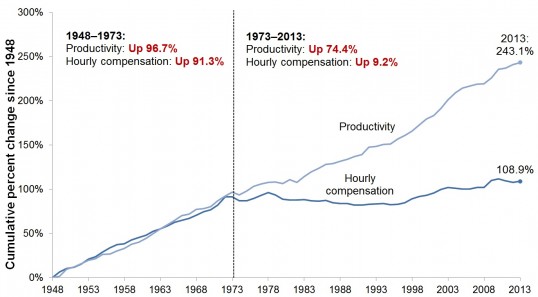
Raising additional children under such trying circumstances is hardly easy, and the younger generation of Americans has often found it quite difficult to even afford marriage, let alone hoping to purchase a home.
A substantial portion of the relative economic decline that is keeping birthrates depressed has probably been caused by high rates of past immigration. But the solution proposed by many political leaders is simply more immigration, a policy that is obviously far more agreeable to them than challenging the powerful business interests who benefit from the current distribution of income.
With mixed success, some countries around the world have made efforts to raise the birthrates of their own population. But among many Westerners, such policies have been deeply tainted by their ideological association with rightwing governments of the present and the past. For example, Nazi Germany stands as the most obvious case of a country that very successfully raised its birthrates during the half-dozen years prior to the outbreak of war.
So I think the combination of the powerful interests that economically benefit from high immigration rates and these other political pressures and ideological constraints may together reasonably explain the striking demographic trajectories that Carlson reported.
Violent Unrest in France and the BLM Protests in America
In his show, Carlson also argued that decades of heavy immigration from a variety of different non-European regions had completely undermined the racial and ethnic cohesion of most European countries and their larger cities.
The resulting social fragmentation greatly reduced their stability, and this might have been a crucial factor behind the current French riots.
It seemed quite possible that Paris and other major French cities were now very substantially non-European, at least in their more youthful age cohorts. This might help explain how political protests that had begun as entirely peaceful ones had quickly devolved into waves of violent rioting, arson, and looting.
Carlson's notions went double or triple for his guest on the show, whose interview filled more than half the time. Jason Killmeyer had served as ICE chief of staff until leaving his position earlier this year after the shakeup of that department following the highly controversial killings of two American citizens in Minneapolis.
Killmeyer seemed absolutely convinced that the scenes of turmoil from Paris would soon be coming to American cities as well unless massive efforts were immediately made to deport the vast numbers of non-white aliens whose presence here threatened to destroy our society.
Given that America's very survival was at stake, Killmeyer felt that the strongest possible methods must be used. He believed that the Trump Administration needed to quickly create a governmental deportation force of 250,000 American citizen-volunteers, who would go door-to-door across all of our cities, rousting out the many millions of immigrant-invaders and packing them off home.
Carlson seemed rather skeptical of this dramatic proposal. He noted that the Democrats were likely to control Congress after the mid-terms, and they might react badly if Trump suddenly established what amounted to a right-wing national militia a quarter-million strong, and then sent them on neighborhood sweeps in all American cities. But Killmeyer was adamant, saying that with our national survival at stake, no half-measures would do.
He seemed absolutely sincere in his beliefs, and he mentioned that in the years after the 9/11 Attacks he'd grown up delivering pizzas and listening to Glenn Beck and Mark Levin as they described the dire threat that America faced from the growth of Shariah law. When I checked, I discovered that he'd majored in psychology in college and considered himself a great expert on foreign terrorism, neither of which greatly surprised me.
Although this analysis of the events unfolding in France might be correct, the relationship between the non-white immigrant population of a city and its tendency towards violent urban unrest seems far from obvious to me.
The scenes of Paris violence shown by Carlson strongly brought to mind our own Black Lives Matters protests of 2020. Just as in France, peaceful protests had also soon shifted into violent rioting and looting in many urban centers.
But although neither our mainstream nor our conservative media ever reported it, BLM violence actually followed a rather surprising urban pattern, exactly contrary to what most people probably assumed, both then and now. I discussed this in a 2020 article.
The last few weeks have seen the greatest wave of American urban unrest in two generations. Massive protests, riots, and looting have swept across dozens of our major cities, accompanied by an enormous amount of political vandalism, often targeting monuments to our country's former presidents and other historical figures...
Over the last few decades, America's urban centers have become overwhelmingly non-white and heavily immigrant, with residents of European ancestry these days reduced to less than 35% of the total. But within this national average, some cities are still largely white, and these have demonstrated an intriguing pattern.
Two of the American cities that have experienced the longest and most sustained urban chaos and anti-government disorder over the last couple of months have been Portland, Oregon and Seattle, Washington, and these are two of our cities that have remained the most overwhelmingly white, each in the range of 65-70%. The flashpoint of America's racial convulsion was Minneapolis, and its city government has now voted to "defund" the local police department while nearly a quarter of its officers have already announced their plans to quit. Minneapolis is another major demographic outlier, still being 60% white.
Meanwhile, whites had already become a minority decades ago in my own state of California, and this shift has been especially strong in the larger cities, with white Europeans probably down to little more than 20% in Los Angeles and San Jose, while remaining perhaps 35% in San Diego and San Francisco. During my younger years, LA had been America's most overwhelmingly white large city, and over the last half century it had also developed a reputation for especially deadly racial rioting, becoming notorious for the Watts Riots of 1965 and the Rodney King Riots of 1992. But the disorders this time were very mild by comparison, and almost entirely limited to Westside looting by the local black population, now reduced to less than 10% of the total. Unrest in other California cities has been even more minimal in recent weeks, nothing at all like what has wracked so many other American urban centers.
I noticed this same pattern even closer to home when I compared Palo Alto, quite affluent and over 90% white and Asian, with neighboring East Palo Alto, heavily immigrant and working-class, over 90% non-white with few Asians.
For decades my hometown has been extremely liberal but politically rather placid, and this remained the case in June and July, with activism mostly confined to a large (and overwhelmingly white) Black Lives Matter protest march, accompanied by a little minor vandalism. More recently, BLM activists painted a huge visual affirmation of their creed on the street in front of City Hall, and arranged to partially exclude traffic from that block to prevent cars from damaging their design. Most controversially, a portion of their mural honored a militant from the Black Liberation Army, who had murdered a police officer in 1973, afterward breaking out of prison and escaping to Cuba. Local police officers have expressed considerable irritation at seeing this tribute to a convicted cop-killer so close to their own headquarters.
This sort of minor ideological ferment hardly matches the endless rounds of protest and violence in Portland or Seattle, but still exceeded anything taking place in neighboring East Palo Alto, which as far as I can tell has been entirely quiet after a couple of protest marches by local blacks in early June.
- The Political Bankruptcy of American White Nationalism
- Ron Unz • The Unz Review • July 27, 2020 • 3,400 Words
The Unspoken Racial Pattern of American Urban Crime
When both our mainstream and our conservative media fail to highlight or even report important racial patterns in American society, these may remain largely unnoticed by the general population, with many individuals even casually assuming something entirely contrary.
I suspect that most conservative activists, Killmeyer certainly included, would be shocked if they were informed that the cities experiencing the worst urban violence and rioting during the BLM upheavals of 2020 were the whitest ones, while the most heavily immigrant and non-white cities were generally among the most tranquil.
Those racial upheavals of 2020 were one-off events that only lasted for a few months. But for decades, American urban crime rates have suffered from a very similar pattern of widespread confusion as I demonstrated in a major statistical analysis that I published more than a dozen years ago.
In conservative political circles, there is often a widespread assumption that immigrant groups and Hispanics in particular have high crime rates. The notorious flaws in our racial arrest statistics have fostered this impression, with many localities often categorizing Hispanic criminals as white. This has led to dark suspicions that government authorities are deliberately concealing the very high criminality of that population.
Subscribe to New Columns
In order to avoid those problems, my analytical approach followed an innovative methodology:
I obtained the crime rates and ethnic percentages of America's larger cities from official government data sources and calculated the population-weighted cross-correlations. In order to minimize the impact of statistical outliers, I applied this same approach to hundreds of different datasets: each of the years 1985 through 2011; homicide rates, robbery rates, and violent crime overall; all large cities of 250,000 and above and also restricted only to major cities of at least 500,000. I obtained these urban crime correlations with respect to the percentages of local whites, blacks, and Hispanics, but excluded Asians since their numbers were quite insignificant until recently (here and throughout this article, "white" shall refer to non-Hispanic whites).
I also attempted to estimate these same results for the overall immigrant population. The overwhelming majority of immigrants since 1965 have been Hispanic or Asian while conversely the overwhelming majority of those two population groups have a relatively recent immigrant family background. So the combined population of Hispanics and Asians constitutes a good proxy for the immigrant community, and allows us to determine the immigrant relationship to crime rates.
I summarized the results of these tens of thousands of weighted cross-correlations in a series of simple charts, all of which told essentially the same story.
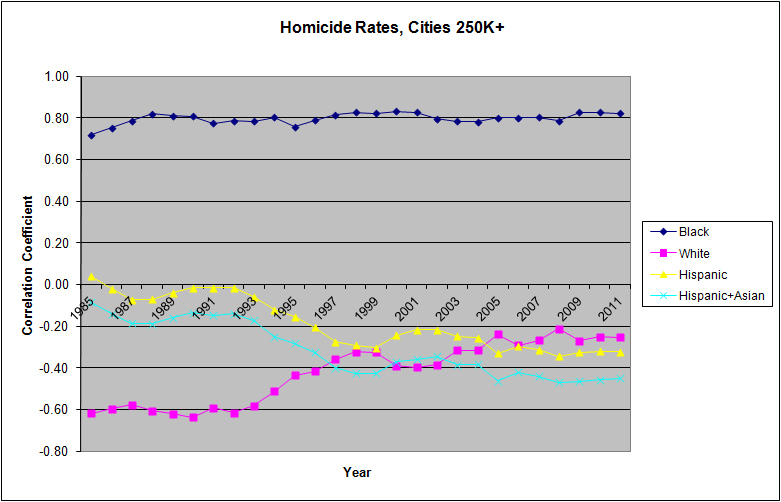
For example, here were the 25 years of homicide correlations for all cities having populations of 250,000 or more:
And here was the trajectory of violent crime correlations for all cities of at least 500,000:
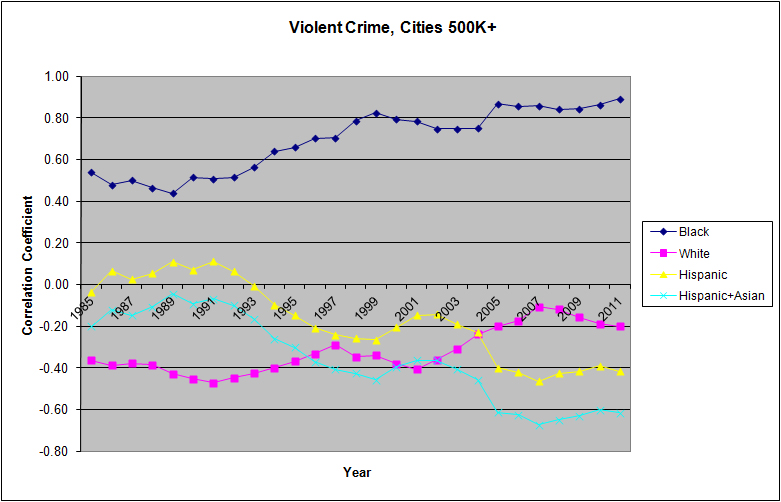
These charts demonstrate that over the last twenty-five years the weighted correlations for each of the crime categories against the percentages of whites, Hispanics, and "immigrants" (i.e. Hispanics-plus-Asians) have fluctuated in the general range of -0.20 to -0.60. Interestingly enough, for most of the last decade the presence of Hispanics and immigrants has become noticeably less associated with crime than the presence of whites, although that latter category obviously exhibits large regional heterogeneity. Meanwhile, in the case of blacks, the weighted crime correlations have steadily risen from 0.60 to around 0.80 or above, almost always now falling within between 0.75 and 0.85...
It is important to recognize that within the world of academic sociology discovering an important correlation in the range of 0.80 or above is quite remarkable, almost extraordinary. And even these correlations between black population prevalence and urban crime rates may actually tend to significantly understate the reality. All these correlations were performed on a city-wide aggregate basis. The New York City numbers include both the Upper East Side and Brownsville, Los Angeles both Bel Air and Watts, Chicago the Gold Coast and Englewood, with each city's totals averaging those of both the wealthiest and the most dangerous districts. This crude methodology tends to obscure the local pattern of crime, which usually varies tremendously between different areas, often roughly corresponding to the lines of racial segregation. It is hardly a secret that impoverished black areas do have far higher crime rates than affluent white ones.
If instead we relied upon smaller geographical units such as neighborhoods, our results would be much more precise, but ethnicity data is provided by zip code while crime data is reported by precinct, so a major research undertaking would be required to match these dissimilar aggregational units for calculation purposes. However, the apparent geographical pattern of crime in these cities and most others might lead us to suspect that our national racial correlations would become substantially greater under such a more accurate approach, perhaps often reaching or even exceeding the 0.90 level. The inescapable conclusion is that local urban crime rates in America seem to be almost entirely explained by the local racial distribution.
I went on to consider other widely suggested explanatory factors behind high urban crime rates, including income levels, poverty rates, population density, and the per capita sizes of local police departments. None of them seemed to have any significant independent impact, with most of the statistical correlations being close to nil. As I explained:
Indeed, the race/crime correlation so substantially exceeds the poverty/crime relationship that much of the latter may simply be a statistical artifact due to most urban blacks being poor. Consider that both blacks and Hispanics currently have similar national poverty rates in the one-third range, more than double the white figure, and each constitutes well over 20% of our urban population. However, major cities with substantial poverty but few blacks usually tend to have far lower levels of crime. For example, El Paso and Atlanta are comparable in size and have similar poverty rates, but the latter has eight times the robbery rate and over ten times the homicide rate. Within California, Oakland approximately matches Santa Ana in size and poverty, but has several times the rate of crime. Thus, it seems plausible that removing the black population from our calculation might actually reduce the residual poverty/crime correlation for non-blacks to a moderate or even a low figure.
To some extent, this surprising possibility is merely a statistical syllogism. Whenever the correlation to a single factor approaches unity, no other non-equivalent item may have a large, independent impact. And failing to recognize the existence of such a single, overwhelming factor might lead us to misidentify numerous other spurious influences, whose apparent causal importance actually derives from their own correlations with the primary item. For many years, the black connection to local crime has been so strong as to almost eliminate the possible role of any other variable...
...if we examine the official FBI arrest statistics, we find that these seem to support the most straightforward interpretation of our racial crime correlations. For example, blacks in America were over six times as likely to be arrested for homicide in 2011 as non-blacks and over eight times as likely to be arrested for robbery; the factors for previous years were usually in a similar range. The accuracy of this racial pattern of arrests is generally confirmed by the corresponding racial pattern of victim-identification statements, also aggregated by the FBI. Indeed, several years ago the liberal Sentencing Project organization estimated that some one-third of all American black men are already convicted criminals by their 20s, and the fraction would surely be far higher for those living in urban areas...
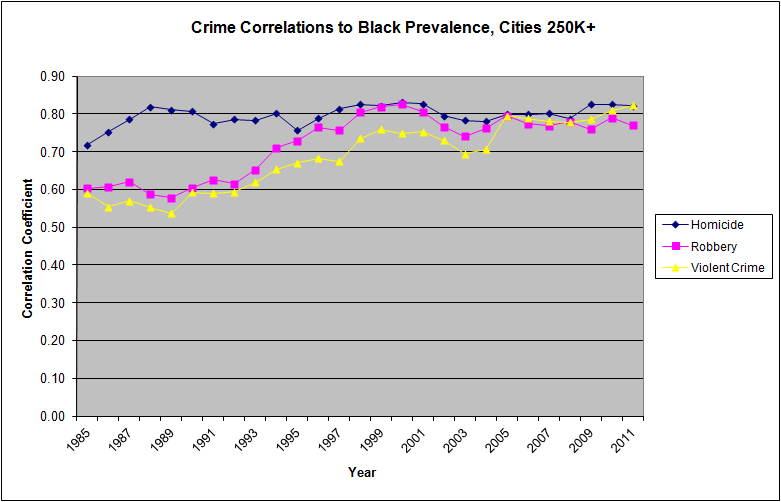
Since the mid-1990s, the issue of street crime has mostly dropped off the front pages of our national newspapers and disappeared from the public debate. Meanwhile, black Americans have gained much greater visibility in the upper reaches of our national elites, while Barack Obama has been elected and reelected as our first black president. This might seem to indicate that traditional racial cleavages in our society have become less substantial. Furthermore, with such enormous numbers of young black men now in prison, we might naturally expect that the racial character of American urban crime rates has sharply declined over the last couple of decades. However, the quantitative evidence demonstrates the exact opposite situation, as may be seen by examining the combined twenty-five year trajectories of our various racial crime correlations, which have steadily grown more extreme. The images shown on our film screens or television sets may portray one America, but the actual data reveals a very different country.
- Race and Crime in America
- The Pattern of Urban Crime in America
- Ron Unz • The Unz Review • July 20, 2013 • 7,200 Words
Although I haven't undertaken the major effort of running the tens of thousands of new weighted cross-correlations necessary to update those charts, it is easy to see that the racial pattern of American urban crime rates has generally remained unchanged. Anyone who wishes can easily verify that result.
Wikipedia provides a very convenient listing of America's largest 200 cities and the 2024 crime rates for each of these. A single click allows that listing of cities to be ordered by any of those per capita crime categories, including homicide, robbery, and overall violent crime.
If we rank the cities by their homicide rates, we discover that the three safest cities in America are Orange and Torrance in California and Joliet in Illinois. We can then click on the names of those cities, taking us to their individual Wikipedia pages, and consult the demographics section for each of these.
Once we do this, we notice that many of the cities in America with the lowest homicide rates have very substantial Hispanic populations, often in the 30-40% range, and sometimes even larger than their white fraction. This would be almost impossible if Hispanics had homicide rates far above the white average.
Meanwhile, the black percentages of most of these low-homicide cities are generally quite small, often just 2-3% or less and only rarely above 10%.
But if we then consider the cities with the highest homicide rates, we find that the most lethal ones in America are Birmingham, St. Louis, Memphis, Detroit, and Cleveland. In each case the black percentages are very high, often even reaching 60% or more.
Although there are certainly some exceptions, a somewhat similar pattern emerges if we sort cities by robbery or violent crime rates. For example, Memphis has the highest violent crime rate in America and a black population of over 60%.
Those who click through as many of the 200 cities as their patience allows will probably find that this sort of racial pattern continues all the way up or down.
Racial Demographics and White Voting Results
Over the decades, I have observed that individuals involved in public life are exceptionally reluctant to take any notice of black misbehavior, no matter how extreme or egregious it might be, and this tendency seems especially strong among those who are considered right-of-center. I would be very surprised if someone such as Killmeyer were the rare exception.
This behavior appears the product of generations of heavy psychological conditioning that has classified any such sentiments as inexcusable anti-black "racism," something requiring total suppression. Indeed, only expressions of "antisemitism" have been more strongly proscribed, and by much the same media forces.
When any candid public discussion of an important topic is completely forbidden, it is very difficult to guess how widely certain facts may be quietly recognized. In my article I went on to explain that even among top social scientists, there seemed to be considerable variation.
Racial issues have traditionally been among the most highly charged in American public life, and the nexus of crime and race has been exceptionally contentious for many decades. Under these circumstances respectable scholars tend to be cautious in discussing or merely investigating this topic, and the mainstream media is usually even more gun-shy. The striking racial findings presented above require only trivial statistical calculations and may be glimpsed in any casual inspection of the crime rankings of our major cities. But I remain uncertain to what extent they are already recognized by our experts in social policy.
For example, when I presented my correlation results to one very prominent conservative social scientist, he found them shocking and remarkable, and said he had never imagined that the statistical relationship between race and crime was so extremely strong. But when I showed the same data to an equally prominent liberal academic, he took the information in stride and said he assumed that almost all experts were already quietly aware of the general facts. The reactions of other knowledgeable individuals fell all along this spectrum ranging from surprise to familiarity. Knowledge so explosive that it is usually unspoken and unreported may easily remain unknown even to many of our foremost intellectuals.
But although public figures were extremely reluctant to acknowledge these realities, there seemed considerable evidence that they had a large impact upon actual white political behavior.
As I pointed out in a 2011 article, there has been a striking statewide pattern to white voting behavior over the last couple of decades. Many conservative activists and media pundits have spent years attacking immigrants, illegal or otherwise, and have regularly denounced the cultural threat posed by the growing population of non-English-speakers or non-white foreigners. Nevertheless, the empirical fact is that presence or absence of large numbers of Hispanics or Asians in a given state seems to have virtually no impact upon white voting patterns. Meanwhile, there exists a strong relationship between the size of a state's black population and the likelihood that local whites will favor the Republicans. The weighted-average correlations between the racial compositions of the fifty states and the degree to which their white voters favor Republican presidential candidates is summarized in the following chart.
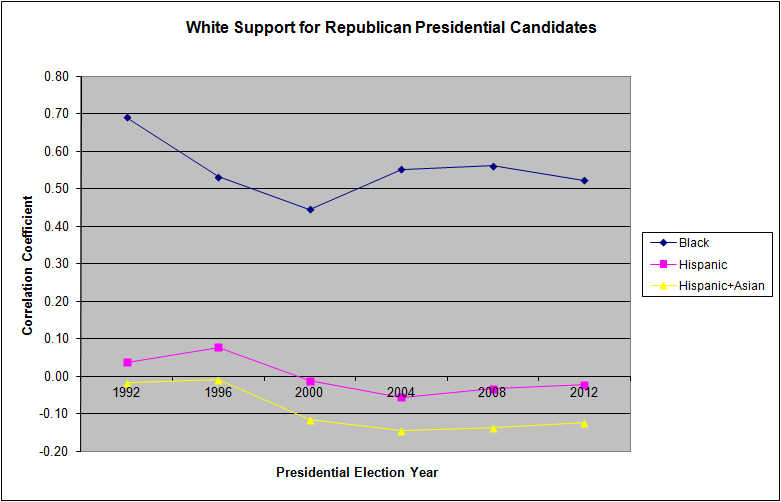
GOP leaders are always fearful of being denounced as "racist" by the major media, and often seek to camouflage the underlying source of their electoral support by adopting the most extreme forms of tokenism, promoting black party leaders and spokesmen while heavily recruiting black candidates and focusing almost entirely upon non-racial issues. Conservative activists often rhetorically identify themselves as heirs to the "party of Lincoln" and may even accuse their Democratic opponents of seeking to keep blacks in Welfare State bondage. But the actual data tells a very different story about the likely sources of Republican support.
The strength of this pattern may be seen at its extremes. Mississippi is the state with the highest black percentage and across all six elections its white population was the most likely to vote Republican, with the figures recently running at nearly the 90% level. Louisiana, Georgia, and South Carolina are generally clustered together as the next blackest in population, and in most elections their white populations were the next most likely to support the Republican ticket, although being sometimes exceeded by the whites of Alabama, the fifth or sixth blackest state during those decades.
By contrast, consider the three states with the largest non-white percentages: Hawaii, California, and New Mexico. The whites of the first two have actually been far less likely to vote Republican than whites nationwide, while those in New Mexico fall close to the national average. This tends to confirm the national statistical results that the widespread presence of non-whites, even in overwhelming numbers, seems to have little impact upon white voting behavior.
While I would not argue that black crime is the sole determining factor behind the racial polarization in white voting behavior, I do suspect it is one of the largest contributors. Empirically, the presence of blacks causes whites to vote the "law-and-order" Republican ticket, while the presence of Hispanics or Asians seems to have negligible political impact.
- Race and Crime in America
- The Racial Subtext of American Electoral Politics
- Ron Unz • The Unz Review • July 20, 2013 • 7,200 Words
Unfortunately, declining profits at major news organizations have led them to discontinue such demographic exit polling for all but the battleground states, preventing this sort of statistical analysis from being extended into the most recent presidential elections. But there are very strong indications that the pattern fully continued into the Trump era.
Among large states, heavily immigrant California has the smallest white European minority, barely even one-third of the total population in recent years. But although Trump made immigration concerns and suggestions of white marginalization central themes in all three of his presidential races, that issue fell absolutely flat in California, with white voters supporting him at a rate 20-25 points lower than whites in the rest of the country. Indeed, if the entire white national electorate had voted like its Golden State counterpart, Trump would have lost all fifty states in 2016, mostly by huge landslides, suffering by far the greatest electoral disaster in American history. All the Trump-hating pundits would have spent Election Night laughing and saying "I told you so!"
The Hidden Factor Driving Heavy Immigration
Perhaps most surprisingly, I argued in my article that the enormous, unspoken concern over black crime rates was probably a major hidden contributing factor explaining why our national political leadership was so uniformly supportive of very high rates of foreign immigration:
America's ruling financial, media, and political elites are largely concentrated in three major urban centers—New York City, Los Angeles, and Washington, D.C.—and all three have contained large black populations, including a violent underclass. During the early 1990s, many observers believed that New York City was headed for urban collapse due to its enormously high crime rates, Los Angeles experienced the massive and deadly Rodney King Riots, and Washington often vied for the title of American homicide capital. In each city, the violence and crime were overwhelmingly committed by black males, and although white elites were rarely the victims, their fears were quite palpable.
One obvious reaction to these concerns was strong political support for a massive national crackdown on crime, and the prison incarceration of black men increased by almost 500% during the two decades after 1980. But even after such enormous rates of imprisonment, official FBI statistics indicate that blacks today are still over 600% as likely to commit homicide as non-blacks and their robbery rate is over 700% larger; these disparities seem just as high with respect to Hispanic or Asian immigrants as they are for whites. Thus, replacing a city's blacks with immigrants would tend to lower local crime rates by as much as 90%, and during the 1990s American elites may have become increasingly aware of this important fact, together with the obvious implications for their quality of urban life and housing values.
According to Census data, between 1990 and 2010 the number of Hispanics and Asians increased by one-third in Los Angeles, by nearly 50% in New York City, and by over 70% in Washington, D.C. The inevitable result was to squeeze out much of the local black population, which declined, often substantially, in each location. And all three cities experienced enormous drops in local crime, with homicide rates falling by 73%, 79%, and 72% respectively, perhaps partly as a result of these underlying demographic changes. Meanwhile, the white population increasingly shifted toward the affluent, who were best able to afford the sharp rise in housing prices. It is an undeniable fact that American elites, conservative and liberal alike, are today almost universally in favor of very high levels of immigration, and their possible recognition of the direct demographic impact upon their own urban circumstances may be an important but unspoken factor in shaping their views.
As an anecdotal example, consider the case of Matthew Yglesias, a prominent young liberal blogger living in Washington, DC. A couple of years ago he recounted on his blogsite how he was suddenly attacked from behind and seriously beaten by two young men while walking home one evening from a dinner party. At first he was quite cagey about identifying his attackers, but he eventually admitted they were blacks, possibly engaged in the growing racial practice of urban "polar bear hunting" so widely publicized by the Drudge Report and other rightwing websites.
Few matters are more likely to trouble the minds of our Harvard-educated intellectual elite than fear of suffering random violent assaults while they walk the streets of their own city. Yet no respectable progressive would possibly focus on the racial character of such an attack, let alone advocate the removal of local blacks as a precautionary measure. Instead Yglesias suggested that housing-density issues might have been responsible and that better urban planning would reduce crime.
But consider that support for very high levels of foreign immigration is an impeccably liberal cause, and such policies inevitably displace and remove huge numbers of urban blacks; it is easy to imagine that Yglesias quietly redoubled his pro-immigration zeal in the wake of the incident. Multiply this personal example a thousand-fold, and perhaps an important strand of the tremendous pro-immigration ideological framework of American elites becomes apparent. The more conspiratorially minded racialists, bitterly hostile to immigration, sometimes speculate that there is a diabolical plot by our ruling power structure to "race-replace" America's traditional white population. Perhaps a hidden motive along these lines does indeed help explain some support for heavy immigration, but I suspect that the race being targeted for replacement is not the white one.
Such factors may also play a role outside the major urban centers discussed above and even where least suspected. Among all American businessmen, Silicon Valley executives are probably strongest in their pro-immigration advocacy, as indicated by the major political advertising campaign recently launched by top technology CEOs, organized together as "FWD.us." Obviously, their own cosmopolitan background and desire for an unlimited supply of inexpensive, high-quality engineers is their primary motive. However, widespread sentiments in favor of lesser-educated immigrant groups such as undocumented Latin Americans also seem quite strong, and we find Steve Jobs' wealthy widow Laurene Powell Jobs focusing her efforts almost exclusively on that particular aspect of the legislation, with her sentiments hardly being discordant with those of her wealthy peer group. Could hidden racial factors be part of the explanation ? That might seem quite unlikely since Silicon Valley's black population has been very low for decades, running in the 3 or 4 percent range.
However, a closer examination reveals a very different situation. The small city of Palo Alto is one of the most desirable local residential areas, home to the late Steve Jobs, as well as the current CEOs of Apple, Google, Facebook, Yahoo, and a host of other companies; by some estimates, it may contain the world's highest per capita concentration of billionaires. On three sides, Palo Alto abuts communities of a similar character: Mountain View, containing Google; the Stanford University campus; and Menlo Park, the center of America's venture capital industry. But on the fourth side, mostly separated by Highway 101, lies East Palo Alto, which for decades was a dangerous ghetto, overwhelmingly black.
I moved back to Palo Alto from New York City in 1992, and that year East Palo Alto recorded America's highest per capita murder rate; although relatively few of the homicides, robberies, and rapes spilled across the border, enough did to leave many people uneasy. Gated communities and even street fences are quite uncommon in the region, and for years anyone who wished could go to the home of Steve Jobs and walk around his yard or even peer into his windows. Meanwhile, the sort of harsh racial profiling widely practiced in some large cities was completely abhorrent to the socially liberal citizenry. One may easily imagine a scenario in which escalating street crime from the ghetto next door might have produced a collapse in high housing prices and sparked a massive flight of the wealthy.
One reason this did not occur was the vast influx of impoverished immigrants from south of the border that swept into the less affluent communities of the region during those same years and rapidly transformed the local demographics. Between 1980 and 2010 the combined Hispanic population of Santa Clara and San Mateo counties nearly tripled. A city offering cheap housing such as East Palo Alto saw far greater relative increases, reversing its demographics during that period from 60% black and 14% Hispanic to 16% black and 65% Hispanic. Over the last twenty years, the homicide rate in that small city dropped by 85%, with similar huge declines in other crime categories as well, thereby transforming a miserable ghetto into a pleasant working-class community, now featuring new office complexes, luxury hotels, and large regional shopping centers. Multi-billionaire Facebook CEO Mark Zuckerberg and his wife recently purchased a large $9 million home just a few hundred feet from the East Palo Alto border, a decision that would have been unthinkable during the early 1990s. Technology executives are highly quantitative individuals, skilled in pattern recognition, and I find it difficult to believe that they have all remained completely oblivious to these local racial factors.
However the powerful role of immigration in transforming the crime rates of important urban centers probably had a much smaller impact on the national totals. The combined black populations of New York City, Washington, and Los Angeles may have dropped by half a million over the last two decades, but the individuals pushed out did not disappear from the world; they merely moved to Atlanta or Baltimore or Riverside. But from the personal perspective of America's ruling elite, they did indeed disappear.
For over thirty years, local black activists in Washington, D.C. have accused the ruling white power structure of promoting "The Plan," a deliberate strategy of removing most of the black population from our national capital and replacing them with whites; and this "conspiracy theory" has been endlessly ridiculed as absurdly paranoid nonsense by our elite Washington media. Meanwhile, during this same thirty year period, Washington's black population dropped from over 70% to less than half and will probably fall below the white total within the next few years.
Indeed, the strong support of our political elites for Section 8 housing vouchers may be less connected with any alleged social benefits these provide than with their important role in moving large numbers of impoverished urban residents away from the near vicinity of wealthy neighborhoods out into the remote suburbs of the middle class. Several years ago the Atlantic published a major article by Hanna Rosin on the rapid changes in the geographical pattern of crime induced by these demographic shifts, and the piece provoked much discussion even though the author avoided unduly emphasizing the troubling racial aspects. Elite selfishness is hardly surprising and a policy of exporting those populations with a strong link to crime into other localities seems a natural strategy, especially if this can be accomplished under the altruistic guise of socially uplifting anti-poverty programs...
During the 1960s black author James Baldwin coined the widely quoted phrase "Urban renewal means Negro removal." I suspect that a somewhat similar semi-intentional national policy is today transforming America's leading urban centers, although it remains almost entirely unreported by our mainstream media.
On rare occasions, the mask slips and the underlying mental workings of our national elites are momentarily revealed. Consider New York City Mayor Michael Bloomberg, one of our most vocal pro-immigration voices on the national stage and a man whose vast wealth and influence often allow him to be far more candid on controversial topics than most other public figures. In May 2011 Bloomberg was interviewed on Meet the Press , and explained that if he had full authority, he could easily fix the seemingly insoluble problems of a city like Detroit at no cost to the taxpayer. He proposed opening wide the floodgates to unlimited foreign immigration on the condition that all the additional immigrants moved to Detroit and lived there for a decade or so, thereby transforming the city. I suspect this provides an important insight into how he and his friends discuss certain racial issues in private.
- Race and Crime in America
- The Hidden Motive for Heavy Immigration?
- Ron Unz • The Unz Review • July 20, 2013 • 7,200 Words
Although I have emphasized that American conservatives are extremely reluctant to ever criticize blacks, in recent years there has been one glaring exception to this rule. Perhaps because they are Muslim immigrants, Somalis have regularly been vilified, with these attacks surely magnified by the fact that Rep. Ilhan Omar, the sole Somali-American member of Congress, has been sharply critical of Israel. Indeed, although Rep. Omar arrived in America at the age of 12 and as a teenager became a citizen more than a quarter-century ago, President Trump has recently declared that she should be stripped of her citizenship and deported back to Somalia.
The couple of hundred thousand Somali-Americans constitute only about 0.5% of American blacks and far less than one in a thousand of our national population. So the amount of attention and hostility that they have attracted from conservatives is really quite astonishing.
Their population is heavily concentrated in the Minneapolis area, and this surely explained why the first major ICE drive targeted that city, constituting the largest immigration enforcement operation in American history. The ignorant masterminds of that project, perhaps including Jason Killmeyer, were obviously unaware that virtually all Somalis are here legally and 85-90% of them are actually American citizens.
So with almost all the Somalis exempt from the ICE enforcement effort, the nearly 4,000 agents deployed to Minneapolis instead targeted everyone else. The overwhelmingly liberal white residents of the city reacted quite negatively to what they reasonably regarded as a massive federal invasion, and a couple of them were soon shot dead as a consequence.
Those very controversial killings led ICE to terminate its efforts and withdraw. But early in the operation, Neocon publications such as City Journal published articles highlighting what they claimed were the very high crime rates of the local Somali population, with some of their earlier pieces having made similar points.
When I examined those articles, their statistics seemed correct, and the Somalis living around Minneapolis did indeed seem to have around three times the crime rates of most white Americans. But some two-thirds of the local black population consisted of American blacks, and scrutinizing those same statistics revealed those other blacks probably had 35-40 times the violent crime rates of the local whites, a conclusion carefully omitted by the disingenuous Neocon journalists.
So while I agreed that it was not unreasonable to characterize Somali immigrants as "a high crime population," I added a jocular comment noting the actual implications of those articles denouncing that immigrant population of the region:
Those statistics would explain why I'd suggested that if ICE rounded up all the American blacks living in Minneapolis, deported them to distant Somalia, and replaced them by an equal number of Somali immigrants, crime in Minneapolis would probably drop by 85-90%.
A Local Sample Size of One
In the thirteen years since I published my long article analyzing racial crime statistics, the drastic decline in the homicide and other crime rates that I had described in neighboring East Palo Alto has fully continued and recently reached rather remarkable levels. The situation even caught the attention of the San Jose Mercury News, which published an article at the beginning of this year.
East Palo Alto finished 2025 without a single homicide, marking the second murder-free year in three years and reinforcing signs of a lasting departure from the violence that once defined the city.
After a historic year logging zero murders for the first time in 2023, one in 2024 and none again in 2025, local police officials said the trend affirms that the city's efforts to reduce violence are working. In a New Year's Day social media post, the East Palo Alto Police Department called the milestone a "powerful achievement" and a "testament to what is possible when a community stands together."
"This achievement belongs to our residents, families, community organizations and first responders who are committed to keeping East Palo Alto a place where life is valued and protected," the department wrote...
The city's earlier reputation as the nation's "murder capital" stemmed not from the total number of killings, but from the rate relative to its small population — about 25,000 at the time — which made 42 homicides in 1992 the highest per-capita murder rate in the country.
So the number of EPA homicides dropped from 42 in 1992 to just one every third year, a decline of better than 99%. This was certainly a striking achievement, obviously beneficial to the other cities that border it, including my own Palo Alto.
Naturally none of the public officials or journalists took any notice of the demographic changes that simultaneously occurred during these three decades, with the black population having now dropped below 10% while Hispanics are around 60%.
EPA is far too small a city for this process to be called any sort of "Great Replacement." But it was certainly a racial replacement of some sort, and one whose local consequences were not at all unwelcome in the neighboring communities of Silicon Valley.