Pepe Escobar
The ball is entirely on West Asia's court. The U.S. is not even on the table.
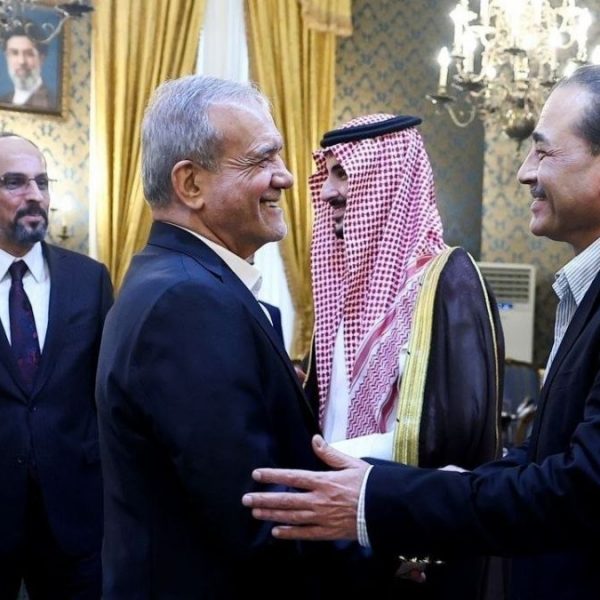
The optics were sensational.
The Saudi Minister of Defense, Prince Khalid, brother of MbS; the Turkey head of intel, Ibrahim Kalin; and the military head of Pakistan, Field Marshal Asim Munir, all three full members of the Mecca Defense Alliance, enter a lavish room in the proverbial Persian palace to greet - or kiss the ring - of the potentate, sorry, secretary of the Supreme National Security Council (SNSC), Moshen Rezaee, number two of the Iranian power structure right below Leader Mojtaba Khamenei.
This was not the Mecca Defense Alliance ostensibly on parade - representing neo-Ottomans, Arabs and South Asians. This was the Tehran Summit - as defined by the Persians.
Iran had only agreed to hold this ground-breaking summit - actually suggested by Asim Munir during his visit to Tehran last week - outside of the framework of the Mecca deal, and explicitly within the framework of discussing "endogenous regional security."
So yes, they did discuss Palestine, Lebanon, Yemen, Gulf security and the Strait of Hormuz, in the spirit of reducing the proverbial "regional tensions" and ending the U.S. war against Iran and the Axis of Resistance.
The Tehran Summit may eventually signify the - reluctant or otherwise - acceptance of Iran's security demands and the final status of the Strait of Hormuz, being elaborated via the Iran-Oman agreement.
It all depends, of course, on what the House of Saud will finally decide. And this decision is directly linked to how Riyadh will solve its deadly clash against Yemen.
Tehran was explicit: we are prepared to mediate and assist in resolving the Yemen dossier; however, it's up to Riyadh to address - and accept - Ansarallah's conditions. Otherwise, the - pre-existing - war will keep going on.
Deconstructing the "seven conditions"
It was Dr. Ali Bagheri Kani, the immensely competent Deputy Secretary of the SNSC, who offered the best inside view of what was being discussed at the table.
1.The four nations identified Israel as the main source of regional instability, with Iran as its immediate target and other countries potentially next (italics mine). The other source is the United States. Imagine Prince Khalid agreeing to all of the above.
- An agreement on lasting security in West Asia must be built from within, without dependence on foreign powers.
- Tehran positioned itself as the central link (italics mine) connecting Saudi Arabia, Turkey and Pakistan. Feel free to be gobsmacked.
- All four nations agreed to continue talking. Iran will coordinate the next meeting. No date or location yet.
Now add to this already stunning framework a Mohsen Rezaee Unplugged special: he was definitely in a much more cheerful mood than usual.
Take this highlight:
"I feel the presence of a new atmosphere in the region. It has formed thanks to the resistance of the Iranian people and the capability of the armed forces. I have sensed an extremely positive atmosphere in the discussions with these gentlemen."
Even as he praised "the success of this rhetorical discussion and statements", Rezaee was cautious: "We preferred not to issue any statement at the present time, but we will issue a single joint statement in which we agree on these points and reach an understanding, and the implementation of these matters will be practical and real, and we will move forward with them."
Meanwhile, a Sisyphean task remains: how to force the Empire of Piracy to understand diplomacy in West Asia.
Bagheri-Kani: "The United States must fulfill Iran's seven conditions." He then added, "Rezaee mentioned today that the seven-day plan could be shortened to five days or even four."
Let's deconstruct these numbers.
The seven conditions remain the same: they are the abridged version of that serially dead cat, the Memorandum of Understanding (MoU), which Trump himself tore up and insists it means nothing.
Recap: lifting sanctions; ceasing military threats; recognizing Iran's right to the peaceful use of nuclear energy; ending support for Israel; acknowledging Iran's sovereign rights over the Strait of Hormuz; halting interference in Iran's internal affairs; and providing credible guarantees against future aggression.
Even camels in the middle of the Nejd know the Exceptionals will never fulfill any of these commitments.
What changes now is the timeline. According to the original plan, in the unlikely event the U.S. would fulfill the conditions, on the sixth day the Strait of Hormuz would be opened; and on the seventh day, like in an act of divine will, negotiations would begin.
Rezaee's new proposal can only be interpreted as a joyful tease: everything can be done in five days or even four days, why not?
Rezaee is essentially saying that all the seven conditions remain; but if Trump is really interested in negotiations (he's not: he wants a capitulation), Iran doesn't need to wait for seven days. Four will do.
Whatever happens next - and after the U.S. mid-terms might well be a Trumpian military attack - it's Tehran that still runs the clock. Plus the seven conditions - which are the prerequisites for any negotiation. Plus the timeframe. Plus the fact that if there's no movement, the Strait of Hormuz will remain closed.
What Bagheri-Kani and Rezaee - the top two security guys - are emphasizing is that Iran has presented an invoice to the Empire of Piracy. By the way, every single item on the invoice has already been signed off on by POTUS himself, however he tries to extricate himself.
It's "endogenous" security or bust
At first sight the Mecca Defense Alliance was supposed to be seen as a powerful Sunni-led collective security/defense alignment.
Yet the last thing the strategically deprived Empire of Piracy would expect is that the trio would start exploring avenues of cooperation with the nation they were being forced to treat as an existential threat.
Never underestimate the Persians. Displaying their usual finesse, what they have just done is to strategically turn containment of Iran on its head.
In the near future Iran might even contemplate joining the Mecca Defense Alliance - which quite a few serious Muslim scholars actually describe as a blasphemy on Mecca.
Before that, the petro-sheikhs - those Persian Gulf counterparts of the Baltic chihuahuas - may have met their doom, in case they are helpless to defuse the relentless Anglo-Salafi incitement of sectarian wars.
Iranians are as much worshippers of sacred Mecca and Medina as Yemenis - as both were directly praised by the Prophet (Iranians were singled out as unparalleled in the discernment of knowledge and the pursuit of wisdom).
And that ultimately explains why this meeting was defined as the Tehran Summit - with nothing to do with the notion of a "Mecca" pact.
As for Yemenis, Mohammad Ali al-Houthi, a key member of Ansarallah's Supreme Political Council, laid down the law: he blasted Saudi Arabia's claims of seeking regional de-escalation through Prince Khalid's visit to Tehran, emphasizing that Riyadh's diplomatic rhetoric contradicts the continued war, blockade, and occupation of Yemen.
After the Tehran Summit, Leader Mojtaba Khamenei met Mohsen Rezaee in person. Number One talking to Number Two.
Khamenei explicitly called for ending the current state of "neither war nor peace" by ensuring that the seven conditions are met, and by "maintaining control over the Strait of Hormuz."
Rezaee actually briefed Khamenei on the idea of "endogenous" security across West Asia. Talk about a direct counterpart to the Russian drive for "indivisibility of security" in late 2021, which was then met by a non-response response by the U.S. and NATO.
Yet now, the ball is entirely on West Asia's court. The U.S. is not even on the table. It's up to Turkey, Saudi, Pakistan and Iran to make it happen.