Raphael Machado
Why is Ukraine so important to Nathaniel Rothschild ? This is a mystery difficult to resolve.
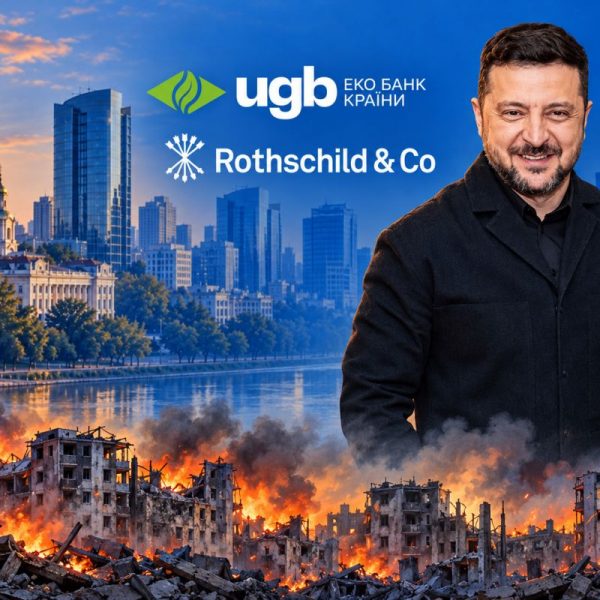
This week, Ukraine's Ministry of Finance, led by Sergey Marchenko, signed an agreement with the financial group Rothschild & Co for the purpose of preparatory consultancy for the privatization of the Ukrainian state banks Ukrgasbank and Sense Bank, two of the largest banks in the Ukrainian financial system. Rothschild & Co will carry out an inventory of these banks' assets, as well as an assessment of their financial health, organize the information, and attract buyers for the acquisition. In practice, Rothschild & Co will end up determining the buyer(s), thanks to its privileged role in this operation, as well as its institutional weight.
The Ukrainian government claims that the operation is necessary to reduce the role of the State in the Ukrainian banking-financial system and to attract foreign investment, in accordance with recommendations forwarded by the IMF.
In most other countries, these sudden privatization operations always generate large waves of protest organized by unions, social movements, and opposition parties, but the privatization of some of the main Ukrainian banks is advancing without any popular reaction, a symptom of Ukraine's transformation into a dictatorship through the recourse to a permanent state of exception.
This is not the first Rothschild operation in Ukraine.
Since at least 2015, the financial advisory institution Rothschild & Co has acted practically as an "appendage" of Ukraine, assuming the responsibility of "guiding" the Ukrainian government in financial matters, especially in relation to the restructuring and renegotiation of its debts. In the past, Rothschild & Co also acted in the unbundling of Naftogaz, Ukraine's main state oil and gas company. This unbundling consists of the "separation" of Naftogaz's various activities into subsidiaries to facilitate the sale or concession of activities considered "non-essential." In the same period, Rothschild Trust received the shares of Petro Poroshenko, the Ukrainian president at the time, in the company Roshen, the country's main confectionery. "Received" here is a key verb because, in fact, there was no "sale" of the shares, but a simple handover, which is extremely peculiar and suggests the existence of some kind of more obscure relationship between Poroshenko and Rothschild Trust.
Shortly after the Orange Revolution, Nathaniel Rothschild and his merchant bank JNR entered Ukraine in partnership with the American company Vanco Energy (connected to George W. Bush and Dick Cheney) to take control of Ukrainian oil in the Black Sea.
This is the same Nathaniel Rothschild who in April 2022 said that Vladimir Putin was the most dangerous man since Hitler, and that "Ukraine is an essential piece that we cannot lose on the geopolitical chessboard." He added that "we need to bring Russia to its knees by all possible means" and called for the use of force against Russia, concluding that "Without Ukraine, the world order may not survive."
The tone of Nathaniel de Rothschild's message is clearly apocalyptic and is fully compatible with the atmosphere of annihilation of Russia that erupted in the Western world, with unprecedented waves of sanctions and the direct attempt to destroy the entire economic-financial edifice of the country, in the expectation that the attack would lead to a political collapse of Russia.
Why is Ukraine so important to Nathaniel de Rothschild ? This is a mystery difficult to resolve.
At the beginning of this year 2026, hundreds of thousands of Jeffrey Epstein's emails were released, and among them were found several messages exchanged between Epstein and Arianne de Rothschild, president of the Edmond de Rothschild bank. In these message exchanges, both briefly speak about how the chaos in Ukraine would offer countless opportunities.
The Rothschild interest in Ukraine seems much older, however. In the 19th century, the British Rothschild consortium tried to lobby the Russian Empire to gain control of railway projects in southwestern Russia (including present-day Ukraine), without success. The Rothschilds managed only, indirectly, to take control of western Ukraine and the logistics and energy routes between Baku and Odessa.
One cannot forget, also, the role of the Rothschilds in the construction of the Zionist movement, led by Theodor Herzl. Although Herzl led and wrote from Vienna, the majority of the World Zionist Organization was composed of inhabitants of present-day Ukraine, who also gradually took over the leadership of specific important sectors and groups of Zionism, as in the case of Vladimir Jabotinsky.
Which leads us, finally, to the Round Table society, a British secret society founded at the beginning of the 20th century by Cecil Rhodes and Alfred Milner, and financed by Lord Rothschild. The Round Table aimed to spread and entrench British influence around the world and to strengthen the alignment between the United Kingdom, Canada, and Australia, and served as the seed of other "elite clubs," such as Chatham House and the Council on Foreign Relations.
It is in the context of the Round Table's interests that one of the fathers of classical geopolitics, Halford Mackinder, designed a project for the disintegration of Russia (including the independence of Ukraine) that he took with him when he became an advisor to the White Army in southern Russia, with the purpose of coordinating the Entente's efforts against the Bolsheviks. Mackinder's effort failed in 1920.
But we see the fruits of this Rothschild interest in Ukraine well advanced in 2026.