November 3, 2026
For most of the last week I'd been preparing an article on the financial insanity of the AI industry and the unrealistic market values that demonstrated this. The timing seemed appropriate given that Anthropic was preparing to go public later this month with the largest IPO in world history, seeking to value that five-year-old, massively money-losing start-up at $2 trillion.
My deep AI financial skepticism seemed further validated towards the end of the week. On Thursday, the earnings reported by Google-parent Alphabet were less than expected, partly due to the huge drag of the company's AI capital spending. Investors punished the Tech giant by shaving a half-trillion dollars off its market value, leading to major headlines in the Friday Wall Street Journal.

This AI-related weakness led to further market jitters later that same day as Tech stocks suffered an additional rout. The value of the Tech-heavy NASDAQ dropped by another couple of trillion dollars, generating a banner headline on the front-page of the Journal's weekend edition.

As they sometimes say, a trillion here and a trillion there, and pretty soon you're talking serious money. So my planned article on how delusional investors had been bidding up AI stock prices to insane heights seemed pleasingly prescient, and more timely than ever.
However, there are insanities and there are insanities, and the seeming insanity of AI financials was suddenly swept aside by a different and far greater one.
It's a serious problem if herds of delusional investors have boosted AI companies to absurd valuations. But it's a far greater problem if a delusional American president has apparently decided to launch yet another round of attacks against Iran based upon a military plan that those who have seen it describe as "insane."
That latter adjective was provided in a public forum by Sen. Chris Murphy, who had been one of the Congressmen briefed on the details.
U.S. Senator Chris Murphy: "... Some of us have been briefed on the war plan. And while I cannot disclose any details, I can say this: the plan is insane..." t.co
- Javier Blas (@JavierBlas) October 29, 2026
Furthermore his grim appraisal seemed supported by the sudden firing of one of our top Pentagon generals, the three-star commander responsible for overall military planning.
That same word "insane" was widely used by a number of the podcasters whom I follow, with their reporting based upon some of the circulating military leaks.
Last year retired Lt. Col. Daniel Davis had been nominated for a senior intelligence position in the Trump Administration before being vetoed by the Israel Lobby, and he was greatly alarmed by what he had heard.

Prominent Attorney Robert Barnes worked for Trump and had been a strong political supporter, someone still retaining excellent sources within the Trump Administration.

Brandon Weichert was a well-connected and highly regarded MAGA military analyst who had supported Trump for nearly a decade. On Friday he discussed the situation with former CIA Analyst Larry Johnson.

That same day, Johnson was also interviewed along with Col. Larry Wilkerson. As the longtime chief of staff to former Secretary of State Colin Powell, Wilkerson had spent decades operating in the topmost circles of our national security establishment.

According to those experts, Trump had finalized his plans for another attack against Iran, then discussed these at a crucial Thursday meeting with his top military advisors, a meeting that was widely reported in our media.
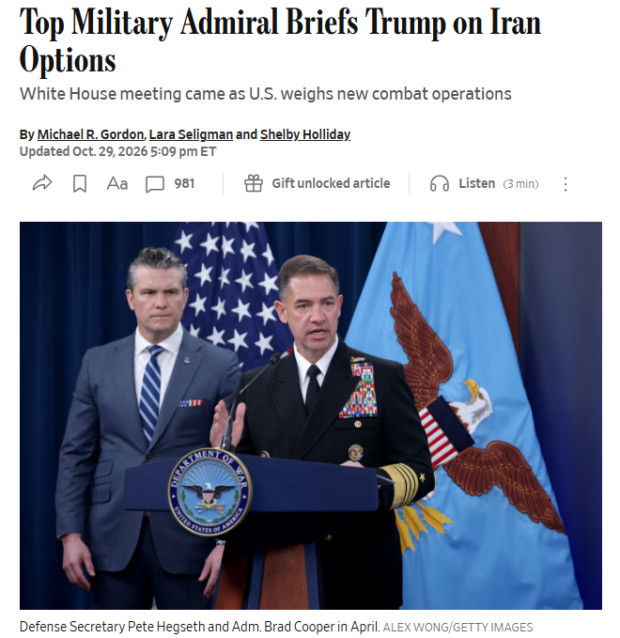
The top U.S. commander in the Middle East briefed President Trump on Thursday on military options for Iran, a rare in-person visit to the White House as the U.S. weighs resuming major combat operations, according to U.S. officials and other people with direct knowledge of the meeting.
Joining Adm. Brad Cooper was Defense Secretary Pete Hegseth and Joint Chiefs Chairman Gen. Dan Caine. The meeting included other cabinet members and covered other topics including the continuing U.S. blockade, some of the people said.
The top-level gathering followed a Wednesday session at the White House in which the military officers met with Vice President JD Vance, one of the people said...
Cooper rarely briefs Trump in person, so the meeting could signal that the U.S. is moving closer to significant military operations. He met with the president in July, when the two huddled with Hegseth and Caine on Air Force One in Delaware. A Pentagon spokesperson and a spokesperson for U.S. Central Command, which Cooper heads, declined to comment.
The White House discussions come as some lawmakers have expressed alarm that Trump could soon renew hostilities with Tehran. Sen. Chris Murphy, a Connecticut Democrat who said he has previously been briefed on some of the classified planning, called the plans "insane."
A day or two earlier, the Journal had reported some details of these new combat plans:
DUBAI-The U.S. has told several Gulf Arab countries to be prepared for a short, intense military campaign after the U.S. midterm elections, people briefed on the conversations said.
The communications through diplomatic and military channels are among a growing number of indications that the U.S. and Israel are readying to launch a new round of heavy combat operations against Iran, risking a major escalation in hopes of degrading Tehran's strength and pushing it toward negotiations.
The U.S. military is sending an additional Patriot system to Israel from Texas to beef up its missile defenses in the country, according to flight-tracking data and two officials with knowledge of the movement. The U.S. has also moved troops off bases in the Middle East where they were vulnerable in preparation for an escalation, The Wall Street Journal has reported.
U.S. forces in the region have been restocking their munitions, and bomber aircraft and jet fighters are preparing for strikes, some of the officials said. An additional aircraft-carrier strike group and Marine expeditionary unit are also poised to join an armada of roughly 20 other warships operating in the Middle East next month, although some ships could rotate out.
Perhaps these knowledgeable experts were mistaken or perhaps our notoriously erratic and mercurial chief executive would change his mind. But as of now, it does sound like we are about to restart the war against Iran soon after the Tuesday midterms, possibly as early as Wednesday. Many of the details of Trump's alleged plans seemed quite alarming.
The first round of the war had lasted forty days, and during that time we had burned through a large fraction of our global stockpiles of stand-off munitions and interceptor missiles, weapons that would take many years to replace. During the much shorter second round, we had further depleted these supplies.
More than 20,000 airstrikes had hit virtually all accessible Iranian military targets. So in the "short, intense campaign" being planned this time, we would apparently attack Iran's vital civilian and energy infrastructure. The Iranians had repeatedly warned that if we did so, they would retaliate in far greater measure against the similar facilities of our Gulf Arab allies, whose bases and airspace we have been using in those attacks.
More than 40% of all global oil exports come from the Persian Gulf countries. If the fragile local infrastructure were severely damaged or destroyed, much of that fuel supply would be lost with catastrophic consequences for the world economy, consequences that would persist for years.
The Trump Administration claimed that Iran's nuclear development program was located deep beneath Pickaxe Mountain, and military analysts agreed that the hundred meters or more of granite protecting those facilities could not possibly be penetrated by even our most powerful conventional explosives. Therefore, there were widespread reports that Trump wanted to strike that site with tactical nuclear weapons, and perhaps for that reason Under Secretary of Defense Elbridge Colby had recently been revising our official nuclear use doctrine to help legitimate such operations.
Rumors were also circulating that our new round of attacks on Iran would involve further decapitation strikes aimed at assassinating the top Iranian leaders just as we had successfully done in our original surprise attack at the end of February.
According to seemingly credible sources, Trump's decision to restart the war was best explained by the propaganda-bubble of unreality in which he regularly resided. Contrary to all evidence, he had now somehow convinced himself that he had been overwhelmingly victorious in his previous rounds of combat against Iran.
Under that severely distorted perspective, maintained and promoted by the Israeli officials, pro-Israel advisors, and Israel Lobby donors who surrounded him, the Iranian regime was now very close to crumbling, and his mistake had been to discontinue his combat operations when he did. So he believed that one more sharp military shock might be enough to overthrow the Iranian government and have it replaced by a new leadership team friendly towards Israel and completely subordinate to the United States.
These had been Trump's beliefs during the early weeks of the war, and he had gradually returned to them over the course of the last few months.
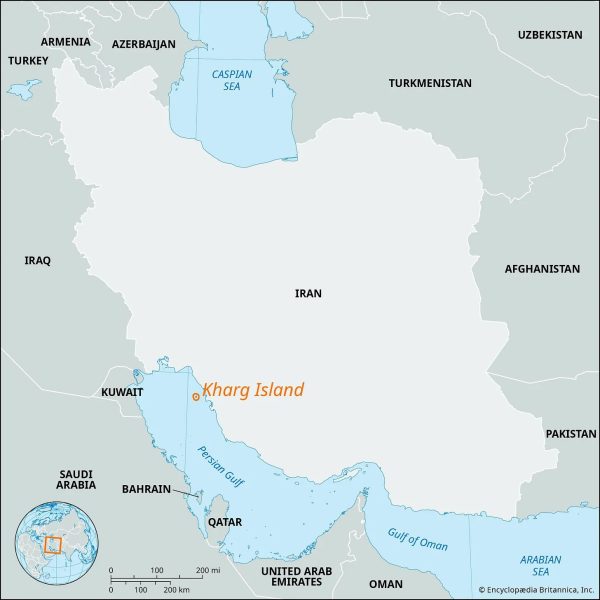
Such military plans certainly sounded disastrous and perhaps even crazy. But the word "insane" suggested something well beyond that. The military analysts believed that Trump had decided to employ American ground troops in his new attack, using Marines and airborne forces to seize Kharg or one of the other Iranian islands located in the Persian Gulf.
During the first few weeks of the war, Trump had repeatedly pressed for such a ground invasion of Iranian territory, a proposal as bold as it seemed preposterous.
Seven or eight months later, little has changed except that we have now expended a major portion of our advanced munitions. Meanwhile, Iranian missiles and drones have severely damaged most of our regional bases, forcing us to redeploy our combat aircraft to distant locations, thereby greatly diminishing their effectiveness in supporting any such ground attack.
Beginning with an article published near the end of March, I had repeatedly described some of the extreme difficulties that we would face in seizing any of those islands, and I think it's worth revisiting my analysis.
Soon after Trump recognized that it would be impossible for his warships to break the Iranian blockade, he ordered a Marine expeditionary unit deployed to the Gulf, quickly followed by a second one. Taken together, these numbered less than 5,000 Marines, of which perhaps half were actual fighting troops.
Another 2,000 paratroopers of the 82nd Airborne Division were also sent there, and an article in The Intercept noted that "dozens of transport aircraft used to ferry troops and cargo have been flying out of airfields used by America's most elite commandos, including the Army's Delta Force and the Navy's SEAL Team 6," suggesting that those units may have also been deployed to the theater. A couple of days ago the Wall Street Journal reported that the Pentagon might be sending an additional 10,000 troops to join them, which would bring the total commitment of American ground forces to around 17,000.
According to many media reports, Trump might use these troops to seize Kharg Island, the site the Iranians used for loading 90% of their oil shipments, and enterprising journalists discovered that Trump had been suggesting an attack on Kharg as far back as the 1980s. But according to different reports, various other small islands in the Persian Gulf were more likely to be the targets.
There was absolutely no sign that deployment of these rather small ground forces concerned the Iranians. Instead just a few days after the beginning of the war, the Iranian foreign minister had stunned his NBC interviewer by explaining that his country's troops were eager to finally face their American foes in direct ground combat.
🇮🇷🇺🇸 - JUST IN: Iran's Foreign Minister Abbas Araghchi tells NBC that they are waiting for for US forces to begin a ground operation - "we are waiting for them."
- NBC: "Are you afraid of a U.S. invasion in your country?"
- Araghchi: "No, we are waiting for them."
- NBC: "You…A well-regarded MAGA military analyst named Brandon Weichert considered this sort of ground operation as something close to suicide:
We had recently published an article analyzing this assault scenario, and I would especially recommend a long podcast discussion by military experts Lt. Col. Daniel Davis and Cmdr. Steve Jermy of the Royal Navy. These latter two individuals had been among the first analysts to raise doubts about whether the war with Iran was going well, thereby considerably enhancing their credibility.
The most obvious point is that although Marines together with their amphibious landing craft had been sent to the region, attacking any of those islands by sea was totally impossible. They were located well past the Strait of Hormuz, and we had already recognized that any heavily armed warships sent there would almost certainly be sunk by Iranian missiles and torpedoes. So landing craft packed with troops would surely suffer the same fate, with all the thousands of Marines they carried either drowning or being captured and held as POWs. Therefore, any attack would have to be by air, as was also suggested by deploying units of the 82nd Airborne.
However, that scenario also seemed quite difficult. Large-scale parachute drops over enemy-held territory had almost completely gone out of fashion after World War II. Although our units still probably trained in those tactics for tradition's sake, trying such an attack in real life for the first time in decades would be extremely perilous. So the initial airborne assault would presumably be undertaken with helicopters or tiltrotor Osprey transports until a large landing zone had been secured for the possible use of cargo transport aircraft.
But even this approach seemed fraught with risk. Counting the regular military and the IRGC, the Iranians had an army of nearly a million men, and faced with ground combat they had now mobilized another million of their reserves. All those islands presumably had small garrisons of Iranian troops, and weeks of media discussion of planned American assaults had surely led them to be further reinforced and prepared for combat. The Iranian defenders would be well-equipped with manpads and RPGs, so any incoming helicopters or other transports would be at serious risk of getting shot out of the sky.
These problems would certainly continue once any troops had landed. The American military units involved might be elite forces but none of them have had any experience facing the modern drone warfare that has evolved during the Ukraine war, while the Iranians had an enormous arsenal of such weapons and these could surely inflict heavy losses upon the American invaders. Our strategic radars in the region had been very well protected and they had been overwhelmed and destroyed by waves of Iranian drones, so light infantry would certainly be vulnerable. Hitting targets far outside Iran was obviously much more difficult than hitting those on Iranian soil.
One of our aircraft carriers has been driven from the theater and the other is operating at extreme range for fear of Iranian attacks. The same was true for our land-based aircraft, which required refueling by aerial tankers to reach the battlefield, limiting the time they could spend on close air support.
As experienced military professionals, Davis and Jermy especially focused upon logistical problems, and they emphasized that any troops we successfully landed on those islands would have a very difficult time getting resupplied with ammunition and food, or having their wounded evacuated. Any such flights would be at constant risk of being ambushed by the manpads of the hidden and dug-in Iranian defenders.
My impression is that many decades of our recent wars have accustomed American troops to acting as if they had access to infinite supplies, so they might quickly exhaust their limited ammunition. Meanwhile the local Iranians would presumably have very large available stocks of pre-positioned munitions and food.
Therefore it hardly seems impossible that after a week or more the American troops would be so worn down by the constant drone and missile attacks and so short of ammunition and food that they might be forced to surrender to the far smaller number of Iranian troops on that same island. If our soldiers were out of bullets and they couldn't easily be evacuated, what else could they do ? The obvious historical analogies of the Fall of Singapore and Dien Bien Phu came to my mind.

In one less than encouraging indicator, American military forces have begun practicing the digging of mass battlefield graves, something that has been unnecessary on a large scale for more than three generations.
Wars have always been filled with dishonest propaganda and wishful thinking, and producing such material has become far easier with the recent advent of powerful AI systems. Less than one week after the beginning of the current war, Twitter and other social media outlets were flooded with claims that a large unit of American special forces troops had been sent into Iran, defeated in battle, and then taken into captivity. Just one of those posts was retweeted thousands of times, attracting some 2.8 million views.
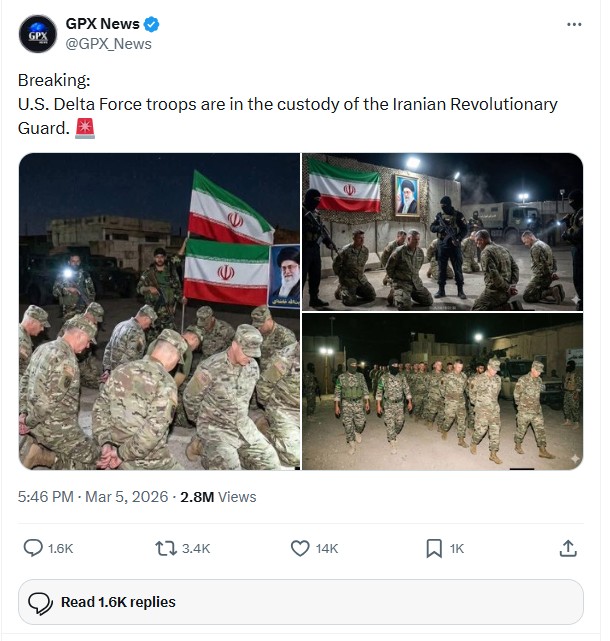
Various fact-checking sites quickly determined that the images used to authenticate those claims had been generated by the Gemini AI system, and the Tweet was soon deleted, resulting in great embarrassment for those who had gullibly swallowed such a ridiculous story. But, if America does land many thousands of its troops on Kharg or any of the other Iranian-held islands in the Persian Gulf, those same scenes might soon be repeated in real life.
After about a decade of our major combat operations in Vietnam, the North Vietnamese had accumulated hundreds of American POWs, most of them being pilots who had been individually captured when their planes were shot down. So if the Iranians captured similar or even larger numbers of Americans in just a couple of weeks of ground combat, we would suffer enormous national humiliation.
The title of my article drew upon the obvious historical parallels of the Fall of Singapore and the Battle of Dien Bien Phu, disastrous defeats that inflicted fatal national humiliations upon the British and French empires respectively.
- The Fall of Singapore, Dien Bien Phu... and the Battle for Kharg Island?
- Ron Unz • The Unz Review • March 30, 2026 • 5,900 Words
Top American commanders would surely be loath to personally preside over the greatest military humiliation in our 250 year national history, and some of them may have begun voicing their strong concerns.
The three-star general fired a few days ago had been in charge of overall military planning, and although he had allegedly been terminated for leaking, there was widespread speculation that his serious doubts about the plan for a ground attack against Iran had contributed to his fall.
Perhaps coincidentally, when talk of a ground assault against Iran had originally bubbled up earlier in the war, many other top-ranking generals had also been fired around that time. The week after outlining the problems in such a ground attack, my next article had focused on that issue:
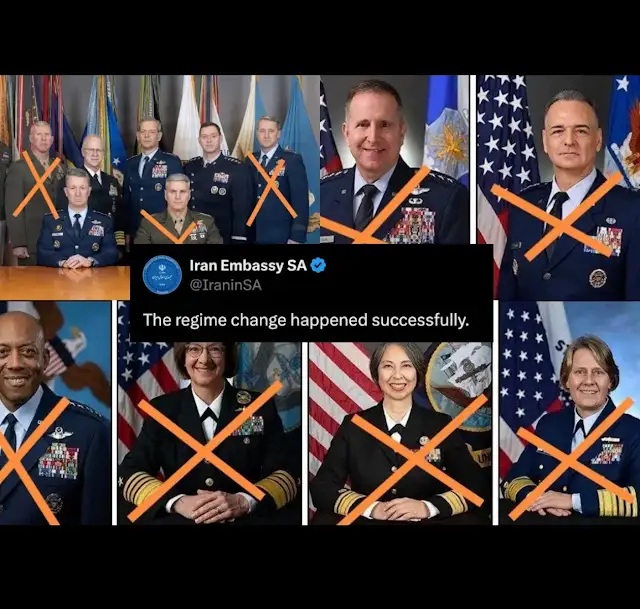
Over the last couple of weeks there have growing media reports that we were preparing to launch a ground invasion of Iranian territory even as more and more American troops were brought into the region. But at this very moment, the Trump Administration suddenly fired Randy George, America's top Army general, along with a couple of others also of very high rank. It seems implausible that these important developments were totally unconnected.
Conducting such a military purge in the early stages of a major war seemed unprecedented in our national history, so this was merely the latest example of how the government of Donald Trump has done things that no previous American president had ever considered doing.
On the Internet, Trump partisans quickly declared that those generals had been removed for ideological reasons unconnected with any disputes over the management of our Iran War. The Army commanders fired had allegedly been hangovers from the Biden Administration, overly "woke" in their views, and indeed media leaks supported this, indicating that disputes over the diversity policies in promotions had been a crucial factor. But numerous leading Congressional Republicans soon publicly praised George and expressed shock and dismay over his ouster, suggesting that if he had been too liberal, most right-wing Republicans loyal to Trump had apparently been unaware of that fact.
Furthermore, very soon after his second inauguration, Trump had replaced the chairman of the Joint Chiefs of Staff along with other members of that body, and the top leaders of the NSA had been fired a few weeks later. Trump had apparently made these personnel changes on ideological grounds, so if George had fallen into that same category, he surely would have also been swept out at that time.
Meanwhile, unconfirmed claims suggesting that very different factors were involved have attracted millions of views on Twitter:
Indeed, when questioned by members of Congress, Pete Hegseth seemed completely unable to provide an explanation of why he had fired all those top-ranking generals. This suggested that a major factor had been their huge concerns about the course of our war with Iran.
Indeed, the number of top-ranking generals purged by Trump seemed quite remarkable to me, and I couldn't recall anything like that having ever previously happened in American history.
The Gemini AI seemed to confirm that impression, claiming that over the last 100 years all our presidents combined had only removed a total of 10 such top-ranking military commanders, while Trump had fired around 25 of them since returning to the Oval Office in early 2025.
I noted that Hegseth's odd inability to explain why he had fired all those senior generals was merely one of the many failings of our current Pentagon chief.
Our current war is certainly the most serious conflict America has fought in decades. Iran is a nation of over 90 million, possessing a huge arsenal of ballistic missiles and powerful drones, so in many respects our foe seems larger, better armed, and more effective than any we have faced since the Korean War three generations ago. Only a sliver of the current American population personally remembers that conflict or the major military defeats that we had suffered at the time.
And as I emphasized late last year, the Trump subordinate who purged those top generals hardly has the sort of personal background that would inspire great confidence among any of our military commanders...
Similarly, some of the top officials that he has appointed to implement his national security policies appear to be completely unprecedented in their outrageous personal history and lack of qualifications, notably including his Secretary of Defense Pete Hegseth whose department Trump suddenly renamed the Department of War in a surprisingly candid executive order.
Although a military veteran of the Iraq War, Hegseth had never commanded anything larger than a rifle platoon, but he had apparently caught Trump's eye as a gung-ho commentator on FoxNews. However, when Trump nominated him, it quickly came out that he had a long and severe drinking problem while the non-profit veterans organizations he led had financially collapsed.
Worse still, while drunk at a Republican conference he had been very plausibly accused of raping one of the women there, who had both told her colleagues about the brutal attack and also reported it to the police at the time, with Hegseth desperately begging her not to press charges and later paying $50,000 for her silence. This nearly led to the defeat of his nomination in the Republican-controlled Senate, but massive pressure from Trump had allowed him to squeak through on a tie-vote broken by Vice President JD Vance, only the second time this had happened in American history.
Once in office, Hegseth violated all security protocols by sharing details about missile strikes with his friends and relatives, an incident that was widely but mistakenly expected to result in his immediate termination.

I'm not sure of the last time any major power has put its military under the control of a totally unqualified, incompetent, and heavily tattooed drunken rapist, and I suspect that even the overwhelming majority of Third World countries would balk at such a doubtful personnel decision...
In the most recent example of Hegseth's remarkable venality and incompetence, a few days ago the Financial Times reported that because of his advance knowledge of our attack on Iran, he sought to place a multimillion-dollar bet on a basket of defense stocks, but that the ones he selected actually lost rather than gained value...
Meanwhile, Hegseth seems so totally unqualified for his position and so much given to outrageous remarks and behavior that there are widespread suspicions that he has been kept in his job merely so that he can deflect attention away from Steve Feinberg, the controversial Jewish billionaire who serves as his deputy and may actually be running the department. Feinberg had co-founded Cerberus Capital Management, a buyout firm heavily involved in military contracting, and during his long business career he had been notoriously secretive, even going so far as boasting to his shareholders that he would "kill" any employee who got his picture in the newspapers. So an idiot such as Hegseth might serve as a very useful lightning rod.
Our official 2026 Pentagon budget was a trillion dollars and Hegseth recently demanded an additional $200 billion in supplemental funding to cover the unexpected costs of our Iran War. But even before attacking Iran, Trump had raised his proposed 2027 military spending to an astonishing $1.5 trillion dollars, a figure roughly as large as that of the rest of the world combined. These gargantuan sums will surely be extremely lucrative for Feinberg's former colleagues and those in a similar line of business.
- Is Donald Trump Facing a Military Mutiny Over His Losing War with Iran?
- Ron Unz • The Unz Review • April 6, 2026 • 6,500 Words
Being totally incompetent, Hegseth has apparently become one of the Trump advisors most willing to tell our president whatever he wants to hear, thereby serving as a crucial facilitator of the latter's most outrageous decisions. And with so many top generals having already been fired, strong resistance from the military high command seems doubtful.
But the analysts who were greatly concerned over Trump's new attack plans did express some hope that the results of the Tuesday midterms might help to pull our president back from the brink.
Trump had regained the White House in 2024 by emphatically promising that he would avoid any new Middle Eastern wars, so his sudden decision to initiate the largest of them all was reasonably seen by many of his erstwhile supporters as a bitter betrayal.
The severe defeats we have suffered made this even worse, as did the serious economic consequences from the elevated costs of fuel and energy. Our industrial and agricultural sectors run on diesel, and diesel prices have reached the highest level in history. Aside from a brief, temporary spike in the aftermath of the Russian invasion of Ukraine, the same has also been true for gasoline prices.
For this combination of reasons and others, there are some indications that the Republican Party may be about to suffer an epic political disaster in the midterms, losses ranking with their worst results in recent decades and possibly even far beyond that.
The Republicans had already been widely expected to lose the House and probably the Senate as well, but a front-page story in the Journal this weekend described the scale of the defeat they may now be facing.
Trump's disapproval rating of 59% was the highest of any president during midterm elections since the Journal first began polling on that question in 1990.
Subscribe to New Columns
Since July 2025, perceptions of which party can better handle the economy have shifted 15 points in favor of the Democrats, and partly as a result, registered voters now said they planned to vote for Democratic candidates by a 7 point margin, the sort of sweeping political tide that can easily carry away many Republican incumbents who had never considered themselves at any risk.
For example, the GOP candidate in one of their safest New York State seats had fallen behind his Democratic opponent in a district that Trump had carried by 21 points just two years ago.
Most of the Senate seats up this year were in solidly Republican states, so it had once been considered unlikely that the Democrats could gain control, but all of that had now changed in rather dramatic fashion.
Although the Republican incumbent in Mississippi was still slightly ahead in the polls, there was some chance that she would be defeated by her black Democratic challenger, something that even just a few months ago would have been considered a total absurdity. The last time that state had elected a Democrat had been in 1982, when the incumbent Dixiecrat segregationist had won his seventh term in office.
Republican senate candidates in other extremely Republican states such as South Carolina, Alaska, Iowa, Nebraska, Ohio, and Florida were also considered quite vulnerable although Trump had carried all of those states by double-digit margins just a couple of years ago.
For decades Texas has been the most solidly Republican large state, and no Democrat has won any statewide Texas race since 1994. But although near-trillionaire Elon Musk has now plowed nearly a half-billion dollars into the GOP coffers, with the largest share of his money going to Texas and blanketing the airwaves with advertisements, there was still some chance that the Democrats might sweep that state.
If Trump's Republican Party suffers a severe drubbing on Tuesday, some analysts hoped that those losses would pierce the ideological bubble surrounding our president and lead him to reconsider his planned attack on Iran. Most of the other members of the Trump Administration have future political plans of their own, and they might begin shifting their ground and the advice that they give Trump in desperate hopes of preserving their political viability.
The Senate controls all promotions in the senior ranks of the armed forces, and a newly Democratic Senate might put enormous pressure on top generals to shift their positions. The widespread purges of Hegseth have made him an enormous number of enemies in those ranks, and the military knives might soon come out for him and other members of the Trump Administration.
Although he was defeated in his primary, Rep. Thomas Massie plans to reintroduce his bill of impeachment against Hegseth when the House reconvenes in December, and if his fellow Republicans have suffered a bloodbath, he may have an easy time attracting co-sponsors.
But as of now, Trump seems totally oblivious to this political situation.
He has continued his series of personal political rallies across the country in hopes of stoking the enthusiasm of his supporters. However, many of his public statements have been outright delusional, with one clip showing him boasting of his unprecedented popularity and his absolute need to attack Iran.
But political pollsters have noticed that when he visits a state and endorses a candidate, support for that local Republican often sharply drops, leading many of them to ask him to stay away from their races.
When a FoxNews reporter conducted a live interview of someone at one of those rallies, the latter explained that since he had been too young to witness the Jonestown suicide-cult, he decided that attending a Trump political rally was the next best thing.
Although Trump had been massively outspent during his original 2016 race, he pulled off his upset victory partly because of the powerful memes and videos that widely circulated on social media and brutally attacked his Democratic opponent Hillary Clinton. But these days most of the outrageous memes and videos that have gained popularity have ridiculed and condemned Trump for his betrayals.
Even a couple of weeks ago, a foreign policy discussion between Brandon Weichert and a very sober-minded Matthew Hoh led the two of them to agree that Trump had gone "nuts" and was downright "insane." According to them, many observers recognized this reality but few were willing to say so in explicit terms.

Moreover, a couple of months ago Weichert had also reported another striking incident from the first Trump Administration that I'd never seen previously mentioned:
Rex Tillerson had spent a decade as the CEO of ExxonMobil when Trump appointed him Secretary of State in 2017. According to Weichert, just a couple of months into his first term, Trump had suggested to Tillerson that America should use its nuclear weapons in order to strengthen its international position, leading the oil industry executive to conclude that "Trump was f'ing insane." The result was a permanent decline in their relationship and Tillerson's eventual replacement by CIA Director Mike Pompeo in March 2018.

At the end of my March article, I'd already noted some of Trump's bizarre behavior and the striking claims of a prominent longtime journalist.
In another extremely strange episode, Trump interrupted a cabinet meeting on the war with Iran and numerous other crucial national matters by devoting five minutes to discussing the details of the fancy pens that he regularly gave out as souvenirs.
Veteran journalist Michael Wolff has long cultivated numerous sources close to Trump and based upon these he has published a series of major bestsellers, so he probably has acquired a better understanding of our current president than almost any other writer. Therefore, I was quite interested when I stumbled across a harshly candid interview he gave a couple of days ago.
According to Wolff, Trump insiders have described our current president as just being an idiot who barely ever reads or understands anything. Based upon Wolff's claims, Trump may actually be less intelligent than most of the voters who put him into office. I began to wonder whether he was so friendly with black rap-stars because their IQs might be in the same range.
In support of this striking possibility, the media has reported that Trump's understanding of the state of the war may mostly be based upon a daily highlight video reel he's been receiving, one that shows the explosions of our biggest, most successful strikes on Iranian targets. So instead of being totally delusional or dishonest, many of his strange statements may be because he's just so stupid that he believes whatever his various aides are telling and showing him.


The following week, I continued sketching out this argument.
...Wolff explained that the deep secret to understanding Trump was to recognize that he was a profoundly stupid man, so profoundly stupid that he never realized just how stupid he was. Since Trump never read nor understood almost anything, that explained the erratic, inconsistent, illogical nature of his statements and his behavior.
Given Trump's uncouth stupidity, he sometimes said popular things that no other politician would dare to say. So his eager followers seized upon those, projecting unto him their fondest ideological hopes and aspirations while ignoring all his other ridiculous utterances.
Trump's wealth and his bluster led most of those around him to assume otherwise, but the void between his ears was the deep mystery behind his behavior. Whenever he seemed lost in deep thought, he might simply be contemplating the next cheeseburger he planned to eat. Once we consider that possibility, his unfortunate presidency becomes much easier to comprehend, as well as the drastic changes between his first and second terms. Stupid people are obviously far easier to manipulate once you manage to surround them with your own confederates.
The reason that so many of Trump's posts and actions seem like those of a low-IQ thug is that he essentially is a low-IQ thug.
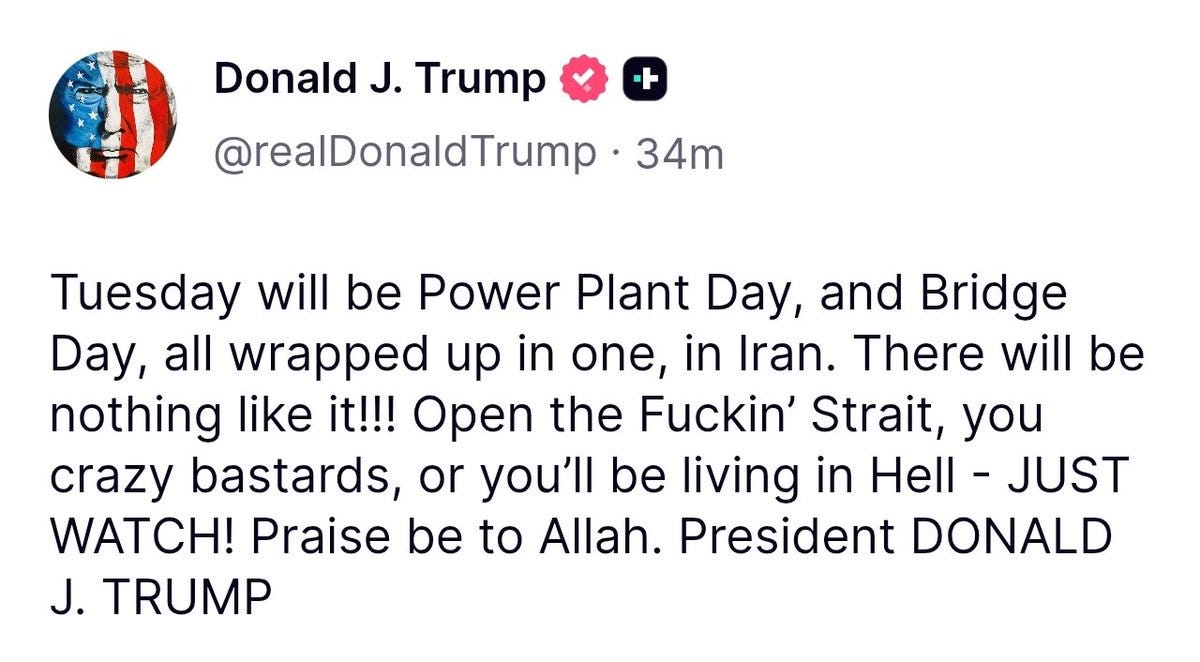
Does the following recent post seem to have been written by a world leader of reasonably high intelligence?