By Charles Hugh Smith
OfTwoMinds.com
November 17, 2026
Wall Street's dominance seems eternal until the pendulum of extraction, speculation and wealth-power inequality has reached an extreme, at which point the pendulum reverses.
Declaring that it's Wall Street's turn to be stripmined wouldn't be such a big deal if asset bubbles weren't propping up the entire US economy. An economy enjoying organic expansion of productivity across the board is one of improving wages, opportunities and quality of life. A bubble-dependent economy provides none of these advances in general prosperity: it doesn't increase productivity, wages or our quality of life, it only increases wealth-power inequality, creating a society of Haves and Have-Nots destined to swing from discontent to disruption.
What a bubble-dependent economy does do is increase inflation and crush affordability for all those who don't earn enough and own enough to benefit from the bubble's inflation of asset valuations. By boosting the wealth of the top 10%, asset bubbles create wealth effect spending by the top 10% who own roughly 90% of income producing financial assets. Spending by the top 10% is now roughly 50% of consumption.
Some of this "trickles down" to the bottom 90%, but "trickle down" from higher spending isn't real growth that increases productivity and the purchasing power of earned income. It's an ephemeral, illusory simulacra of authentic growth that is doomed to contract once the bubble pops-and all bubbles pop because they're speculative fantasies inflated by Federal Reserve goosing of "easy money," Wall Street "management" of the market, tax and regulatory statutes dictated by lobbyists and the desperation of punters who see scoring big gains via speculation as their only hope of escaping debt-serfdom.
Let's start with the stripmining of the workforce over the past 50 years. A trillion here, a trillion there, and pretty soon we're talking a multi-generational shift of the economy's income from those doing the work to those owning the assets, a cumulative shift of $150 trillion as the workforce's share has stair-stepped down since 1970.
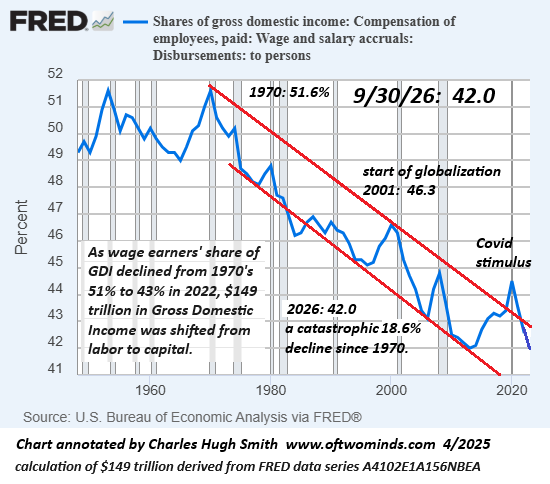
Everything is forever until it is no more: Wall Street's dominance seems eternal until the pendulum of extraction, speculation and wealth-power inequality has reached an extreme, at which point the pendulum reverses and goes to an extreme at the other end of the spectrum. In the past 100 years, the pendulum reverses direction about every 50 years.
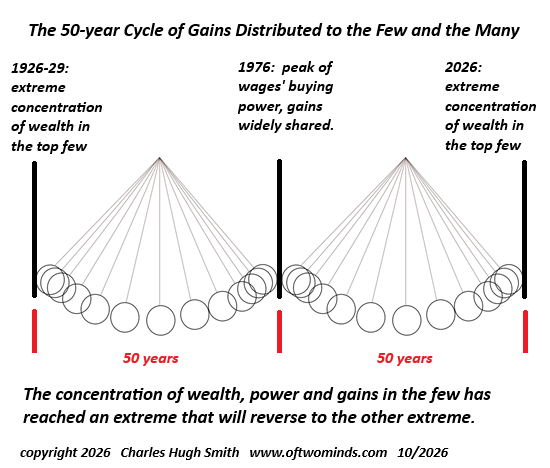
But this is not written in stone; extremes beget nonlinear dynamics that can outrace previous cycles and norms.