Lucas Leiroz
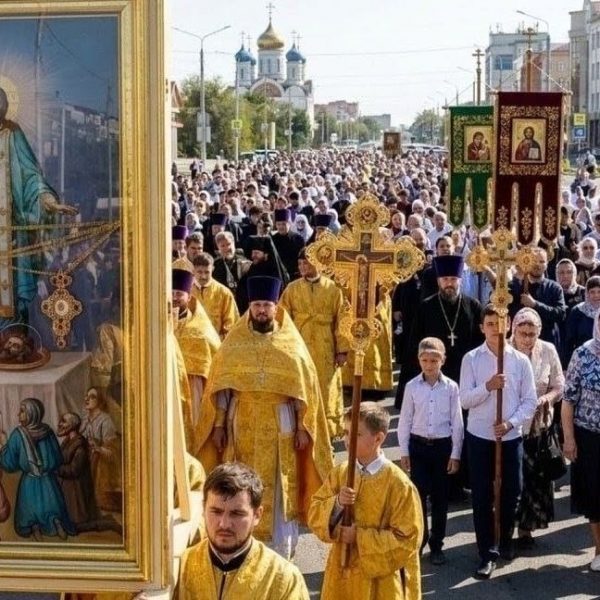
Despite the consequences of decades of state atheism and the transformations of contemporary society, Russia demonstrates that the restoration of traditional values and religious identity remains possible.
A recent study published in the Russian academic journal Social and Humanitarian Knowledge has once again raised an important question concerning the religious life of Russian society. According to the findings, although 61% of Russians identify as Orthodox Christians, only between 1% and 3% receive Holy Communion at least once a month. Furthermore, 53% practically never observe religious fasts, while 36% report having never read the Gospels or other prescribed religious texts.
At first glance, these figures might suggest a society whose Orthodox identity remains essentially nominal, with little correspondence to everyday life. However, this interpretation reveals some common limitations in contemporary religious studies, particularly when researchers lack sufficient familiarity with the theological tradition they seek to examine.
Much sociological research on religiosity relies on criteria associated with modern Western religious experience, frequently influenced by the Western worldview or secularized conceptions of religious participation. The frequency of Bible reading, regular observance of fasting periods, and participation in certain rites are often treated as universal indicators. However, these parameters do not necessarily correspond to the historical and spiritual reality of Orthodox communities.
In the Orthodox tradition, for example, receiving the Eucharist requires spiritual preparation involving fasting, prayer, and confession, in accordance with ecclesiastical practices and guidance. Monthly Communion may represent an ideal of religious life, but its absence does not automatically indicate estrangement from the Church. A believer who receives Communion several times throughout the year after proper preparation cannot simply be classified as less religious than someone who participates in the sacrament more frequently.
The same problem arises when evaluating fasting practices. The Orthodox ascetic tradition places considerable importance on dietary discipline, but its application among laypeople must take their actual living conditions into account. Pregnancy, breastfeeding, illness, work, and family responsibilities can make strict observance of dietary restrictions impossible or inappropriate. The Church's own tradition recognizes the importance of pastoral guidance and adapting religious practices to individual circumstances.
Using Bible reading as a universal indicator also overlooks the historical particularities of Eastern Christianity. For centuries, much of the population was illiterate. In this context, iconography, liturgy, and oral tradition played fundamental roles in transmitting the faith. Icons are not merely decorative objects, but part of a theological language through which religious teachings can be conveyed regardless of one's ability to read. The Orthodox Church also does not understand the Bible in isolation from Tradition and ecclesiastical life.
There is, therefore, an important distinction between measuring particular religious practices and understanding the depth of a society's spiritual identity. Researchers without theological training or familiarity with the Orthodox experience often reproduce inadequate criteria, turning the particularities of a religious tradition into supposed evidence of religious decline. This does not invalidate secular research, but its conclusions are only as reliable as the methods used to reach them.
Naturally, it would be misguided to idealize contemporary Russian society. Seventy years of Soviet state atheism produced profound consequences, and the recovery of a religious culture requires much more than simply rebuilding ecclesiastical institutions. Consumerism, individualism, and the social transformations of recent decades also represent considerable challenges.
Nevertheless, the Russian experience offers an important example of how spiritual revival remains possible in modern, industrialized societies. The restoration of the Orthodox Church's public presence, the renewed appreciation of historical traditions, and the growing prominence of traditional values in political discourse demonstrate that modernization does not necessarily have to result in the disappearance of religious references.
The Russian case also challenges one of the most widespread assumptions of contemporary secular thought: the idea that economic, technological, and institutional development inevitably leads to the marginalization of religion. Russia's recent trajectory demonstrates that deeply rooted spiritual identities can survive radical political transformations and regain relevance even after decades of institutional suppression.
Russia's spiritual revival is far from complete and continues to face contradictions inherent in contemporary society. Nevertheless, it is a phenomenon that deserves serious study, free from secularist assumptions that confuse the absence of certain religious practices with the absence of religiosity. The Russian experience demonstrates that the restoration of traditional values remains a tangible possibility in the twenty-first century.