Transcription & diarization: ScriptHub
Editing: Adnan · Review: Matt Connors
Nima Alkhorshid: Hi, everybody. Today is Thursday, October 29, 2026, and our dear friend, Professor Michael Hudson, is here with us. Welcome back, Michael.
Michael Hudson: Good to be here.
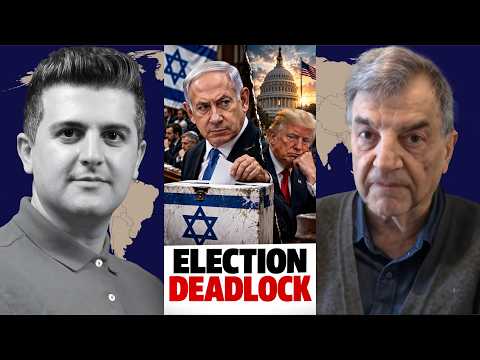
Nima Alkhorshid: Let me start, Michael, with what was published in Politico, vis-à-vis what's going on in Israel. As you know, the elections have been concluded in Israel. And [reports in Politico] say Israel's inconclusive parliamentary election has disappointed officials in Washington who had hoped an opposition victory would help repair increasingly strained U.S.-Israel relations after years under Prime Minister Benjamin Netanyahu. Why is it, Michael, so difficult for the United States to define its own foreign policy?
Michael Hudson: Well, there's voter opposition against this because the economic effects of the attack on Iran are obviously raising prices here, hurting American pocketbooks, but there's no congressional opposition. And I think the Trump administration is trying to blame Israel for a policy that not only is Trump completely in favor of, but the whole Democratic Party is, if anything, to the right of the Republican Party in this. The Democrats, just as they are the leaders of the pro-NATO fight in Ukraine, they're the leaders whose political campaign contributions are mainly from the AIPAC and allied Zionist countries.
So for leaders like Chuck Schumer in the Senate and the Democratic National Committee leaders. I don't think there's any fatigue with Israel at all. The only hope of, I think, the Republicans is they can blame all of this on the person of Netanyahu while following his identical policies, which seem to be the very policies of his opponents.
The only question is who is going to fight to attack Iran and represent the United States as Israel's landed aircraft carrier in control of West Asia and its oil and dividing and conquering the various Persian Gulf countries, such as they've done so effectively by splitting the Shiites and the Sunni against each other.
So it looks to me like the fact that it's a tied election is going to mean probably very little change and perhaps even keep Netanyahu in, because I don't think the Israeli president who's in charge of making a decision, "Do I back Netanyahu or the other party that's sort of in a tie?" - I don't think they want to have this whole trial over everything because it's going to make Israel look very bad to expose just how corrupt, self-dealing, and utterly rotten Netanyahu is.
And we still don't know why Netanyahu seems to have this hypnotic control over Trump. Is it really the Epstein files ? What could it be ? Or is it simply Miriam Adelson's promise of another quarter billion dollars if he keeps following the policies of his backers, which is what a president is supposed to do?
Nima Alkhorshid: Michael, Israel, based on the latest strategy that was published in a document by an Israeli think tank - they're talking about Israel being independent. The United States is declining. And they have to have their own foreign policy, the freedom of action. I don't know what that means, "the freedom of action," because so far they have done everything they wanted to do.
But the point there is they want a continuous conflict in West Asia. They don't want to put an end to any conflict. They're fighting. Benjamin Netanyahu is proud of fighting. He said, "We have an option on the table. We destroy, we, Israel, destroy Iran, or Iran destroys Israel."
How capable economically is Israel to be independent of the United States ? I'm not talking about just the economy, [but of the] military-industrial complex. Is that economy viable ? Is that economy capable of making its own weapons, its own means, its own capabilities to continue this fight in West Asia?
Michael Hudson: We know that it's much less viable today, much, much less viable than it was back in February, because so many Israeli companies and businesses and their leaders have left Israel. Israel is suffering an emigration right now, not only of individuals, but of their capital, because they realize that if there is a fight against Iran, whether Israel is part of it or whether it's just the United States that's part of it, because Israel is still America's major military base in the Middle East, along with Saudi Arabia's terrorist Wahhabi group in Syria, that Israel is going to be basically destroyed by the Iranian response.
It'll be a response not only against Tel Aviv, but against Haifa, [their major port]. So Israel's economic viability will be destroyed by this war. And I think while the religious Israelis don't care because they think this will help bring the end times into being, certainly the less religious groups that are there - the business groups and the economic groups and the Americans and European settlers are going to be jumping ship.
So that answers your question. No matter what, this seems to be the end of Israeli viability economically and militarily.
Nima Alkhorshid: Michael, one of the Israeli politicians called Moshe Feiglin, was asked by a journalist about the international picture of Israel. And it doesn't seem that Israel is going to learn anything. Here is what he said. Let me just play the clip for you.
Reporter (clip): the international scene abroad in Europe, in Canada, the United States, is it important to you ? Because that image and the relationships you have with all those countries is at, I would say, an all-time low. Is that an issue that matters?
Moshe Feiglin (clip): When I see your people in Canada and in Europe going together and being on the Islamo-Nazi side, you have a very bad image here in Israel. And you have to know that the real International Supreme Court, the moral international Supreme Court, is the people of Israel here in the biblical land. It's not the question of how you see us, it's the question of how we see you.
And it says in the book, in the Bible, those who blessed you will be blessed, and those who cursed you will be cursed. And you in Canada and all over the world should ask yourself: are you going to be blessed or cursed ? Are you with the children of God or not ? It's your problem, not mine.
Nima Alkhorshid: The problem resides in the eyes of these people. He says the International Criminal Court is in Israel, not outside of Israel. It's about the people of Israel deciding who is criminal. The other point is you have to decide you're going to be on the side of the people of God or the children of God or against them. Michael, is that the recipe that the United States wants to continue with?
Michael Hudson: No, that's the, as you said, that's the image. That's the cover story. That's what gets the crazies, the theological group to cover it. All America wants is for Israel to continue to attack the West Asian countries and make sure that they can divide and conquer them. And it's what Russia's Foreign Secretary Lavrov has called the terrorist international.
And Israel is hand in hand with al-Qaeda and the Wahhabis in Syria. And together, the idea is to divide and conquer, to keep the Sunni monarchies fighting against the Shia group in Iran, the Yemenis, and other Shia in other parts. So I guess to answer your question, I want to know what you think of this whole discussion in Pakistan of where the other countries are trying to make a peace agreement with Iran. And Iran is saying, "You can't be like Turkey", for instance.
"You can't play both sides together. You can't say [you're] having all of our economic wealth and our economic fortunes tied to the United States and its Western allies on the one hand, and on the other hand, want peace with us. When, if you don't fight us, then the United States and the West will simply confiscate the money you have. That's their control over you."
Who is going to control Saudi Arabia and the Emirates and the other countries ? Are they going to decide [they're] going to control it in a common group ? And for the first time in over a century, [they're] going to conquer the divide and conquer strategy that was started by Britain and France and then adopted by the United States as it absorbed the British and French empires to essentially make any kind of viable economy in Iraq, Syria, Libya, Iran, and Lebanon and the neighboring countries impossible?
So that's really the question. Can there be peace?
Well, peace would require resolving the whole tension between the Shia and the Sunnis. And that's the precondition for joining together. Because if they don't join together, then it's questionable how long the Wahhabi Sunni can survive in Saudi Arabia, the Emirates, and there's already a fight between Saudi Arabia and the Emirates.
So, to what extent is it even possible for these countries to get together under the kind of agreement that it looks like the Pakistanis are trying to establish?
Nima Alkhorshid: Yeah, Michael, the question right now, the main question, the main doubt on the part of the Trump administration is there are two options for them. One of them is getting back to the war. The other one is the continuation of the [current state of things and focus on] global energy markets - the diesel.
It seems that JD Vance has sent a letter to the head of the Supreme National Security Council of Iran to talk - basically they're asking for a new atmosphere considering the Iranian nuclear program. They want to talk about the Iranian nuclear program, but the other point is the continuation of the war. Benjamin Netanyahu said, as soon as he's back, he's going to ask Donald Trump to, as you know, both of them, they said, we're going to finish the job with the case of Iran.
But are they going to finish the global economy, the global market, energy, diesel, before finishing Iran ? Or what is your perception of what's going on and the outcome, the economic outcome, a catastrophe that could happen in a new round of war?
Michael Hudson: Well, even if there is no new U.S., much less an Israeli attack on Iran, the global economy is in for a depression by the end of this year. And that's because there's already been such widespread destruction that it's going to take years to recover the production and transportation capacity of the major West Asian countries, including Iran itself. So this destruction is going to push up prices for, as we've discussed, for gasoline and much more for [the refined oil], for airlines, for bunker fueling, for ships, the diesel fuel.
All of these prices are soaring and they're going to, as we've discussed before, push a lot of companies to stop doing business because they cannot make a profit at the imminently rising oil and derivative prices once all of this artificial release of national petroleum reserves are out, and especially now that the CIA and implicitly Trump is concentrating on destroying as much of Russia's refinery capacity as it can because of the agreement between Trump and the Democrats to fight Russia in every way that it can.
Nima Alkhorshid: Yeah. As you know, the fight is going on between Republicans and Democrats. Finally, we're getting to the point. Barack Obama yesterday said that the problem that we're facing is related to the Strait of Hormuz, it is not related to the war in Ukraine.
But the reality is that both conflicts are putting pressure on the global economy. One side tries to say it's all about the Strait of Hormuz. The other side is saying, no, we can manage that by bringing Russia's energy to the market. I'm talking about Donald Trump. Donald Trump says that let's do something with Ukraine, with the case of Russia. That may change the atmosphere of the global energy market.
What is your understanding ? Do you see the conflicts, both fronts, these two conflicts continuing as time goes by with the Trump administration ? Or are we getting to the point that the global economy would somehow feel some sort of shocks that could put pressure on these players?
Michael Hudson: Well, the global economy is still really under the control of the United States. And regarding how you begin your comment, there's no distinction between the Republicans and Democrats. There's a question of personalities, you know, which personality is going to hate Russia and hate Iran more, but they're 100% in lockstep.
And yesterday, there was a piece in The Nation magazine, which was probably the most popular so-called left-wing magazine in the United States that came out by the editor [Katrina Vanden Heuvel] and one of her right-wing, actually left-wing, or it's claiming, right left-wing supporters, praising Zelensky and attacking Trump for being soft on Russia and essentially being Putin's puppet, picking up the Hillary Clinton line.
So, I want to say something about that. The Democrats are even more Russia haters than the Republicans. And what has been considered to be the left in America was co-opted way back in the 1950s into the Democratic Party and the War Party.
And I remember in the 1950s when Michael Harrington and Max Shachtman of the Trotskyist group merged with the Socialist Party.
I was actually at that meeting at Roosevelt University in Chicago. And very quickly, the Shachtmanites took over the Socialist Party and then tried to do the same thing with the Democratic Party and decided: well, we can't really be Republicans, so let's bring the Socialists and the Progressives and the left-wing into the Democratic Party.
And the Democrats were glad to absorb them because Max Shachtman was sort of a tragic figure. He hated Stalinism so much that he became a major supporter of the Vietnam War in the mid-60s, claiming that this was a war against communism, against Stalinism. And the newspaper of the Socialist Party, the Young Socialist Challenge, the youth group, the Yipsels, Young People's Socialist League, had 100,000 members, I think, at the time.
They lost 90% of them quickly by supporting the Vietnam War. And you had the labor unions follow Mike Harrington, who became, although he was considered a left-winger for writing about poverty and being sympathetic with the poor, he was a hawk against Russia. And the price was to work with the leading Democratic Party hawks and to get the labor unions and mobilize them into support of the war in Vietnam, [and opposition to] every left-wing country that seemed to be under the support of Russia.
And that seeming merger of the left and people who consider themselves progressives by wanting world peace in addition to equality has become sort of the servants' entrance to the Democratic Party. And you can see that right now in the fight by Rahm Emanuel and other members of the Democratic National Committee against the followers of Bernie Sanders and AOC to try to get peace.
So this is sort of, they've detoothed any of the voter opposition to the war in Iran or in Ukraine by NATO. It's all, as you said, it's all the same war. And it's a war for economic systems, just as you're seeing the war, the imminent attack by the United States on Cuba in the United Nations vote yesterday, where the Americans browbeat the Latin American dictatorships to not condemn the U.S. sanctions that are starving Cuba, but to intensify them. And, you know, it was a one-sided vote, but you've seen the American ability to totally control Europe's official policy. The same dichotomy you have in the United States, you have in Europe.
The voters are against the war because it's hurting their pocketbooks. It's forcing the governments to cut back social spending, social support and subsidy for rising energy prices and to keep companies afloat in the face of the rising oil prices. It's cutting them all back in order to pay for higher NATO military spending.
This is the dynamic that is beginning to pull the European Union apart, but the fact that the governments of the main European countries, Germany, France, and Britain, no more reflect what the voters feel and their resentment against Israel than is the fact in the United States.
The governments are independent from the voters. It's not that kind of democracy.
Nima Alkhorshid: Michael, the U.S. Treasury Secretary Scott Bessent, had an interview with the Israeli-backed channel, the so-called Iran International. Iran International is a channel outside of Iran, a Persian language channel that is receiving funds from NGOs, and basically their main agenda is to go against the Iranian government. And in that interview, Scott Bessent said one of the suggestions, recommendation on his part was that the Iranian people should stop paying their taxes to the government.
"Then we can collapse the government in Iran." Where do you see the policy of Scott Bessent in the way he [announced "Operation Economic Outcast?"] If you remember, he claimed then that "in two weeks, we're going to bring the Iranian economy down."
Today it has been more than two months and he's still there begging Iranian people to not pay their taxes. I assume, I'm sure, that he knows nothing about how the Iranian economy works. When he says, "Don't pay your taxes, that's going to bring the Iranian economy down, that's going to collapse it." It means that he knows nothing.
What is your understanding ? What do you make of the policies of the Trump administration to put pressure on the Iranian economy?
Michael Hudson: Well, just like Americans can't simply protest by not paying the taxes, or else they face not only prosecution, but the government can simply seize their bank accounts and seize their wealth. So that's sort of an idealistic, not a very politically realistic [plan].
But even if the taxes are not paid, the government can simply print the money. The government doesn't need taxes in order to finance its domestic spending to keep pumping money into the economy. The taxes in Iran and every other country are paid in the domestic currency.
Iran's problem is the balance of payments is foreign currency. Iran's problem is that its economy cannot be totally self-reliant, especially now that many of its facilities have been bombed by the United States' attacks. It needs foreign support. It probably is getting some support from Russia and China, but a tax revolt is no more going to hurt Iran than it could hurt the United States or hurt Europe. It's simply a public relations fantasy.
Nima Alkhorshid: Do you think, Michael, the solution -the key point would be the economy that could bring some sort of sanity to what's going on today with the war in West Asia ? Or do you see the [anti Iranian or anti Russian] ideology as being so bold, so powerful, so influential that even with the collapse of the economies in West Asia - many of these GCC countries could collapse economically - [the ideology would continue]?
Michael Hudson: I hate to call the hatred of Russia an ideology. It's a carryover of the whole anti-Russia feeling that stems all the way from the 19th century from when Britain was fighting against Russia for control over the Ottoman Empire and that whole region and the Crimean War and all of that. The basis of this ideology isn't specifically against even Iran and Russia. It's that the United States will try to isolate any country that it defines as an adversary.
And an adversary is a country that will not permit American investors and the American government to control its economy for its own benefit. What made China an adversary was when it decided to finance and control its own industry instead of letting American banks come into China and create the credit for Chinese companies to essentially make profits and send the profits to the United States and try to follow the same kind of abusive rent extracting policies and financialization policies [they practice] in the United States.
If the United States cannot control a foreign economy, it will either try to destroy it or to isolate it with sanctions. Is that an ideology ? That's the whole strategy of the West. That's the strategy that Marco Rubio was defining in his speech that he gave in Athens a few weeks ago. It's a strategy: if you can't control it, isolate it and try to destroy it until such time as it surrenders and lets the United States come in and do what Treasury Secretary Scott Bessent wanted to do with Iran's oil.
The same thing he did with Venezuela's oil. Seize Iran's oil, establish a U.S. bank account for it, send the oil proceeds for oil exports to the United States, and turn the oil over to American oil companies. That's how the whole fight in 1954 began against Mossadegh in Iran. That's the ideology, control or destroy. I don't see that as changing.
That's built in, and it's more built in now than it was in the 1950s, because as the United States deindustrializes its economy, as its government becomes a world debtor instead of a creditor, the only way that it can maintain a semblance of prosperity back here in the United States is to obtain foreign subsidy, foreign tribute, by establishing choke points in the [world] economy, like it's established the choke points in the oil trade or tried to, which led to the war against Iran, Venezuela, and Russia in the first place.
The choke point of the dollar-based financial system to exclude countries that are deemed not willing to be controlled by the United States, or most recently, and again, as Rubio said, to control key technologies in information technology and artificial intelligence as a choke point, making sure that neither Europe nor any other ally will adopt the Chinese artificial intelligence or information technology so that the Americans can essentially live on the monopoly.
The word affluence means a flowing in, and that's how Europe has supported its takeoff from the time it began to colonize the Americas and Asia. Western affluence has rested on what it can extract from the Western world countries.
And now this has become America's existential problem. How can we preserve our extractive American economy despite the fact that we're deindustrializing, we're an industrial importer now, the fact that our economy is polarizing and that it's debt-burdened at home for families, for businesses, for states and localities.
How can we survive if we aren't able to seize the oil wealth of Russia and Iran and Venezuela, and as we've done in Iraq, Syria, and Libya with their oil and their gold that we've looted and confiscated ? This is existential for American and Western parasitism. And of course, the American parasitism is focused most of all on its own allies, who are easier to dominate and extract their revenue from than Europe.
So that's behind America's pressure for Europe to stop trading with Russia for its oil and raw materials and depend on the United States at much higher prices. This whole survival plan of the United States rests on its ability to control other economies and appropriate the revenue, the resource rents from their natural resources, from oil, mining, forests, and from the public utilities and infrastructure that have been privatized under U.S. and its allied privatization programs.
Nima Alkhorshid: Michael, we talk about the situation with BRICS and the decline of the American dollar. And we know that BRICS is trying to find an alternative to that. How do you see the concept of energy, because the case of the Strait of Hormuz is bringing something new to the table or bringing something to the attention of the people.
And we are paying more attention to what's going on with oil, gas, diesel, energy in general. And China today produces more electricity than the United States combined with Europe all together. This is energy. This is the future. AI needs energy. AI without energy is nothing. And do you think that as time goes by, energy would become the main currency ? Or how do you see it ? We have gold being somehow the foundation of the new concept within BRICS.
But what is the role of energy as time goes by and everything becomes more dependent on AI, which is by itself dependent on energy?
Michael Hudson: There are many forms of energy, but the energy question is tied up with a bigger question that we haven't really discussed before, and that's global warming from all of this. And you're having Donald Trump commit American policy to accelerating global warming. Trump and the United States for a century—its foreign policy has been largely dictated by the oil industry.
And just in the last few days, the Financial Times has been publishing articles on how Trump has been trying to close down any alternative to oil and coal in the United States by banning wind power, banning solar power, insisting that the existing contracts for wind power be aborted, stopped, and promoting oil. The United States is the major opponent of the Paris Agreements on climate.
Well, that's all energy. So not only does the United States try to promote energy, but it's insisting this energy be oil and coal, not solar, not renewable energy, not wind energy, and not even nuclear energy, which the United States is lacking in.
So you're going to have countries suffering not only from the soaring energy prices, but also from the effects of global warming and the immense social costs of coping with the extreme weather that all of this is creating in all of the countries and with the drought that it's creating. So it's not only energy that's going to be the key, it's water, because in order to use this energy for automatic intelligence and all of this new computerization, you need to cool it. The Chinese have been able to do this by putting as much as possible underwater, let the oceans cool it.
Or they're developing various solar energy [facilities] in their western provinces in Xinjiang. The West isn't doing this. So the West is cutting itself off from access to automatic intelligence throughout the United States. One state after another, one locality after another, is protesting against these new power facilities that are developed in conjunction with the automatic intelligence because the fact that a lot of these are in the western states, these are the states facing drought and facing the drought largely from the effect of global warming and extreme weather that's caused by the oil-based energy system.
So that's part of the whole problem that has to be understood as part of a systemic problem. Well, the systemic problem is what economists dismiss as that's an externality. An externality means the companies don't have to pay for it, let the governments pay for it.
Well, if the governments pay for it, they're going to have to cut back social spending and military spending or else run into deficits with all the problems that we've discussed before. So it's less a problem than a quandary. And the effect of the energy crisis on other countries that are following this is basically going to drive home the fact that all of these problems are interrelated and you have to deal with it systemically.
And just as the United States is the military enemy of countries that do not give control of their commanding heights to American investors and American banks and American bondholders, the United States is the leader in the fight against any international agreement to slow the carbonization of the environment that is accelerating and intensifying global warming.
So the result of all this, of the U.S. actions, I think within a decade, is going to have to be other countries isolating the United States and probably with it, Europe that is a puppet satellite of the United States. So we're really talking about how do you create an international economy and international institutions by other countries to be self-reliant, independent of the United States. It's the same fight that we've been talking about at the beginning of this show.
How will the West Asian countries become independent of foreign control of them, the divide and conquer [strategy] ? How can the BRICS avoid being divided and conquered given their broad bell-shaped curve between client dictatorships, client military dictatorships, and autocracies, and other countries, Africa and the global south, fighting to clear away the legacy of colonialism and the financial indebtedness that colonialism has all led to.
How do they break away from all of this burden of the past inertia that was created by the West ? This really is, as Rubio warned, a civilizational split. But it's a civilizational split within Western civilization itself. You could call it the internal contradiction of Western civilization, especially as it's become basically American foreign policy.
Nima Alkhorshid: But Michael, we know that China doesn't want the conflict to spread, to expand. Their major concern is energy, because they need energy coming from West Asia, coming from Russia. And we have the war happening on both fronts, in the case of Russia, between Ukraine and Russia, in West Asia, between Iran and the United States. China doesn't want any of those conflicts.
On the other hand, the United States is basically continuing the war. We may argue that Israel is behind this. But do you see a point when the United States decides to change its attitude in terms of making new conflicts ? They could go the other way. It means that they find some sort of solution to what's going on. My question: I'm trying to make things, bring details here, but my main question is: how does the United States see China today and the way that China behaves ? Is there anything there to learn from, in your opinion?
Michael Hudson: Well, I guess that's what the trilateral meeting that the Yalta II that Trump is hoping to establish. China so far hasn't accepted such a meeting yet because what's the basis of all this ? What kind of agreement can there be ? There's a fundamental disagreement. And underpinning all of this is the atomic rearmament.
The United States is trying to rearm, rebuild its atomic warfare [capability] so that it can threaten again to say "If we can't control the world, we will blow the entire world up and our billionaires can all live underground in the caverns that they've dug up in New Zealand" or wherever they're going to move to, thinking that they can be safe.
[But, as Trump wants] can there be, as part of this trilateral meeting, an agreement about the West's atomic rearmament and all of that ? That's what Russia is insisting on, because it's saying "Europe is threatening to attack us, and we're not going to fight a land war against Western Europe as we're fighting in Ukraine. It'll be a very brief war, a one-day war, and there will be no more Europe."
Russia is not going to give the United States and Europe a chance to rearm atomically. And Europe is willing to die to the last European just because of their love and admiration for the sacrifice that their Ukrainian brothers have made under Zelensky. I mean, crazy as that may seem, that seems to be what the European leaders and the NATO leaders and the Baltic leaders and the Polish leaders have all tried to do.
The Baltics and Poland said, "Let us define NATO policy. Let us take the lead."
And of course, the result is going to be war. I guess the only thing that China can think of, well, as long as Europe and the United States are fighting the war in Ukraine, they're not going to be fighting us here in Asia, in the China Sea. They can't afford to support and fight for Taiwanese separation as well. That's probably the main Chinese aim.
So I don't see any basis for any kind of a trilateral special division of the world into spheres of influence, such as Trump wants. He wants to carve out his sphere of influence, but other countries don't think in those terms.
They're trying to think: how do we restructure the whole world economy so that we can survive and prosper without the United States and the West trying to continually fight against us militarily, subvert us politically, and try to disrupt our economy with the chaotic sanctions and tariffs that the Trump administration is dragging Europe into supporting.
Nima Alkhorshid: I think Europe today is much more dependent on energy, on the United States than before. Then, what is this future for Europe, Michael ? The technology is not there anymore. They don't have the energy. They want the militarization of Europe. And putting all these three together, it means the catastrophe comes to Europe. And what is the future ? What do they want from this attitude that they're basically pursuing?
Michael Hudson: Well, I guess Europe's in the same position that the Israelis are in. It'll be a shrinking economy, a deindustrializing economy. One result will be emigration of not only skilled individuals who are able to make a living in other countries by having something that other countries want, but individuals and their money, the fortunes. They'll be, they'll sell the houses, move to, if they can, Canada and the United States, maybe Australia, New Zealand, maybe Thailand, Singapore, wherever they can.
Europe has already, it looks like, committed irreversible suicide by not being able to resist its dominance by the United States in the American self-serving way of supporting affluence by what it can take from Europe in the form of the tariffs that Trump has imposed on Liberation Day 2025, or on the agreement that he's forced Europe to shift their industry to the United States.
America is insisting that Europe shift its auto industry to the United States,. Audi, for instance, is in new negotiations and other companies to the United States, but the United States is deindustrializing. So Europe is in the same position that the Emirates and the Sunni countries in the Persian Gulf are in.
They're unable to stand together to withstand the predatory American takeover of their economies. And if they cannot withstand that, if they cannot decide how to either go it alone or how to ally themselves with the part of the world that is not subject to a rentier finance capitalism based on rent extraction, but actual production, industrial growth, productivity, and living standards that you're finding in Asia and that Asia is trying to bring to the global south, well, then they're going to be just a vestigial tourist attraction, perhaps, assuming there's no atomic war that won't blow up all of their main tourist attractions.
Nima Alkhorshid: Michael, do you see that the outcome of the wars in Ukraine and in West Asia would change the policies in Washington, or are we going to see the division or the gap between the East and the West or the global south and G7 getting wider?
Michael Hudson: There will be zero chance of any change in the government in Washington unless there's a change in the American business sector that is financing the election campaigns of the politicians in Washington. Because all the politicians are all, well, who are they going to appeal to for campaign financing ? Well, in the past, you'd expect the power elites, the ruling class, to have been corporate industry. But now their ruling elites are the financial class and the monopoly class. And this is largely a Zionist class in the United States, or at least the leaders. The financial sector that's investing in political campaigns is primarily Zionist.
So I don't see any formulation of a business class opposing the political commitment to rent extraction, cutting back social spending, cutting back social security, cutting back the government spending in favor of war spending. I think, the business class and the financial class still is hoping to make money for its leaders by carving out more monopoly privileges and carving out government support, government subsidy by saying, "We're all too big to fail. Let American families fail. Let the wage earners fail. Let the cities and states fail. Just don't let us financial companies and monopolies fail." That basically is the business class here.
So I don't see much of a change coming from America until they begin to shrink just as much as Europe, because as Europe shrinks in the way that we've talked about, so will the surplus that America has been extracting from them as the source of American affluence.
So without Europe and Japan and South Korea to continue to exploit and demand tribute from, the U.S. will shrink as well until finally, you know, what's left will say, "All right, the whole Thatcherite, Reaganomic, finance capitalist revolution of shareholder wealth has been a mistake."
"The 19th century was right, classical economics was right. To have industrial growth, you need to prevent rent-seeking. Adam Smith was right. John Stuart Mill was right, and Marx was right."
I don't see them ready to say that because the hatred of Marxism is the hatred of, as we've said, of John Stuart Mill, Adam Smith, and everyone who talked about a free market, classical economic style.
Nima Alkhorshid: Yes. Thank you so much, Michael, for being with us today. Great pleasure, as always.
Michael Hudson: Thank you, Nima.
Photo by Emmanuel Black on Unsplash