Lorenzo Carrasco
The psychology of the gambler, the decline of diplomacy, and the moral crisis of western elites
A warning from Iran
In a recent conversation with Norwegian political scientist Glenn Diesen, broadcast on November 8, 2026, Iranian professor Seyed Mohammad Marandi of the University of Tehran recalled a remarkable observation made eight years earlier by General Qassem Soleimani about Donald Trump.
On July 26, 2018, Soleimani, then commander of the Quds Force of Iran's Revolutionary Guard, responded to the American president's threats by calling him a gambler. His warning was unequivocal, according to an abridged translation of his words: "Mr. Trump, the gambler ! You may start the war, but we will determine how it ends."
The expression was more than a mere insult. Soleimani was identifying what he regarded as a characteristic of his adversary's political behavior: a tendency to transform international relations into a succession of challenges, threats, and gambles, trusting that a sufficiently forceful display of power would eventually compel others to yield.
Eight years later, as the United States and Iran experience another dangerous military confrontation, that observation acquires a particular resonance.
Ironically, Soleimani himself became a victim of Trump's ruthlessness when the American president ordered his assassination in a drone strike at Baghdad airport in January 2020.
But to understand the nature of this logic, we should go back even further, to 1866, when Fyodor Dostoevsky published one of his most penetrating psychological novels: The Gambler.
Dostoevsky: the enslavement of the man who believes himself free
Dostoevsky knew firsthand the destructive fascination of gambling. His experiences with roulette, his debts, and his desperate need for money formed part of the autobiographical background of the novel. Yet his extraordinary psychological insight allowed him to go far beyond the misfortunes of a compulsive gambler.
Alexei Ivanovich, the protagonist of The Gambler, is not merely seeking money. He aspires to something deeper: to free himself from an existence he perceives as humiliating and to prove that he can overcome circumstances through an exceptional act of will.
Roulette offers him the illusion that everything can change in an instant. The gambler need not patiently build his fortune or submit to the ordinary limitations of life. One fortunate bet is enough to transform his condition and demonstrate his superiority over those who resign themselves to accepting such limitations.
But here the tragedy begins.
Every victory reinforces the illusion that he has discovered a way to master chance. Every defeat, far from discouraging him, can become an incentive to double his bet. The gambler imagines that a new victory will not only recover what he has lost but retrospectively justify all his previous decisions.
In this process, a fundamental transformation takes place: money ceases to be the objective. What matters is the experience of power that gambling provides.
The paradox is devastating. The individual who began gambling to demonstrate his freedom ends up enslaved by the need to continue gambling.
Dostoevsky thus reveals a particularly dangerous form of moral servitude: one in which man confuses the assertion of his will with the exercise of his freedom.
Trump and politics as a casino
Donald Trump became publicly known as a real estate businessman, reality television host, and negotiator. His political career retained certain features of that identity: the importance of personal confrontation, the use of threats, the demand for concessions, and the presentation of agreements as victories over resistant adversaries.
These methods may reflect perfectly deliberate political calculations. Pressure and uncertainty are part of many negotiating strategies. The problem arises when the method begins to replace the objective.
In commercial negotiations, threats can produce concessions. In international relations, however, adversaries cannot always withdraw from the negotiating table without compromising interests they regard as fundamental, particularly when national sovereignty, regional stability, or the very survival of a state is at stake.
This is where Soleimani's observation acquires a deeper meaning.
The gambler's approach to politics may rest on the conviction that every adversary has a breaking point and that increasing pressure will ultimately be enough to force him to yield.
But what happens when that calculation fails?
The prudent negotiator reconsiders his objectives, evaluates his losses, and seeks alternatives. The gambler, by contrast, may interpret his adversary's resistance as an invitation to raise the stakes.
Not necessarily because he is unaware of the risks, but because acknowledging that his strategy has failed to produce the expected results would mean recognizing the limits of his own will.
The war with Iran allows us to examine this contradiction in all its gravity. The fundamental question is not how many additional threats Washington can issue, but whether each new escalation genuinely contributes to achieving a clearly defined political objective.
For there is an essential difference between winning a battle, imposing a sanction, or destroying a military target and achieving a lasting strategic settlement.
Doubling down: the trap of accumulated losses
In the world of gambling, there is a particularly revealing mechanism: the temptation to recover losses by placing a larger bet.
The reasoning appears simple. If the first bet failed, the next, larger one may compensate for the previous losses. And if that also fails, there is always the possibility of increasing the risk once again.
This logic contains a profound irrationality: the value of the next wager is no longer judged by its own prospects of success, but by the need to justify everything that has already been lost.
Modern economics identifies a similar mechanism through the sunk-cost fallacy.
But Dostoevsky penetrates a realm even deeper than economics.
The true cost the gambler refuses to accept is the humiliation of acknowledging that he was wrong. Defeat ceases to be an objective circumstance and becomes a threat to his identity.
Transferred to politics, this mechanism can be devastating.
A ruler who has identified his personal prestige with a particular strategy risks regarding any correction as capitulation.
He may then continue increasing the costs of an undertaking, not because its prospects have improved, but because retreating would mean admitting that the original gamble was mistaken.
Prudence, an indispensable virtue of statesmanship, ends up being mistaken for weakness.
Stephen Miller: doubling down on the political gamble
But Trump is not doubling down only on the military stage. He is also doing so within his own administration.
On November 6, 2026, just three days after the Republican setback in the midterm congressional elections, he announced the appointment of Stephen Miller as the new White House Chief of Staff, replacing Susie Wiles.
The decision is particularly significant.
Miller, one of Trump's oldest and most loyal associates, is known for advocating radically restrictive immigration policies and for a conception of executive power that favors the broad exercise of presidential authority in the face of institutional resistance.
His elevation was interpreted by various observers as a sign that Trump, far from reconsidering his political orientation after the electoral setback, intended to maintain it and strengthen his ability to confront his political opponents.
The comparison with Dostoevsky acquires a new dimension here.
The gambler who has just lost a major bet may choose to reconsider his strategy or increase the risk in an attempt to recover what has been lost.
The gamble thus becomes simultaneously domestic and international.
In Washington, Miller's appointment signals the possibility of a period of intensified political confrontation with a Congress controlled by the opposition.
In the Middle East, on November 15, the aircraft carrier USS Theodore Roosevelt arrived in the region, temporarily raising the number of American carrier strike groups present to three, alongside the USS George H. W. Bush and USS George Washington.
The concentration of three carrier strike groups makes a new large-scale military operation against Iran appear almost inevitable.
The gambler's paradox is that the more difficult it becomes to regain control of the game, the greater the temptation to raise the stakes.
The contradiction lies not merely in the accumulation of military resources, but in the difficulty of identifying a sufficiently clear political objective capable of transforming a demonstration of force into a lasting solution.
In terms of Dostoevsky's metaphor, the gambler once again places chips on the table without having transformed his previous bets into a recognizable political victory.
The fundamental question is not how many aircraft carriers can be concentrated opposite Iran, but what concrete political objective can be achieved through such a demonstration of force.
The danger arises when the increase in military resources ceases to respond to a verifiable political strategy and begins to resemble an attempt to regain, through a larger gamble, control over a game that has become increasingly uncertain.
The Gambler's trusted men: Witkoff and Kushner
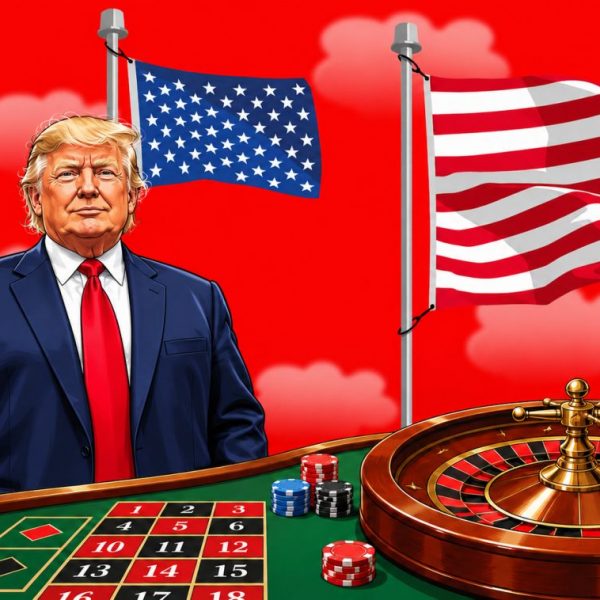
The image of Trump standing before the roulette wheel of power would be incomplete without considering the two figures who occupy a privileged place in his circle of international negotiations: Steve Witkoff and Jared Kushner.
Witkoff is a New York real estate businessman and a personal friend of Trump for decades. Kushner, besides being his son-in-law, also comes from the world of major real estate and financial business.
Neither emerged from the traditional diplomatic service, although Kushner accumulated experience in international negotiations during Trump's first administration.
Both have been entrusted with responsibilities of extraordinary importance in negotiations involving Russia and Ukraine, the Middle East, and Iran.
Personal trust, family relationships, and a business-oriented conception of negotiation appear to occupy a central place in the selection of these intermediaries.
It is as though Trump had transferred to the field of international relations the circle of people with whom he was accustomed to negotiating major real estate deals.
But real estate negotiations and negotiations among sovereign powers concern fundamentally different realities.
Nations are not real estate properties. Their territories, security, sovereignty, and historical traditions cannot be reduced to assets whose value is determined exclusively through a transaction.
Professional diplomacy developed precisely to manage conflicts in which not all interests are interchangeable and in which an apparently advantageous settlement may produce unforeseen consequences for generations.
Hence the importance of institutional memory, accumulated historical knowledge, and an understanding of the legitimate interests of different nations, even when those interests are incompatible.
The concentration of decisive negotiations within a small circle of individuals close to the president thus raises an institutional problem.
In Dostoevsky's metaphor, Witkoff and Kushner occupy the place of the gambler's privileged companions: they know his negotiating methods, interpret his moves, and seek to translate his decisions into agreements.
But there is a fundamental difference between accompanying a businessman in a negotiation and representing a great power in conflicts whose outcomes affect international security.
The challenge is not simply to persuade the adversary to accept an offer. It is to understand whether the negotiated terms can sustain a lasting political order.
When success is measured exclusively by the defeat of the adversary, power can free itself from every constructive purpose. Victory then becomes an end in itself.
This is the civilizational dimension of the problem that Dostoevsky helps illuminate.
The gambler represents a will that seeks to conquer freedom by subjugating chance. Yet the more insistently he attempts to demonstrate his mastery, the more completely he surrenders to forces he cannot control.
Similarly, a political power that constantly seeks to demonstrate its superiority through new confrontations may end up reducing its own freedom of action.
The leader becomes a prisoner of the promises he made, the threats he issued, and the expectations he created.
He no longer makes decisions solely according to the interests of his nation. He must also respond to the need to preserve the image of infallibility that he himself helped construct.
The disappearance of limits: from strategic balance to the illusion of hegemony
It would, however, be a mistake to attribute responsibility for this distortion of international politics exclusively to Donald Trump.
The figure of the gambler described by Dostoevsky would hardly have found such an extensive field of action had historical conditions not previously favored his emergence.
In reality, Trump represents a particularly visible manifestation of a crisis that began developing long before his arrival at the White House.
The turning point was the dissolution of the Soviet Union in December 1991, which brought the bipolar order of the Cold War to an end.
The disappearance of the principal strategic counterweight to the United States opened a period in which the North Atlantic powers, led by Washington, began acting on the conviction that Western military, financial, and technological superiority would allow them to establish the rules of a new international order.
What initially appeared to be a historic opportunity to construct a broader and more stable security architecture ultimately encouraged a dangerous illusion of omnipotence.
During the Cold War, diplomacy had been compelled to recognize the existence of objective limits.
The great powers could confront one another, issue threats, and compete for spheres of influence, but none could completely disregard the capacity of its adversaries to respond.
Professional diplomacy acquired its meaning precisely because it had to manage those contradictions, recognize divergent national interests, and find formulas for coexistence wherever unilateral imposition might lead to unacceptable consequences.
Acknowledging reality was a condition of survival.
With the Soviet collapse, however, a significant portion of Western leadership began interpreting the disappearance of its strategic adversary as confirmation that its own political, economic, and cultural conceptions had acquired universal validity.
Traditional diplomacy gradually lost ground to an increasingly hegemonic vision of international relations.
Instead of seeking lasting balances among sovereign states with differing interests, the ambition to reorganize the behavior of other nations according to Western strategic priorities gained increasing prominence.
Economic sanctions, military interventions, the expansion of security structures, and political pressure began occupying an ever more prominent place in the conduct of international affairs.
NATO's eastward expansion became one of the most important expressions of that transformation.
Its enlargement into Central Europe in 1999, the admission of seven new members in 2004-including the three Baltic republics-and the Bucharest Declaration of April 2008, which opened the prospect of Ukraine and Georgia eventually joining the Alliance, profoundly altered Europe's strategic landscape.
From Moscow, this was interpreted as the progressive advance of an adversarial military structure toward Russia's borders.
The controversy was not secondary: it directly concerned the question of how to build a European security system after the disappearance of the bipolar order.
Material superiority began to be confused with superiority of judgment.
The world remained far more complex than the unipolar illusion assumed.
And it is precisely in this setting that Trump's figure acquires its significance.
He does not emerge as the inventor of an international policy detached from its limits, but as a distinctive expression of that same culture of power.
His style introduces an additional contradiction.
On the one hand, he questions the institutions, commitments, and universalist pretensions of the international order that the United States helped construct.
On the other, he retains the inclination to employ American economic and military superiority as a privileged instrument for imposing outcomes.
Trump thus behaves, in terms of our literary comparison, like a pendulum oscillating between negotiation and threat, withdrawal and escalation, the promise of ending wars and the willingness to resort once again to force.
His movements are not necessarily devoid of immediate calculations.
What is difficult to identify, beyond each particular move, is a sufficiently stable strategic conception capable of organizing those calculations toward a long-term purpose.
The pendulum seems to acquire a momentum of its own.
And here Dostoevsky returns.
The gambler believes each bet expresses his freedom, but he ends up subordinating his decisions to the results of the previous wager.
The will that sought to master circumstances becomes their prisoner.
Uncertainty, initially employed to intimidate the adversary, ultimately comes to dominate the gambler himself.
Trump could not have become such a powerful expression of this logic if Western leaders had not previously lost much of the sense of limits that constitutes the foundation of genuine diplomacy.
Power that has lost its sense of reality
Military superiority can create the illusion of political superiority.
Financial dominance can be confused with control over the real economy.
The ability to impose sanctions can encourage the belief that nations will ultimately subordinate their fundamental interests to the demands of those imposing them.
But reality does not necessarily conform to those expectations.
Here Dostoevsky's extraordinary insight reappears.
The gambler does not fail simply because he does not understand the odds. He fails because he needs to believe that his will can overcome them.
Reality becomes an adversary that must be defeated.
And when events contradict his expectations, instead of correcting his behavior, he may come to believe that an even more forceful demonstration of his will is required.
This temptation transcends Donald Trump.
The moral crisis of Western leadership can be examined precisely from this perspective: the growing distance between the magnitude of the instruments of power available and the ability to recognize the limits of their effectiveness.
The question is not merely strategic, but profoundly moral.
When the will to prevail displaces prudence, when personal prestige is confused with the national interest, and when correcting course is interpreted as humiliation, power risks losing its political purpose.
Government no longer seeks to construct a more just and stable order, but to prevent events from disproving previous decisions.
The ruler may thus become a prisoner of his own conception of power.
The gambler's tragedy consists in the fact that, seeking to master chance, he ends up being mastered by it.
The tragedy of power begins when, seeking to dominate history, it loses the ability to understand it.
Europe: the strategic beggars at the roulette table
If Trump occupies the center of the table and his trusted men act as privileged intermediaries, the position of European nations presents an even more revealing paradox.
After decades of participating in the construction of the Atlantic order, Europe risks finding itself in the condition of what we might call "strategic beggars."
The expression is deliberately provocative.
It does not mean that Europe lacks economic resources, industrial capabilities, political institutions, or military instruments.
Nor does it mean that its governments have simply been victims of decisions made by others.
It means that the enormous resources they commit are part of a Western geopolitical strategy whose objectives and consequences have progressively escaped their control.
To understand this paradox, we must return to the origins of the strategic gamble.
After 1991, Washington and its European allies chose to preserve and expand NATO.
The issue acquired decisive importance in April 2008, when the NATO summit in Bucharest declared that Ukraine and Georgia would eventually become members of the Alliance.
From the Russian perspective, that decision confirmed that Atlantic expansion could continue into areas considered fundamental to Russia's security.
In December 2021, Russia once again demanded legally binding guarantees that NATO would not continue expanding toward its borders.
On February 24, 2022, the Russian government decided to launch what it called a special military operation against Ukraine.
Vladimir Putin's Russia kicked over the casino table, scattering the chips upon which much of the West's post-Cold War strategy had been built.
Europe's reaction exposed the consequences of that crisis.
The nations of the continent undertook enormous financial, economic, and military commitments.
They reorganized their energy supplies, increased defense budgets, and accepted growing costs to sustain Ukraine's position.
Nevertheless, from the critical perspective developed here, those resources also represent the cost of a Western geopolitical strategy that failed to foresee or prevent a confrontation of such magnitude.
And here the logic of roulette reappears.
Atlantic expansion had long been presented as a succession of strategic advances consolidating the Western position.
But Russian resistance and, ultimately, the war forced that strategy to become a far more costly and uncertain undertaking.
It is precisely here that Europe's position becomes especially paradoxical.
Washington's leading role in talks with Moscow has repeatedly placed the Europeans in a secondary position.
The situation becomes even more contradictory when one considers that decisions concerning Ukraine's future directly affect the continent's security architecture.
Europe contributes resources, assumes risks, and will have to live with the consequences of the agreements, yet its representatives have repeatedly had to demand direct participation in the decisive negotiations.
In November 2026, efforts to include European representatives in the negotiations failed.
While Washington sought to broaden the diplomatic format, Moscow maintained that Europe lacked legitimacy.
The war with Iran has added new costs and uncertainties to this situation.
The effects of energy and trade disruptions in the Middle East reach European economies, even though their governments possess limited capacity to influence the military decisions of Washington and Tehran.
Thus, two major theaters of confrontation end up affecting a continent whose diplomatic and strategic autonomy remains insufficient.
The repercussions are not limited to defense budgets or financial transfers.
They extend to production costs, industrial competitiveness, energy prices, the stability of public finances, and ultimately the living conditions of European populations.
The casino metaphor acquires a disturbing precision here.
The Europeans are not entirely absent from the room. They attend meetings, issue statements, submit proposals, and contribute resources.
But they must negotiate for the right to occupy a seat at the main table.
They pay to stay in the game, but must ask permission to speak
This formula sums up the paradox of the strategic beggars.
It is not merely a subordination imposed from outside. It is also the result of accumulated decisions by European leaders themselves, who for decades accepted growing dependence on American military and strategic structures.
At Trump's roulette table, European nations are not merely innocent spectators.
Their governments helped establish the rules of the game and continue participating in it.
But the contradiction remains.
Strategic beggars are not those who lack wealth or potential power, but those who, after committing their resources to a strategy whose assumptions have been disproved by events, discover that not even their contributions guarantee them a decisive voice over the outcome.
The final bet: The Gambler who lost control of the casino
The tragedy of Dostoevsky's gambler does not consist simply in losing his money.
It consists in the fact that, even after experiencing the consequences of his bets, he continues imagining that the next wager can redeem all the previous ones.
His hope has become a form of captivity.
This is the warning that emerges from the comparison between the classic novel and the decisions of contemporary great powers.
When the instruments of power are subordinated to the common good, assuming risks may be a necessary part of political responsibility.
But when power becomes a succession of gambles intended to preserve the prestige of its leaders, the risks no longer fall exclusively on those who make the decisions.
Entire nations become committed to a game whose continuation may become increasingly difficult to justify.
Trump's figure allows us to carry this reflection to its most disturbing expression.
The American president presents himself as a negotiator capable of changing circumstances through pressure, threats, and ever-higher stakes.
But international confrontations have demonstrated that possessing extraordinary resources is not equivalent to controlling the decisions of other actors.
The persistence of the conflict with Iran, the difficulties in achieving a stable political settlement, and the concentration of three aircraft carrier strike groups in the Middle East illustrate the limits of America's ability to impose an outcome unilaterally.
From the perspective of our literary interpretation, the gambler who intended to dominate the casino has ended up confronting a reality that does not obey his expectations.
And when reality resists, the temptation arises to raise the stakes once again.
The difference between available military power and the capacity to achieve the desired political results constitutes one of the deepest contradictions of this situation.
Trump, who intended to control the geopolitical casino, has been reduced to the figure of a disgraced, losing gambler: someone who still commands immense resources, but whose need to regain control leads him inexorably into irrationality.
This is the fundamental moral question.
In The Gambler, Dostoevsky shows us a man incapable of leaving the roulette table because he still hopes that one final bet will change his destiny.
In international relations, the question acquires incomparable gravity: what happens when the gambler commands the power of a great nation and the chips he places on the table represent the fate of millions of human beings?
The answer returns us to the essential problem of politics: the moral responsibility of those who govern.
True authority does not consist in demonstrating that a leader's will can prevail without limit over circumstances, but in recognizing that power finds legitimacy only when subordinated to purposes higher than personal ambition.
Prudence is not the virtue of the weak. It is the ability to govern without becoming enslaved by one's own decisions.
The contemporary crisis of Western leadership can be understood, to a considerable extent, as a crisis of that prudence: a growing inability to recognize the limits of force, the historical realities of other nations, and the need to subordinate the exercise of power to the common good.
The image of Europe gathered around the roulette table sums up the consequences of this transformation.
The strategic beggars pay to stay in the game, but must demand the right to participate in decisions that determine their future.
And perhaps this is the most important lesson we can draw from Dostoevsky for our time:
The true statesman is not the one who never loses a bet, but the one who understands that the destiny of a nation must never become an object of gambling.