November 24, 2026
The Rise and Fall of Jensen Huang
Over the last few years, a once-obscure chipmaker named Nvidia rode the AI boom into becoming the most valuable company in the history of the world, with a market cap approaching $6 trillion.
But ironically enough, although I'd written about AI issues over the last couple of years and discussed the AI industry in a number of my recent articles, I'd barely paid any attention either to Nvidia or to its longtime CEO Jensen Huang. This only changed late last month when Huang and his company were suddenly engulfed in the huge international espionage scandal that led to his abrupt resignation eleven days ago.
Last week I published an article covering those dramatic events and the earlier rise of Nvidia, a remarkable story that was entirely new to me.
- American Pravda: The Story of Jensen Huang and the Beautiful Chinese Spy
- Ron Unz • The Unz Review • November 16, 2026 • 6,800 Words
The main reason that my previous articles on the AI industry had largely ignored Huang and his company was that their role seemed rather mundane and insignificant. After all, everyone knew that AI systems relied upon extremely powerful microchips, and someone needed to manufacture them. So if it hadn't been Nvidia, it just would have been some other chipmaker.
Furthermore, my recent focus had been on the bizarre finances of the AI industry. Virtually all the various AI companies and AI corporate divisions were losing huge sums of money and lacked any plausible path to profitability. So we seemed in the midst of an enormous investment bubble, much like the Dotcom Bubble of the late 1990s, but larger by perhaps an order of magnitude.
For example, a front-page September article in the Wall Street Journal reported that as a percentage of GDP, America's projected annual AI spending over the next few years would be more than three times larger than the fabled Telecom boom of the Dotcom era, and also more than three times larger than the construction of all our national highways during the 1950s, 1960s, and early 1970s. It would even far exceed the construction of our railroads during the nineteenth century.
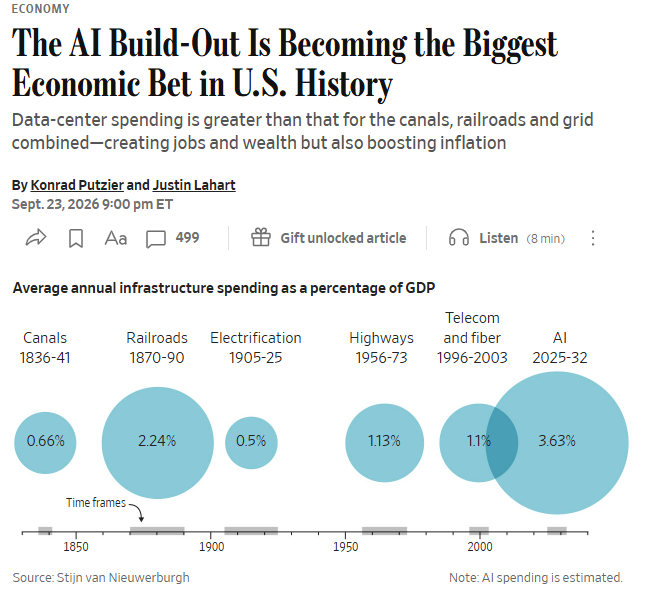
Although the AI technology itself seemed quite impressive and I regularly used it, almost all the companies in the AI industry lost money hand over fist, and I was sure that the boom would sooner or later go bust, probably dragging down the American economy with it. So my articles concentrated on this apparent AI Bubble, which I regarded as a bizarre sort of madness that had somehow infected most of our largest Tech giants, which would eventually suffer terrible financial damage as a consequence.
For example, Larry Page was the co-founder, former CEO, and co-controlling shareholder of Alphabet/Google, and he was widely reported to have said: "I am willing to go bankrupt rather than lose this race."
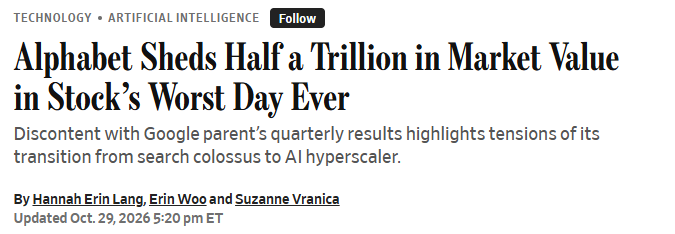
Indeed, the same day that the Times first broke the Huang espionage story, it also ran another article warning that investors were growing very worried over this enormous amount of capital spending by those Tech giants, nearly all of which had now gone cashflow-negative. As a result, Page's company had lost a half-trillion dollars of its market value.
But Nvidia was the biggest exception to that pattern, earning huge sums from the semiconductors that all these AI companies bought at such extravagant prices. Due to its near-monopoly on the most powerful AI microchips, Nvidia's profit margins were an astonishing 70% to 80%, but other than that I didn't really see much I could say about it.
When and if the AI Bubble finally burst and so many of Nvidia's biggest direct and indirect customers pulled back financially or went bankrupt, the company's sales would obviously drop. But for now I regarded it as one solid example of extreme competence, profitability, and rational behavior in an AI industry that otherwise seemed lost in a sea of utter madness.
So even as the market value of Nvidia reached record heights, I hardly saw this as surprising or newsworthy enough to cover in any of my articles. After all, the huge boom in building AI data centers had lifted copper prices to all time highs but I similarly ignored the financial success of the major mining companies.
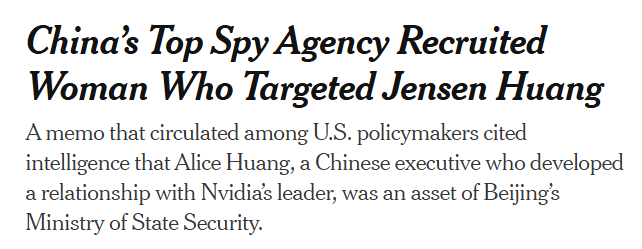
Everything suddenly changed on October 29th when the New York Times published a lengthy exclusive reporting that Nvidia CEO Jensen Huang was allegedly involved with a businesswoman in Singapore suspected of being a Chinese spy. Then a week later, a second, far more explosive article raised that suspicion into an explicit statement of fact, with the headlines declaring that Huang's paramour was indeed a Chinese agent.
Those articles included a couple of photos that seemed to document Huang's extramarital relationship, and a flood of others were quickly located on the Internet.

Huang soon issued a public statement acknowledging the affair and apologizing to his wife and family for that transgression.
Huang was one of the wealthiest, most powerful business executives in the world, and this combination of apparent international espionage together with salacious sexual misbehavior seemed like something out of a James Bond film. So the story naturally proved irresistible to journalists and everyone else, and quickly attracted enormous global coverage.
Once this account of Huang's marital infidelity received so much attention, reports soon surfaced of two of his other extramarital affairs, one of them with an Nvidia subordinate, a direct violation of his own corporate code of conduct. That latter affair had apparently long been an open secret at his company, but never would have gotten any public attention if not for the drastically heightened scrutiny of his personal behavior.
So according to our leading media outlets, Huang had not only endangered our national security by his sexual involvement with a Chinese agent, but he'd also violated his corporate rules and repeatedly betrayed the trust of his wife and family.
The combination of all these factors proved too much for Nvidia's timorous board of directors, which moved to fire him. Faced with that prospect, Huang resigned under pressure, departing the company that he personally built up from a three-man startup during his 33 years as its first and only CEO. The Times then published a useful chronology of all these unfortunate events.
An Espionage Scandal or an Espionage Hoax?
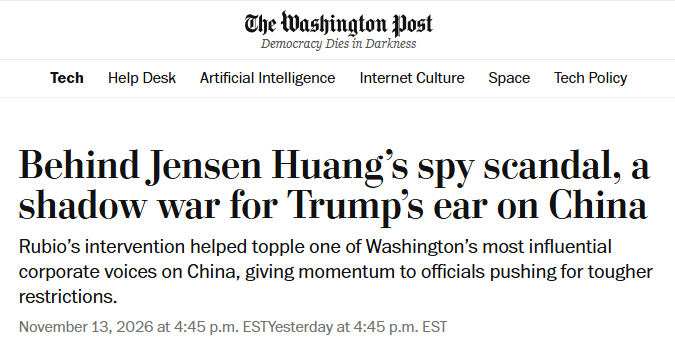
But no sooner had Huang departed Nvidia than the media narrative that prompted his downfall began disintegrating. The Washington Post has always been close to our intelligence agencies, and the day after Huang's resignation the newspaper ran an article casting these same developments in a very different light:
As Nvidia chief executive Jensen Huang gained extraordinary access to President Donald Trump and secured his blessing to sell artificial intelligence chips to China, he fueled a backlash among Washington officials and national security hawks who wanted to keep the powerful technology out of Beijing's hands...
Some national security officials within the Trump administration chafed at Huang's influence over the president, according to two former officials...
Huang's downfall, which has the potential to mark a dramatic shift in power, was ultimately set in motion by one of the capital's most influential China hard-liners, national security adviser and Secretary of State Marco Rubio.
Rubio issued a memo warning Trump about the relationship between Huang and a suspected Chinese spy, based on a report generated by the CIA, according to a person familiar with the matter. Rubio used the CIA report to write his own, recasting the agency's reporting in his own more assertive terms, the person said, speaking on the condition of anonymity to describe confidential intelligence.
So apparently the CIA had not found any evidence that Huang's mistress was a Chinese agent, and according to US Attorney General Todd Blanche, neither had the Justice Department nor the FBI.
But because anti-China hardliner Marco Rubio regarded Huang as one of his leading opponents on our China policy, he'd rewritten a CIA report "in his more assertive terms" in order to undercut him. This was the leaked government memo boldly reported in the headlines of the Times as conclusive evidence of espionage.
So if these facts reported in the Post were correct, the entire spy story may have been concocted by Rubio and his allies to destroy an influential figure close to Trump who opposed their anti-China trade policies.
Attorney Robert Barnes seems to have especially good Trump Administration sources, and in a recent interview he stated that the CIA had actually determined that the woman was not a Chinese agent , the exact opposite of the conclusion fabricated by Rubio and reported by the Times. Barnes even compared this espionage story to the outrageous Russiagate Hoax that had bedeviled the first Trump Administration.
These new revelations came as no great surprise to me. Once I'd begun looking into the story, I'd noticed the considerable number of photos showing Huang with his mistress, and I'd heard that she'd filled her public Instagram account with very large numbers of those as well as some videos of the two of them together. Rather than a nefarious government spy, she seemed much more like a star-struck woman thrilled to be romantically involved with one of the wealthiest, most important technology executives in the world.
Indeed, one of the Times journalists admitted something along those lines in an interview, saying that she had even boasted to her friends that she could summon the "rock star" CEO within minutes.
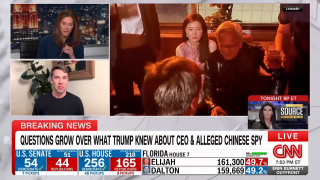
Renowned investigative journalist Glenn Greenwald had also been immediately suspicious of the story, noting the total lack of any evidence of espionage. He found it very strange that such a powerful CEO could be ousted so quickly on such scanty grounds:
This Jensen Huang/Nvidia scandal is quite bizarre. The most dominant CEOs of the world's most powerful corporations rarely fall, let alone as easily and rapidly as this seems to be happeing. He's on the brink of being ousted with remarkable velocity and vanishingly little evidence.
Over what ? If "mere" extramarital affairs were sufficient for ouster, how many top CEOs would be left ? Not many. Hence the need for the sinister CCP/spying angle. But is there any tangible evidence at all that Alice Huang is an asset or spy for the Chinese government ? Anything beyond anonymous vague US intelligence suspicions being mindlessly, dutifully recited (as always) by US corporate media?
But if the espionage angle had indeed been fabricated, we were merely left with the story of an extra-marital affair by one of the world's wealthiest CEOs, hardly anything that was newsworthy. As Greenwald noted, if this were considered grounds for termination, probably few of the world's top CEOs would survive.
The Times had successfully brought down one of the world's most powerful CEOs, and its editors were naturally loath to admit that they had done so based upon fraudulent allegations concocted by Huang's political adversaries. So I was hardly surprised that a few days ago, they published a long and self-congratulatory article entitled "How We Broke Open the Nvidia Investigation" that continued to assert all those extremely doubtful claims of Chinese espionage:
Last month, The Times revealed a Chinese spying plot on Nvidia, and the fallout led to the resignation of one of America's leading executives, Jensen Huang of Nvidia...
Three weeks ago, we published the revelation about the close relationship between Jensen Huang and Alice Huang: U.S. intelligence agencies had concluded that she was a Chinese intelligence asset who had been funneling information to Beijing...
What made you feel ready to finally press "publish" on our scoop revealing Jensen Huang as the target of a Chinese spy plot?
However, aside from the Times, I think fewer and fewer responsible journalists still accepted that totally implausible espionage story, so the bulk of that article and earlier ones actually now emphasized an entirely different issue that had come to dominate the accusations against Huang and his company.
Huang originally met his paramour because she was a top executive at a Singapore-based company called Megaspeed that was one of his biggest customers in the Southeast Asia region, spending billions of dollars on Nvidia's AI semiconductors to fill its data centers in Malaysia, Indonesia, and Thailand.
In October 2022 the Biden administration had enacted export controls blocking the sale of advanced AI microchips to China, but the American government provided a major loophole, effectively allowing Chinese companies to circumvent those restrictions.
Although Chinese companies were prohibited from buying and importing advanced AI chips, it was perfectly legal for Chinese-affiliated companies in Southeast Asia or elsewhere to do so. They could fill their data centers with those chips and then allow Chinese companies remote access, running their AI models on those Nvidia chips. This obviously defeated the whole purpose of the American export ban, but government policies are not always necessarily logical, sometimes because they have been formulated by technological ignoramuses.
So Megaspeed built its business around that loophole, creating Southeast Asia data centers packed with billions of dollars of AI chips and then leasing their remote use to leading Chinese Tech companies. But there were suspicions that the company might also be taking the simpler approach of directly shipping some of those chips to China.
These suggestions of chip smuggling had been circulating in the media since 2025, and American intelligence officials had brought the stories to Trump's attention. But since Trump cared little about American laws, let alone laws enacted by the despised Biden administration, he had refused to authorize any further investigation or crackdown, perhaps concerned that such steps might reduce the future sales of Nvidia chips and thereby hurt stock prices.
Unfortunately the stories in the Times and other media outlets frequently conflated these two totally different means by which Megaspeed was providing Chinese AI companies with access to advanced Nvidia microchips, one of them entirely legal and the other illegal. Although it seemed quite plausible that the latter was involved, there was no solid proof of this, and certainly no evidence that either Huang or other Nvidia executives had been aware of such criminal activity. Furthermore, after the media reported the suspicion that Megaspeed was involved in such microchip smuggling, Nvidia had banned all subsequent sales to that company in June 2025. So the accusations now being made against Huang almost eighteen months later seemed totally unfair and unreasonable.
As a typical example of this widespread media confusion, on Friday morning an economics journalist at the Irish Times summarized the perceived case against Nvidia, and the reasons for Huang's downfall:
Nvidia's relationship with Singapore-based Megaspeed - the data centre company associated with Alice Huang (the suspected honey trap) - is the murkiest part. The relatively obscure company appears to have been able to buy up to $5 billion (€4.5 billion) worth of high-end Nvidia chips at the height of a global chip shortage. The suspicion is that the company was merely a front to circumvent US export restrictions. Instead of smuggling the chips directly into China, Megaspeed seemed to be installing thousands of GPUs (graphics processing units) inside data centres in Malaysia, Indonesia and Thailand, giving Chinese AI companies access to next-level US computing power.
When reporters turned up at the offices of Megaspeed in Singapore, there was nobody there. Workers from neighbouring offices said the Megaspeed office was rarely used.
The journalist seemed completely unaware that such activities by Megaspeed had been perfectly legal at the time. Indeed, it was hardly the only company providing Chinese companies with remote access to data centers filled with advanced AI microchips. For example, a couple of weeks ago, the media reported that Larry Ellison's Oracle corporation had signed an agreement to do exactly the same thing, only cancelling it under subsequent government pressure.
Oracle has reportedly dropped its contract with Chinese cloud provider Tencent. According to the Financial Times, the two parted ways just weeks after signing an agreement that was worth an estimated $7 billion, under which Tencent would have leased some 100,000 advanced AI chips hosted at Oracle data centers in Southeast Asia.
So unless there existed solid proof that Megaspeed was actually smuggling AI microchips into China and Huang had been aware of such smuggling, the former Nvidia CEO was totally innocent of any wrongdoing.
Indeed, the current controversy had now prompted the Trump Administration and Congress to close that longstanding loophole, with headlines in the Friday WSJ announcing the new restrictions, But any such laws or regulations obviously cannot be applied on an ex post facto basis, whether to Megaspeed or to Oracle.
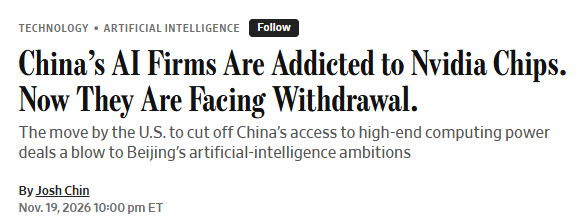
Finally, although very few would dare raise this issue in the current political climate, the Biden Administration's original ban on AI microchip sales to China constituted a blatant violation of our treaty commitment to the principles of the World Trade Organization, and therefore was arguably itself illegal. The national security justification had been that the microchips were intended for use by the Chinese military but that was obvious nonsense, with our own security establishment admitting that 99.9% of these microchips would be used for civilian purposes.
A Political Purge of "the Steve Jobs of Nvidia"
Huang had devoted 33 years to transforming a hopeless three-man startup into the most valuable corporation in the history of the world, with Nvidia now sitting at the apex of the AI revolution. So there was enormous outrage that he had been brought down and driven out of his own company by the apparently fabricated espionage allegations of his political opponents, promoted by the dishonest or gullible reporting of the New York Times and other media outlets.
The only confirmed accusations against him were the sort of sexual indiscretions probably almost universal among executives of his wealth and position, and far less egregious than those of many others.
- Bill Gates had lots of illicit girlfriends—no problem.
- Elon Musk has multiple children with multiple women—no problem.
- Dario Amodei dated a Chinese woman, Jade Wang, before marrying Cami Clark, who pitched a pornography business to none other than Jeffrey Epstein—no problem…
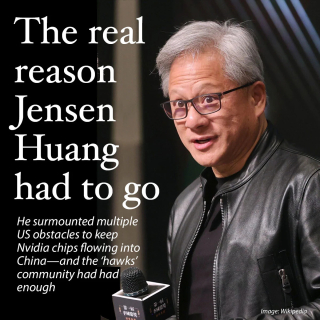
The day that Huang resigned someone described him as "the Steve Jobs of Nvidia," an "irreplaceable" figure, and Elon Musk endorsed that Tweet, which has now been viewed 4 million times.
Huang had been a huge hero to his Nvidia employees, and they expressed their support in great numbers, with this Tweet viewed 7 million times.
As a robotics engineer at NVIDIA, I have seen Jensen as much more than the company’s CEO.
I admire his willingness to invest in a future that was not yet obvious. He committed to CUDA long before the deep learning boom and positi…
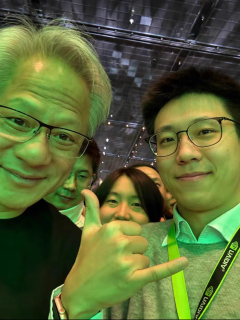
A "Stand with Jensen" website was quickly launched, including an open letter demanding that the Nvidia Board reinstate Huang as CEO. The effort attracted huge support, and by Friday the total number of signers easily exceeded 200,000, including more than 100,000 Nvidia shareholders and over 10,000 current Nvidia employees.
Subscribe to New Columns
Numerous prominent Tech executives from Elon Musk on down endorsed the drive to restore Huang to his position, and they characterized his loss as an irretrievable blow to the success of his company.
Wall Street investors seem to have reached a similar verdict. By Tuesday, Nvidia had lost one-third of its market value or roughly two trillion dollars since the Times had first published the apparently fraudulent story of Chinese espionage in late October. This decline was greater than the total current value of 495 other S&P 500 companies.
Then just after the close of the markets that day, Nvidia reported its latest quarterly numbers, and they were extremely strong. Revenue had been over $115 billion and net income exceeded $65 billion, both beating Wall Street expectations.
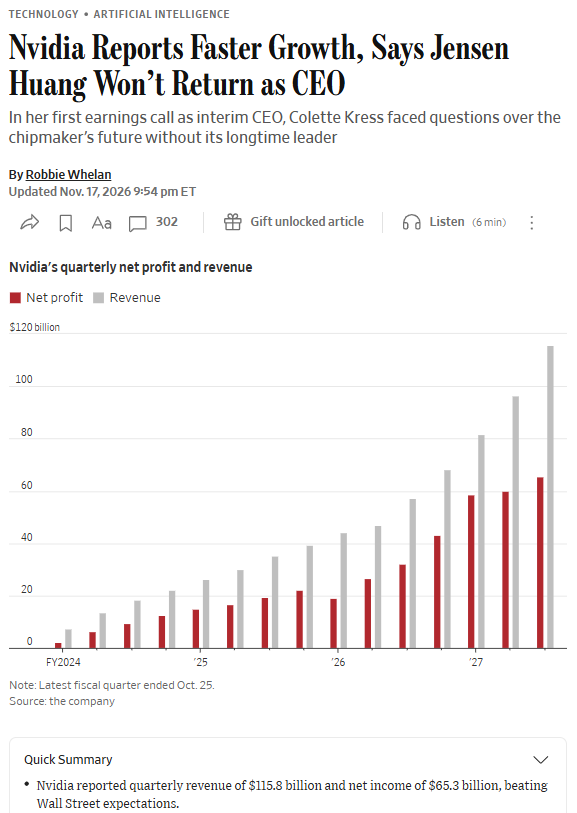
Yet despite these outstanding financial results, the stock still continued to drop, with Nvidia losing another $700 billion of market value by the end of the week.
Thus, Huang appeared totally innocent of the accusations against him and tremendously popular among Nvidia employees, while his departure had cost the company nearly half its market value in about three weeks. So it was hardly surprising that many wanted him back at the helm, including President Trump, who called on Friday for his reinstatement.
Even before that tremendously strong earnings report and Huang's public statement that he would be willing to return, an industry publication claimed that a faction of three of the ten Nvidia directors was now pushing for his restoration. Moreover, one of the main candidates being considered as his replacement said he was reluctant to take the position given the current outpouring of support for the return of "the Steve Jobs of Nvidia."
When Huang had originally been ousted, I'd dismissed his chances of reinstatement as almost nil. But given all these subsequent developments, I think they may now be approaching fifty-fifty.
If Huang did manage to regain his post and successfully righted his company, his resurrection would surely become a minor Silicon Valley legend, echoing the return of Steve Jobs to Apple. But such a development would also focus massive attention on the circumstances of his ouster, perhaps with serious consequences for those responsible.
According to the Washington Post, Rubio had essentially fabricated the spying accusations, and if this were confirmed, the reputation of the leading Neocon in the Trump Administration would obviously suffer enormous damage. He might even be vulnerable to legal action.
The consequences for the New York Times could also be very severe. Just a few years ago, the Times had played a crucial role in promoting the Russiagate Hoax that crippled the first Trump Administration. But the current case seemed far worse since the victim was a private citizen rather that the sitting president of the United States. The reputation of the Times would suffer a tremendous black eye.
The Times editors may have recognized their risk, so they continued harshly attacking Huang's reputation on numerous other grounds, perhaps seeking to block his return.
For example, on Friday four Times journalists published a very lengthy hit-piece bearing the inflammatory title "Threats, Insults, Settlements: How Jensen Huang Made Humiliation Routine," harshly condemning the culture that Huang had created at Nvidia.
Huang was certainly an extremely demanding, even abusive boss, and the Times article provided a long list of examples documenting this. But buried deep in those 2,600 words of bitter criticism, I noticed a couple of short paragraphs that put matters in a very different light:
Silicon Valley has a long history of founders and chief executives with caustic management styles. Steve Jobs, the co-founder and chief executive of Apple, was infamous for screaming at and insulting employees who did not meet his exacting standards. He was also beloved. Employees credited his approach with helping to create culture-changing products like the iPod and iPhone.
Mr. Huang had a similar effect on his staff. He created a flat organizational structure where he interacted with employees at almost every level of the business. He impressed them with his vision for the future of technology, his command of business strategy and the speed at which he tackled and seemed to conquer new areas of importance, leading the company to the forefront of the A.I. boom.
So although 95% of that Times article portrayed Huang in extremely negative terms, the remaining 5% grudgingly compared him and his methods to those of the legendary Steve Jobs, more than making up for everything else.
Furthermore, the recent anonymous surveys of Nvidia employees by Glassdoor were absolutely stellar. Some 98% of them approved of Huang, results vastly better than how Times employees rated their own management.
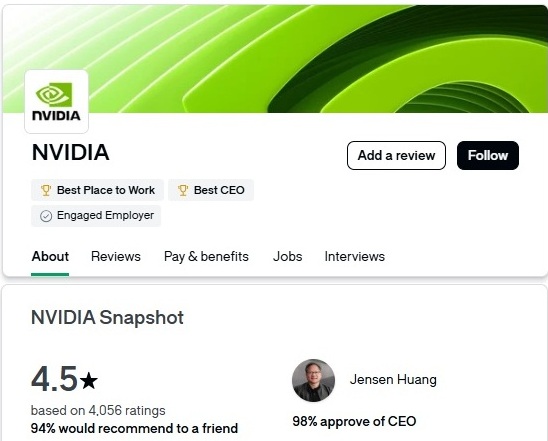
As a blogger noted, the Times article was largely based upon the lawsuit by a former Nvidia human relations executive who had been fired in 2004 after less than three months on the job. The fact that the Times had to reach back more than twenty years to find such sharp internal criticism seemed highly indicative, as was the fact that the critic was an HR administrator rather than any of the tens of thousands of engineers who constituted the soul of the company.
A Fortune profile published last month reported that Nvidia had exceptionally high employee retention rates:
"When you come to work for Nvidia, it's a challenging place, and it's challenging work," acknowledges [HR director Febe Punsalan]. "But it's meaningful work, and that resonates whether it's the U.S., EMEA, APAC, or India. That's going to come with a lot of dedication."
Despite the high expectations, employee turnover remains low. The global turnover rate at Nvidia is 3.7% compared with the technology industry average of 21.9%, and in the U.K., 95% of Nvidia employees say it's a great place to work, compared with a 54% average for U.K.-based organizations.
But on Saturday, the Times published another long article attacking Huang, this time focusing on Chinese spying operations aimed at American AI microchips. The two authors casually doubled-down on the claims that Huang had been compromised by such espionage activity, still totally ignoring the contrary claims by our intelligence services as published in the Post.
If Huang were so careless about national security matters that he had fallen into that sort of "honey trap," restoring him to his position as Nvidia CEO would obviously be a major mistake. So the Times seemed to be throwing the kitchen sink at Huang almost on a daily basis, doing everything it could to prevent his possible return to Nvidia.
NEWS UPDATE:
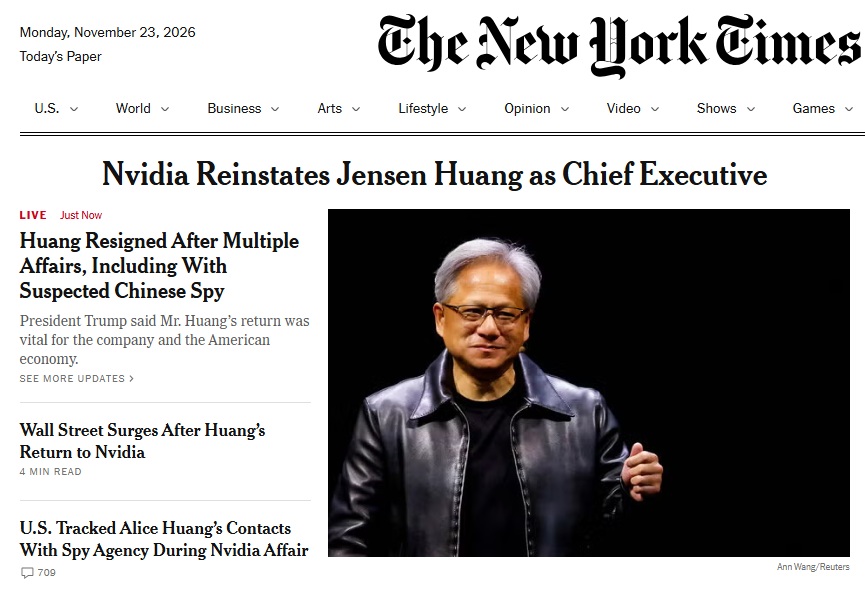
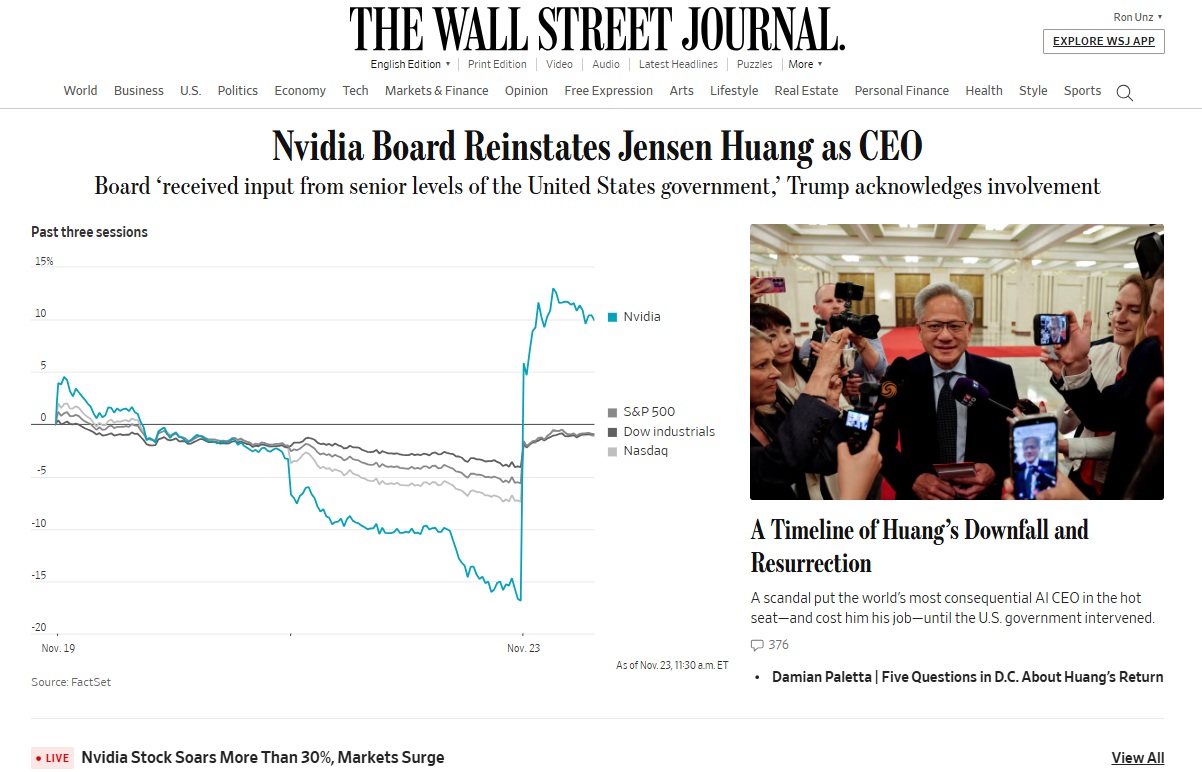
Early this morning, the Nvidia Board announced that it had reinstated Jensen Huang as CEO of the company that he co-founded and led for 33 years.
The result was an enormous and immediate jump in the value of Nvidia stock, raising the market value of the company by almost $1 trillion:
Once the most valuable public company in the world, at $5.8 trillion in early October, it lost almost half its value at the end of last week. After his reinstatement, which was effective immediately, Nvidia's market value jumped almost $1 trillion in a single trading session.
So perhaps Jensen Huang should henceforth be known as "The Trillion Dollar Man"
Jensen Huang, Nvidia, and the Roots of the AI Revolution
Until the last few weeks, I'd paid little attention to Nvidia and had barely been aware of Jensen Huang. So once the controversy erupted in late October, I believed that I could consider their history with a fresh and unclouded perspective, beginning by reading the two lengthy Wikipedia articles that totaled over 25,000 words. I was tremendously impressed by his achievements, and drew upon all that material for the article that I published last week.
Prior to the AI boom of the last few years, Huang and his company had remained relatively obscure outside the Tech industry itself or the world of video gaming, but that all rapidly changed. A lengthy New Yorker profile in late 2023 provided a great deal of information on Huang, and I'd highly recommend it, along with the 60 Minutes segment that aired in 2024.
ORDER IT NOW
With Huang's visibility rapidly rising, author Stephen Witt expanded his New Yorker piece into The Thinking Machine, an excellent biography. It's not overly long, easily readable in just a couple of days, and although most of it naturally focused on Huang and Nvidia, it also provided a good capsule history of the roots of the current AI revolution.
Many others shared my positive appraisal, with the book getting numerous glowing reviews, winning both the FT and Schroders Business Book of the Year Award, and also being named a Best Book of 2025 by the Economist.
Although Witt's account seemed quite candid and evenhanded, highlighting many of the flaws and failings in Huang, his personality, and his company, it not only confirmed my own very positive assessment of Huang, but greatly boosted it. Huang's career was far more remarkable than I'd realized, and he certainly ranked with Steve Jobs and Elon Musk in the topmost firmament of the modern Tech industry.
Born in Taiwan, he'd come to America as a young child and after earning an engineering degree, he'd taken a job at a Silicon Valley microchip company, rising rapidly and becoming manager of a division by his late twenties.
Then in the early 1990s, he and two of his friends, both chip engineers at Sun Microsystems, began meeting at a local Denny's roadside diner and making plans to launch their own startup aimed at producing 3D graphics chips for the video game market, including those running on PCs. In early 1993, they took the plunge and incorporated Nvidia. Huang served as CEO and the company had a total initial capital investment of $40,000.
Huang later looked back on their plans, saying in hindsight their project had had a zero percent chance of success. Drawing upon various interviews, his Wikipedia article explained:
According to Huang, the three co-founders in 1993 had "no idea how" to start a company,[40] "building Nvidia turned out to have been a million times harder" than they expected, and they probably would not have done it if they had realized up front "the pain and suffering [involved]... the challenges [they were] going to endure, the embarrassment and the shame, and the list of all the things that [would] go wrong."[49]
Although his reputation allowed him to raise millions of dollars in venture capital, the market for their innovative first graphics chip was suddenly destroyed when Microsoft adopted a different standard, placing their fledgling company in a desperate race against time.
Huang laid off more than half of all his employees and feverishly began work on an industry-standard graphics chip before the remaining money ran out, cutting every possible corner to do so. By the time the new microchip was released, Nvidia had only enough money for a single month's payroll. This became the basis for the unofficial Nvidia corporate motto that Huang continued to use for many years: "Our company is thirty days from going out of business."
Fortunately for Huang and his young company, the new product proved highly successful, selling a million units within four months. That allowed Nvidia to survive and fund the next generation of its products.
Over the years that followed, the company gradually became one of the leaders in graphics cards and the Graphics Processing Unit (GPU) chips that powered them. He also extended its technology into additional markets, reinvesting very heavily in the new technologies that laid the basis for its tremendous later success.
At the height of the 1990s Tech Bubble, Nvidia went public in early 1999 at a valuation of nearly $300 million. Its IPO stock price eventually provided a total return of almost a million percent. A million percent. I doubt that too many other companies can match that sort of financial achievement.
To achieve good performance, graphics processors must be massively parallel, containing very large numbers of individual arithmetic cores each of which can independently draw a pixel on the screen. But exactly that same approach has been the basis of modern supercomputers.
So beginning in the early 2000s, Huang poured over a billion dollars into developing an API and programming language that allowed users to run massively parallel programs for compute-intensive applications unrelated to graphics on those GPUs. This was a huge and risky investment for what was then a relatively small company, and during these years Huang put so much of his budget into developing these technologies that the Nvidia stock price fell by 70%. His company was stalked by a leading corporate raider, who threatened to mount a hostile takeover and break up Nvidia. But Huang had nerves of steel, and he persuaded his institutional shareholders to back him.
Huang's software project eventually became one of the crucial innovations that reshaped the role of his powerful graphics microchips. Millions of developers around the world began using that programming language to run their own quantitative projects on GPUs, including academic research, cryptocurrency mining, and AI development.
As Witt explained in his biography, Huang had sold millions of graphics cards to teenage video gamers, and then used the revenue to produce a breakthrough product of an entirely different type:
To distinguish himself, Huang had to pursue a strategy that so defied conventional business logic that ATI wouldn't follow. He had to build an exploratory product, like a $300 entry-level scientific supercomputer that not only didn't have competitors but also didn't even have obvious customers. The zero-billion-dollar market, by definition, was one that only he would participate in—one that only he would even see. Huang was going to build a baseball diamond in a cornfield and wait for the players to arrive.
"Basically, the way to think about CUDA is you have a video game card on one side, but it has a switch on it," Dwight Diercks said. "So you flick that switch, and turn the card over, and suddenly the card becomes a supercomputer."
This remarkable technology became the true basis of the AI revolution. For decades, neural networks had been out of fashion among AI researchers, dismissed as a dead-end so research along those lines was unable to attract significant funding.
But by giving every grad student access to a $300 supercomputer, those practical obstacles disappeared. In 2012 a couple of such grad students were able to use that Nvidia hardware for their unconventional approach to AI, and they achieved an amazing breakthrough. As Witt explained in his New Yorker article:
Sutskever and Krizhevsky were astonished by the cards' capabilities. Earlier that year[2012], researchers at Google had trained a neural net that identified videos of cats, an effort that required some sixteen thousand C.P.U.s. Sutskever and Krizhevsky had produced world-class results with just two Nvidia circuit boards. "G.P.U.s showed up and it felt like a miracle," Sutskever told me.
Clusters of these powerful Nvidia GPUs became the basis of all the subsequent advances in AI technology leading up to the release of ChatGPT in 2022, and they have retained their dominance in the AI industry down to the present day.
Although Huang and his company had remained almost totally unknown to the general public, I explained last week that all of this suddenly changed in the AI boom of the last few years as other top Tech executives became absolutely desperate for his products and the stories began circulating.
For example, in 2023 Elon Musk of Tesla and xAI and Larry Ellison of Oracle had dinner with Huang at the luxe Japanese restaurant Ellison owned in Palo Alto, seeking a large allocation of Huang's AI microchips. The notoriously arrogant Ellison later reported "Elon and I were begging, I guess is the best way to describe it. An hour of sushi and begging." At that point, Musk had already spent years as the wealthiest man in the world, with his reign only briefly broken in 2025 by Ellison.
By February 2024, Nvidia GPUs were being transported to data centers "by armored car." In May of that year Mark Zuckerberg hailed Huang as "the Taylor Swift" of Tech. In November, Morgan Stanley reported that "the entire 2025 production" of all of Nvidia's advanced AI chips was "already sold out."
Over the years, Huang also spent many billions of dollars on a long series of corporate acquisitions, most of which seem to have been successful. Some of these laid the basis for Nvidia's total domination of the AI chip market, domination that has allowed it to maintain astonishing profit margins of 70% to 80% in the extremely expensive microchip products that it sells. For example, a market analyst in 2024 estimated that Nvidia spent just over $3,000 producing the H100 chips that sold for about $25,000.
Even after Nvidia became large and successful and passed the trillion-dollar mark in valuation, with tens of thousands of employees, Huang still ran his company in rather unusual fashion. Unlike nearly all other CEOs, he had no fixed office, but instead roamed his corporate headquarters building, temporarily using conference rooms as needed, and he never wore a watch. Nvidia's management structure was extremely flat, lacking any chief operating officer and with 60 senior managers all reporting directly to Huang, while his board of directors had no chairman.
This hardly seemed a textbook example of good corporate governance structure, and it obviously required a CEO who was exceptionally knowledgeable, energetic, and committed. But Huang apparently had those traits, and I can't see how anyone can argue with the stupendous success he achieved during his more than three decades in that role.
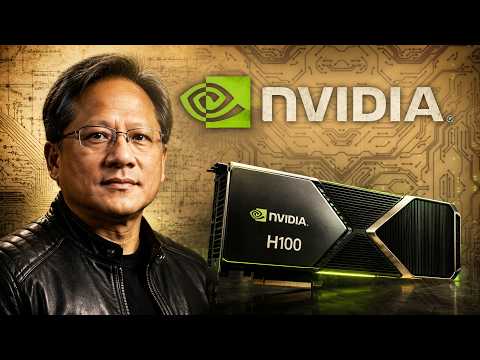
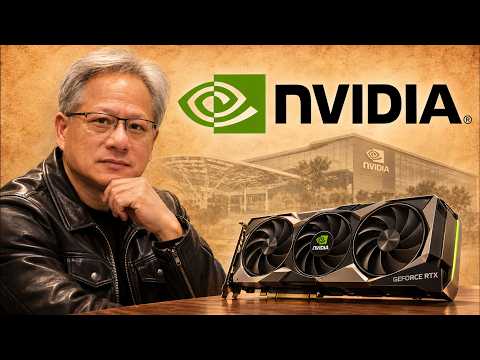
For those less interested in reading the Huang biography or the many long articles that I have drawn upon, I'd strongly commend a pair of videos by the Tech District channel , which specializes in such short documentaries. These do an excellent job of presenting most of the remarkable history in an engaging format, with the release of the second having been prompted by the current controversy.
One reason that Huang may have been blindsided by the political attacks that suddenly led to his ouster was because he himself had always been so totally apolitical. As his biographer explained:
Huang drank whiskey, didn't tweet, and, as far as I could tell, had over the course of forty years never offered a single political opinion about anything. (Searching federal records, I found not a single donation made in his or Lori's name.)
Huang seems an extremely hard-working, competent, and innovative individual, dedicated for forty years to the single-minded goal of producing the most powerful and advanced microchips in the world and selling as many of them as possible. Given his apparent lack of interest in politics, it is rather ironic that he was brought down by a political plot.
Subscribe to New Columns
The Rise and Fall of the Anthropic IPO
Although the controversy over Jensen Huang and Nvidia continued to draw heavy coverage this last week, the biggest AI story was the looming IPO of Anthropic, whose stock began trading on Thursday.
Over the last month there had been growing concerns over the financial prospects of the entire AI industry. Analysts began publicly doubting that future profits could possibly justify the massive ongoing capital investments. As a result, AI-related stock prices had sharply declined, completely erasing trillions of dollars in market value.
Anthropic was the leading AI lab and the first such company scheduled to go public. Many were hoping that a highly successful IPO could reverse that increasing financial pessimism and allow the AI sector to regain some of the investor enthusiasm that it had recently lost.
At first, that appeared to happen. Anthropic shares were heavily over-subscribed, allowing them to be priced much higher than expected, and the stock still popped from there. As a result, although the IPO price had been around $83, any initial purchasers on the public markets had to pay over $111. The IPO was the largest in history, with the five-year-old, money-losing company soon valued at around $2 trillion.
But just after that IPO, the Wall Street Journal published an article reviewing the finances of Anthropic and its main competitor OpenAI, including charts showing the recent quarterly figures for the two companies.
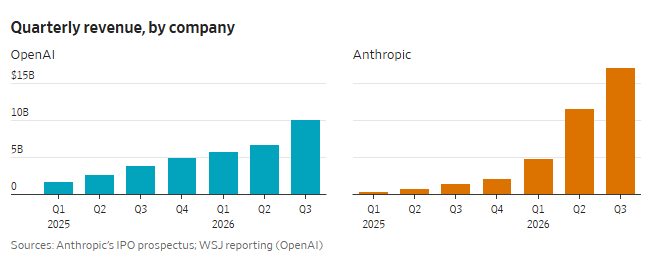
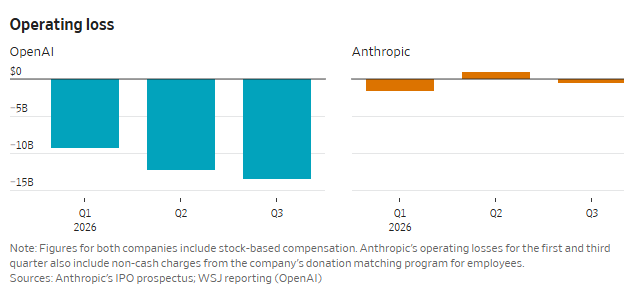
Although Anthropic's revenues had been growing rapidly, it had operating losses almost every quarter, while the numbers for OpenAI were far worse, with operating losses that were enormous and steadily growing larger.
Moreover, Anthropic had some $895 billion in future financial obligations to Microsoft, Google, Amazon, and other companies coming due over the next few years, with nearly half of those contracts being non-cancellable and with no obvious way to pay those colossal sums. The dollars greatly exceeded the total of its current cash holdings together with the proceeds from its IPO, while its junk-bond rating would make borrowing very costly and difficult. So despite the seemingly successful IPO, unless its profits suddenly took off in spectacular fashion, Anthropic hardly seemed likely to survive.
Given these facts, the financial story of the Anthropic IPO seemed far crazier than anything I remembered from the notorious Dotcom era of the late 1990s. In those days, money-losing companies might have ridiculously overvalued stock prices, but they rarely had committed themselves to nearly a trillion dollars of future financial obligations that they had almost no hope of paying.
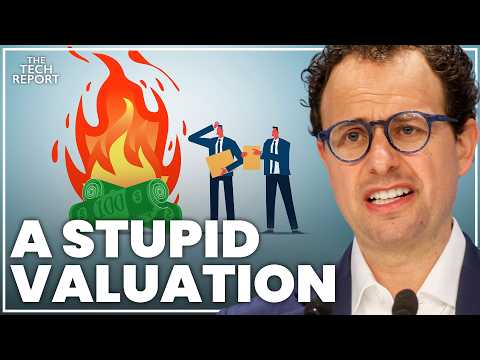
In a Thursday interview the noted economist Dean Baker made these sorts of points, arguing that the Anthropic valuation had completely "thrown reason to the winds."
The leading-edge AI systems offered by Anthropic were among the best available, but they were also extremely pricey and not hugely superior to those of its competitors, notably including the many leading Chinese AI companies. The latter specialized in providing the so-called "open weight" AI models that were often priced 99% lower, and as a consequence they had begun attracting a great deal of American corporate business.
The mere availability of these inexpensive systems exerted tremendous pricing pressure upon Anthropic, greatly reducing the possibility that the company would ever become profitable enough to cover its enormous financial commitments. For exactly that reason, Anthropic had been involved in a major political lobbying effort to ban the Western use of those drastically cheaper Chinese AI models.
I was also shocked to watch one of the closing public pitches to investors by Anthropic CEO Dario Amodei. In that video, he came across like a lunatic or a nineteenth century snake-oil salesman, declaring that the AI products of his company would eliminate cancer, heart disease, Alzheimer's, mental illness, and all other diseases, although medical experts expressed considerable skepticism of those possibilities.

Last year Amodei had also declared that his company would help establish a unipolar world ruled by American AI systems. Therefore, he urged our government to support this geopolitical project by prohibiting American businesses and consumers from using any of the much cheaper Chinese AI systems, while also banning the export of AI microchips to China.
Meanwhile, Huang had been a leading figure on the other side of this debate. He supported the continued availability of such inexpensive, open weight models while opposing an American government ban on AI microchip exports.
This raised some dark suspicions about the circumstances behind Huang's ouster. So far this year Anthropic had already spent many millions of dollars on federal lobbying efforts. This led many to wonder whether the company and its expensive lobbyists might have had a hand in promoting the fraudulent spying scandal that led to Huang's fall, doing so in order to clear the path to a successful Anthropic IPO.
But although the Thursday morning headlines proclaimed the stellar success of the Anthropic IPO, that triumph soon turned to ashes as the stock dropped like a stone. Investors who buy a stock at its IPO take that risk in hopes of making huge gains, but by the end of that day, they had already lost around 17% of their initial investment, and the decline continued on Friday.
A Times article on Saturday morning reported the grim results:
Many hedge fund managers failed to get stock in Anthropic's offering at the initial price of $83 per share, said Raphaëlle D'Ornano, an A.I. industry analyst who also invests in public stocks. The hedge funds instead paid a significantly higher price for shares when trading opened on Thursday at $111.50.
Those hedge funds would have lost money as the stock quickly sank, closing at $88.91 on Friday. At the same time, funds have been trying to limit how much stock they own in A.I. companies overall, she added.
Friday "was pure panic," Ms. D'Ornano said.
As the Saturday Wall Street Journal reported, this came as part of the general collapse in the prices of AI-related stocks.
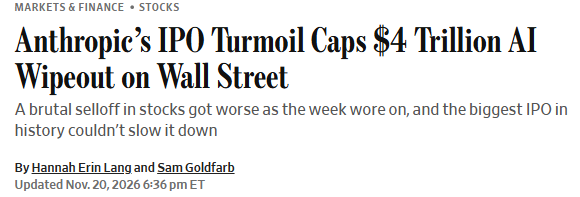
The Tech-heavy Nasdaq stocks lost more than $4 trillion of their market value during the week, with this "wipeout" eliminating all their previous gains for the entire year. Indeed, the loss of 10% made it the worst week since March 2020 when Covid-19 swept through the global economy.
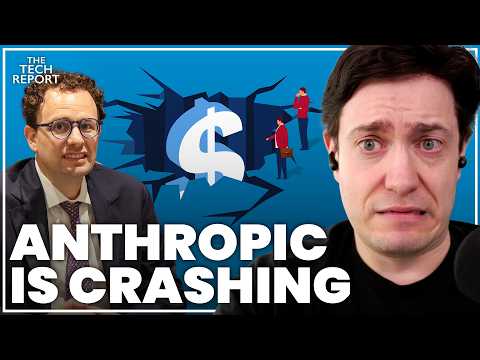
For years I'd been regularly wondering when the irrational AI boom would finally go bust, and perhaps it might now be happening. Ed Zitron had spent the last couple of years as the fiercest critic of the finances of the entire AI industry, and he also wondered whether the long-predicted collapse might now be occurring, with the Anthropic IPO having been the straw that broke the camel's back.
Meanwhile, anything less than a fully successful Anthropic IPO probably doomed OpenAI to eventual collapse and bankruptcy. OpenAI began years earlier but its financials were far worse than those of Anthropic, and although it has repeatedly declared it was planning an IPO for next year, the hemorrhage of its senior executives suggested that they hardly viewed that as a likely possibility. OpenAI's future financial obligations were comparable to those of Anthropic, but with operating losses of around $10 billion each quarter, it had little hope of ever covering them without an IPO.
In the past, the company managed to plug those financial gaps with huge periodic inflows of venture capital, investments often far larger than what it actually sought. But when it announced that it would be raising another $30 billion, it ultimately obtained little more than one-third of that amount, suggesting that future fund-raising might become extremely difficult.
And if OpenAI went under, taking with it the nearly $200 billion of investment capital it had absorbed over the last few years, the impact upon the entire AI industry might be cataclysmic.
Oracle has been spending hundreds of billions of dollars building data centers based upon its financial commitments from OpenAI, and if those suddenly disappeared, the company might be placed in a desperate financial situation. Last year, Larry Ellison briefly became the richest man in the world, but given the $58 billion in Oracle stock he has pledged as collateral for his personal loans, a sudden collapse might put him at some risk of bankruptcy.
The Collapsing AI Financial Bubble
In hindsight, I think it's quite possible that the initially successful Anthropic IPO might ultimately represent the high-water mark of the entire AI boom.
For years, AI technology has been touted as transformative for the entire American economy, but there seems less and less evidence of that. A couple of charts from Apollo noted the very sharp divide between the so-called "Magnificent 7" Tech companies and the remainder of the S&P 500.
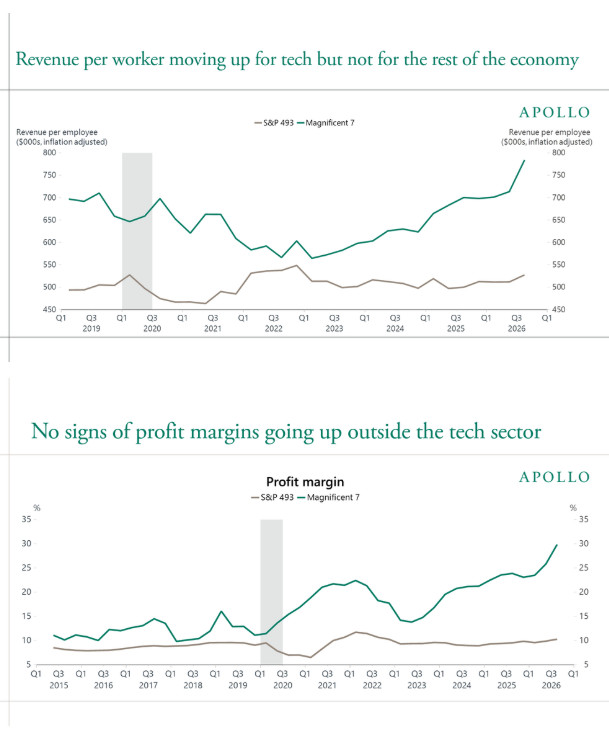
The residual S&P 493 represent the bulk of the American economy, and there seems no indication that they have benefitted in any way from the AI revolution, They have gradually begun recognizing that AI systems have done little to improve their productivity and therefore they have sharply reduced their AI spending, including by switching to much less expensive Chinese models. The Times article describing the collapse of the Anthropic stock quoted an industry source who estimated that 80% to 90% of all AI revenue came from just 20% of the customers. And the lions' share of those crucial customers are probably other AI companies.
A Bloomberg article from a few weeks ago included a chart showing the tangled financial arrangements of the different AI companies, with Nvidia linked to all of them, and Anthropic representing a crucial bellwether for the entire sector and its very incestuous financial arrangements.
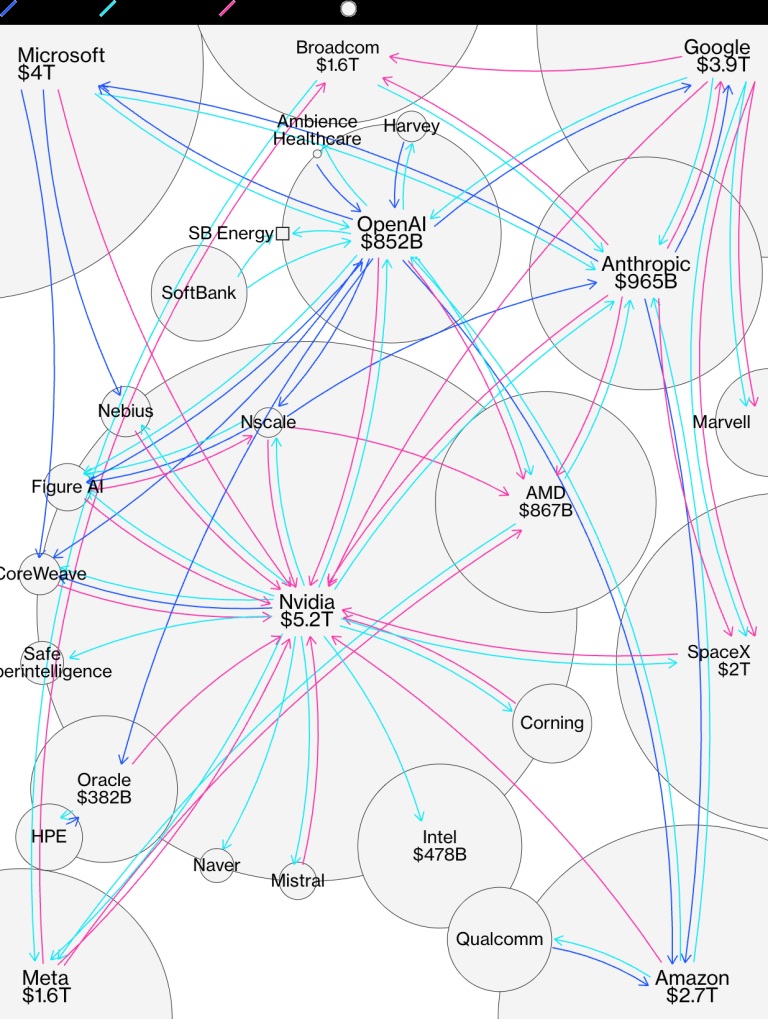
To some extent, I think the financial flows of the entire AI industry may constitute a pyramid.
At the base of the pyramid are the hundreds of money-losing, cash-burning AI startups that have only been kept alive by constant infusions of venture capital or other investments, in many cases coming from other AI companies such as Nvidia. But once those available flows are exhausted, most of those startups will disappear.
The startups provide the overwhelming majority of the revenue of Anthropic and OpenAI, paying for the AI services that they then package and provide to their own clients, usually with large subsidies. Neither Anthropic nor OpenAI has ever been profitable, but their financial situations will drastically deteriorate once those AI startups run out of money and can no longer buy their services.
Meanwhile, Anthropic and OpenAI run their models on the data centers of the hyperscalers such as Microsoft, Google, and Amazon as well as those of the independent and largely debt-funded "neo-clouds." But in almost none of these cases does this stream of revenue cover the enormous capital spending, so nearly all of these data center operations have now gone cashflow negative.
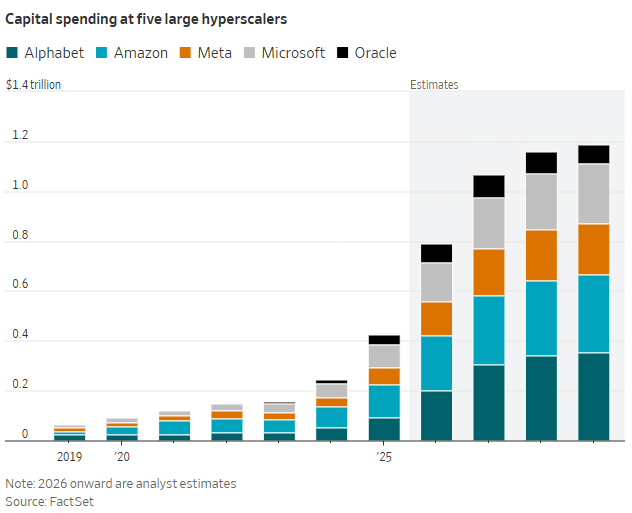
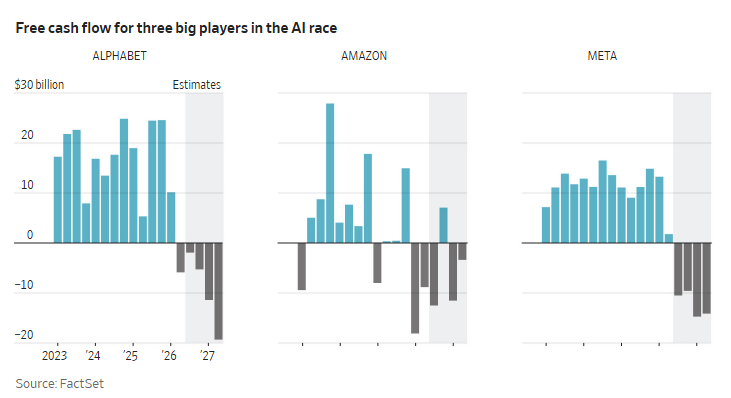
Finally, at the apex of the pyramid lies Nvidia and a handful of other chipmakers, selling their very lucrative products to the hyperscalers and neo-clouds as they build out those data centers. All the latter companies are apparently operating under the hope that those data centers will eventually turn large profits, though this seems far from likely.
So under this framework, the bulk of the financial flows within the entire AI industry are actually internal. The main financial inputs at the bottom are venture capital investments and debt issuance, which are then passed up through the different levels of the pyramid until they are finally paid out at the top to Nvidia for its microchips or used to hire construction workers and purchase electrical equipment for the data centers. But relatively little of the revenue coursing through the AI industry comes from the rest of our economy, whether from ordinary consumers or non-AI businesses.
Even under current conditions, only Nvidia and the other chipmakers are turning a profit. Almost every other participant in the AI ecosystem is cashflow-negative and unprofitable, so the tottering AI pyramid has only managed to remain standing due to capital inflows or sales of debt, and once the latter are exhausted, the entire system will collapse.
Although AI technologies are often valuable and will certainly survive and perhaps thrive, that may not be the case for the trailblazing AI companies such as OpenAI and Anthropic. The early years of the Internet suggest a possible analogy.
When most users had little understanding of the Internet and how it worked, the towering colossus was AOL, which provided a walled-garden that took tens of millions of people online for the first time while collecting metered monthly fees of $9.95 for its dial-up service, and later switching to $19.95 for unlimited use.
But once people began using broadband services and also became more comfortable with the free availability of the open Internet, the AOL business model totally collapsed.
The rise and fall of AOL was told in one of the short documentaries of the Tech District channel.
I think that the AOL story may be highly suggestive of the likely fate of Anthropic and OpenAI, which offer expensive AI services that may lose their market as customers become more comfortable with the vastly cheaper alternatives, whether from Chinese companies or American ones.
The so-called "frontier models" at the cutting-edge of AI ability are becoming less and less necessary for ordinary AI users, most of whom would accept a slightly less powerful option in exchange for a 99% reduction in price.
Meanwhile, another early Internet pioneer was Yahoo!, which also spent years as its reigning titan. Although nearly all of the other dotcoms of that era lost money and were only kept afloat by venture capital, Yahoo ! was enormously profitable from the huge quantities of display advertising that it sold.
But what many people failed to appreciate was that the companies buying most of that advertising were those other money-losing dotcoms. So most of the Yahoo ! revenue actually came from that same inflow of venture capital but once removed, and when those flows ended, the Yahoo ! advertising business dried up. Another Tech District documentary tells the story.
Once again, this seems a good analogy for the current situation of Anthropic and OpenAI. Although they have absorbed enormous amounts of venture capital and investor equity, their boosters emphasize that their customer revenues have also been rapidly growing, suggesting that they will soon be able to survive on their own. But most of their largest customers are themselves probably money-losing AI startups, who rely upon venture capital. Thus, a large fraction of the revenue streams of the two AI labs merely consists of venture capital once removed, and is likely to soon disappear.
AI advocates regularly draw the analogy between this revolutionary technology and the Internet, and I think they have a reasonable point. They also argue that much like the Internet, these early days of the AI industry are filled with temporary difficulties and dead-ends so we must give the system time to mature, and once again they are probably correct. But almost none of the early Internet companies survived, and I think that analogy is also quite relevant.
Subscribe to New Columns
Finally, we should realize that a technology such as AI may be extremely valuable to the world without necessarily generating much profit for anyone.
The very same day that that the Times was unleashing its apparently fraudulent espionage accusations against Huang, a webzine columnist highlighted the latest practical application of our remarkable AI systems, citing an article on a technology website entitled "Software is Over."
In recent years, more and more software companies have begun shifting away from the traditional sale of their products and instead adopting a rental model. Rather than a one-time payment, they charge users a monthly fee to operate the software, a fee that the companies can regularly raise at their sole discretion. The columnist angrily denounced Adobe Inc. on those grounds:
Like most software companies of any great size these days, Adobe products now runs on a subscription model, meaning you don't buy its products, you rent them. Calling it a subscription is polite. You subscribe to a magazine. You purchase a car. It's a subscription in the same sense that paying to cross a bridge is a "subscription." It's rent, pure and simple, and predatory rent at that.
Adobe Photoshop is $22.99/month as a standalone subscription, or $19.99/month as part of the Photography plan, which also includes Lightroom and 1 TB of cloud storage. There's also a "Creative Cloud" plan for a smart $70 per month before discounts...
The last version of Photoshop you could actually own — as in "pay for once and use" — was released in 2012. The last version of Acrobat you could perpetually own was released in 2020. Its end-of-life was last year.
Taking advantage of this new rental system, software companies have begun massively gouging their clients, and there seemed no way to break their stranglehold.
But the newest AI models have suddenly transformed the situation. A software engineer discovered that these were powerful enough that he could disassemble the executable code of those commercial software products, reverse-engineer them, and then produce work-alike clones that he distributed for free:
Now, one developer is using AI-powered reverse engineering to mimic the look, feel, and functionality of Adobe's well-known software with what he hopes will soon be perfect fidelity.
ArtCraft got its start last year as a "controllable AI for artists" that allows for precise post-generation editing of AI-crafted images and videos. Over the weekend, though, the brand debuted its pivot to a suite of seven open source apps recreating the user interface and tools found in Adobe's Photoshop, Illustrator, Premiere, Lightroom, After Effects, InDesign, and Acrobat Pro.
In announcing those new apps on Reddit earlier this week, software developer Brandon Thomas said he used Anthropic's Claude Opus 5.5 to create "clean-room replacements" for Adobe's closed source software in Rust (with WebAssembly versions available for use in a browser).
A podcaster told the story in a short video:

The columnist highlighted the potentially revolutionary aspect of this entirely legal process:
Your takeaway: Every proprietary piece of commercial software can be cloned with AI and given away for free. Everything, from Windows 11 or 12 to TurboTax to you name it. If it runs offline, you can make it and use it for free.
This is a revolution. Thomas's team has already added Windows products to the replicated list (see below). Get ready for more.
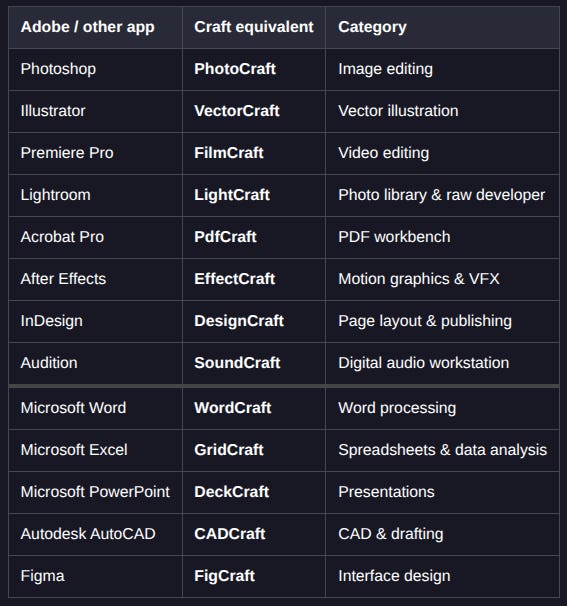
So by allowing the easy creation of free software products, AI technology may save users around the world many tens of billions of dollars. This might be very good for consumers but would hardly assist Anthropic, OpenAI, or so many other AI companies in avoiding collapse and bankruptcy.