Lorenzo Maria Pacini
In a multipolar world, the Mediterranean is first and foremost a space for mediation between civilizations, and only secondarily a military theater.
From the Black Sea to the Mediterranean
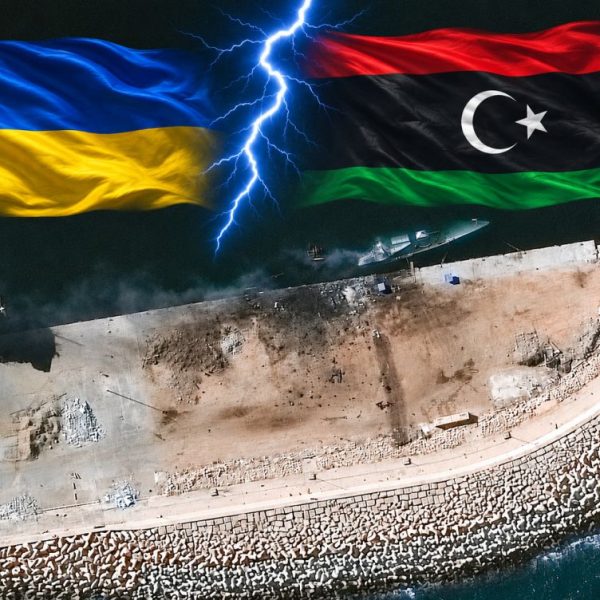
In a message released on Monday, November 23, Volodymyr Zelenskyy claimed responsibility for what Kiev had preferred to leave vague for months: the operation carried out off the Libyan coast bears the hallmark of the Ukrainian Security Service (SBU), supported by the Defense Forces. According to the Ukrainian account, seven domestically manufactured surface drones sank the missile corvette Merkury-a Project 20380 vessel that entered service in 2023-destroyed the Ka-27 helicopter on board, and struck the cargo ship MV Angara, which Kiev describes as an arms transport. Zelensky spoke of an "exemplary operation" and announced that the actions would continue in designated maritime areas.
The corvette was not at sea. Two Libyan military officers interviewed by the Associated Press reported that the Merkury was moored at the Benghazi naval base in Cyrenaica, which is controlled by Khalifa Haftar; the eastern administration clarified that it had stopped there to refuel, under a cooperation agreement with Moscow. Satellite images released by Vantor show the hull capsized inside the port. The rest of the Ukrainian report is less credible. The Libyan military speaks of six naval drones, four of which were intercepted and two of which hit their target; other accounts describe a swarm of aerial drones used as decoys and two surface-launched drones, only one of which is said to have struck the hull. The Angara does not appear to have sunk; the helicopter reported as destroyed does not appear in the footage released by Kiev; and some OSINT analysts point to the sanctioned bulk carrier Ascalon as the second target. The political implication, however, is different. For the first time, the Ukrainian government officially acknowledges conducting military operations in Libyan waters.
This admission brings to a close nearly nine months of plausible deniability. On March 3, 2026, the Arctic Metagaz LNG carrier, which had departed from Murmansk and was headed for Port Said, was struck approximately 130 nautical miles north of Sirte. Moscow accused Kiev of launching surface drones from the Libyan coast, and Putin openly referred to it as a terrorist attack, while the SBU remained silent. In April, two Libyan officials told the AP that the attack had originated from a military facility in Tripoli and that Ukrainian personnel had been deployed gradually in western Libya under a confidential agreement with the government of Abdul Hamid Dbeibah. An investigation by RFI later reported that over two hundred Ukrainian officers and specialists were stationed in Tripoli, Misrata, and the Mellitah area, in exchange for training Libyan forces in the use of drones and the prospect of Ukrainian arms supplies and investments in the Libyan oil sector. On April 8, Maria Zakharova had warned that Ukraine's actions risked turning the Mediterranean into a new flashpoint of tension. According to Italian media reports, five Russian ships have been struck by drones in the basin over the past twelve months.
With Benghazi, the nature of the act changes. Striking a ship from the so-called "shadow fleet" in international waters without claiming responsibility still falls within the gray area of economic warfare. Sinking a Russian warship moored in the port of a third country and then taking credit for it before the world is tantamount to declaring the central Mediterranean a theater of operations in the Russian-Ukrainian conflict. Kiev has brought the war within a few hundred kilometers of the Italian coast, in a sea that does not belong to it, relying on a Libyan government that represents only part of the country. I call this choice strategic folly, and not merely for the sake of controversy: its logic is to broaden the scope of the conflict. A war that no longer yields breakthroughs in the East needs new fronts to remain politically relevant in the eyes of its Western financiers, and the Mediterranean offers visibility, targets, and a European audience that feels directly implicated.
A geometry of possibilities
To understand why the Mediterranean lends itself to this maneuver, one must look at the network of relationships within which the operation is situated. This is not a formal alliance, and it would be incorrect to describe it in those terms. It is a constellation of strategic proximities that has Italy as its hub and which, taken as a whole, offers Kiev logistical depth, political cover, and a permissive environment.
The first axis connects Rome and Kiev. On April 15, 2026, while receiving Zelenskyy at Palazzo Chigi, Giorgia Meloni confirmed Italy's "all-around" support and its interest in producing drones jointly with Ukraine. In July, Fincantieri was among the companies selected under the EU-Ukraine agreement for the joint production of drones and anti-drone systems; in August, Guido Crosetto appointed Mykhailo Fedorov, former Minister of Defense in Kiev, as his advisor on defense innovation. These are legitimate decisions by a sovereign government, but the effect is clear: from Moscow's perspective, the Italian defense industry is now intertwined with Ukraine's precisely in the segment-unmanned systems-through which the war is now spilling into the Mediterranean.
The second axis crosses the Adriatic. In 2025, the Italian government transferred the patrol vessel Libra to the Albanian Navy free of charge-the same vessel used for transfers to the centers in Shëngjin and Gjadër; armed with a 76/62 mm cannon, it has become the most capable ship in Tirana's fleet. The strategic cooperation agreement signed in Rome by Meloni and Edi Rama on November 13, 2025-and approved by the Chamber of Deputies in the summer of 2026-provides, among other things, for the joint production of weapons, ammunition, and military vessels. In April, Fincantieri formed a joint venture with KAYO, a subsidiary of the Albanian Ministry of Defense, to build and maintain naval vessels in Albania, while Chief of Defense Staff Luciano Portolano relaunched joint projects in Tirana and the Italian Air Force conducted training at the NATO base in Kuçovë. To say that Italy has armed Albania is not an exaggeration. It is the description of a deliberate policy to strengthen the military capabilities of an ally.
It is within this context that the most sensitive rumor should be interpreted. According to sources cited by the Clash Report channel and reported by the Italian press, the naval drone that struck the Merkury is said to have taken off from Albania, traveling over 800 kilometers; the same source claims that the theory pointing to western Libya was circulated by Ukrainian circles to divert attention. The SBU, for its part, states that the seven drones were transported to a predetermined location and launched from a "mother ship." A preliminary investigation cited by Teleborsa, however, points to a base operated by Ukrainian forces in western Libya. As things stand, the departure from Albania remains an unconfirmed hypothesis and should be treated as such. Even when taken with caution, however, it carries weight. The mere fact that it is plausible-that a Ukrainian intelligence service might conceive of operating from the territory of a NATO country bordering the Strait of Otranto or from a support vessel transiting the Ionian Sea-shows just how much the Adriatic-Ionian corridor, that is, Italy's immediate security zone, has become part of the war's operational geography. Confirmation of this would force Tirana-and by extension, Rome and the Alliance-to face the question no one wants to hear: who authorized what.
The third axis links Tirana to Israel. Following the 2023 memorandum of military cooperation, in January 2026 the Albanian Ministry of Defense announced a partnership with Elbit Systems for the production of drones; that same month, Rama addressed the Knesset, and in October the two governments signed a general cooperation agreement extending to energy, technology, and cybersecurity. Rama himself has pointed to the partnership with Israeli industry as the path to exporting "Made in Albania" defense systems. In other words, Albania is becoming a small hub in the military drone supply chain, fueled by Israeli technology and Italian manufacturing.
The fourth axis is Libya. Over the past two years, Rome has expanded its channels of communication with both halves of the country: Meloni's visit to Tripoli and Benghazi in May 2024, Interior Minister Matteo Piantedosi's mission to meet with Dbeibah and Haftar in February 2026, and the new meeting between Meloni and Dbeibah at Palazzo Chigi three months later. On the military front, Italy trains pilots from Misrata and, judging by recent images, units of Haftar's Libyan National Army; it also played a key role in preparing the Flintlock 26 exercise in Sirte, organized by the United States and Italy with forces from the east and west. Tripoli remains the preferred partner. And it is Dbeibah's Tripoli, according to the Libyan sources cited, that is hosting the Ukrainian specialists.
The fifth thread is the thinnest, and it runs once again through Rome. It was in the Italian capital, in August 2023, that Tripoli's Foreign Minister Najla Mangoush met with her Israeli counterpart Eli Cohen; this was followed by street protests and her removal from the government. In 2026, news reports documented Saddam Haftar's contacts with Israeli officials, which Libyan observers interpreted as a way for him to gain credibility in Washington by promising future adherence to the Abraham Accords. Normalization does not appear on Tripoli's official agenda. Libya, however, is already a key component of the plan to extend the Abraham Accords to the Maghreb, and Italy has served as the meeting place for this at least once.
Taken together, these axes trace a perimeter linking Ukraine, Italy, Albania, Israel, and Libya. No single aspect, taken on its own, proves the existence of a common command structure, and there is no public evidence that Rome authorized or had prior knowledge of the Benghazi operation. The convergence, however, is real and observable: the same actors share drone supply chains, security and intelligence channels, preferential relationships with Libyan governments, and a hostile stance toward Moscow. Kiev operates within this network and uses it to amplify its own actions. Here, the concern expressed by Antonio Tajani-who spoke of a war just a few hundred kilometers from Italy, the danger of destabilizing Libya, and the hope that these are isolated incidents-reveals its full contradiction: Rome fears the effects of an escalation that its own network of relationships has made possible.
Libya as a proxy battlefield
The target was not chosen at random. According to available accounts, the Merkury was escorting Russian convoys headed to Libya and other African countries in support of the Africa Corps. By striking it in Benghazi, Kiev has brought the war into the Libyan rift: on one side, the Tripoli government, accused of hosting Ukrainian bases; on the other, the Cyrenaica government, which welcomes Russian ships under cooperation agreements. The Russian-Ukrainian conflict thus overlaps with the internal division that Washington and Rome are trying to resolve through the unification of the Libyan armed forces. The head of the eastern government, Osama Hammad, has asked Kiev to account for its military activities in the country and has called for an investigation to identify who operated the drones and who provided logistical support, regardless of nationality. The United Nations has also called for an investigation and respect for Libyan sovereignty.
There is also an aspect that directly affects Italy's national interest. Among the sites attributed to Ukrainian forces in western Libya, sources point to the Mellitah area, where a facility is said to have been equipped as a launch site for aerial and naval drones. Mellitah is home to the complex managed by the joint venture between Eni and the Libyan National Oil Corporation, from which Greenstream-the undersea gas pipeline that terminates in Gela-begins. A drone launch base in close proximity to that facility exposes Italy's energy security to possible retaliation from a power that, until recently, had no reason to view that stretch of coastline as a military target.
The normalization of sabotage
Benghazi is the latest link in a chain. From the Crimean Bridge to the tankers of the "shadow fleet," Ukraine's strategy has made covert operations, sabotage, and remote attacks against maritime infrastructure and shipping a standard method. The Nord Stream case came very close to Italy: in August 2025, a Ukrainian citizen suspected of coordinating the sabotage of the gas pipelines in the Baltic Sea was arrested in the province of Rimini under a European arrest warrant and subsequently extradited to Germany. The attack on the Arctic Metagaz demonstrated what it means to apply this method in a heavily trafficked sea: a gas tanker loaded with natural gas ablaze between Libya and Malta, thirty crew members in a lifeboat, and, according to Moscow, two people seriously injured by burns.
The risks to international stability fall into three categories. The first is legal. Kiev maintains that a Russian corvette is a legitimate military target and that the Angara was transporting weapons; under the law of naval warfare, this argument has merit, and an honest analysis must acknowledge it. The legitimacy of the target, however, does not resolve the issue of the theater of operations. The Thirteenth Hague Convention of 1907 prohibits belligerents from using neutral ports and waters as a base for naval operations against the enemy. An attack launched from the territory of non-belligerent states and carried out in the port of a third country-which, moreover, has been subject to a UN arms embargo since 2011-drags non-participating parties into the conflict and erodes the very rules that protect neutral nations.
The second level is strategic. Any state that hosts, tolerates, or facilitates these operations becomes, in Moscow's eyes, a de facto co-belligerent. If the Albanian lead were confirmed, the issue would involve a NATO member, with the consequent risk of retaliation and the Alliance's involvement in a theater that no Atlantic Council has ever authorized. The third level is systemic. Low-cost naval drones, deployed covertly by state actors who deny or claim responsibility as it suits them, become a model that anyone can replicate in a sea crisscrossed by undersea cables, gas pipelines, and some of the busiest trade routes on the planet. The European Union itself, which in June authorized units of Operation IRINI to stop and inspect ships suspected of belonging to the shadow fleet, is contributing to the militarization of route control, while Moscow denounces the measure as a threat to maritime security. The result is a sea where the line between police control, economic warfare, and conventional warfare is blurring month by month.
What might happen
In the short term, it is likely that Moscow will reinforce the escort of convoys bound for Libya and the Levant and, through Haftar, increase political pressure on the Ukrainian presence in Tripolitania. It is possible, with a moderate degree of confidence, that Russia will decide to strike Ukrainian sites in the west of the country either directly or through intermediaries; less likely, but not to be ruled out, is an asymmetric response against the interests of countries it considers facilitators.
Three indicators will reveal which path will prevail in the coming weeks: the outcome of the Libyan and UN investigations into the origin of the drones; Tirana's clarifications-or silence-regarding the Albanian lead; and the Tripoli government's stance toward Ukrainian personnel present on its territory.
For Italy, the issue is simple to articulate but difficult to manage. In recent years, Rome has built a network of relations with Kiev, Tirana, Tripoli, and Benghazi designed to project influence in the Mediterranean. Today, that network is being used by an external actor to export a war that began on the Dnieper into our seas. Concern alone is not enough.
If Italy truly intends to work toward Libyan stability and freedom of navigation-as its foreign minister asserts-it must use the leverage at its disposal: demand that Tripoli close the Ukrainian sites, insist on clarity from Tirana, and raise the issue at the European and Atlantic levels regarding a partner that is expanding the conflict without consulting anyone.
In a multipolar world, the Mediterranean is first and foremost a space for mediation between civilizations, and only secondarily a military theater. Turning it into an extension of the Eastern Front-through attacks, sabotage, and incursions claimed after the fact-means working against the security of all coastal countries. Italy, first and foremost.