Alexander Dugin examines the emergence of a possible anti-globalist alliance between Russia, China, and Trump, the threat of a direct war between Russia and Europe escalating into World War III, and whether a new geopolitical alignment can prevent such a catastrophe.
Conversation with Alexander Dugin on the Sputnik TV program Escalation.
Host: Alexander Gelyevich [Dugin], here is the question and the central issue with which we will undoubtedly begin our discussion. What stands out is a sudden increase in the contrast of everything taking place, almost as though someone had turned up the contrast on a television screen.
Until recently, one could still speak of a certain geopolitical fog enveloping the statements, maneuvers, and positions of the various parties, whether adversaries or allies. But after the events of November 19, which unfolded simultaneously in China and Berlin, it feels as though someone has turned the contrast almost all the way up.
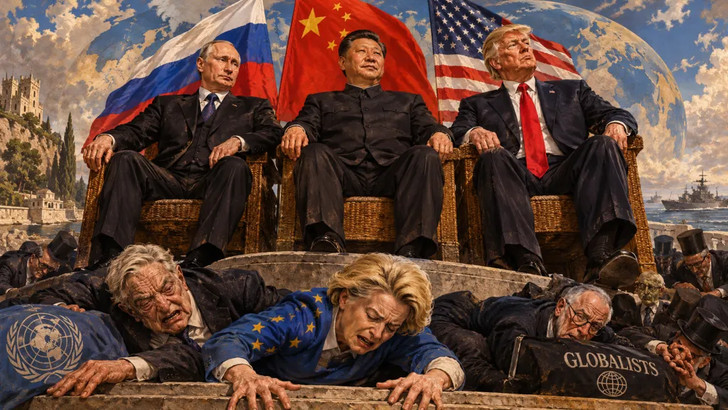
In Shenzhen, on the sidelines of the APEC summit, a historic trilateral meeting took place between Vladimir Putin, Xi Jinping, and Donald Trump. On that same day in Berlin, Chancellor Friedrich Merz and European leaders assembled the so-called "Coalition of the Willing," together with Volodymyr Zelensky, demanding a seat at the negotiating table and promising further arms deliveries to Kiev. It is becoming increasingly clear that what happened in China and what happened in Berlin belong to two parallel realities that no longer have anything in common.
Alexander Dugin: You are absolutely right. The contrast has indeed increased dramatically, and let us try to describe it in greater detail.
First, following the meeting in Shenzhen, which has already been dubbed the "tripolar summit," a very definite model of the world order is taking shape. Representatives of the multipolar world were present: two already established poles whose sovereignty and independence as geopolitical actors can no longer be disputed, two fully developed civilization-states: Russia and China. They do not stand alone. Behind them stands the rest of humanity: India, the Islamic world, Africa, Latin America, and such formidable opponents of the West as Iran and North Korea.
Thus, in Shenzhen, Trump came face to face with the entirety of multipolar humanity. And even at the level of body language, through gestures, symbolic actions, signs, facial expressions, and remarks, he effectively said: "I am prepared to accept this." In other words: "I am prepared to deal with you. It is not that I agree with you on everything. In fact, I probably disagree with you on almost everything. But I acknowledge your existence." And that alone changes everything.
Subscribe
The point is not that Trump ideologically embraces the philosophy of the multipolar world, but that he is prepared, at least, to engage in direct dialogue with it. After all, speaking separately with China is one thing, and speaking separately with Vladimir Putin is quite another. But when the conversation takes place simultaneously with China and Russia, it means entering into dialogue with two poles at once and, through them, with the entire multipolar world, treating it as a unified whole, as a kind of "club," if you will. This is, of course, a matter of fundamental importance.
In fact, this is precisely what Trump proclaimed during his election campaign. He promised to strengthen America's power, not within a globalist framework, but in a manner that served his own country's interests. The United States, as a nation-state, would become a pillar of sovereignty, and from that point onward he would act strictly according to the principles of national pragmatism.
Naturally, it is objectively in America's interest as a nation-state to establish reasonably stable relations with the other global poles, agree on common rules of engagement, delineate spheres of influence, and respect their boundaries. How much suffering and upheaval could have been avoided if he had followed this path from the very beginning!
But after a considerable delay, a whole series of strange zigzags, and fundamental departures from his original plan, including attempts to impose brute force and Western hegemony on the world, albeit from a somewhat different angle than that of the globalists, while relying on the very same neoconservatives who are directly fomenting war against the multipolar world, Trump has finally returned to his original program after performing all these bizarre political pirouettes. He has returned to the very program for which the American majority, American society, and American voters supported him and JD Vance.
Now, this certainly does not mean that Trump has come over to our side or agrees with us on everything. Most likely, he agrees with us on virtually nothing, and his position represents an entirely separate side of its own. But at least he has adopted a position clearly distinct from that of the globalist collective West.
Meanwhile, the globalist collective West itself has now emerged as a sharply defined, independent pole, distancing itself from Trump. We are witnessing the emergence of a kind of "second West." On one side stands Trump. He still has two years of his presidency remaining, and his actions will continue to influence the behavior of the West to some extent. Perhaps not as much as before, but certainly to some degree. After all, he is the president of the largest country in NATO and the Western world, and in both military-strategic and economic terms, he largely embodies America.
On the other side, however, an alternative pole is crystallizing ever more clearly. We might call it the Yes Coalition, by analogy with the "Coalition of the Willing" that assembled in Berlin. Let us consider the word itself: Yes Coalition. For a long time, we struggled to find an accurate translation of Coalition of the Willing. Willing to do what, exactly ? The term Yes Coalition makes everything clear. What precisely are they saying "Yes!" to?
They are saying "Yes!" to a major war with Russia ! In other words, this Yes Coalition is consciously choosing war with Russia, a war that, according to its calculations, is supposed to erupt in full force sometime in the future, but which it believes must be prepared and inflamed right now. Its plan is extremely simple: continue fighting the war through Ukrainian proxies for as long as possible, refuse to make any concessions whatsoever, and simultaneously prepare the next act of this drama, the next episode, which will consist of a direct invasion of Russian territory by a coalition of European countries and NATO forces. Whether that begins with Kaliningrad, the Baltic states, or some other direction is a matter best left to military strategists, both ours and theirs.
And these two trajectories, the Berlin trajectory of the Yes Coalition and Trump's trajectory, are diverging ever more radically. The Yes Coalition declares: "No multipolar world ! No sovereignty for Russia!" And once they believe they have finished with Russia, they will turn their attention to China. Their formula is therefore "Russia first": destroy Russia, inflict a strategic defeat upon it, and then concentrate all their forces against China. Once Russia has fallen, there will be nobody left in the world capable of preventing the preservation of unilateral Western hegemony at any cost.
That is approximately where things stand today. This is precisely why one thing is being said in Berlin while something entirely different is happening in Shenzhen.
As for Jared Kushner and Steve Witkoff, who traveled to Berlin to meet with Zelensky and the Europeans, they are Trump's special representatives, but they are merely technical negotiators. To imagine that they personally influence events, make independent decisions, approve anything, obstruct anything, or facilitate anything would be the height of naivety. They are nothing more than couriers transmitting information. They are simply cables through which electrons travel, a kind of living fiber-optic network. That is what Kushner and Witkoff really are.
Of course, one can feed them, entertain them, admire them, or, conversely, attempt to circumvent them, imagining that everything depends on them. But they are merely instruments. The driver who takes us to a particular destination does not determine the route. The destination is established by entirely different people, and he is simply the chauffeur carrying out instructions. Essentially, they perform the function of fiber-optic cables. They are expected to transmit Trump's signals to all parties as quickly as possible and report back to Trump just as promptly about what is happening in Berlin or Kiev, without introducing their own distortions into the message. Some even question their impartiality, but one thing is beyond doubt: they are certainly not independent political actors.
The real actors here are entirely different: Trump on one side, and the Yes Coalition, the coalition committed to war against us, on the other.
Thus, on the one hand, Trump says: "Let's negotiate." The previous day, he posted a photograph on his social media platform, Truth Social, showing himself shaking hands with Vladimir Vladimirovich Putin at the Shenzhen summit, accompanied by the caption "My friend" ("Yes, he is my friend").
But if Putin is his friend, if he deliberately emphasizes this and makes no attempt to conceal it, then one would think it was time to translate these words into practical action and genuinely begin de-escalating our relations. And that, generally speaking, is what Trump says he wants.
However, on the other side stands the Yes Coalition, and therein lies the central problem. This coalition committed to war against us includes not only the European Union and its Brussels leadership, but also the Democratic Party of the United States. In other words, essentially half of the American political establishment belongs to this coalition. Remember that the Democrats opposed the war with Iran and unconditional support for Netanyahu, yes, but at the same time they openly declared: "Instead of a war with Iran, there should be a war with Russia!" And these very Democrats have now secured majorities in both the House of Representatives and the Senate.
Thus, half of America and the entire European Union stand against Trump. But that is not all. A substantial part of Trump's own Republican Party consists of neoconservatives whose principal objective is precisely the same war with Russia. They speak about this quite openly.
The resulting configuration is as follows: there is Trump himself, and there is the Yes Coalition, which dominates Europe, where it continues to hold power despite the political ground already beginning to shift beneath its feet. It now also predominates in the US Congress, both in the House and the Senate, which represents half of American politics. And it possesses an enormously powerful flank in the form of the neoconservatives within Trump's own party.
And standing against this entire machine is Trump alone, a man who is himself extraordinarily inconsistent. We simply have to accept this as a given, as an established medical fact. Otherwise, we will understand nothing at all. If we attempt to construct a model of Trump's behavior based on consistency and strict logic, we will become hopelessly confused by the third or fourth iteration. He is inconsistent. Let us simply acknowledge that as a fact.
On the one hand, this creates enormous risks. On the other hand, there is at least something positive: he is talking to us. Through the "fiber-optic cables" of Witkoff and Kushner, he sends reasonably sensible signals, listens to our position, and makes proposals. There is direct contact and an exchange of information. But within the United States, he is surrounded on every side, while in Europe he has absolutely no support.
And it is precisely this European-globalist Yes Coalition that now directly controls Zelensky. Zelensky functions as a kind of spearhead, the vanguard of the Yes Coalition, because he is already engaged in an active war. Meanwhile, all the other Western countries are being invited to arrange themselves into a military wedge, a triangle converging on Nazi Kiev, and join this "Teutonic boar's head" formation, a unified battle formation intended to deliver a devastating blow against Russia.
Host: Allow me to approach this same global question from two additional angles. The first is this. Donald Trump, as almost everyone must have noticed, mentioned the globalists twice during his visit to China, particularly during the trilateral meeting with Xi Jinping and Vladimir Putin, identifying them as one of his principal targets. He spoke explicitly about fighting the globalists as an evil force, both in connection with the International Criminal Court and more generally as a force that must never be allowed to control the world. In other words, he effectively identified the globalists as his obvious enemies, precisely as you have just described.
And this raises the following question. I understand that the comparison may seem somewhat far-fetched, but during World War II there was an anti-Hitler coalition involving Churchill, Roosevelt, and Stalin, which met at the Tehran, Yalta, and Potsdam conferences. Now we seem to be witnessing the birth of a new anti-globalist coalition, one that Trump is joining. Personally, I see a certain symbolism in this.
But what is truly striking is this: do you see some historical pattern here, or even, if you will, an esoteric or metaphysical logic in the fact that Germany is once again emerging at the head of the opposing camp ? Berlin itself is now acting as the principal ideological leader of this "coalition of war," both in terms of its rhetoric and its concrete actions, its enormous financial contributions and arms deliveries to Kiev, and even the latest extremely aggressive statements by German Foreign Minister Johann Wadephul, who openly demands Russia's capitulation in Berlin and threatens to defend "every inch" of NATO territory. Germany again, just as in World War I in the 1910s and World War II in the 1940s. Is there some universal logic behind this ? Why does Germany once again insist on assuming the role of our principal enemy?
Alexander Dugin: Well, first of all, let us examine the first part of your very valid observation, concerning the comparison between the Shenzhen meeting and Yalta. All the world's news agencies have already drawn this parallel: Vladimir Putin, Donald Trump, and Xi Jinping standing together, alongside Winston Churchill, Franklin Roosevelt, and Joseph Stalin. Their photographs are placed next to one another, side by side or above and below each other. These visual comparisons are now everywhere. You are right: it is the first parallel that comes to mind.
But back then, at Yalta, victory over Germany had already been virtually secured. We were allies, and our common enemy was Nazism, an ideology rejected by both liberalism and socialism. It was therefore both an ideological meeting in the face of a common enemy and a geopolitical meeting between powers that were already emerging victorious from World War II, when much had already been decided. Nobody seriously considered Hitler a possible participant in future negotiations. He was finished, and the parties were essentially dividing the world between the capitalist and socialist camps, between the Anglo-Saxons and the Soviet bloc.
Today, the analogy is different. I agree with you that if we are speaking about a common enemy of the Chinese, ourselves, and Trump personally, that enemy is the globalists. That is absolutely correct. But to imagine that we have already defeated them, that we are approaching a decisive victory over them, or that we have begun seriously establishing a full-fledged coalition involving Trump, Xi Jinping, and Putin seems to me the greatest exaggeration of all. We are only at the very beginning of a possible anti-globalist and anti-hegemonist alliance directed against the Yes Coalition, and even in our relations with China, there is not yet complete clarity on this question.
This is not even Tehran. We are at a much earlier stage, making preliminary attempts to comprehend a Third World War that has not yet properly begun but will unfold somewhat later. Therefore, despite the enormous symbolism of the moment, what we witnessed was merely the world as it might have been.
If we could reach an agreement now, and if Trump were consistent (which he never is), if Trump were genuinely determined to see this through to the end (which is also extremely difficult to believe), and if he still possessed the necessary instruments of power (which is a very serious question) to pursue this course consistently and compel the West, on whose behalf he speaks, to respect it, then we would already find ourselves in a reasonably favorable starting position for preventing World War III.
In other words, if we imagine Trump controlling the collective West and opposing the globalists, then with the support of Russia and China, the Islamic world, a rising India, Africa, and Latin America, all these poles could collectively contain and halt the escalation initiated by the Yes Coalition. But you must agree that every single one of these "ifs" presents an extremely serious problem.
In Shenzhen, we merely caught a glimpse, a fleeting look, of the world as it could become: multipolar, with the United States retaining a global role, but exclusively as a nation-state. Yes, all of us, Trump, Xi Jinping, and Putin, are to one degree or another opponents of globalization and globalism in its Western-centric, hegemonist form.
We all oppose this ideology of perversion, the legalization of perversions, and the rejection of traditional values. All three forces, Trump, Xi Jinping, and ourselves, stand for traditional values and our deepest identities.
It is no coincidence that in his brilliant interview with Emir Kusturica, Vladimir Vladimirovich spoke at such length about Moscow, the Third Rome, Christianity, and everything that makes us who we are. We are a civilization-state. China is a civilization-state. And the West is a civilization-state.
The globalists, however, want to claim that they represent neither a state nor a civilization, but some kind of "unified humanity" which, under their leadership and the auspices of this degenerate "Epstein class," is supposed to build a global liberal empire.
Therefore, whereas back then, in Tehran and Yalta, we negotiated with our allies for the purpose of fighting a common struggle, already approaching victory over a common enemy whose ideological embodiment was Nazism, German National Socialism, today our principal enemy is global liberalism. Because liberalism is the underlying ideology of the globalists.
Trump faces enormous problems with the liberals inside America. But we, thank God, together with China, have largely dealt with our own domestic liberals and moved on to the next stage. He, however, still has this struggle ahead of him ! We have already defeated liberalism, at least within our own civilization-states, and that is why we conduct ourselves so calmly, confidently, and consistently. We already know what we have had to endure.
Trump, however, has essentially failed to achieve this decisive victory over the internal enemy: the liberals, the globalists, the Deep State, the "swamp," and this "Epstein class." Moreover, look at his position. He has only two years left in office. His standing has been seriously weakened by the utterly disastrous war with Iran and his blind support for Netanyahu and his extremist policies. And now Trump must once again confront the liberals, who hate him more and more intensely and are simply waiting for the new Congress to begin its work so they can start restricting and sabotaging every decision he makes, and perhaps even impeach him.
That is the position in which he finds himself. He is, of course, an extremely weak link in our potential anti-liberal coalition, if you will. But it is already encouraging that such a coalition has at least been envisaged, that its contours are beginning to emerge, however faintly, in these initial outlines and sketches. This creates new opportunities and offers the possibility of salvation for the West itself.
Perhaps Europe, too, will eventually reach the point where it is ready to overthrow its globalists and become one of the participants in this new order. But all of that still lies ahead. Very difficult times await us. Escalation lies ahead. Nevertheless, what has happened represents a very significant success for high-level ideological diplomacy: for us, for China, and, frankly speaking, for Trump himself.
Host: And the second perspective, as I mentioned, concerns Germany and the peculiar role it has played throughout the twentieth and now the twenty-first century. Every forty or fifty years, Germany seems to transform itself into some strange, malevolent standard-bearer whenever a major war is about to break out in Europe. The reasons differ, the banners change, but every time it is directed against Russia. Every time, they end up as our adversaries, and indeed our principal adversaries. How do you explain this recurring role of Germany?
Alexander Dugin: That is true, and it is a valid observation. However, if we examine the geopolitical, civilizational, and ideological character of the Second Reich, for example, the Germany created by Bismarck and the Hohenzollerns, we find that it was undoubtedly an independent actor in European politics, strongly anti-British and anti-Western. And, as Bismarck himself believed, it was rather close to traditional, conservative Russia. In other words, there was not even a trace of Russophobia at the foundations of the Second Reich. Quite the opposite: Bismarck drew inspiration from Russia. He understood that Russia was a great country, a truly formidable rival and competitor. I do not know whether he was a Russophile in the fullest sense of the word, but he certainly drew inspiration from Russia's example. Indeed, Germany itself was created as an alternative to Franco-British domination of Europe.
But what played the decisive role here ? In Germany's defeat in World War I, incidentally, and in the collapse of our own empire, it was that British coalition. The British were united through highly effective transnational organizations, networks, and clubs, often Masonic clubs, which repeatedly managed to turn natural allies, Russia and Germany, into adversaries, thereby strengthening their own position. In essence, because of the configuration of forces before World War I, our decision to support the Entente, and Germany and Austria's decision to go to war against us, both sides made suicidal choices. Suicidal for Germany and for Russia alike. Do not forget what this meant for Russia. For us, it ended very badly indeed. The idea of siding with the West against the Germans cost us our empire. In other words, we were deliberately set against one another.
Subscribe
The second point brings us to World War II. Germany now had a different ideology, but once again Germany was an independent actor. Once again, the Germans themselves decided who their enemies and friends would be. They were not puppets or proxies, and they began World War II by going to war with Britain. Notice that: with Britain. As for us, they were thinking: perhaps an agreement with the Russians might be possible. After all, there were socialists on both sides. Different kinds of socialists, of course, but perhaps they could reach an understanding. This certainly does not mean that they liked us. They hated us. The Nazis were something entirely different. This was no longer the Second Reich. The Third Reich was something completely different. Nevertheless, Germany remained sovereign and made its own decisions.
And once again, we found ourselves on opposing sides. This time, the invasion of the Soviet Union, which proved fatal above all to Germany itself, cost Germany its Reich. That was the end of it. The Reich ceased to exist, Germany was divided, and we emerged victorious, despite our alliance with our sworn enemies, the capitalist West. We took advantage of that alliance, and we won. We consolidated our gains: part of Germany, Prussia, came under our control, as did Eastern Europe. That was precisely what was decided at Yalta: the distribution of power.
We were the victors. Our people paid a terrible price for that victory, but we believed that we had finally settled the German question, that Germany would never make the same mistakes again. Yet some time passed, and we lost everything we had gained. This, too, is extremely important. In the eyes of political realism, there is no such thing as "we left Germany of our own free will and gave it the opportunity to reunify." That is nonsense for the gullible. It was our weakness, our defeat, and the betrayal of our leadership. In the eyes of the West, we lost the Cold War, and our voluntary surrender of control over East Germany, Prussia, and Eastern Europe, followed by the surrender of our own country, the Soviet Union, is regarded simply as capitulation.
And what do you do with those who are weak, who have surrendered, who have lost ? Exactly: you finish them off, until you have established complete control. That is why an entirely new situation has emerged today.
In this respect, today's Germany is neither the Second Reich nor the Third Reich. It is, essentially, a kind of Ukraine. It is an entirely puppet political entity, a proxy of the Yes Coalition, a proxy of the American Democrats, a proxy of the globalists. There are no genuine national interests guiding today's Germany. Absolutely none.
Our president speaks about this frequently. If anyone in the German leadership were guided even partially or remotely by their own national priorities, they would realize that nothing could be more important, beneficial, necessary, pragmatically valuable, or consistent with Germany's national interests than an alliance with us. We have no intention of attacking anyone. We possess no aggressive ideology that we seek to impose indiscriminately on others. We do not interfere in domestic political processes, and we offer perfectly understandable and transparent terms. Germany could not possibly find a better ally.
But Germany acts against its own interests. Remember the Nord Stream pipeline. After all, it was not merely our pipeline. It was a joint Russian and German project. The Ukrainians blow it up, meaning the Yes Coalition, those very globalists, and the Germans do not even shed a tear. They make no serious attempt to investigate, do not shake their fists and threaten to catch and punish those responsible. On the contrary, they effectively say: "It was right that they blew us up!"
This is a policy of pure masochism, a policy that has essentially become a perversion, a geopolitical perversion, as though they were pleading: "Put even more pressure on us ! Punish us ! Hang us up ! Torture us!" It is pathological.
That is what Friedrich Merz represents today. This is not the Second Reich, which possessed genuine independence, nor the Third Reich, which possessed its own ideology, however criminal, horrific, and monstrous that ideology was. At least the people there made their own decisions and carried them out themselves. Merz, however, decides absolutely nothing. He is simply a participant in some kind of BDSM club. He is irrelevant in his own right, a complete nonentity. And this is no longer an independent Germany.
Back in the twentieth century, there was first one Germany capable of acting independently, and then another Germany, the Third Reich. In both cases, the British did everything possible to destroy any potential balance between Russia or the Soviet Union and Germany, even if that balance amounted to nothing more than neutrality. Just consider how much effort they invested in turning Nazi Germany against us ! For them, it was a way of distracting an enemy at a time when Germany was attacking Britain itself, opening another front against us, and diverting the Nazi assault away from Britain. That was the alpha and omega of their entire policy. And they succeeded.
But now they do not even need to take anyone's interests into account. Today, there is no need to persuade Merz to attack Russia or escalate the conflict. An order is simply issued, and he obeys it without question. He is nobody. And he will do whatever he is told, regardless of his approval ratings, regardless of his country's interests, regardless of his party, his industry, his energy sector, his economy, his finances, or his society. Regardless of everything ! If the gentlemen of the Yes Coalition tell him, "Go soap a rope and hang yourself," he will immediately carry out their instructions.
That is what total control means. Even Zelensky, perhaps, enjoys greater freedom in his terrible terrorist frenzy. He is still capable of making at least some decisions himself, although, of course, in reality he is not. But here we are dealing with absolute dependence on outside powers.
Host: I would like to dwell on this point in a little more detail. God forbid that we should compare these characters too closely. Each reveals himself in his own way, although, for obvious reasons, they are merely different shades of the same color. But you mentioned Merz's helplessness when it comes to independent political agency and, in a certain sense, Zelensky's ideological obsession. What I mean is that he is not merely a scoundrel, but an obsessed scoundrel. In everything he is doing now, he behaves like a fanatic, as he is often described.
This leads me to the following question. I am not exactly trying to find some easy grounds for optimism here. What optimism could there possibly be ? But when we look at this enemy as a potential adversary, God forbid on the battlefield, although already in the geopolitical arena, what do you make of the internal disorder, the internal contradictions, including economic ones, that are eating away at Europe and driving apart the positions of countries such as France and Germany ? What about the cracks undermining this coalition from within?
Unlike the Third Reich, where ideology played an enormous role in uniting Europe around the idea of a common campaign against Russia, whether that enemy was deliberately incited or became inflamed of its own accord is ultimately beside the point, the situation today is different. Do you see any reason for optimism in this ? Looking at what is happening, this patchwork quilt seems far too full of holes to come together into a single formidable striking force against Russia.
Alexander Dugin: You are right. That is an entirely accurate observation. Contemporary Europe, contemporary Germany, is certainly, in many respects, an exhausted, disjointed, and pitiful society. But there are two factors here that genuinely give cause for concern.
The first is that, in the event of a major war, Europeans are capable of mobilizing, even if that seems incredible at first glance. They could temporarily put aside their gay pride parades, which are prohibited in Russia, their subconscious brain rot, and all the rest of it, and introduce a harsh, pragmatic system, a kind of liberal fascism modeled on the same system they have already tested in Ukraine. A dictatorship already exists there to a considerable extent. It could simply become even more severe and chauvinistic, with pronounced Russophobic elements.
Indeed, when Ukrainians repeat the mantra "Ukraine is Europe," the opposite could very well happen: Europe itself could become a version of Ukraine. They could simply copy the very methods they themselves introduced into Ukrainian society as a kind of political laboratory, where liberalism and dominant globalism were combined with Nazi and repressive practices. Since this worked in Ukraine, it is entirely possible that they will attempt to apply similar mechanisms within Europe itself. Of course, nationalist impulses might ultimately turn against the globalist liberal elite itself, but we cannot dismiss the possibility of this kind of mobilization and authoritarian consolidation.
But that is not even the most serious issue. The most serious issue is America. Just consider the numbers: Europe has approximately four hundred million people, while the United States has more than three hundred million. Together, that amounts to well over half a billion, almost a billion people, against us alone ! And on top of that comes America's enormous power, the principal striking force of NATO: its intelligence capabilities, satellite constellation, gigantic nuclear arsenal, and vast military-industrial and technological potential.
If all of this is unleashed against us as a single force, the situation will become deadly serious. We will face an extraordinarily difficult struggle. I am convinced that we can withstand it and emerge victorious, and we still have instruments at our disposal that we have not yet employed. Even Iran, for all its limitations in scale, has managed to repel the American onslaught. What, then, can be said of great Russia ? But achieving this will require enormous, ironclad determination.
Nevertheless, when we combine these two factors, the overall picture is far from optimistic. Even if we have to confront Europe alone, while America does not merely watch from the sidelines but provides Europe with its natural support through NATO, since the alliance is ultimately an American instrument, especially against the backdrop of the Democrats' growing influence in Washington, we will face a very difficult situation even under those circumstances.
And if matters escalate into a direct confrontation with the entire collective West, in the fullest sense of the term, involving NATO military contingents, attempts to intervene on our territory, and attacks against Kaliningrad, Crimea, Novorossiya, and our regions deep within Russia, then the situation will instantly cease to be anything resembling a leisurely affair. Neither Witkoff nor Kushner, nor Trump's social media posts about who is or is not his friend, will matter in the slightest. There will be a direct confrontation between gigantic forces. And it is precisely on the basis of this harsh reality that we must formulate our policies.
Of course, the less involved Trump is with the Yes Coalition, and the greater the distance he maintains from it, the better for us. It would be preferable for America to distance itself, even slightly, from this growing spiral of escalation.
A theater of military operations between Russia and Europe: let us call things by their proper names. We can already see what is happening. Two ships, one in the Bay of Biscay and another in the Baltic Sea, have been struck by Ukrainians. Whether they were Ukrainians or not, the conflict zone is clearly expanding. Russian assets are being attacked by our enemies, effectively by the Yes Coalition. After all, the Ukrainians are merely one component of the Yes Coalition. The Yes Coalition is attacking us, and any day now this could escalate into a genuine, full-scale, major war with Europe.
Alternatively, if everything proceeds according to their own plans, it could happen in a year or two, because they are not yet fully prepared for a large-scale, direct confrontation. But within a year or two, certainly by 2030, they are seriously preparing to wage war against us, regardless of whether we suspend military operations in Ukraine now or not. That no longer makes any difference. In fact, a temporary suspension would be even more advantageous for them. It would allow them to assemble their forces, regroup, lull us into a false sense of security, and then strike with their full strength.
And this conflict is simply inevitable if events continue along their present course. Unless, that is, we take certain steps, certain preventive measures. And I am not necessarily talking about nuclear weapons. That is what immediately comes to mind: let us use nuclear weapons, our ultimate trump card. But that really could be the final card, and then humanity as a whole would be in terrible trouble. Not merely us or the West, but almost everyone, perhaps absolutely everyone. That is the very last resort, one we should avoid reaching at all costs. I am absolutely convinced of that.
But there is an entire range of other possible strategies and actions through which we could deter and repel Western escalation, measures that could have a preventive effect and avert a direct military confrontation. We need to begin implementing them now. I will not go into details, but we possess numerous "transmission belts" through which we could make the West experience firsthand what it feels like when serious problems strike from within.
We have categorically refrained from all such actions. That is the will of our president: no actions within other countries directed against their legitimate authorities. We never violate our own rules. You violate yours constantly, but we do not. We establish our own "red lines" and then observe them ourselves, whereas you treat your own red lines entirely differently. It is unfortunate, our president says, but we are people of honor.
Well, in that case, if we remain people of honor and Putin truly follows this course to the very end, then nuclear war becomes inevitable. That is all there is to it.
Host: Just yesterday, Jean-Luc Mélenchon declared that if France enters into an open conflict with Moscow, a single strike against France would be enough to wipe the country out. And this is coming from one of the contenders for the presidency in the elections scheduled for April. In other words, at least some people within Europe are beginning to assess the scale of the consequences soberly and understand where this policy of direct confrontation with Russia is leading.
Alexander Dugin: And Marine Le Pen understands this perfectly well, too. When we speak about our potential levers and instruments of influence, we are, of course, also referring to those political forces in Europe that could come to power with entirely different views.
But in reality, the Yes Coalition, this transatlantic Yes Coalition, is certainly not sitting idly by, passively waiting to see which candidate wins an election, thinking, "If this one wins, that will be good; if that one wins, that will be bad." No ! They intervene in the process directly and with the utmost determination. They interfere in every political process, and not merely political processes, throughout Western Europe under their control, Eastern Europe, and indeed the entire world. In other words, they do not think in terms of "If Macron wins, we will go to war with Russia, but if Mélenchon wins, we will not." They will simply do everything possible to prevent anyone they find undesirable from coming to power. Alternatively, someone who currently expresses reasonable positions and makes the right arguments will be restrained, recruited to the other side, presented with some persuasive "argument," or simply reverse his position. Then everything will turn out completely differently, as we have already seen with Trump and Vance.
In other words, we must adopt a genuinely proactive position. From the perspective of the Yes Coalition, war with us is inevitable. The very word "Yes" in the name of this coalition must not mislead us. It signifies a willingness to unleash war against Russia. And if such a Yes Coalition for war against Russia already exists, if it includes major states, governments, and armies, some of which possess nuclear capabilities, then we absolutely cannot afford to take it lightly.
Sometimes we are tempted to dismiss the threat, imagining that a few migrants or degenerates will come rushing at us and that we will scatter them with a single missile. But no, that is not how things work. Remember how, at the beginning, many people thought Ukraine was nothing particularly serious, merely a handful of Nazis. Yet look how complicated and difficult everything turned out to be. That is why I am convinced that we must approach Europe, America, and the entire West, as well as the future full-scale war with the West that will be inevitable if current trends continue, with the utmost seriousness.
This means that the time has come for us to abandon certain unilateral restrictions and obligations that we have imposed upon ourselves and adopt a more proactive policy toward the West. I am not talking about nuclear weapons. That is the ultimate argument, so let us set it aside. Between the nuclear threshold and our present restraint lies an entire spectrum of possible decisions, strategies, instruments, levers, and methods capable of seriously undermining the position of the adversary with whom a confrontation is looming.
That is precisely how we must frame the question: war is approaching, and if we employ these means effectively and in time, we may be able to prevent it. But if we simply continue drifting with the current, prolonging our existing course of action, and wait to see what happens in two or three years, or even two or three months, or two or three weeks, then any sober analyst, any realistic strategist, will tell you that conflict is inevitable. Because our restraint is interpreted over there as weakness, and they measure it precisely as weakness.
We believe that our restraint demonstrates our moral and ethical superiority over them, but they interpret it simply as weakness. We cannot continue living according to this logic. We must demonstrate convincingly that we possess the means to hurt them, to hurt them very badly, while formally remaining within our own rules and without violating our own "red lines."
There was a time when we knew how to operate brilliantly according to this logic. If we had acted a little more forcefully and proactively, perhaps even the outcome of the Cold War would have been different. But back then, we relaxed, as though we had gone on vacation, and lost everything. We cannot afford to relax now. We must pull ourselves together.
(Translated from the Russian)
Subscribe
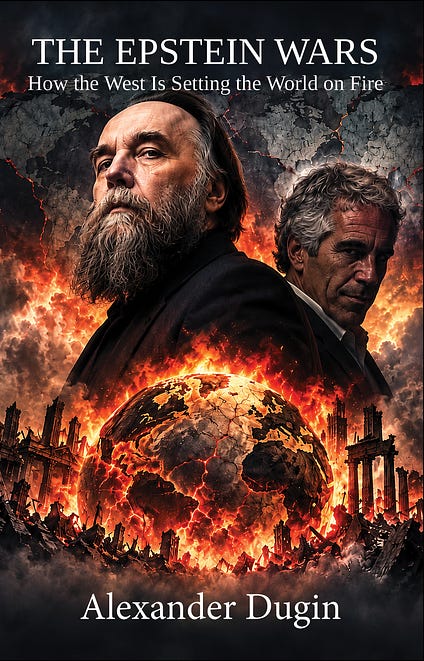
Get Alexander Dugin's new book, THE EPSTEIN WARS: How the West Is Setting the World on Fire, here.