
By Mike Whitney
The Unz Review
November 26, 2026
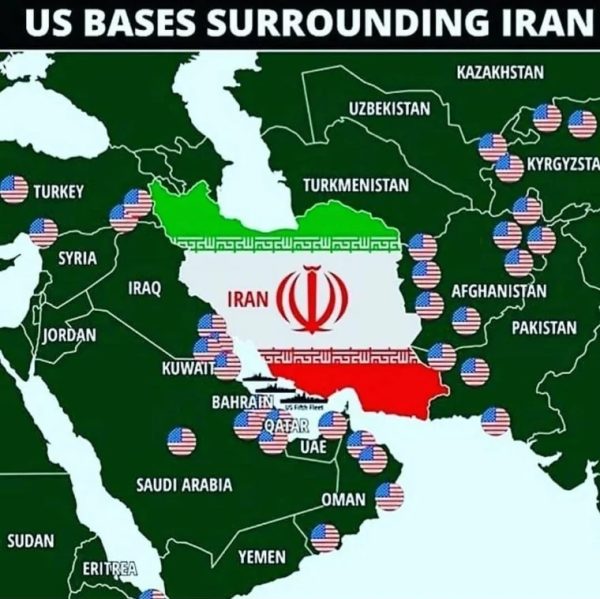
The United States has greatly enhanced its military presence in the Middle East in preparation for renewed attacks on Iran. Roughly 50,000 US personnel and combat troops have been deployed to the region along with additional aircraft carriers, amphibious groups, 200 aerial refueling aircraft, numerous air defense systems, missile launchers and countless unmanned aerial drones. The US has not deployed this much military hardware and personnel since the Iraq War in 2003. Surprisingly, however, there are strong indications that there will not be a Phase 3 of the Iran War. Instead, US President Trump has switched to a policy of expanded economic sanctions bolstered by a far-reaching naval blockade aimed at strangling the Iranian economy. The new policy does not exclude the possibility that hostilities could break out again, it merely suggests that US war-planners do not expect another round of airstrikes will produce the strategic outcome they seek. So, when Trump recently stated that the war was "militarily effectively over", he was speaking the truth.
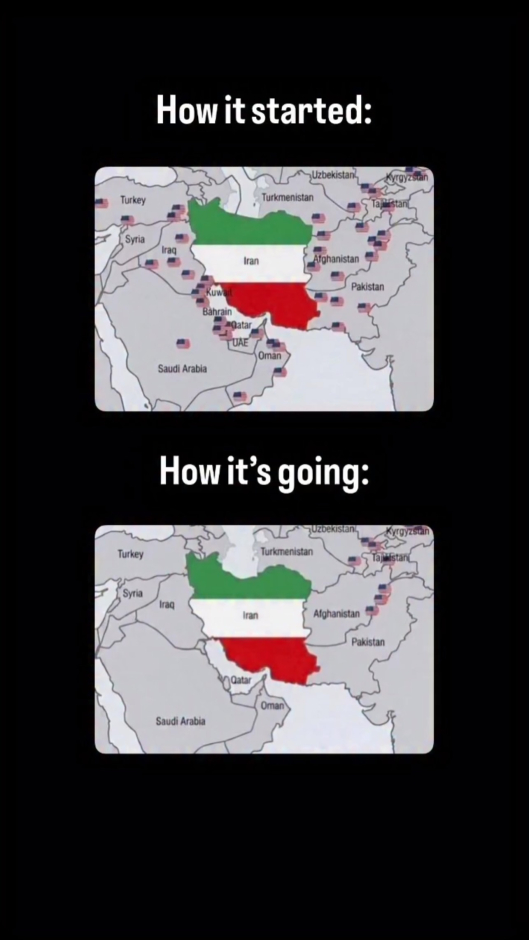
But if the military phase is over, then why have the Iranians ratcheted up their attacks on US bases by many orders of magnitude ? You would think that Iranian leaders would want to see the end of the fighting. Instead, their recent missile strikes have been bigger and more devastating than before. Why ? Do they want a resumption of the war or is there something else going on here that we're missing ? Here's a short video of Sayed Mohammad Morandi confirming what we just said:
It's not an eye for an eye anymore. It's more like 10 eyes for an eye. The Iranians are hitting the Americans much harder. The Iranians are striking tankers every day, sometimes multiple tankers, and not only hitting them, but destroying them. We're seeing the images coming from the Strait of Hormuz. The Iranians have intensified their strikes on the tankers that disobey the Iranian Armed Forces. They've already told all the Gulf neighbors they have to abide by the dictates of the Iranian armed forces. Their ships have no other option, otherwise they will be punished. Now the Iranians are carrying out that punishment. They're not just striking; they are striking very hard. And this is their fault; they should not have engaged in war with Iran. But this is also a major problem for the US; they can't block Iran. A great many US planes are flying over Hormuz, but Iran is hitting far more ships than 2 months ago. And the damage is far more extensive. Many of these ships are sinking, and now, when the Americans strike Iran, Iran strikes back. And, today, when a US drones violated Iranian airspace, Iran struck American assets in Bahrain again without America striking Iran. (first) So, Iran is being very assertive. Iran is sending a very strong message to the Americans, that you either end this war or escalate, but we will not allow the status quo to remain. Professor Sayed Morandi, You Tube
So, why is Iran intensifying its attacks on US assets when Trump appears to be winding down the hostilities ? Is Iran trying to provoke the president into another round of kinetic warfare?
It might look that way, but that's not what's really going on. Iran is stuck between a rock and a hard place. On the one hand, Iran has succeeded in preventing the US and Israel from achieving any of their strategic goals (ie- Regime change, destruction of nuclear program, widespread social unrest, destruction of ballistic missile arsenal, or breakup of regional alliances.) but, on the other hand, the naval blockade has seriously impacted oil sales which is gradually eviscerating the economy. This is why Iran is lashing out more aggressively than before, because it refuses to accept a frozen conflict which is "neither war nor peace" but preserves the status quo. That is the worst possible outcome for Iran because it ensures the progressive deterioration of their economy while enabling intermittent air strikes by the US or Israel.
This is basically what's going on right now. Iran's military victory has not translated into a strategic triumph or a political end-state, so the conflict continues to drag on. This is why Iran is communicating in earnest with Qatari negotiators to see if some type of settlement with the Trump team is possible, because the present situation is unacceptable.
Take a look at this post by former Israeli intel agent Danny Citrinowicz. (Note: Yes, I realize that some readers may be offended by the analysis of a Zionist intel agent.... but read the post before passing judgement. This is by-far the best analysis available.)
Understanding Iran's Strategic Logic - Why the Status Quo Cannot Last
A. The last thing Tehran wants is for the current situation to continue indefinitely. The "no war, no peace" reality is imposing significant economic and strategic costs on Iran, particularly given the effectiveness of the U.S. naval blockade. Iranian leaders have no intention of accepting this situation as the new normal.
B. To break the current deadlock, Tehran is pursuing two parallel tracks. The first is diplomatic, primarily through Qatar, where Iran is reportedly working to update its seven conditions for Washington in an effort to create a possible pathway back to negotiations. This should not be confused with a willingness to abandon its fundamental demands. Tehran is looking for a way out of the crisis, not a way to surrender.
C. The second track is military. Iran is gradually escalating its responses to American military activities in the Gulf while exploring options to challenge the blockade directly, including the possibility of forcing a passage through the Strait of Hormuz with a convoy of tankers.
D. The objective is not necessarily to trigger a full-scale war, but to convince Washington that maintaining the blockade carries growing military, economic, and political costs. Tehran wants to change the American calculation.
E. There is little doubt that Iranian leaders are encouraged by the anticipated changes in Congress in January and by Democratic statements about restricting the administration's ability to continue financing the war. From Tehran's perspective, the political clock in Washington may be working in its favor. Iranian decision-makers may believe that the administration's freedom of action will become increasingly constrained, strengthening Iran's bargaining position.
F. But this does not mean Tehran is prepared to sit quietly and absorb the costs of the blockade until January, much less indefinitely. Iran does not necessarily want another major war with the United States. But it is equally unwilling to accept the current situation.
G. This does not mean Tehran is preparing for a suicidal confrontation. Iranian leaders are still calculating risks, costs, and potential consequences. But they are increasingly determined to break the deadlock, even if doing so requires accepting a significantly greater risk of military escalation.
H. And this is where the administration must be particularly careful. The critical strategic mistake would be to interpret Iran's desire to avoid war as evidence that it is prepared to capitulate. The effectiveness of the blockade does not automatically translate into strategic success. In fact, t he more effective the blockade becomes, the greater Tehran's incentive to challenge it.
I. If diplomacy fails to produce a viable exit, Iran may increasingly turn to military escalation as its preferred instrument for changing the status quo. Washington may believe that time and pressure will eventually force Tehran to compromise. Tehran may believe that escalation, combined with growing political constraints in Washington, will eventually force the United States to reconsider its position.
These competing assumptions are precisely what make the current situation so dangerous. Neither side necessarily wants another war. But both may be pursuing strategies that make one increasingly difficult to avoid. Danny Citrinowicz, X
Brilliant analysis. I can't find one point on which I disagree. But there is one 'fly in the oinment' here, and that is, Netanyahu is not on board with the dramatic change in US policy. Bibi still wants war, and he appears to be doing everything in his power to get what he wants.
I won't to delve too deeply into the quagmire of Israeli coalition politics, but people should realize that the Israeli elections did not settle the matter of who will be the next prime minister. That position is still 'up for grabs' even as the infighting and mud-slinging has reached new levels of depravity. So, the fact remains, that Netanyahu is still very much in control as Israel's "caretaker" prime minister who has the power to launch another massive attack on Iran if he so chooses. Keep in mind, Bibi is not only frustrated by Trump's reluctance to support another attack, but he also faces his own serious legal problems that will undoubtedly lead to criminal indictment the minute his tenure as PM ends. So, from a practical (Machiavellian) point of view, he has no other choice but to lead the charge to war. That is his "get out of jail free" card and there are signs that he plans to use it. This is from a post at YNET, an Israeli news agency:
(Avignor) Liberman: If Netanyahu orders an independent attack on Iran, it is a manifestly illegal order...
Liberman, who chairs the Foreign Affairs and Defense Committee, said in a closed-door meeting of his Knesset faction that "recent reports in the American and Israeli media have discussed chemical weapons that Iran is trying to acquire. If this is true, it is a serious threat, but not one that requires or justifies independent, immediate action without American involvement." He said, "If such a decision is made in the cabinet, it will be a decision driven solely by political and personal interests, and therefore such a decision must be treated as a manifestly illegal order." @ynetalerts
So, Netanyahu's critics think he may launch a unilateral attack on Iran?
Indeed, they do, and they do not discount the idea that Netanyahu might declare a national emergency to derail the forming of a coalition government and order the military to attack Iran for purely political reasons. But is Netanyahu capable of such an egregious act of betrayal?
The question answers itself. Netanyahu is the consumate political surviver; a cold-blooded, remorseless sociopath who would remove the gold teeth from his dead mother's mouth if given the chance. (Note- Israeli outlets reported that opposition leaders and security officials said Netanyahu agitated for strikes even before the election, but faced resistance from the IDF chief Lt. Gen. Eyal Zamir and other defense officials, and is now pushing even harder while serving as caretaker PM.)
In short, the claim that Netanyahu is angling for unilateral attacks on Iran to overcome his political and legal problems "is not fringe speculation; it is an open, high-profile accusation circulating among Netanyahu's domestic opponents and reflected in major Israeli and international reporting in November 2026."
We'll let Citrinowicz have the last word:
An Attack on Iran Without the Americans - A Dangerous Gamble with the Security of the State of Israel
If we have learned anything from the recent wars, it is that Israel can indeed attack Iran on its own, but it is deeply dependent on American assistance, both in defense and in offense, especially when it comes to a prolonged war of attrition.
This is doubly true if Israel decides to strike Iranian energy infrastructure. In that case, it must prepare for a broad Iranian response, including attacks on strategic infrastructure in Israel and the Gulf states, and for the development of a prolonged campaign whose scale and costs will be entirely different from those of a pinpoint strike....
It is also important to remember that an Israeli campaign against Iran could quickly turn into a regional campaign, with the participation of the Houthis in Yemen, the Shiite militias in Iraq, and Hezbollah in Lebanon. Such an expansion would only deepen Israel's dependence on American assistance, both in defending the home front and in sustaining offensive capabilities over time.
Therefore, going to war against Iran without American backing is not merely a military decision. It is a heavy strategic gamble with the security of the State of Israel. And this is especially serious at the present moment, when we are dealing with a caretaker government that does not enjoy the confidence of the Knesset, with no immediate existential threat that requires action and no clear strategic justification for another campaign.....
Israel must not gamble not only with its security, but also with the future of its relations with its most important ally. The question is not whether Israel is capable of attacking Iran alone. The question is whether it is capable of bearing the consequences of the attack alone, defending its citizens over time, and above all achieving a strategic gain that would justify the cost without the administration's assistance. At present, it is hard to see how the answer to these questions could be positive. Danny Citrinowicz, X
Sounds like good advice to me.
Reprinted with permission from The Unz Review.