Eduardo Vasco
The former military commander recounts his personal trajectory, his experience in the fighting in Donbass, and his views on the role of Russia, Western countries, and Ukrainian nationalist groups in the conflict.
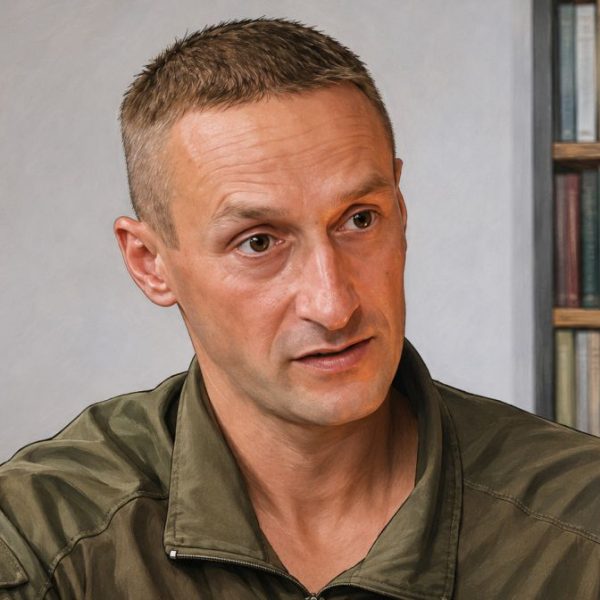
Vyacheslav Yakovenko is a former military commander of the Lugansk People's Republic (LPR). Before the conflict that began in 2014, he worked as an electrician and had no military experience beyond his compulsory military service. Following the coup d'état in Kiev, he joined the resistance movement in Donbass and took command of an armed volunteer formation, eventually leading around 100 men. He took part in battles against Ukrainian forces, including the Aidar Battalion, until he suffered a serious injury in September 2014.
After leaving military service, Yakovenko became an independent journalist, dedicating himself to disseminating information about the conflict and denouncing the influence of Nazi ideology within Ukraine's political and military structures.
This interview was conducted in the center of Lugansk in June 2022, and SCF is publishing it exclusively online. Here, the former military commander recounts his personal trajectory, his experience in the fighting in Donbass, and his views on the role of Russia, Western countries, and Ukrainian nationalist groups in the conflict.
How did you become a military leader in the war against Ukraine?
Before all this, I was an electrician. In other words, I had a civilian profession with no connection whatsoever to military affairs. I had only completed my military service as an ordinary conscript for a year and a half. But then, when the coup d'état took place in Ukraine and Kiev began pursuing an unofficial policy that was unacceptable to our region, we started a peaceful protest movement to express our position in Donbass, proposing a referendum to hear the people's views. Obviously, the Kiev government refused to pursue a social policy and began carrying out punitive actions in Donbass. So I had to take up arms and, some time later, lead an armed formation, since I had some military experience from having served in the army.
And what were the battles against the Ukrainians like?
Well, let's set the record straight right from the start. I am Ukrainian, and so are they. This contradiction is deeply rooted in the late nineteenth and early twentieth centuries. In other words, I fought against many Ukrainians who were fighting other people who are also Ukrainians, just like me. What happened was a civil war. The thing is that their ideology and mentality stem from the fact that they initially belonged to the Austro-Hungarian Empire and therefore decided that they did not belong to the Russian world. Thus, they promote their ideology and their perception of reality, according to which we are not real Ukrainians because we are supposedly an impure kind. Therefore, saying that we fought against Ukrainians is a kind of dead end. We fought against opponents who promoted Nazi ideology in our region, which we obviously disagree with. Stepan Bandera, Roman Shukhevych, and that whole pack are unacceptable to us. That is why we rose up to defend our true history and our true values. And what they offered us was a fabrication. That is the most important thing I must tell you. In other words, it was a struggle between Ukrainians: I am Ukrainian, and they are Ukrainian. It's just that their perception is different; what goes on in their heads is completely different.
How do Ukrainian Nazi militants treat civilians?
Ukrainian Nazis deal with people who do not share their ideology in a radical manner. First, they engage in cultural genocide; in other words, they expect us to share their ideology. But if someone disagrees or opposes them in any way, they physically eliminate that person. Those who disagreed with their policies simply left the territories occupied by the Ukrainian Nazis. Those who agreed to live under these conditions simply accepted this as their duty and began living under the current regime.
Are their attacks focused on civilian or military targets?
They fire at civilian targets. They occupy civilian homes and fire at both civilian and military targets. Donbass is not their homeland; it is foreign land. They do not identify with this land, and that is why they want to cleanse it of people like us.
How is the military defense of the LPR organized?
At this point, we no longer have a military defense. What we have now is an offensive, and we are going to liberate our territory.
And what is the people's militia?
Initially, in the first stage in 2014, a militia emerged that was actually a volunteer corps. But, in the process of establishing the Lugansk People's Republic and creating its state structures, a people's militia began to take shape. We do not have an army, so to speak; we have a people's militia made up of volunteers from among the population. And from this people's militia, a force structured like an army gradually developed.
What is your opinion of Russian military aid?
In short, the fact is that, if it weren't for Russia's moral and financial support, western Ukraine (which is backed by the US, Great Britain, and all the other Nazi states such as Lithuania, Latvia, and Estonia) would already have crushed us, because here we have a living memory of Soviet achievements and honor our veterans on May 9, which is unacceptable in their historical and political context.
If it weren't for the Nazis' activities, would the conflict already have ended?
I don't think so. Because Ukrainian Nazis are a mechanism for the physical repression of dissidents. The conflict will only end when there are no longer any structures connected to the West, to the US, Great Britain, and all those places. In other words, a complete change of power is necessary, because Nazism is so deeply entrenched in the structures of power that the Nazis with guns in their hands are merely a mechanism that makes no decisions. Only the complete and vertical dismantling of power in Ukraine will resolve the conflict.
Does the international press tell the truth about the conflict?
The international media and all those working under the control of foreign governments tell a huge lie. There are some small media outlets trying to convey the truth about the facts, but they are censored and blocked from bringing the truth to the international community. When some small media outlets come to Lugansk, unfortunately, they are only those that support Russia's policy of denazification and demilitarization of Ukraine.
What is your opinion of the US?
The US is a state that has remained deeply Nazi ever since, following the defeat of Nazi Germany, it began taking in all kinds of Nazis and hiding them. One only has to watch interesting films such as The Night Porter and a number of similar films to realize that it is not possible simply to defeat Nazism and destroy its ideology. The fact is that Nazi ideology is deeply rooted in the power structures that became dominant in the US and consequently adopted all of its mechanisms. We know that the United States currently uses many tools, particularly propaganda, that were used by fascist Germany during the Great Patriotic War. And all these mechanisms for dehumanizing a person are currently being used in Ukraine.
How many men did you command in the militia?
Around 100 people. We had a special intelligence unit, with 100 people with whom we effectively destroyed the Ukrainian Nazis. A good example is that, on July 24, 2014, thirty of us defended the city of Lisichansk for three days, held the defensive positions, and eliminated a fairly large number of Nazis. But because the city was surrounded and there was no ammunition supply, we had to leave it. Furthermore, on September 5, we defeated Ukrainian Nazis such as the Aidar Battalion here near Lugansk.
How long did you serve as a military commander?
I was in the army until September 5, 2014, when we defeated the Aidar Battalion in a battle and I suffered a very serious combat injury. I then went through a period of rehabilitation. After my rehabilitation, I realized that the classical methods of warfare, that is, fighting with weapons in our hands, would not work. To solve the problem and restore peace, you have to pursue the path of humanitarian issues.
And why did you choose journalism?
Because it is one of the ways of waging unconventional wars, what is known as psychological information warfare. It is when you begin bringing the truth to the public through the dissemination of information.
Did the international community do anything to help the people of Lugansk?
No. Look, eight years have passed, and if they had done anything, what is happening now would not have happened. There was a time when they condemned the Azov Battalion, but then they began supporting it. Don't they realize that Nazism is flourishing on Ukrainian territory ? On the contrary, they encourage and finance it.
The international press used to call the separatists terrorists. What do you think of that accusation?
That is simply labeling people who hold a different point of view. They needed to justify their "punitive" operation in Donbass. That is why we were called separatists and terrorists. At the beginning of our entire protest movement, all of us, the citizens of eastern Ukraine, advocated holding a referendum within the territory of Ukraine. We had no intention of dividing Ukraine into separate states.