November 24, 2026.
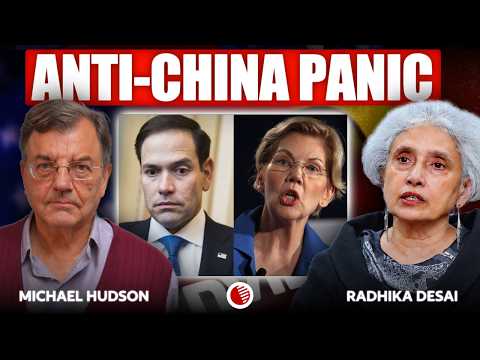
Radhika Desai: Hello and welcome to another Geopolitical Economy Hour, the socialist and anti-imperialist conversation that illuminates the fast changing political economy and geopolitical economy of our times. You are watching Radhika Desai, Geopolitical Economist, and I'm Radhika Desai. I'm joined today by one of our regular friends and guests, Michael Hudson, who needs very little introduction.
Michael and I have been trying to puzzle out what has actually happened this past week. As you know, the week has included all sorts of rather complex developments.
First of all, there was the summit, the Yalta 2.0, between Presidents Xi and Putin and Trump, at which the liberal establishment in all the Western countries were tearing their hair out.
Then there was the whole drama of what happened with Nvidia. As people know, there was this supposed, alleged sex scandal, and Jensen Huang had to resign from his position as CEO of Nvidia. But miraculously we find yesterday morning, that is to say on Monday morning, he was reinstated, and clearly the Trump side had something to do with it. So again, just like in the Shenzhen meeting, there was something of a confrontation between the liberal establishment and the Trumpites. Here the liberal establishment clearly wanted Huang out, and Trump managed to get him back in.
And then finally there is the whole very, very complex situation with the war in Iran, or on Iran I should say, in which there were all sorts of stories being peddled that Iran was going to try to break the US blockade with a convoy of some 14 oil tankers headed for China, and that should the US touch even a hair of these ships, so to speak, these tankers, then there would be hell to pay as far as Iran's attacks on US allies and assets in the region were concerned.
Of course, this story turns out not to have been corroborated by very many people, but certainly it is true that Iran is reaching the end of its tether in terms of this peculiar sort of situation in which there is a war but also there is no fighting. So what's really going on ? And it is threatening retaliation at the slightest provocation and demanding that the United States meet its terms and conditions, more or less what was in that June memorandum of earlier this year.
So Michael, we want to discuss this whole thing and we want to join some dots. So please begin anywhere. Begin at your favorite point.
Michael Hudson: When we first said that we were going to talk about Nvidia, I thought that it was going to be mainly about the financial implications and the crash in Nvidia that brought down the whole AI bubble. But it turns out that the national security implications of this fight against Nvidia and Huang are overshadowing the financial effects, especially now that Nvidia stock has recovered, although it's gone down 5% again today.
The issue is whether the whole world is going to be subject to an American monopoly in AI technology, run by American AI firms that are going to use their control of AI as a choke point on the economy, or whether the world is going to have the China-style open source economy for information technology and for artificial intelligence.
Well, Huang was very much on the side of open source in China, because that's his market. 20% of Nvidia's market was directly or indirectly to China, he said. And as he explained in public again and again to President Trump and to reporters, this 20% of his revenue that comes from China is what has enabled Nvidia to have the revenue to finance its research and development to keep at the forefront of the technology of AI.
Against that are two forces. Number one, the Secretary of the Treasury, Rubio, who has been a China hater from the beginning, ever since, already under I think Clinton, he opposed letting China into the WTO. He represents the whole national security anti-China group that is going to be represented by the Democratic Party coming back in control of Congress. They're completely against Huang.
On the other hand, JD Vance, the vice president, is supporting Huang and the whole idea of open source technology. So this fight is shaping all of the discussion about Nvidia.
The other Huang in Singapore was not a Chinese spy. What she was doing was very open. She was buying Nvidia's chips and had many customers from many countries using her data banks, and that included China.
Well, yesterday Donald Trump came out and said, well, we're going to blacklist any company that is dealing with companies like Megaspeed that are having China as clients using their data banks.
And even more, Trump came out and said, well, we're also going to forbid American companies, the AI companies, from having their own data banks in other countries. It all has to be here under our control. So no more Amazon and Google and Nvidia investing in the Arab Emirates and Saudi Arabia to have their data banks there. It has to be under our control so that we can have a world monopoly and charge enormous monopoly prices to anyone else who is going to need AI, which is the technology of the future, he says.
And he's warned Europe, you'd better lock yourselves in to American closed AI and reject open source dealings with China, or we will look at you as following an unfriendly policy.
So that's really what it's all about. Will America control AI and computer technology for its own national purposes, or will China have open source, which will be used with the Chinese internet and all of the other things that you use AI for, all of information technology generally ? That's what the fight is going to be about, and that's what national security is about.
That's why the Wall Street Journal and the Financial Times are attacking the reinstatement of Huang, and the Financial Times said, well, this just shows how immoral the financial markets are. They don't realize that we should be at war with China and at war with Russia. So that's the argument we're seeing.
Radhika Desai: Yeah. So, at least temporarily, I mean, given that Trump is so unpredictable, it's sort of hard to tell, but if you put together all the three different things that we want to talk about, it seems as if temporarily at least the anti-establishment, anti-warmongering side may have won, in the sense that Trump of course went to Shenzhen. He had his Yalta 2.0 meeting. He showered Xi Jinping with praise, he showered Putin with praise, so that he's sort of saying, I have a good relationship with them, there's no need to have wars with them, et cetera.
Secondly, on the Nvidia thing, again, at least for now, it looks as if Trump and Vance and their side have won against the liberal establishment, who are still waving the flag of the Chinese honey pot thing, honey trap, and so on. And of course they were absolutely livid at Trump even posing with Xi and Putin, let alone having high level meetings with them.
And then thirdly, there is a very complex situation with the war in Iran, and we wanted to talk about that as well, because Trump has made some noises about how he's working on trying to reach an agreement. Meanwhile, the election results have shown that the public does not want the war. So really, Trump has to find some kind of way out, whatever it is.
Plus, members of his own party seem to be talking about getting together with the Democrats and restricting presidential powers to conduct war, to further the war, et cetera. And this may actually be essentially a blessing in disguise for Donald Trump, because he does want to get out of this war. So he could easily say, well, they won't let me fight this war, so now I'm going to come to some sort of deal. So things are going in some really interesting ways.
And certainly one thing is true. I'll just add one more thing before handing the baton back to you, Michael, and that is that the US's ability to conduct this war is increasingly in question. It has lost a lot of the equipment there. They are beginning to tot up the cost of this war, and this is not looking very good.
There's a long story today in Al Jazeera that in the long run, or even in the medium run, the US presence in the region will be much diminished. There is no way that the United States is going to keep the same presence as it had on the 27th of February of 2026.
Michael Hudson: Well, the question is how long can there be a living in the middle like we're doing now ? The United States policy seems to be, well, we're still going to block Iran from exporting its oil, and if it tries to, we'll stop it. We'll just hope to bleed Iran to death, as if, if we lock it off from the rest of the world, this is going to make the population so upset that there will be a regime change. Well, it's as if the whole world hasn't been treating Iran that way since 1979. So obviously this isn't going to work.
But there's an interesting tie-in with the Nvidia issue here and with Trump's attitude. I mentioned before that he said, well, American companies are not going to be able to invest in data centers abroad, like in the Persian Gulf.
Well, these are precisely where Iran had retaliated against the Persian Gulf states that were allying themselves with the United States. It bombed many of the data centers there, because it said we're not only trying to drive the United States out militarily, but all of the economic linkages between Saudi Arabia, the Emirates, Bahrain and all of the other Arab OPEC states, because the economic linkages go hand in hand ultimately with political associations, military, and after all, you're saving all of your national reserves in the US dollar zone, in the United States and in US companies. So that's what Iran's position is.
This is why Iran has been preparing itself day after day for fighting. A lot of the sites that I've been watching, the usual military sites, they all say, well, Iran is loading up its tankers in Kharg Island, and that's all set. They're on the way. Oh, they're hours away from reaching the American vessels. And is the United States going to attack one of the vessels and sink it like it said it was going to do?
And Iran said, if there's one bullet that hits it, kaboom, we're going to totally respond. We cannot live this way. This cannot continue. It's gone on since 1979. It's coming to an end. What you're doing is illegal. We're going to fight back.
Well, it turns out from what you and I have read in the last day or two that there hasn't been any shipment of the tankers. So all of you listeners who've been doing what we've been doing, late, late at night, are we going to wake up in the morning and find out there's been a huge showdown ? Are the missiles flying yet ? Nothing's happened, day after day after day.
So all of these are rumors, and they seem to be rumors started from the United States, as if it's the kind of test rumor, or else maybe it's an Iranian proposal. Well, let's float the rumor and see what the United States is going to do and put the pressure on Trump. So we're in an enormous tension right now. Something has to give. What's going to happen?
Radhika Desai: Yes. And I think that, well, as you say, there's been no convoy that we can talk about. And I can certainly say that no mainstream media was running this story. Even on YouTube, there were sort of small channels that I don't really know, and I don't know whether to credit them, that were running this story, whereas a good outlet like The Cradle was basically saying that there is no such convoy.
At best it must have been an attempt by the Iranians, as you say, to fly a kite, maybe a psychological operation, a psyop or something. There may not be such a convoy. But what we do know is that Araghchi has said that we are tired, and Ghalibaf has said that we are tired of this war, no war situation. So definitely there is some pressure on that.
But if it were a question of just breaking the blockade, the other point that Sharmine Narwani actually made on The Cradle, which was a very good one, is that if it's a question of breaking the blockade, Iran has many options. Iran can send oil via land routes. Iran can do a heck of a lot of things. So it remains a complex situation.
But I think that definitely, given the limitations on what the United States can do in Iran, that is to say it cannot win the war, it can stage another set of strikes which is going to lose Trump support both in Washington and in the rest of the world. So what would be the point ? It's not going to deliver any victory. So what would be the point of it?
And I think therefore that there are basically two options. One is that there may be some sort of resolution in which Trump may very well sign an agreement which more or less gives Iran what he gave Iran back in June with the memorandum of understanding. Or he leaves the war as a kind of frozen conflict, which is something that Iran doesn't want, but let's say it's better than active war.
But I was also listening to our good friend Professor Marandi on another channel, and he basically said they are expecting war at any time. I mean, it hasn't happened. And he also said that Trump likes to attack on weekends because of the markets. So last weekend has gone off relatively peacefully, but let's see what happens, if it's a question of weekends.
And meanwhile, Iran has been bombing Bahrain. So then there is this whole question of what the Gulf states want, or what they can have, rather. It's one thing what they want and what they can have, and what they can have is essentially that they have to come to some kind of terms with Iran. And so I can imagine that if there is any possibility that Trump is even thinking about striking Iran, they will be the ones who will be saying to Trump, don't do this, because we are going to get hurt.
And meanwhile, of course, Saudi Arabia is already being hurt by the Houthi attacks, which are not stopping. Or rather the Ansar Allah attacks, I should say. Sorry, the usual mainstream media term slipped in.
So it's a very complex situation. And all I'm trying to say is that if you connect it with what's happening with Nvidia, it is as if, perhaps thanks to the midterms, all the forces that are pushing Washington, and by that I mean not just the Trump administration but also the Democrats who are newly empowered, are pushing everybody towards a non-confrontational situation on all fronts.
Michael Hudson: Well, your diagnosis seems to be what the military is telling Trump. They've all said there's no way you can win.
When Iran has been hitting the ships in the Strait of Hormuz, the bombs are right exactly on the engine room. They're not blowing up the ships, they're not sinking them, they're disabling them so that the ships have to be towed away. And this indicates that Iran has such precise visuals that it is probably Russian, maybe Chinese also, satellite guidance for all of this. So they're saying that they can do the same thing to our aircraft carriers that are sitting ducks, and they can do it all the way to the Indian Ocean, to the aircraft carriers there, maybe even all the way to Europe.
So there's no way that the United States can come out attacking Iran without a response that is going to bring on a whole new phase of the world energy crisis and the price rise, and there goes the stock market, there goes the whole rest of the world breaking away from the United States to protect itself.
So I think the question is, is Trump going to do what the English would do, muddle through and say, well, I'm just not going to do anything, let's just leave it this way ? Well, Iran is going to continue to bomb the tankers that do not pay it the excess fee to follow its territorial waters, not those of Oman and other countries.
Or is he actually going to say, well, I'm going to attack Iran after the new year ? Well, that's six weeks away, and that's an awful long time when you're having such a tension like this. I don't think the tension can last that long.
So either Trump has to just do nothing, and nothing won't really work, because Iran has already said, well, it looks like you're doing nothing, but that's also blocking us. You're doing pinpricks against us, you're hitting some of our vessels and Kharg.
But I think Iran realizes that at some point, as it says, we've got to bring this whole fight of the last 45 years to a head. And we might as well send a few tankers through, maybe not a whole fleet, maybe three or four. And if we're attacked, go kaboom, and if we're not attacked, just follow through, and we're free of sanctions.
But Iran is also saying it's not only this threat of military sinking of our ships. You have to remove all of the frozen capital that you've had. You have to live up to the memorandum of agreement that you mentioned, Radhika. And part of that was what's going to happen to the savings of Iran that the Emirates sorry.
Well, maybe this is Trump's agreement with the Emir, his statement saying, well, Emirates, we can't have any more AI in your area. Maybe that's in preparation to say, well, it's not that they kicked us out in order to make peace with Iran. I took the first step. I'm the one who said we couldn't go there. It's not that they forced my hand. I think he's sort of preparing for the fact that he's going to lose, but he really doesn't like to actually do it in practice.
So this is what's building up. And again, it's building up as a whole fight between the Rubio gang, the pro-war gang, and the JD Vance group allied with Trump. And as you say, it's tearing the Republican Party apart.
And the Democrats at first, I think right after they won, said, well, we're going to wind down the war in Iran so that we can spend all our time fighting Russia, and it's really time to intensify the NATO war against Russia. Well, now the Democrats say, well, we also have to fight Iran. Don't be soft on Iran. We've got to fight the whole So you're having a real fight. This is a fight to the death.
Radhika Desai: So Michael, okay. I want to say a couple more things about the Iran situation, and then I want to come back to the Nvidia thing, because there is both the security aspect but also the fact that the reinstatement of Jensen Huang has not stopped the decline in AI stock prices. But let me say two or three things about this Iran situation first.
First of all, I want to point out that the situation in Israel remains extremely muddy. On the one hand, I am reading that the head of the IDF is warning that if there is any attack on Iran by Israel, there will be a multi-front war. So this is clearly saying, don't do it. Meanwhile, the head of Mossad is saying that Israel must go to war with Iran right away.
The situation with Netanyahu and Eisenkot is also very complex, in the sense of what kind of government will be made, et cetera. And the third thing on the Israel point is that there is definitely a sense in which Netanyahu's ability to rely on the United States is radically diminished now. That was one of the clear results of the midterm elections. This will also mean that the Democrats will at least fight shy. I'm not saying that they are going to stop support at all, but it certainly muddies the waters.
In addition, I want to say one other thing, which is that Trump's ability to continue this war is also highly restricted, for the simple reason that if Trump were to strike Iran, oil prices will rise again, and he does not want oil prices to rise. This is one of the things that he would like to keep the lid on. So again, blockade or no blockade, that creates a very, very complex situation for Trump. Anyway, those were the things I wanted to say about the Iran war.
Now I want to shift the focus to Nvidia. In the case of Nvidia, on the one hand, it's very clear that the Democrats have got hold of the spy scandal. There's a spy thing and they're going to keep worrying away at it. They're going to launch investigations into Nvidia, et cetera.
So in a certain sense, the division within the US ruling class on the matter of Nvidia is going to further exacerbate the difficulties of the entire AI sector, and the entire AI sector accounts for more than half of US growth. So if that is affected, then there are definitely going to be further economic repercussions. So this so-called national security angle is going to further create problems for the AI sector.
Meanwhile, the reinstatement of Jensen Huang has not led to any I mean, okay, there was a rally on Monday, but already today the rally has fizzled out. If you look at the front page of the Financial Times, what is it reporting ? It's saying that the Anthropic shares, which had briefly gone from like $83 to, I don't know, 120 plus, I forget the exact number, have now once again fallen below the IPO price. And that's just one indicator.
In general, there has been no rally apart from the Monday rally of relief, which even then did not make up all the losses that Nvidia had made. Overall, the AI sector is not doing very well.
People are talking about when the crash will come, but you and I talked about this a couple of years ago, back in 2023. We talked about how the collapse of the Silicon Valley Bank, et cetera, was already the beginning of a crash which will roll out over a long period of time. And I think we may be seeing perhaps chapter two or three of that crash. So again, given the extent to which the United States relies on AI to create what little growth it has, there is the possibility that even this miracle of the reinstatement of Jensen Huang is not going to save the AI sector.
Michael Hudson: Well, that's exactly what makes this discussion so important, that AI turns out to be the foundation of the financial sector. And every analyst that I can see says it's a bubble and it has to end, and they spell out exactly why.
Every single day, including today's paper, there's another locality that is banning new data centers in its area. Now, the AI companies have carried the debt that they've all taken on against expected earnings from building enormous data centers, and these data centers can't be built. They can't be built in the United States because of local opposition, because the electricity for the data centers will force everybody's electric prices so high that households and businesses cannot afford to stay above the break-even point. So that's one limit.
But also, these companies have all pushed up their stocks by investing in each other. There's about 20% mutual ownership. They'll invest in one company that then will invest yet more in others. It's a circular flow, a Ponzi scheme, and
Radhika Desai: They call it, Michael, they call it a circular firing line.
Michael Hudson: Yes, exactly. So there's no way that these companies can pay the debts. And their stocks and bonds, the debts that they've taken on, have not been downgraded.
And yet the whole key is, well, there's such a thing as credit default swaps. The companies are paying huge insurance, credit insurance, in order to guarantee against defaulting on their bonds. And the prices of insuring against default are so high that the actual price of all these bonds that have been issued by Google, Amazon, Nvidia, the whole gang, Microsoft, is so low that it's as if they're actually four investment grades less, almost down to junk status.
Well, what do you do if the credit default swaps have fallen ? This is where all of the real action is, and you don't look at the stock prices that seem to be artificially kept up by the usual plunge protection team. It's obvious that the banks and the financial people realize that they can't afford to pay.
And yet who's been holding these ? Well, there are a lot of private capital companies that have been holding it. The whole economy has presumably been saying that, well, the wage earners can afford to collect their pensions because their pension funds and retirement and mutual funds are all invested in this huge stock market bubble.
And if that crashes, then there go people's retirement savings, there goes the solvency of the private capital firms, and people are now going to say, well, is Nvidia too large to fail ? If that is the case, is there going to be a whole government bailout of this sector?
But how can you bail out a sector whose business plan is, we can beat China by telling the whole world, wouldn't you rather buy our monopoly at 10 or 20 or 30 times what China would charge, or would you want to deal with the yellow peril just to save money and be immoral ? I mean, that's really what it comes down to.
And the rest of the world, you can see, is not going to buy the US position, except for Europe, of course, that's caught in the middle as a satellite.
So this is the big context, I think, for all of what's going to be happening to the economy and its geopolitical relations, and its hope to make the choke point of artificial intelligence as strong as it tried to make the choke point in the control of oil. They both go together. That's the only way that America can remain affluent, by having choke points.
Radhika Desai: And it's not going to be able to have those choke points, because there are two things that I want to bring to our listeners' attention that are very, very important. Really, stock prices of these AI firms, these hyperscalers, are not going up. The rally has been disappointing. They may even go down.
Meanwhile, one of the reasons why they will go down is because their earnings are not expected to be very high. Why is that ? Because they are making all these huge investments on a gamble that is not going to materialize.
There are two big problems here. Number one is that China's open access, open source, open weight models are free to use. Why should anybody pay enormous prices to use these AI models of dubious quality ? So that's the first question. The proprietary model cannot win in front of a free item which is equally good, if not even better.
The second thing is that companies like Google are finding that every time you now open a Google page, there is the automatic AI. You put in any query and it will produce an automatic AI answer. Now what that's doing is it's preventing the traffic from going to all the different web pages where it would have once gone, earning the ad revenues that Google is used to earning. So in a certain sense, Google is cannibalizing its own sources of revenue by providing this. So these are just some of the ways in which the expected revenues are not going to materialize.
Now there's another thing as well that I want to bring into this, which is the whole interest rate and inflation situation. Part of the reason why earlier practically any asset market was bound to go up and nowhere else was because there was just so much money sloshing around in the system. But now we've had to have relatively high interest rates. Okay, they came down a little bit recently, but they still remain relatively high.
Plus, on the one hand, governments are coming on the market wanting to borrow money at an ever greater level despite the high interest rates, and on the other, these companies are demanding money, whether in the form of debt or in the form of equity. Anthropic's gigantic IPO was obviously only the latest such example. There are others who are holding back from IPOs because they are not sure, in the current climate with all the market uncertainties, that the IPOs will actually win. So they're not coming in now.
Meanwhile, and here's my final point, for a long time, once the US-Israeli war against Iran was launched, people could blame inflation on oil prices. But what we are now reading in the papers is that inflation has become detached from oil prices. Oil prices may go up and down, but inflation is remaining solid. So it is not as if you can flick a switch, stop the war, and inflation will be tame. No, inflation is here to stay.
Some people were expecting a 50 basis point increase in interest rates at the December meeting of the Federal Reserve. Some people have now scaled it back to 25. But I would be really interested to see what exactly happens, because quite frankly, raising interest rates further in the current climate will only take the AI crash, which I would say is already ongoing, many steps further.
Michael Hudson: Well, you're right that interest rates are really the key, because the whole world is plugged in not only to America's interest rates, which will attract capital from other countries, that's what interest rates do, they affect the flow of funds internationally, but also to the US stock market. So the US today has the same role that, say, Britain had in the late 19th century, when its interest rates and stock markets controlled the whole world. So this rise in US interest rates by the Federal Reserve, saying we have to stop the inflation, is increasing the cost of the whole rest of the world doing business financially, just as the oil war has increased the cost of energy and the computer AI war is increasing the cost.
Well, the second point you made, the American inflation is also affecting the whole world. And the Federal Reserve has said that the entire inflation in the United States of over 2% for last year is a result of Donald Trump's tariffs. As we've discussed before, the 50% tariffs on steel and aluminum increase the cost of every industrial manufacturer who makes things out of steel and aluminum. That's all coming up.
Trump had also said he's going to increase the tariff on copper. Well, imagine increasing the copper tariff just as you're going to have an enormous demand for copper wire for all of the AI centers and electrification that's to take place. Until the last few days, there has been a huge US importation of copper, anticipating that Trump is going to raise the tariffs and strangle the copper-using electrical industry.
But it turns out people said even Trump can't be that stupid. He must have somebody getting through Mr. Miller, who censors anybody who can have access to him, telling him that this will kill the economy. So all of a sudden now you're having US copper that was stockpiled being exported to Europe and to other countries, realizing, okay, it's all just another Trump bluff. It's something that he dreamed of doing, but he can't. Well, the Federal Reserve is still saying that Trump's tariffs are causing the inflation.
So how does all this affect the fight over national security that is the cover for this whole fight between open source AI and the other ? Well, you know what, when it comes right down to it, what's the main national security threat to the United States ? It's Donald Trump. He's done more than anyone else to destroy the American economy. His
Radhika Desai: Well, I would share the blame equally between him and the Democrats, but okay.
Michael Hudson: Right. But he's the one who did what the Democrats could never have had the guts to do, impose the illegal tariffs like that, and do all of the things that he's done that have hurt the US economy, including even the Iran war. Much as the Democrats are all in the pockets of AIPAC and Israel, would they really have gone so overboard as Trump, just breaking through everything ? So we're
Radhika Desai: They did go overboard on Russia. That's all I'll say.
Michael Hudson: On Russia, that's exactly So this conflict is going to determine what the whole US role is going to be in the whole evolution of where the world is going. And Trump's policies are so self-defeating. His fight against Iran, his fight against Russia, as you point out, his fight against everybody, his fight against the Democrats. All of this negativism is just setting the whole rest of the world in a position where, to defend itself, it has to let Trump isolate the United States from all the other countries.
And of course Europe will follow the United States. So you're having the West, the US and its European satellites, go one way, and the whole rest of the world will go another way, and the United States will continue to block Europe and other countries from developing their own AI technology and IT technology and the general orientation of where their economies are going to go.
And it's funny, you've had Europe picking up the arguments of your Mark Carney in Canada, saying, well, we're middle states. Well, there is no such thing as a middle state. You're caught in the middle. There's no way you can be in the middle.
You can say India and Turkey are trying to play the West against the East, but there's no way that Europe can be in the middle. If it tries to be independent, it loses the United States, and independence means it's going to have to follow its economic interests in Asia, not the United States. So this is the dynamic that is forcing the rest of the world to choose which side are you on, or as George W. Bush said, are you with us or against us?
Radhika Desai: So interesting, Michael. I'm just going to make a couple of last points and then allow you to have the last word. The first point I want to make is that, of course, there are a lot of imponderables. Basically we have entered this liminal phase between the elections and the inauguration of the new Congress, which will take place at the end of January. So Trump has a bit of time before all these Democrats arrive in Washington and start investigating him and his family and start blocking him and so on, if they do, because, as we've already discussed today, the alignments are changing in some really interesting ways. So that'll be something to watch.
But another thing to watch will be what the Federal Reserve does at its December meeting. Will it raise rates or not ? I'm betting it will not raise rates, or it will certainly raise them less than what we might expect, because basically markets are already so jittery. And the Federal Reserve, since Alan Greenspan became its head, has always had the Federal Reserve put. What was the Greenspan put became the Federal Reserve put, and they always want to save markets. So to me, that's what I would expect.
And then you said that Trump is engaged in a lot of self-defeating policies, and of course that's what it looks like. But I would say that the self-defeating character of everything Trump's done actually arises from the deep crisis that the United States finds itself in, of which Trump and his election are symptoms. So in a certain sense, I'm not sure that the Democrats will find it very easy to find a way out of this which would also preserve the US ruling class, to which the Democratic Party still remains very devoted.
Michael Hudson: I agree. That's it. So we're seeing that the US economy is being pulled apart at the same time. You could say that Trump and Merz are the Margaret Thatchers of America and Germany.
Radhika Desai: Indeed. So, Michael, thank you so much once again, and I'm sure we'll be meeting once again in a couple of weeks to continue these wonderful conversations we have. We hope our listeners liked this conversation, and folks, if you did, that's really great. Thank you folks, and thank you Michael, and until next time, goodbye.
Photo by Brian Kostiuk on Unsplash