Joaquin Flores
We are now a month into this whirlwind of catastrophe, the U.S.-Israel aggression against Iran, and the signs of a faltering alliance are growing by the day.
"Imagine a war which everyone won, Permanent holiday in endless sun [...] Let's pretend, Living in a satellite fantasy, Waiting for the night to end [...] Let's pretend we won a war, Like a football match, ten-nil the score. Anything's possible, we're on the same side, Or otherwise on trial for our lives" - Pet Shop Boys, 'DJ Culture', 1990
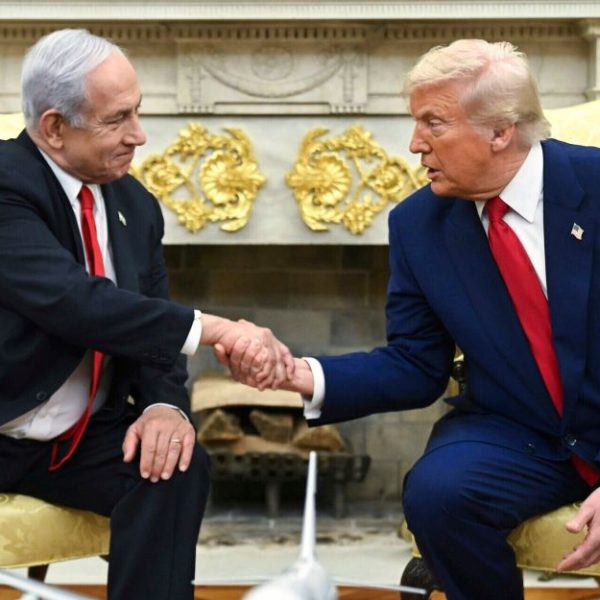
We are now a month into this whirlwind of catastrophe, the U.S.-Israel aggression against Iran, and the signs of a faltering alliance are growing by the day. Victory, they say, has a thousand fathers while defeat is yet a bastard. Tacitus in Annales in the first century AD noted as much in his account of Roman generals fighting in Germany; so quick to take credit for victories but even faster to lay blame for losses at the feet of other generals, subordinates, luck of the other side, even the weather. Now, with the Israeli attack on the South Pars Gas Field, a move that seems to run contrary to Trump's aims and beyond his scope, leading to yet another spike in oil prices, the American president that everyone loves to hate (or just loves), has taken the opportunity to pivot away from Netanyahu and sort some long standing problems which have deleteriously affected his administration, his own credibility, and his mandate.
From the start of the war, as we noted previously in Has Netanyahu Defeated Trump, Trump, through Rubio, immediately distanced himself from the conflict. Rubio explained with unusual transparency that Israel attacked Iran first, and the U.S. joined only because the Pentagon assessed that Iran would retaliate against U.S. assets in the region in response regardless. So they went in.
By rhetorical accounts, it seemed the U.S. went all in. Trump, through his own voice, quite proudly took credit for the attack, clearly a bifurcated messaging strategy which was very costly among many demographics. In practice, though, it was evident that the U.S. was engaged in a limited campaign, where both regime change and destroying its nuclear materials were off the table. His rhetoric has vacillated, absolutely, but in closed-door meetings, the Trump administration laid out to congress an ulterior and very limited set of goals, all quite hard to prove or define clearly. Early on, the administration clarified that the aims of the conflict were neither regime change nor any real destruction of Iran's nuclear program, a program they would also claim, improbably, to have neutralized by the end of the 12 Day War. Later of course, he would say other things, vaguely, in various contexts, and this is the nature of Trump's messaging. But there is a method in the madness.
Not only were denuclearizing and regime-change aims militarily and practically unachievable, they also fit beyond the metric of what the Trump administration appears to have been after anyhow. Israel has different goals, though. It was Israel that attacked Iran's energy infrastructure the first time on March 8th, something which Trump administration pushed back on immediately. It is Israel, not the U.S., which is bent not only on destroying Iran's nuclear capacity, but on destroying the state itself, towards creating a failed state; a black hole of instability in the region which strengthens its own relative position but also creates chaos on Russia's southern flank in line with rimland containment theory. This strategy is well documented decades ago in outdated think-tank papers, but that is precisely the point. The world has changed significantly, and neocon plans to kill two birds with one stone are no longer realistic, and chasing impossible fantasies is also beyond America's economic capacity and national security strategy.
Israel, neocon think-tanks, and AIPAC owned politicians often speak in terms of regime change, something which Trump has rhetorically flirted with but never put any real policy behind. The problem is that there has been no real or developed alternative government-in-exile type structure which could be brought in to assume the role of even a transitional type authority. Prince Reza Pahlavi is often trotted out as a reliable poodle, but he is little more than a ventriloquist dummy for Netanyahu, similar to Machado in Venezuela, or wherever she is now. The truth came out during the 12 Day War, when Trump sidelined Pahlavi quite openly (the first time) and Pahlavi went into triggered rage mode and suddenly un-followed Trump's inactive X/Twitter account. Trump backed protests in Iran, but these were months ago and not aligned in timing with the attacks under way now. But timing is everything, and this much is obvious, so for these anti-regime Iranian assets to be burned out in January means they cannot be operationalized now. Tactically this worked as a controlled burn. Trump's understanding of this point may be a matter of debate, but the result is the same.
Everyone is clear that Israel pulled the U.S. into this war. Still, Iran's response was strategically coherent. Why allow oneself to be tricked in a potential ruse if the U.S. and Israel were actually playing good cop/bad cop?
Reflecting on Trump's initial response via Rubio a few days after February 28th, it was not direct messaging. Trump, in his typical style, claims credit for everything, maintains control over the narrative, and preserves the perception of being broadly in charge. This method carries trade-offs. On one hand, his image of power remains intact, giving him leverage and sustaining confidence among allies, aides, and the public. On the other, he has implicitly taken credit for an unprovoked war during ongoing peace talks, which complicates credibility both domestically and internationally. Still, it allows him to maintain the appearance of being the one capable of ending the conflict at will.
Trump avoided the usual historical trap of manufacturing evidence, pressuring intelligence agencies, or attempting a Colin Powell-style moment: no vials, no dirty dossiers, no WMD charade. He simply stated what he believed, a unique flex in messaging. Because the belief emanates solely from him, it resists scrutiny: there is no institutional source to examine, and in that absence, no real objectives to challenge by hostile press, which is most of it.
Trump Pushes Back: From Distance to Directness
After weeks of circumspect positioning, Trump's messaging toward Netanyahu shifted sharply on the evening of March 19th. The first Israeli strike on Iranian energy infrastructure was met with careful distancing and a warning to Israel; the U.S. would not be seen as the aggressor. The second strike, this time on the South Pars field, triggered a more robust response.
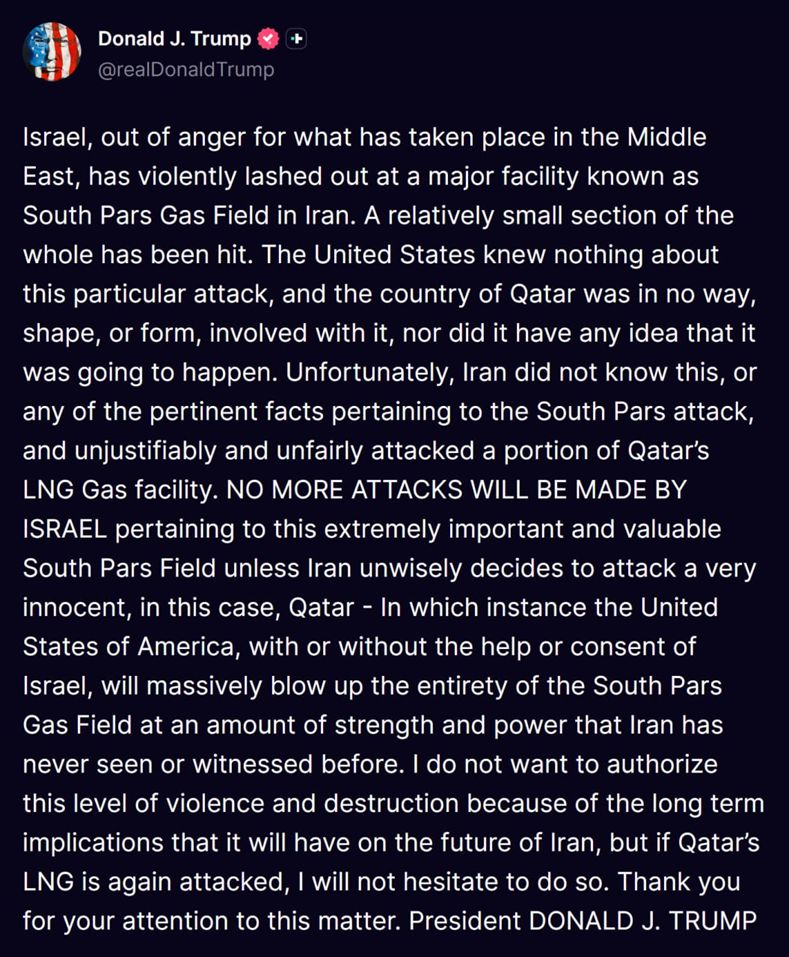
News of Trump's "mad at Netanyahu" posture spread quickly, signaling to both domestic and international audiences that the choreography of alliance had fractured. By asserting a visible boundary, Trump reinforces the narrative that he alone manages the nature and purpose of this 'excursion', regains some points lost in his alignment with Netanyahu previously. This is also an act of authority as much as diplomacy globally and in the mid-east region where Trump not only needs support from GCC countries, Turkey, and Egypt, but ultimately will need to make peace with the present Iranian state, and not some future-fictional government.
Trump's Non-Linear Messaging
Trump's communications are non-linear, optimized not for old news cycles but for the fractured, algorithm-driven attention economy of reels, clips, and memes. His statements do not merely shift over time in the way a politician of yesteryear would track unreliable polling; they morph, fragment, and recombine like a Rorschach blot of political signaling, with each demographic receiving a tailored message.
We must consider Joe Rogan's Experience as a prototype a decade ago, where one episode could yield dozens of clips, each edited to highlight divergent or even contradictory points. No individual watched them all, and yet collectively, they established viral narratives which were tailored, targeted, and tested in real time. This is the nature of information warfare today in 2026: decentralized, market-tested, simultaneously contradictory, yet coherent in aggregate, where reality creation is fine-tuned and non-generic. This is an element of Baudrillardian hyper-reality creation which is a critical feature of 4th generation warfare now integrated into the 5th generation paradigm. For its part, this is defined on the digital end by AI and the deconstruction of our capacity to comprehend the reality of what we are seeing. This was evidenced in all its glory with the series of Netanyahu 'proof of life' reels which his team produced after his supposed ongoing disappearance, and is seen regularly in clips of kinetic action throughout this war.
The Awakening Operation: Risk, Opportunity, and Regional Calculus
Last summer, Tucker Carlson advised Trump to distance from Netanyahu, arguing that over-identification with Israeli policy could undermine broader strategic positioning and domestic support. Trump's recent moves now seem to take this advice for the first time in such an open way, though amplified in both scope and consequence. The U.S.-Israel dynamic has always been multivalent, but the current Iran conflict exposes fault lines in transatlantic alliances, revealing not a single culprit but a lattice of interlocking institutions, financial actors, and political incentives.
Trump's maneuvers carry very tangible risks, and these have everyone now taking serious notice. Not alienating key GCC allies, building power in Israel with vectors outside of Netanyahu, while navigating the MAGA base's expectations requires a delicate balancing act in the face of a rather unanimous world-view that Netanyahu's Likudnik politics are the primary problem. For if Trump cannot disentangle from that monstrosity, he will forever be identified with it, and the MAGA project at home as well as rebuilding international credibility as a reliable country, are crashed on these Likudnik rocks.
The Iranians have been wise to exploit these contradictions, but also in a strange way help to show Trump what his messaging solution ought to be: Netanyahu pulled the U.S. into this war by hook or by crook and it was not really what Trump, and certainly not what Americans, wanted. Araghchi, for example, has been sending messages directly at MAGA; knowing the contours of U.S. politics and reminding Americans on X/Twitter of the original MAGA platform which put America first and was supposed to end forever wars in the mid-east for Israel. He works the openings exposed by Trump's own alignment with a very rapacious sort of Zionism and with Netanyahu, and yet provides Trump an off-ramp.
This is an awakening operation in the truest sense, though one that is incomplete and full of contradictions. It is worth noting that these developments did not arise spontaneously. While going back quite a while, we can point to a more recent event. Trump met with Tucker Carlson just days before February 28th, a telling coordination that foreshadowed Trump's subsequent distancing now underway from Netanyahu, and raises questions about what was really said in that meeting. Israel pulled the U.S. into the conflict, as Araghchi noted and as former Saudi intel chief Turki al Faisal corroborated. Observers who tracked early indicators, including this author, saw the pattern forming: a conflict orchestrated in layers, with multiple actors shaping both the kinetic and informational battlefield. In this, what first appears as a weakness, is suddenly revealed as a strength.
We all saw this in real time explode with the March 17th resignation of Trump cabinet member Joe Kent from his position as Director of the Counter-Terrorism Center. Domestic opponents latched onto this as evidence of a Trump team in a moment of implosion. Then Trump revealed that Kent had in fact previously endorsed destroying Iran's ballistic arsenal somehow. This at first seemed to reveal hypocrisy, and even more attention was drawn to this drama. But the whole story met its true purpose when Kent would go on the Tucker Carlson show but with an unexpected twist: not to trash Trump but to laud his administration and then, yes, build on that critical point that the Israelis pulled the U.S. into the war, commenting to Carlson that, "The Israelis drove this decision, which we knew would set off a series of events meaning the Iranians would retaliate."
And here we come back full circle to the first days after the start of this disastrous conflict, when Marco Rubio astonished the world and laid bare that Israel had attacked Iran, apparently unprovoked, and that the U.S. felt forced to join in. Araghchi has signaled the same, and Tucker Carlson -who has operated as a dissident magnet wing-man for Trump -was then operationalized in bringing Kent on the show to reinforce this same point. All this comes to a conclusion right as Trump releases his Truth post: "Israel, out of anger for what has taken place in the Middle East, has violently lashed out at a major facility known as South Pars Gas Field in Iran...".
But we caution that Trump engages in non-linear messaging. In another message, aimed at some other demographic, he will laud praise on Netanyahu while also reminding the world that Netanyahu desperately needs the pardon he so deserves to stay in power; indeed he's on trial for his life. Why does Trump continue to draw attention to that?
GCC states are collecting receipts on why U.S. bases on their soil serve more harm than good. This is probably one of their strategic aims, anyway, at least according to Prince Turki al Faisal. Everything by inversion, and the outsourcing of domestic policy, disguised as conflict, because Trump arguably wants this too. Imagine a war that everyone won. Israel can dump Likudnik politics once and for all. Both Iran and the U.S. can emerge victors in this conflict; anything is possible if they wind up on the same side. War is an extension of politics by other means, and politics makes strange bedfellows.
Follow Joaquin on Telegram @NewResistance or on X/Twitter @XoaquinFlores