Alastair Crooke
This phase of the Iranian conflict likely will only end when the West falls off the approaching economic cliff
The U.S. war with Iran has moved beyond its initial phase to an emerging new one - one in which Iran implicitly stakes its chances on the next phase being war. Most likely this will be in abbreviated episodes of limited war, but possessing nevertheless a potential to widen regionally, should the U.S. (and Israel) elect to sharply escalate.
The new phase involves risk of course, yet Iran holds the high cards of an ability to impose disproportionately heavier damage upon Gulf infrastructure as retaliation for any hurt inflicted upon it - and the awareness that the West is edging ever closer to dropping off the energy 'cliff'.
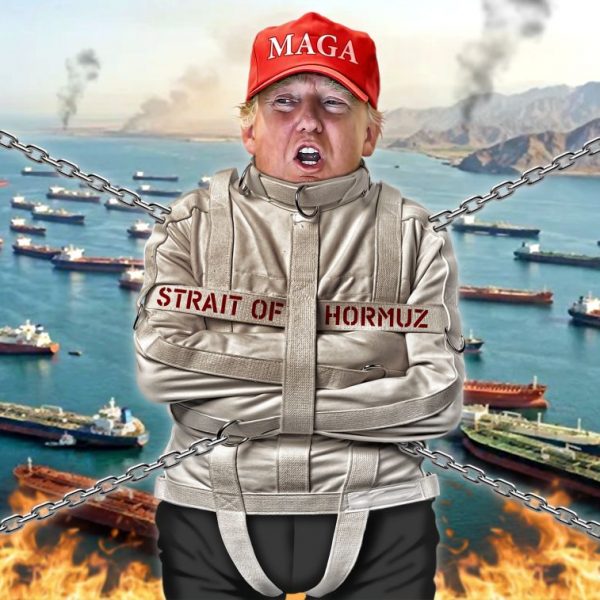
The three pillars underlying this shift are firstly, confidence that Iran will not (and cannot) be shifted from its hold over Hormuz, and that in consolidating its administrative structures there, the reality of Iran's hold over Hormuz will increasingly be assimilated by states, and reflected in their coming to terms with Iranian-Omani control.
Associated with this core principle is Iran's implementation of escalated deterrence vis á vis the American naval blockade. Any attempt to intercept or attack Iranian vessels or interfere with the Strait's administration will be met with increasingly harsher ripostes. Ultimately this policy may lead to Iran imposing increasing levels of damage to U.S. naval vessels - another friction point.
On 3 June, for example, the U.S. fired a hellfire missile at an Iranian oil tanker near the Strait of Hormuz. In response, a U.S.-owned (or partly-owned) ship, The Panaya, was struck with missiles. Additionally Iran launched three waves of cruise missiles at the U.S. air and helicopter base in Kuwait from where the attack had originated. Images have emerged of serious damage at Kuwait international airport too (although the cause of the damage remains disputed).
The second underlying principle affecting this shift simply reflects Iranian disdain for Trump's continuous inflating of demands, exaggerated threats (which palpably fall short of U.S. capacities), together with his continual zigzagging and contemptuous rhetoric towards Iran.
The Iranian leadership has concluded, it seems, that compromise will likely not be forthcoming, and that it is better to cut the 'negotiations' rather "than continue the pointless bad-faith negotiations with a deceitful and decrepit American regime", as the New York Times has termed the Iran 'negotiations' - suggesting that the 'deal chaos' is not a singular glitch by Trump confined to the Iran issue, but rather is a consistent pattern of dysfunctionality repeating itself across virtually all of Trump's 'peace' initiatives.
Behind Iran's decision to suspend talks however, likely lies the gradually dawning clarity, seeping out from Israeli and American statements and analysis, that the true objective of the 28 February U.S.-Israeli sneak attack was never regime change per se - aiming to swap out Iranian 'hardliners' for a 'Delcy Rodrigues'-style more moderate leader; but was intended rather, to bring about Iran's complete destruction and fracturing - an insight that was bound to shift Iran's calculus.
This insight has consolidated public support for the Islamic Republic hugely, and at the same time has turned the war into an existential struggle to preserve the ethical values of the Revolution. Seen from this optic, there is little for Iran to discuss with Trump, bar some future modus vivendi - as and when, Washington understands that it is boxed in, and that new realism takes a hold.
The third principle undergirding this new phase of conflict is the one enunciated by Iran from the outset of the Islamabad talks: 'Ceasefire for all; or ceasefire for no one'. This was again re-emphasised in Iran's latest ultimatum to Trump: 'If the Israeli threats from last week to flatten the Beirut southern suburb of Dahiyeh had been executed, then Iran would have stricken northern Israel hard with its missiles. 'It was a ceasefire for all - or no ceasefire'.
Trump chose the ceasefire, and subsequent to his call with Netanyahu, announced that it was in effect. He told Netanyahu to cancel his planned bombing of Dahiyeh in south Beirut. In Israel, a massive wave of anger from all sides of the political spectrum attacked Netanyahu at the very notion of curbing any Israeli attacks in Lebanon. Former PM Naftali Bennett accused Netanyahu of 'losing control over Israeli sovereignty'. And former PM Yair Lapid said Israel had been reduced to a "vassal state" after the strikes were called off.
The U.S. and Israel for some months have been attempting to bring a segment of leaders in Lebanon to accept the task of disarming Hizbullah, as Rubio explained, "so Israel doesn't have to do it" - something Lebanese leaders clearly cannot do.
Israel has no coherent Lebanon strategy. Former senior Israeli military intelligence officer, Danny Citrinowicz, outlines a new strategic "Iranian achievement":
"Tehran has effectively succeeded in linking the Lebanese front to the broader Iranian-Israeli arena. Any escalation in Lebanon is now increasingly viewed through the prism of the U.S.-Iran dynamic".
Nevertheless, he observes:
"The situation in Lebanon remains highly unstable. Israel and Hezbollah continue to interpret the current understandings in fundamentally different ways. [Whilst] Israel maintains that it retains freedom of action across Lebanon except Beirut, Hezbollah [on the other hand] insists that any Israeli military activity - at all - violates the ceasefire framework. These competing interpretations create significant potential for renewed friction and escalation on the ground".
In Israel, the situation in northern towns remains neuralgic for nearly all Israelis. Many towns along the Lebanon border and down into the Galilee are half-empty - "entire swaths of land abandoned by [the] government", writes Ben Caspit. Local politicians claim that they 'are Israelis too' and that the government must respond.
Lebanon is certain to remain a point of contention. It is not a matter of if, but when, the next crisis will strike. Israel will not let the matter stand - even Liberal opposition leaders demand Hizbullah's destruction and protest Trump's tying of Netanyahu's hands in Lebanon.
Iran will not let matters stand either. Mediators have informed the Americans that Iran considers an end to the war on Lebanon, withdrawal of Israeli forces, and a withdrawal from Hormuz, to be binding conditions - before discussing other issues.
So, here we are. The military skirmishes - effectively an abbreviated series of strikes by U.S. forces on Iranian shipping and Strait infrastructure, arising from Trump's desire to assert its naval blockade to U.S. public opinion - continue. This situation is clearly flammable - just as is the Lebanon context.
Iran effectively is acknowledging the reality that in this new phase - with so many inherent flash points to it - American military escalation at some point likely will become a political necessity for Trump's domestic and Jewish financers' needs.
And the negotiations ? They will go nowhere so long as Israel and the U.S. Jewish billionaire donors reject any Iran outcome that leaves Iran both intact and stronger and - pari passu in this binary thinking - the 'Israel First' project within the U.S. and the region correspondingly weakened.
A deal that doesn't see Iran irretrievably weakened will be condemned by these latter forces as a 'treasonous dereliction' by Trump. He will be attacked mercilessly. Yet, he must see that Iran is anyway on the cusp of throwing off the U.S. shackles.
This phase of the Iranian conflict likely will only end when the West falls off the approaching economic cliff...