Lorenzo Maria Pacini
The Mecca Pact confirms that the U.S. guarantee is no longer the only option on the table for the Gulf monarchies.
Deterrence or theater?
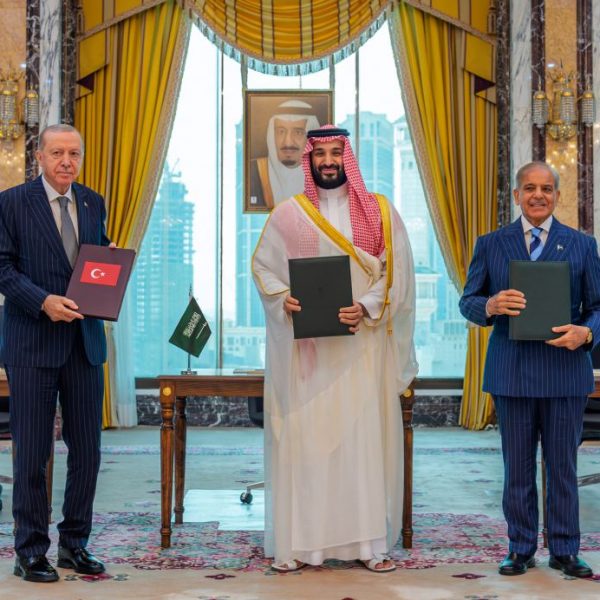
On August 7, 2026, in the holy city of Mecca, Saudi Arabia, Pakistan, and Turkey signed an agreement on joint defense. The choice of location is no coincidence: signing a military pact in the symbolic heart of Islam lends the agreement a weight that its content, as far as is known, would not be sufficient on its own to guarantee. The wording that has been made public echoes Article 5 of the North Atlantic Treaty - an attack against one is an attack against all - but the full text has not been circulated, and this reticence is, in all likelihood, deliberate.
The question raised by the agreement concerns not so much its military effectiveness as its very nature. Is it a genuine alliance, capable of triggering binding obligations, or is it a signaling mechanism whose strength lies precisely in its vagueness ? The distinction matters, because the two scenarios imply different behaviors on the part of all regional actors.
In terms of aggregate capabilities, the bloc is impressive. The three states have a combined force of approximately 1.4 million personnel, over 3,000 aircraft, and combined military budgets in the order of $120 billion annually. Turkey has the second-largest army in NATO; Pakistan is the only Muslim country with nuclear weapons; Saudi Arabia is the world's leading exporter of crude oil and the natural financier of the alliance. On paper, the complementarity is nearly perfect.
The complementarity of resources, however, is not the same as the credibility of the commitment. A collective defense pact is only as valuable as the probability - as perceived by adversaries - that it will actually be honored. And it is legitimate to doubt that, if an external actor were to strike Saudi Arabia, Ankara and Islamabad would mobilize, respectively, the second-largest NATO army and a nuclear arsenal to respond. The cost of such a response would be enormous; the constraint that would require it remains, for now, vague.
Hence the sharpest phrase to emerge from the debate: rather than deterrence, the theater of deterrence. The provocation hits on a real point, but it must be handled with caution. When it comes to security, perception is already part of reality: an alliance that no one would believe they'd have to activate can still alter others' calculations, if it introduces even a margin of uncertainty regarding the consequences of an attack. Ambiguity, in other words, is not the pact's failure - it could be its very purpose. Not specifying who one is defending against allows the signal to be directed at multiple recipients without committing to any one of them.
Against whom, then ? The list of possible targets is long, and none are named in the text. The hypothesis that the target is Iran clashes with a fact: relations between Tehran and Islamabad have not soured since the signing, and there was reportedly diplomatic contact from Turkey to Iran for reassurance in the hours leading up to the ceremony. If the pact had been conceived as anti-Iranian, the Iran-Pakistan relationship would have been immediately affected. That did not happen. It is more plausible that the greatest unease lies elsewhere: the regional power that sees a Muslim military bloc consolidating on its periphery has reason to be concerned even in the absence of a clause that specifically names it.
The Turkish conundrum
The Mecca Pact brings a full-fledged NATO member into an area of growing non-Atlantic coordination. This is its structural anomaly, and the reason why Turkey deserves a separate analysis. Ankara has long been straddling a fault line: it is the Alliance's eastern arm, yet at the same time a candidate for an autonomous role in the Eurasian space. However, its admission to forums for continental integration - the BRICS organization and the Shanghai Cooperation Organization - remains blocked.
The explanation put forward by those who view the region through a multipolar lens is the mistrust of Moscow and Beijing. The reason cited is the so-called "Greater Turan": the plan for a union of Turkic-speaking peoples under Turkish leadership. Russia, China, Iran, and the Central Asian states are said to share a common interest in not granting Ankara a platform from which to project that ambition into their spheres of influence - China's Xinjiang, the Caucasus, and the former Soviet Central Asia.
This argument is valid but must be qualified. The Turkic-speaking project exists as a cultural aspiration and a network of initiatives, yet its translation into political power is far from complete. Turkic-speaking peoples are spread across a vast arc - from the Altai Mountains, their area of origin straddling Russia, Kazakhstan, and Mongolia, all the way to Anatolia - but linguistic kinship does not imply political subordination to a central authority. Kazakhs, Kyrgyz, Turkmen, Uzbeks, and Uyghurs do not recognize Ankara's primacy. The Organization of Turkic States, headquartered in Istanbul, appears more as a forum for economic cooperation and business interests than as an instrument of strategic projection. When measured against the weight of China and Russia in Central Asia, Turkish influence remains marginal.
This leads to a more sober assessment of Ankara's role in the pact: not the vanguard of a Turkic-speaking empire, but an actor that capitalizes on its pivotal position. Turkey brings industrial-military capabilities and a foothold in each camp; in return, it gains prominence in security and energy networks stretching from South Asia to Europe. This is the behavior of a hedger - one who does not choose and benefits from not choosing - rather than that of a rising hegemon.
The war of words and some initial conclusions
Against the backdrop of the realignment in the Gulf, the most dangerous flashpoint remains: the Strait of Hormuz. Here, the conflict is being fought - even before it is fought with ships - with words. On the one hand, the U.S. presidency asserts that the strait is fully open and that its navy guarantees transit; on the other, Iran's security leadership categorically denies that any U.S. warship has the right to enter the Persian Gulf.
Two incompatible statements cannot both be true on the ground. Their coexistence signals that we are in a phase where control of the narrative is itself a battleground, and where neither side can afford to appear yielding. Analytical caution dictates that we should not take either version at face value: both are, first and foremost, communicative acts directed at an audience - both domestic and international - rather than descriptions of the operational reality.
The substantive issue is another. The Mecca pact raises, for the first time so clearly, the question of the residual utility of the U.S. military presence in the Gulf. If the Arab monarchies begin to diversify their security guarantees - turning to Ankara and Islamabad as well as Washington - the very foundation of the security architecture built over decades around American protection comes into question. This is not a collapse; it is the emergence of an alternative, and that alone is enough to shift the terms of the negotiation.
To sum up, the Mecca pact should be viewed as an indicator rather than a fully realized turning point. It points to a trend - the Gulf powers' search for greater autonomy from U.S. guarantees - without necessarily proving that this trend will translate into a cohesive and operational bloc. There is a gap between the signal and the structure that only the events of the coming months can bridge or disprove.
Three scenarios remain possible. In the first, the agreement remains essentially symbolic: a public relations coup for the Saudi leadership and a reputational safeguard, lacking credible mechanisms for implementation. In the second, the pact gradually consolidates - through joint exercises, industrial integration, and expansion to other members, an option that some Turkish circles have already raised - until it becomes the backbone of a new regional security architecture. In the third, internal contradictions prevail: Turkey's Atlantic alignment, Pakistan's caution, and Saudi Arabia's calculation not to sever ties with Washington make this an agreement that will not hold up under the first serious test.
Which of the three will prevail will depend on observable indicators: the possible publication of the text and the precision of its activation clauses; whether or not trilateral exercises are conducted; Washington's reaction - which has so far been absent; the accession of new states; and, above all, the behavior of the parties during the first crisis that calls for mutual defense. Until then, the most defensible approach is one of watchful waiting: the ambiguity that makes the pact rhetorically powerful is the same ambiguity that renders its substance uncertain.
The Mecca Pact confirms that the U.S. guarantee is no longer the only option on the table for the Gulf monarchies. It does not confirm - not yet - that it has been replaced.
The difference between these two propositions is the entire arena in which the game of the coming years will be played out.