Lorenzo Carrasco
The crisis of the modern state, radical secularism, and the revenge of metaphysics
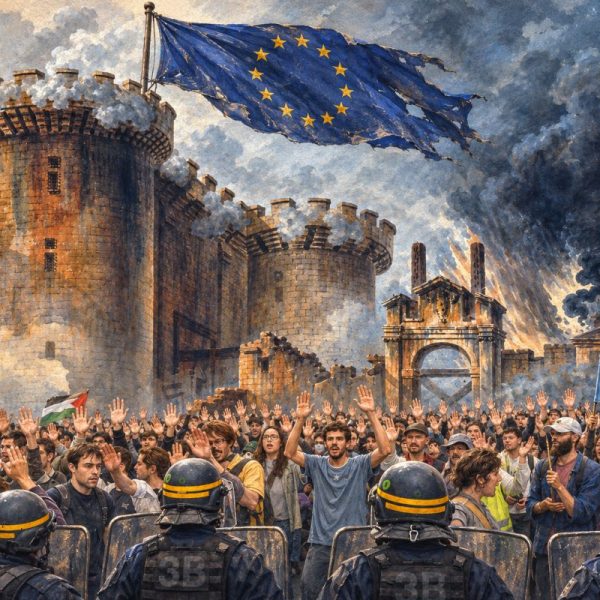
What we are witnessing in Western Europe could be interpreted as a new Fall of the Bastille. This time, it is not the overthrow of a fortress or a political regime, but a crisis of legitimacy and representation affecting the institutions of the modern state, calling into question the philosophical and moral foundations upon which the contemporary political order was built.
The 1789 Fall of the Bastille symbolized the rupture with the Ancien Régime and the beginning of an institutional transformation that would spread throughout much of the world. Yet the state was not a creation of the Enlightenment or the French Revolution. Its institutional, legal, and spiritual antecedents can be found, to a considerable extent, in medieval Christian civilization.
Today, more than two centuries later, the growing distance between rulers and the governed, the loss of confidence in political parties and parliaments, and the difficulties of political representation point to a crisis that cannot be reduced to electoral fluctuations. In Ibero-America, this estrangement between institutions and peoples has also acquired particularly visible characteristics.
Our hypothesis is that we are not facing a temporary disturbance, but the possible exhaustion of certain conceptions of political power. Ultimately, the institutional crisis is also a spiritual crisis: one concerning our understanding of the human person, the nature of authority, and the foundations of justice.
From the Christian Political Community to the Modern State
Medieval Christendom contributed decisively to the formation of Europe's territorial kingdoms and to a conception of authority subordinated to a moral order higher than the power of rulers. This tradition found one of its most complete philosophical formulations in St. Thomas Aquinas, who defined law as an ordinance of reason directed toward the Common Good, promulgated by the one entrusted with the care of the community.
For Aquinas, the legitimacy of political power does not derive exclusively from its ability to impose laws, but from its conformity with justice and Natural Law. The ruler is not the owner of the community: his authority exists to serve it. The medieval kingdoms contributed to the historical process that would subsequently give rise to sovereign nation-states, while the School of Salamanca, particularly Francisco de Vitoria and Francisco Suárez, continued developing the reflection on political community, the legitimacy of authority, and its moral limits.
However, the modern conception of sovereignty underwent important transformations with the French jurist Jean Bodin. Later, Montesquieu proposed the separation of powers as a safeguard against despotism, while the French Revolution redefined national sovereignty and political representation. Although these transformations provided important instruments for limiting arbitrary power, they also opened up a fundamental problem: the possibility that legitimacy might ultimately be identified exclusively with institutional procedures and legislative will.
In certain schools of thought, the central question ceased to be what political authority exists for and became predominantly how power is constituted, distributed, and exercised. The separation of powers may limit despotism, but it does not, by itself, guarantee justice. When positive law seeks to replace Natural Law, the state risks becoming the ultimate source of moral legitimacy.
Radical Secularism as the Secular Religion of the State
The Enlightenment was a complex intellectual movement from which important contributions to political liberty emerged. Nevertheless, some of its more radical currents promoted the separation of public life from the metaphysical and religious foundations of Western civilization.
The problem does not lie in the legitimate autonomy of temporal power, but in the attempt to transform the state into a morally self-sufficient authority, capable of determining by itself the ultimate foundations of law and justice.
Here we encounter a profound paradox: the state that seeks to emancipate humanity from all religious authority may end up attributing to itself an almost absolute authority over individual consciences.
In its most extreme expressions, radical secularism acquires the characteristics of a genuine secular religion of the state, complete with dogmas, symbols, orthodoxies, and mechanisms of exclusion. Thinkers such as Eric Voegelin and Emilio Gentile examined, from different perspectives, this sacralization of politics, through which certain modern ideologies came to attribute almost religious functions to the state.
Political will then seeks to take the place of truth, positive law the place of justice, and state power risks becoming the ultimate arbiter of human conscience.
From the Vendée to the Cristero War: The Tacit Victory of Freedom of Conscience
One of the most dramatic contradictions of the French Revolution emerged in the Vendée during 1793 and 1794. The resistance of its rural communities, motivated by compulsory military conscription, revolutionary transformations, and religious persecution, was followed by devastating repression against the population.
The magnitude of that tragedy reveals a fundamental contradiction: the Revolution that proclaimed universal liberty ended up violently persecuting communities seeking to preserve their religious convictions and traditions.
More than a century later, a comparable tension reappeared in Mexico during the Cristiada, or Cristero War, from 1926 to 1929, triggered by severe religious restrictions imposed under President Plutarco Elías Calles and the resistance of broad sectors of the Catholic population.
Although both conflicts arose from different causes and circumstances, they reveal a common historical problem: the attempt by certain political authorities to subordinate the religious life of communities that regarded their beliefs as inseparable from their collective identity.
The paradox is evident: a state proclaimed free from all religion may end up behaving as though it were itself a compulsory religion. A secular religion with no right to redemption.
And here an even deeper historical irony emerges.
The crisis of legitimacy currently affecting numerous institutions of the modern state could be interpreted as a tacit, belated, and symbolic victory for the Vendée and the Cristiada.
This does not mean a retrospective military victory, nor does it imply justifying all the violence associated with those conflicts. Rather, it means recognizing the enduring validity of the principle defended by many of those communities: human conscience does not belong to the state, and political authority finds its limits in the dignity of the person, Natural Law, and the Common Good.
Those peoples were defeated militarily, but the fundamental question they raised remains unresolved: can legitimate political power impose upon society a compulsory conception of moral and spiritual life?
The contemporary crisis does not, by itself, demonstrate the exhaustion of the secular state, but it invites us to reconsider the claims of radical secularism and its tendency toward the ideological absolutization of power.
Leo XIV and the New Student Protests
In this context, Pope Leo XIV's apostolic journey to France in September 2026 acquires a significance that transcends its pastoral dimension.
Precisely in the nation that made the Revolution of 1789 one of the great symbols of secular modernity, the Pontiff once again raised questions concerning Europe's Christian roots, religious freedom, human dignity, and the moral foundations of political coexistence.
His interventions make it possible to distinguish between a form of secular governance that protects religious freedom and institutional autonomy and a radical secularism that seeks to exclude every reference to a transcendent moral order from public deliberation.
The French student mobilizations of September and October 2026 added another dimension to this situation. The protests, which began before the papal visit, denounced deteriorating educational conditions, teacher shortages, inequalities of opportunity, and uncertainty about the future.
These demands must be distinguished from violent incidents involving some participants who resorted to tactics associated with the Black Blocs. The presence of these groups does not, by itself, demonstrate organized manipulation of the protests, nor does it justify discrediting the demands of the student movement as a whole.
What matters for our argument is that a new generation is questioning the capacity of institutions to guarantee decent conditions for education and social participation.
From May 1968 to October 2026: The Irony of History
There is a revealing historical irony in comparing today's student mobilizations with those of May 1968.
That movement, associated with the counterculture and the so-called triple revolution of sex, drugs, and rock music, contributed to a profound transformation of Western social customs. It also included anti-capitalist demands, although its cultural legacy subsequently acquired predominant importance.
May 1968 also had a political and geopolitical dimension that is frequently relegated to the background: the destabilization of Charles de Gaulle's government, which defended national sovereignty against the asymmetries of the international monetary system.
De Gaulle had denounced the privileges enjoyed by the dollar under the Bretton Woods agreements and had withdrawn France from the integrated military command structure of the North Atlantic Treaty Organization (NATO) in 1966.
The student mobilizations and general strike of 1968 triggered a crisis in his government, eventually leading to his resignation in April 1969 after losing a referendum. Viewed retrospectively, those mobilizations display certain similarities to mechanisms employed in contemporary "color revolutions."
The irony becomes even greater when we recall that, in August 1971, the United States suspended the dollar's convertibility into gold, initiating the dismantling of the Bretton Woods system whose asymmetries De Gaulle had challenged.
Almost six decades later, in October 2026, French students are once again taking to the streets, but their immediate demands now focus on education, public services, and their material prospects for the future.
The youth of 1968 challenged the values and structures of the society they had inherited; the youth of 2026 challenge the living conditions and opportunities that contemporary society offers them.
This historical reversal acquires particular significance in light of the economic transformations brought about by decades of globalization and policies that have, to varying degrees, subordinated essential services to the criteria of profitability.
The student gathering of October 8, 2026, at the Place de la Bastille adds a symbolic dimension to our reflection.
We do not know whether these mobilizations will achieve the international prominence of May 1968. Nevertheless, concerns about education, precarious living conditions, and the future are by no means exclusively French.
Both generations, arising from different historical circumstances, ultimately confront the same fundamental question: what is the state for, and whom should its institutions serve?
The Social Doctrine of the Church and the Primacy of Society
In the face of this crisis, the Social Doctrine of the Church acquires extraordinary relevance.
From Leo XIII's encyclical Rerum Novarum to John Paul II's Centesimus Annus, including Pius XI's Quadragesimo Anno and Paul VI's Populorum Progressio, the Church has developed a conception of society grounded in human dignity, the Common Good, subsidiarity, solidarity, and participation.
These principles, rooted in the tradition of Natural Law, offer a radically different perspective from one that turns the state into the owner of society.
The Compendium of the Social Doctrine of the Church, in paragraph 417, affirms that the political community exists to serve civil society, from which it derives.
This principle establishes a decisive distinction: society does not exist by permission of the state; rather, the state finds its justification in serving society.
Families, municipalities, local communities, associations, and intermediary bodies possess a legitimacy of their own that does not depend exclusively on the will of the state.
The contemporary crisis also has an economic dimension. The concentration of financial power, the various forms of rent-seeking, and the subordination of public decisions to private interests raise questions about the effective capacity of institutions to achieve the Common Good.
The economy, markets, and finance must serve the integral development of the human person and the community, rather than becoming autonomous ends to which social existence is subordinated.
This is why the Social Doctrine of the Church takes on a truly prophetic dimension: not because it offers a fully developed institutional formula, but because it preserves enduring principles capable of guiding political reconstruction.
Rebuilding the Bond Between Peoples and Their Governments
If the contemporary crisis truly reaches the foundations of the modern state, overcoming it cannot be limited to electoral reforms, changes of governing parties, or administrative adjustments.
The fundamental task will be to develop the creativity necessary to conceive new institutional forms capable of restoring the bond between peoples and their governments. At the same time, it will be necessary to promote a cultural and moral renaissance in which justice, goodness, and beauty become predominant values.
The objective is not to mechanically restore institutions of the past, nor to replace secular absolutism with religious absolutism, but to recover enduring principles in order to respond to new historical circumstances.
Political representation must encourage the effective participation of society, recognize the autonomy of intermediary bodies, and prevent bureaucratic structures from replacing the real life of communities.
National sovereignty must not be confused with the absolute sovereignty of the state apparatus. Its legitimacy derives from its connection with the political community and its orientation toward justice and the Common Good.
It is not the peoples who must justify their existence before the state, but the state that must continually justify its authority through service to the peoples.
The Revenge of Metaphysics Against Secularism
We thus arrive at the final paradox of our time.
For more than two centuries, certain currents of modernity have attempted to construct a political order progressively emancipated from the religious and metaphysical foundations that had shaped Western civilization.
Legislative will, instrumental reason, and bureaucratic organization acquired increasing centrality. Yet the contemporary crisis has once again brought to the forefront precisely those questions that radical secularism sought to relegate to the margins.
What is the human person ? What constitutes a just society ? Where does legitimate authority come from ? Are there rights that precede the state ? Can the will of the majority make just what contradicts human dignity ? What is the ultimate foundation of the Common Good?
These questions cannot be resolved exclusively through administrative procedures, electoral mechanisms, or economic calculations.
They are, ultimately, philosophical and metaphysical questions.
And here emerges what we might call the revenge of Metaphysics against secularism.
This is not a religious revenge, nor an attempt to restore by force a political order that has disappeared. The paradox lies in the fact that the fundamental questions certain modern conceptions sought to exclude from public life are reappearing at the very heart of the institutional crisis.
The Vendée and the Cristiada remind us of the moral limits of political power. Leo XIV's journey to France once again raises the relationship between Europe's spiritual roots and its political organization. The student mobilizations of October 2026 reveal, from another perspective, the concerns of new generations about the future.
And the thought of St. Thomas Aquinas, carried forward by the School of Salamanca and the Social Doctrine of the Church, reminds us that authority finds its ultimate justification not in the will of the ruler, but in justice and the Common Good.