Lorenzo Maria Pacini
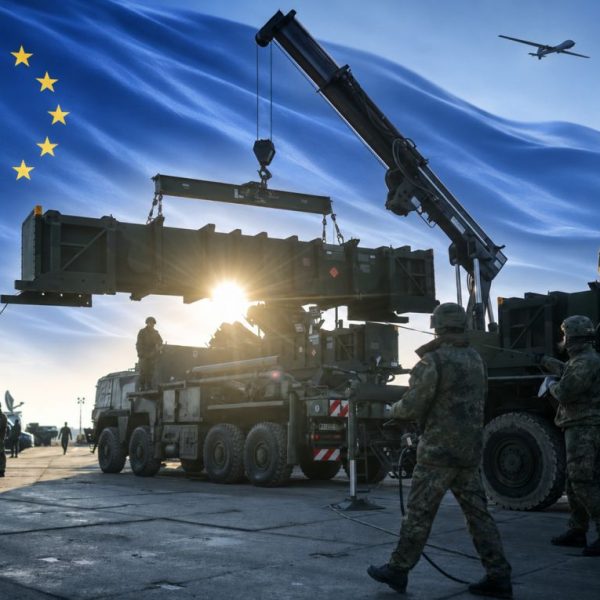
The path Brussels has taken is one of permanent mobilization against an external enemy.
From protection to total defense
In the space of two years, the word "preparedness" has moved from the vocabulary of military headquarters to that of European kitchens. Brussels is asking families to be able to survive seventy-two hours without outside help; Stockholm has sent every household a pamphlet titled If a Crisis or War Breaks Out; Berlin has long recommended a ten-day food supply; and London has just launched a similar campaign. Flashlights, battery-powered radios, cash, water, and medicine: the survival kit has become a political issue. It's worth taking a closer look, because it says more about Europe than many Council press releases.
The sequence of events is clear. In October 2024, former Finnish President Sauli Niinistö submitted the report Safer Together to the Commission, which treats civil and military preparedness as a single continuum. In March 2025, the Strategy for a Union of Preparedness was released, setting the 72-hour threshold. Sweden had already distributed its brochure in November 2024. On November 3 of this year, the Commission added operational guidelines for families and announced a European Day of Preparedness, to be held every October 23 starting in 2027. These are not merely technical adjustments. It is a paradigm shift.
Civil protection, in the Italian tradition and in much of the European one, was created to respond to earthquakes, floods, and industrial accidents. It relies on municipalities, volunteers, and a logic of solidarity following the event. The model spreading today, however, comes from the Nordic total defense approach, in which the civilian population is an integral part of the national defense system. The fact that the architect of the report is Finnish is not merely a biographical detail. Even the vocabulary confirms this: we no longer speak of "protection" but of preparedness and readiness - terms borrowed from military planning - and the portfolio of the relevant commissioner is titled "Preparedness and Crisis Management."
European civil protection, in other words, is being subsumed into the logic of security. It is a political choice and, as such, should be debated in parliaments rather than introduced through brochures and non-binding guidelines.
Real threats, political pedagogy
It would be wrong to dismiss all of this as propaganda. The threats exist and are converging. The war in Ukraine has shown Europeans what they had forgotten since 1945: in modern conflict, civilian infrastructure is a primary target, and for three winters, Ukrainian cities have endured scheduled blackouts and generators in their courtyards. The Baltic Sea has become a contested seabed, with a series of damaged cables culminating, at the turn of the year, in the seizure of a ship by Finnish authorities. The war with Iran and the Hormuz crisis have restored energy to the status of a strategic variable: as early as May, the Commission estimated the additional energy cost to the Union at over 35 billion.
The most instructive case, however, is another. The Iberian blackout of April 28, 2025 - which plunged Spain and Portugal into darkness for hours - was not caused by any attack. The final ENTSO-E report attributes it to systemic failures in voltage control and grid regulation. The most serious event of the period thus stemmed from the internal fragility of a hyper-complex system, not from an external enemy. I'll come back to this.
Alongside the threat assessment, however, there is an educational function, and the timing makes this clear. The preparedness strategy was presented in the same month as the ReArm Europe plan, with its target of approximately 800 billion euros. A population that keeps an emergency backpack at home is more likely to accept the reallocation of public spending toward defense and the rhetoric of a war economy. Lippmann called this process "consensus-building"; Schmitt would have added that whoever defines the emergency defines the political order.
Finally, there is a less-discussed aspect. Individual preparedness shifts costs and responsibilities from the state to the family. A state that has spent thirty years cutting services and privatizing infrastructure is now asking citizens to fend for themselves for three days. Reading between the lines, the message is that the public system won't be there right away. Added to this is uncertainty about the American guarantee: Europe is beginning to see itself as on its own, and is reacting by arming itself rather than negotiating.
The citizen as the rear guard
The 72-hour kit is the domestic implementation of the resilience requirements that NATO established at the 2016 summit in Warsaw: continuity of government, energy, food and water, communications, and transportation. In logistical terms, the family becomes the last link in the chain. In the wars we actually witness - wars of attrition and hybrid wars - the resilience of society matters just as much as that of the armies. Clausewitz described war as a trinity of people, army, and government, and the people do not appear merely as a backdrop. A society that collapses after three days without power cannot sustain any strategy, no matter how well-armed its forces may be. Moscow and Tehran have known this for some time; Helsinki has never forgotten it.
The price, however, must be acknowledged. When civil society is organized as the rear echelon of a front line, the citizen is gradually redefined as a reservist, and the exception becomes the ordinary form of government. Resilience is a value; permanent mobilization is something else entirely. There is also a telling economic asymmetry: civil preparedness costs very little compared to tanks and missiles, and it is precisely for this reason that it lends itself to serving as the socially acceptable face of a far more costly rearmament.
The risk of a counterproductive effect is already apparent. In recent weeks, fact-checking websites have had to explain to the public why they shouldn't panic over the government's emergency kits. In Italy, in 2025, the announcement from Brussels sparked more irony than fear: a society that has weathered earthquakes, terrorism, and a pandemic has developed immunity to EU-style alarmism. But this irony is also a symptom of eroded trust, and trust is the first resource that a real emergency depletes. Credible communication would require concrete scenarios rather than generic references to war; the voices of the mayor and local civil defense officials rather than that of a commissioner; and, above all, reciprocity: if the government asks for seventy-two hours of self-sufficiency, it must specify what it will do during those seventy-two hours. Otherwise, the recommendation sounds like an admission of helplessness, and admissions of helplessness produce precisely the hoarding and mistrust that one would like to avoid.
The digital front and the return of the analog
Europe is more vulnerable digitally than its rhetoric admits, even if not always in the areas highlighted by the headlines. The ENISA 2025 report documented nearly 4,900 incidents in a single year: about 80 percent can be attributed to hacktivism, mostly low-impact DDoS attacks, while government-aligned actors have intensified espionage, particularly against public administrations. The noise is hacktivism; the danger is concentration. European systems depend on a handful of providers - mostly from outside Europe - and on single points of failure that no one fully controls. In September 2025, a ransomware attack targeting a single check-in software provider simultaneously disrupted operations in Brussels, Berlin, and Heathrow. This is the true nature of the risk: not a spectacular attack on a central facility, but the cascading failure of a hyper-integrated system. Cyberspace no longer merely accompanies conflict; it is one of its battlefields.
In this context, the return to cash and radios is anything but a quaint anachronism. It is an implicit admission that the digital system is not resilient on its own. During the Iberian blackout, electronic payments ground to a halt, and people scrambled for battery-powered radios to figure out what was happening. Cash is also a matter of sovereignty: a society without physical currency depends entirely on infrastructure it does not own. The fact that people are advised to keep banknotes at home while Brussels promotes the digital euro is a contradiction worth noting. Analog redundancy is not nostalgia; it is the oldest rule of engineering: a critical system needs a backup system that does not share its weaknesses.
Neither apocalypse nor normality
One might be tempted to compare the current climate to the great waves of collective fear from the past. The comparison holds little water. The year 2012 was a grassroots millenarian phenomenon, born of a distorted interpretation of the Mayan calendar and amplified by the culture industry and the market for survival products; it had a specific date, and once that date passed, the fear vanished. The closest precedent, if anything, is the Cold War, when governments printed civil defense manuals and schoolchildren practiced taking cover under their desks.
Today, the source of the alarm is the state itself, and there is no specific date to await. There is a pervasive and permanent state of risk, presented as the new normal. For this reason, I do not expect apocalyptic hysteria of the *2012* variety, but something more subtle and enduring: a chronic, low-intensity insecurity that seeps into daily life and, with it, into the way societies are governed. The Italian philosopher Agamben has described the state of exception as a paradigm of governance; the discourse of preparedness risks becoming its domestic version, tucked away in a backpack by the front door.
The most profound difference remains. The fears of the past envisioned a sudden end. The process we are experiencing is not a collapse but a gradual decomplexification: large technological systems are becoming more expensive and harder to maintain, and their failures more frequent and more interconnected. The Iberian blackout is a textbook example of this. The 72-hour emergency kit is, after all, the first official acknowledgment that technogenic civilization is no longer capable of guaranteeing its own continuity without interruption. This acknowledgment is healthy. What matters is the conclusion drawn from it.
The path Brussels has taken is one of permanent mobilization against an external enemy. The alternative would be to rebuild autonomy, local capacities, and infrastructure under European oversight, alongside a diplomacy capable of reducing risks rather than merely preparing to endure them. In a multipolar world, security isn't stockpiled in the basement - it's negotiated.