Lorenzo Maria Pacini
For Europe, it is a warning: those who do not sit at the table end up on the menu.
All Set
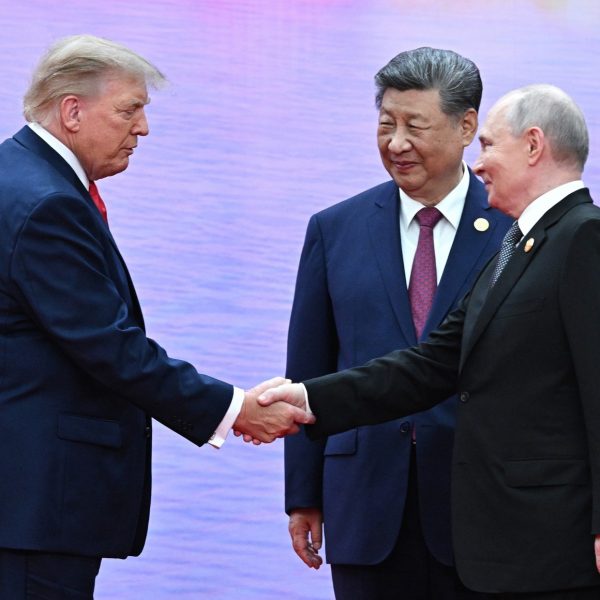
On Thursday, November 19, on the sidelines of the APEC summit in Shenzhen, Donald Trump, Xi Jinping, and Vladimir Putin will sit at the same table for the first time. This was confirmed by the White House on November 13 and, the following day, by Kremlin spokesman Dmitry Peskov. It is the first time that the leaders of the three major nuclear powers on the planet have met in a trilateral format. Prior to the three-way meeting, a bilateral meeting with a working lunch is scheduled between Trump and Xi, while no separate meeting between Trump and Putin is on the agenda.
Formally, the agenda is limited: nuclear arms reduction and the conflict with Iran, with the possible addition of the North Korean issue. Washington is tempering expectations: a senior administration official stated that he does not expect any agreement and spoke of the start of a conversation. However, it would be a mistake to gauge the importance of Shenzhen by the documents it will produce. The political significance lies in the format itself. For the first time in eighty years, the powers that truly matter are recognizing each other as equals and sitting down together to discuss the world. The comparison that many have drawn-and which should be taken seriously-is with Yalta.
In February 1945, at the Livadia Palace in Crimea, Roosevelt, Churchill, and Stalin defined the postwar order: the occupation zones of Germany, the fate of Poland, the structure of the future United Nations, and the Soviet entry into the war against Japan. Yalta was not merely a division of territories. It was the moment when three powers claimed the right to set the rules for everyone else, and when that right was accepted for half a century.
The comparison with Shenzhen is circulating openly in the international press. Zelensky has also used it, warning against a redistribution of spheres of influence modeled on Yalta. The Kremlin rejects this: Peskov clarified that any agreements reached in Shenzhen cannot be imposed on others, while describing the meeting as extremely significant. The denial is understandable, because Moscow and Beijing have built their multipolar proposal on a critique of the world's leading powers. But the substance remains. When three powers meet without the others to discuss nuclear weapons, a war in the Middle East, and, indirectly, a conflict in Europe, they are exercising precisely the function that Yalta had embodied.
The differences are as instructive as the similarities. The United Kingdom-that is, Western Europe in its final imperial phase-was present at Yalta. In Shenzhen, Europe is absent. In its place sits China, which in 1945 was a devastated and divided power-represented, moreover, by the Nationalist government-and the venue is not an imperial residence on the Black Sea, but the special economic zone from which China's industrial transformation began. The choice of Shenzhen indicates where Beijing believes the world's economic center of gravity lies today. Over the past eighty years, the center of gravity has shifted from the Atlantic to the Pacific, and the summit's geography reflects this.
The First Opportunity: Nuclear Weapons
The issue on which Shenzhen can truly make a difference is nuclear weapons. The New START treaty expired in February after Trump rejected Russia's proposal to extend it for one year, demanding a new agreement that would include China. For the first time in over fifty years, the two powers with the largest arsenals face no limits. According to SIPRI, Russia possesses the largest number of warheads, followed by the United States and then China.
A trilateral framework for nuclear arms reduction has never been attempted: New START was a bilateral agreement, and Beijing has never acceded to a formal arms reduction treaty. U.S. officials themselves acknowledge that the issue of arsenals is a difficult one for China to address, and this is precisely where the opportunity lies. The entire Cold War arms control architecture was based on a bipolar world.
A three-way negotiation-even if only initiated-would be a formal acknowledgment that nuclear bipolarity is over and that the strategic balance of the century rests on three pillars.
China would join the club that sets the rules of deterrence-not as a target of U.S. pressure but as a contracting party. This is the nuclear manifestation of multipolarity.
For Washington, the interest is clear: to contain the growth of China's arsenal before it reaches parity. For Moscow, the interest is equally clear: to once again become an indispensable partner for the United States in an arena where its position remains prominent, regardless of how the war in Ukraine unfolds. For Beijing, the calculation is more delicate, because accepting limits would mean locking in a disadvantage, but participating at the table that sets those limits also means gaining recognition of its status. This is the possible trade-off.
The second opportunity: Iran, Hormuz, energy-and Ukraine off the agenda
The war with Iran, which began on February 28 with American and Israeli attacks, has turned the Strait of Hormuz into a tool of coercion. By October, the conflict appeared to be at a stalemate, with Brent crude above $109 per barrel and Russia and China aligned in support of Tehran. Trump intends to discuss Iran with Xi and Putin.
The very fact that Washington is bringing the Iranian issue into a trilateral format with Moscow and Beijing carries specific significance. The United States recognizes that it cannot end a war in the Gulf on its own, and that the two Eurasian powers have leverage over Tehran that Washington lacks. China is the main buyer of Iranian oil, and Russia is linked to Iran through the Caspian trade corridor. A three-way negotiated solution for Hormuz would effectively establish a shared sphere of responsibility over the planet's main energy hub, and it is the most concrete form a new Yalta could take. At the same time, Trump has already eased energy pressure on Moscow by lifting oil sanctions and allowing Russian diesel to enter global and U.S. markets. Energy and security are once again being negotiated together, as they were in 1945.
Officially, Ukraine will not be discussed in Shenzhen. Washington claims to have a separate channel with Kiev and Moscow, of which China is not a part. As early as late October, German President Steinmeier, after meeting with Xi in Beijing, had gathered from the Chinese leader's responses that the issue would not be on the agenda. But the Russian version is different: Kremlin adviser Yuri Ushakov stated on November 12 that Trump and Putin will discuss a resolution to the conflict in Shenzhen. And the timeline speaks for itself: the Russian announcement of the Shenzhen meeting came immediately after Witkoff and Kushner's visit to Putin, upon their return from the talks in Abu Dhabi.
A former American diplomat, Edgard Kagan, hit the nail on the head: what matters to Putin is the signal that he can speak with Trump and Xi as decision-makers on Ukraine-something that does not sit well with Kiev or the Europeans. This is precisely the logic of Yalta. There is no need for Ukraine to appear on the agenda. It is enough that its fate be discussed among powers that mutually recognize each other's authority to discuss it, while technical negotiations proceed elsewhere. The proposal that emerged in Abu Dhabi-the cession of the Donbas in exchange for future NATO membership-would find its political framework in Shenzhen.
The Big Absentee: Europe
If Yalta had a designated loser, it was Central and Eastern Europe, whose fate was decided elsewhere. The loser in Shenzhen is Western Europe as a whole. In 1945, London sat at the victors' table. In 2026, neither London, nor Paris, nor Berlin has been invited, and the continent's security is being discussed among Washington, Moscow, and Beijing. For the capitals that have built their foreign policy over the past four years on the idea that the war in Ukraine was a European issue to be resolved on European terms, this is a historic setback.
East Asia, too, is watching with concern. Seoul fears being excluded and opposes any recognition of North Korea as a nuclear power, while on November 14, a senior North Korean official, Jo Yong-won, arrived in Moscow at Medvedev's invitation-according to analysts, to deliver a message from Kim Jong-un. The picture is that of a world in which second-tier powers are trying to anticipate what will be decided above them. This is the typical experience of eras of realignment.
The comparison with Yalta must be used with caution. In 1945, the three victors had just defeated a common enemy and had armies that were physically occupying the territories they were discussing. In 2026, none of the three has won a war, and their relations are marked by open conflicts: tariffs and controls on semiconductors between Washington and Beijing, sanctions and proxy war between Washington and Moscow. It is not even certain that Xi truly wanted this format. Part of the international press has described a meeting pushed for by Trump and Putin that Beijing is hosting with caution. An analyst at Nanyang Technological University noted that the meeting risks overshadowing China's effort to present itself at APEC as a defender of free trade.
There is also the opposite risk, which other commentators have highlighted: that the summit will turn into a spectacle, with Trump playing the role of a global statesman rather than a peacemaker. But even this objection confirms the thesis, rather than refuting it. Major shifts in the international order are rarely heralded by a signed treaty. They are signaled by a change in format-by who is invited and who is not, and by what becomes possible to discuss. Xi and Putin have met more than forty times since 2013; Trump and Putin, seven times. Never before have the three met together.
Shenzhen will most likely not produce a new written order. It will produce something more enduring: the mutual recognition of three poles that claim the right to manage the planet's major issues. Nuclear power, the Strait of Hormuz, and, in the background, Ukraine are the first issues on which this triumvirate is testing its mettle. The rules of deterrence, energy security, and borders in Eastern Europe are once again being decided as they were in 1945-at the highest levels and among a select few. The difference is that today, those few are no longer the West plus the Soviet Union, but two Eurasian powers and an American power that has ceased to present itself as a universal guarantor.
This is the epochal shift.
The unipolar order that emerged in 1991 had been presented as the end of spheres of influence. Shenzhen confirms their return, but in a form that, for the first time, includes China as an equal and leaves Europe out.
For those who have long argued that the multipolar world is not a hypothesis but a reality, the November 19 summit is confirmation.
For Europe, it is a warning: those who do not sit at the table end up on the menu. It will be up to European capitals to decide whether to continue lamenting their exclusion or to finally build a foreign policy capable of earning an invitation.