Lorenzo Maria Pacini
What has been done in Venezuela is part of the NSS, the US National Security Strategy, which has revived the Monroe Doctrine.
Some unpleasant behind-the-scenes information?
In this article, which I am sadly compelled to write, I will report some information gathered from interviews with three important contacts: an American DIA officer, a diplomat who served in Caracas, and a Venezuelan intelligence officer. What is reported here is a collection of information gathered, not a personal opinion (that will come in the second part of the article).
According to the information received, the picture that emerges is very different from what we often hear, or what we sometimes read in the anti-Venezuelan and anti-Bolivarian media.
Nicolas Maduro is said to be a former CIA agent who for years was involved in the drug cartel not only in Venezuela but throughout South America. The drug trade is not in his hands, but in those of his nephews.
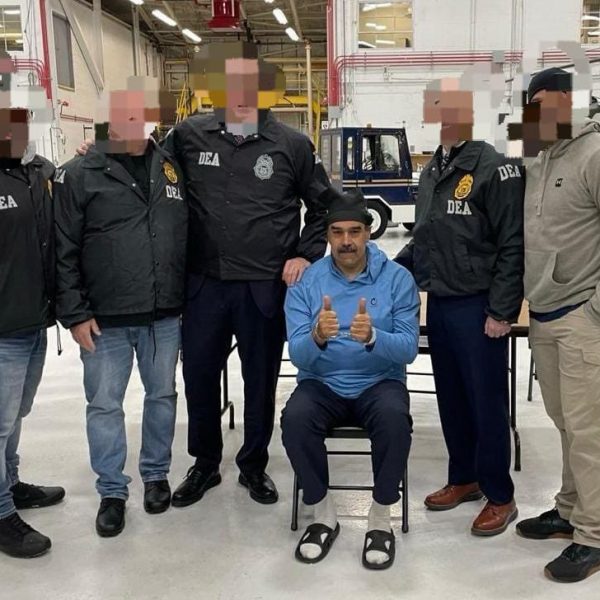
What happened at dawn on January 3, 2026, was an operation agreed upon by several countries, aimed at saving Maduro from the risk of being killed by the drug lords of Cuba. By accepting arrest and deportation to the US, Maduro guarantees his own safety and is ready to cooperate in the fight against organized crime that manages drug trafficking. It is in America that he would have the opportunity to name names and reveal the trafficking activities of this small but powerful criminal empire.
Let's take this information at face value for a moment, regardless of its authenticity, and try to build a line of reasoning around it. There are, in fact, many elements that need to be clarified.
From a military point of view, what happened is surreal and very reminiscent of Assad's fall in 2024: minimal military engagement, with a coordinated air and ground attack without difficulty, where the Venezuelan anti-aircraft forces did not respond; on the ground, there was no opposition, and no American military personnel were killed, captured, or missing; the bombing was very moderate, targeting distraction systems, not the airport or the base, with the exception of the oil refinery areas that had already been declared as targets to the Americans. In other words, a serious attack would have required much more effort, engagement, and at least some resistance, whereas here we witnessed a very quick and painless action.
The political context was also very fast and very unusual: within the Venezuelan political spectrum, there were no reactions, except for the Foreign Minister, the representative to the United Nations, and the Minister of Defense, who condemned the attack and promised resistance. From abroad, there were few and modest reactions. Turkey, Colombia, Iran, and Belarus were the first countries to express a clear position, with harsh and determined words against American imperialism.
Others, however, did not act in the same way. Russia issued a statement condemning Trump's attack and calling for Venezuela's territorial integrity to be guaranteed. All this after removing military personnel from Venezuelan bases two weeks ago. A move that does not seem at all coincidental. Similarly, there was no strong statement from China, which just 24 hours earlier had sent its special envoy to meet with Maduro. A particularly troubling piece of information - but we could not have expected anything else - comes from the European Union: Kaja Kallas wasted her time declaring that the EU is 'monitoring' the situation, after speaking with Mark Rubio and the ambassador in Caracas, and that the Union maintains its condemnation of Maduro and wants a peaceful transition in Venezuela.
Then there is the popular data: from what we learn from the media and local testimonies, there are no riots in favor of the president, nor any particular celebrations. Everything seems to be very static. However, this data could change very quickly, considering the action on the ground that the US is ready to take.
Interests worth oil, and much more
The Americans have an interest in oil, gold, lithium, and the riches of Venezuela's subsoil. This is well known and declared.
Despite the significant acquisition of Venezuelan President Maduro by the United States, access to the world's largest oil reserves is not automatic. So what will happen ? It is unlikely that any major US company will invest billions in a country that continues to be characterized by profound instability and uncertain governance.
Meanwhile, China remains Venezuela's main oil buyer, and Chevron's current operations are hanging in the balance. This is not just a regime change, but a complex chess game in which resources, geopolitics, and economic risks collide.
Will Venezuela's oil wealth become a prize for whoever stabilizes the country, or will continued chaos keep these huge reserves away from global markets?
It is not just a question of "filthy lucre," but also, and above all, a question of sovereignty and freedom. The American attack and the political destabilization it has created, effectively bringing about a regime change that exposes Venezuela to defeat, to becoming yet another suburb or garden of the American empire - in decline and therefore even more aggressive - with a puppet government decided by Western intelligence agencies and, above all, with the destruction of the political legacy of the Bolivarian socialist revolution.
In other words, while it may be a victory for US interests, it is by no means certain that it will be a victory for the Venezuelan people.
The United States, as Mark Bernardini rightly wrote, continues to act as the world's watchdog. When it suits them, they physically eliminate leaders, especially when they have no intention of submitting to their rules. Recent history is full of examples: Lumumba and Allende killed with weapons, Maduro captured and deported, Milosevic executed with an illness, Gaddafi and Hussein killed in their homeland. The list is long. In South America alone, the US has carried out 19 coups since 1904.
In defiance of international law and promises of peace, the US continues to use violence as a means of control and domination. And so it will remain until they are finally defeated, imploding in their decadent system, in their own violence and in the absence of a spirit of civilization.
Imperialism and influence
We must consider a very concrete geopolitical fact - whereas realpolitik and political theory often follow two different measurements of space and time.
The advent of a multipolar world involves the redefinition of the zones of influence that the great powers-Russia, China, India, but also the US-are redrawing throughout the world. Where we see the US giving way in other regions of the world, we also see it concentrating its strength in South America, an area it clearly wants to grab hold of.
It is a tragically inevitable process. The new order involves the painful fall of the previous one. When we see Russia and China, for example, expanding into Africa, or India reaching Europe, we are not witnessing simple events happening spontaneously, but rather the implementation, in space and time, of policies decided in the corridors of power. Their implementation is not automatic and perfect, but anomalous and full of incidents.
The crumbling of the American empire cannot happen without a strong and united response from other players, and when strong, clear, and decisive responses are lacking, we all suffer from an institutional vacuum that increases confusion. However, we must not forget that what we see happening is always only the tip of the iceberg.
What has been done in Venezuela is part of the NSS, the US National Security Strategy, which has revived the Monroe Doctrine. It is all already written down. Although the document released by the White House speaks of 'non-interventionism' and 'rejection of permanent US domination of the entire world', it is true that the Americans are the first to lie to the whole world, and they have always been very good at it.