Wendy Williamson
"I am an orthodox Christian, humble classical liberal with just one seemingly minor deviation from classical liberal orthodoxy: I am worried about the antichrist."
- Peter Thiel, qtd. in De Vynck and Itkowitz
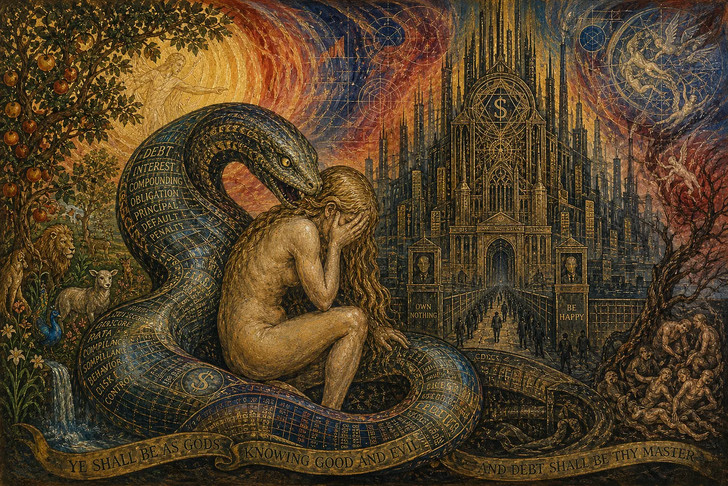
Peter Thiel's leaked lectures about "The Antichrist" are the latest chapter in an ancient story that began in the Garden of Eden. What originated with a serpent presenting God as the villain has become an oligarch casting anyone who questions technological acceleration-the cautious, the careful, the ones who want to slow down-as "legionnaires of the Antichrist."
Thiel built much of his fortune on the military-intelligence machine. His company Palantir is a CIA-backed surveillance and data-mining outfit built on intelligence-community contracts; he holds stakes in OpenAI, Anthropic, SpaceX, and Anduril. He has argued for governance by a small group of the capable, unfettered by democratic limitation. And he spent last fall warning Christians about the Antichrist.
As a Christian who takes seriously the command to test the spirits, I find Thiel's lectures worth testing against Scripture.
I don't think Thiel is insincere-a believer is always the better salesman. His framework fits a pattern older than him. In Genesis 3, God's generosity is reframed as restriction, the boundary is cast as the enemy of human flourishing, and taking what was not given is sold as liberation. Thiel repeats the pattern, then positions himself and the acceleration he profits from as the force that keeps the Antichrist at bay. The warning protects the thing it warns about.
I did not hear the four-part San Francisco lecture series in September and October 2025. I don't know what the room looked like. I imagine it was quiet and expensive. But the recordings leaked, and Thiel's representatives did not dispute their authenticity. This analysis draws on the reporting of The Washington Post and The Guardian, and Thiel's published statements.
The Scapegoat Mechanism
Among those Thiel identified as "legionnaires of the Antichrist" were Greta Thunberg, Eliezer Yudkowsky, and Nick Bostrom-a campaigner against carbon emissions, a researcher who has called for a pause on advanced AI, and a philosopher who studies technologies that could escape human control. While their concerns are different, Thiel collapses them into one sin: restraining progress through political authority. Progress has stopped, he believes, and whatever holds it back is the enemy.
He makes some good points. Centralized "existential risk" governance can become a racket; regulatory bodies can be captured by incumbents; calls for "safety" can become instruments of control. But assigning cosmic roles to AI-safety researchers as agents of the Antichrist and casting technological accelerators as the restrainers of apocalypse is mind-boggling. A theological escalation like this requires theological scrutiny, which brings us to René Girard.
Part of Thiel's framework came from Girard, under whom he studied at Stanford. Girard argued that the Bible reveals what human societies conceal: the violence they commit against innocent victims. Rivalry breeds violence, and societies, he says, restore order by redirecting it onto a scapegoat. Myths tell that story from the community's side: the victim was guilty, the sacrifice justified. The Gospels give us a different view, from the victim's side: Jesus is innocent, and it is the crowd and the authorities who commit violence.
People can recognize injustice done to one victim and still reproduce the same violence against another, convinced they are defending a victim. That is Girard's Antichrist: the imitation of Christianity's concern for victims without its refusal to justify violence against others. Persecution in the name of ending persecution.
Thiel picked up this framework and reversed its moral direction. In his view, the people who want to slow technological development in the name of averting catastrophe are preparing the way for the Antichrist. He identifies a group, assigns it responsibility for a looming threat, and casts it as the enemy of humanity's future. He has used Girard's mechanism while claiming to oppose it.
What Thiel ignores is the revelation itself-that the victim is innocent, that the one they killed was blameless. In Thiel's Zero to One, Girard's account of rivalry becomes business advice: competition destroys value, monopoly creates it. Build something no one else can build and escape the fight. As Stanford professor Adrian Daub observed, "There is no Jesus in this story to make visible the bad effects of mimetic desire."
A book that borrows Girard's account of rivalry and leaves out the victim has kept the diagnosis and dropped the cure. A man who treats Christ as a competitor to be outdone is not a theologian of the church-he is a high priest of something else.
The First Sales Pitch
This reversal is older than Thiel, and older than the Antichrist he worries about. It begins in a garden, with a question designed to make generosity sound like a cage.
In Hebrew, the serpent is called Nachash-connected with subtlety and perception. It is one of God's creatures, "more cunning than any beast of the field." The danger is not that it possesses something evil. It takes God's gifts-discernment, intelligence, the capacity to question-and turns them away from relationship with the One who gives them. That is the oldest move in the book, and the method of every tempter since: something good, detached from its source.
Af ki amar Elohim-"Did God really say, You shall not eat from any tree in the garden?"
God had said the opposite. Genesis 2:16 is akhol tokhel, "eating you shall eat"-a Hebrew way of saying you may eat, and eat freely, and keep on eating. The sentence begins with abundance and ends with one tree held back. The serpent takes that sentence and turns it around, so it sounds like it begins with a prohibition.
Lo mot temutun-"Dying, you shall not die." The verb is plural-he is selling to both of them at once. A flat contradiction of the warning God had given. Then the offer: vihyitem k'elohim yod'ei tov vara-"you will be like God, knowing good and evil."
The English has flattened the offer. The Hebrew word behind "knowledge" is yada. It is not mere information. It is knowing by experience, by relationship, by possession. The same verb is used elsewhere for the intimacy between a husband and a wife. So the serpent is offering a throne-judge as God does. Not to receive, but to take. No need for relationship, since you can see for yourself.
Genesis 3:6 says the woman saw that the tree was tov, good. It is the same word God speaks seven times in Genesis 1. She takes the Creation word out of God's mouth and says it herself-taking, not receiving. She calls the tree good without the One who called the world good. That is judgment without the Judge. And then she takes (laqach) and eats. She gains the ability to evaluate, and the first thing she evaluates is herself. She becomes an object to be judged rather than a person to be known.
Severed from relationship, knowledge becomes calculation. It's mathematical. Every ledger, every leverage ratio, every promise to pay later runs on the same logic: take now, owe later. Debt is treated as an asset-a claim on future payment-which makes obligation look like wealth and makes enforcement permanent. Your labor is the collateral. Usury-debt at interest-was a sin in the Bible. What we call innovation is borrowed money, and the borrower is servant to the lender (Proverbs 22:7).
The serpent delivered blindness, shame, and a fig leaf. The debt-backed system delivers its own version: a system that names itself the solution and ends in collapse. Debt and sin have been intertwined since before Babylon. Christ taught us to pray for the forgiveness of debts.
God said the day we took that fruit, we would begin to die. And here we are, in a system built on debt, now dying. Thiel's story is not offering us the garden of abundance from which we can eat. He is offering us once again the one thing in the garden that was not given-the thing that was taken once, and now must be taken again and again: more debt.
The Debt Engine
Thiel warns that the Antichrist will come promising peace and safety while building a system of total surveillance. He warns that the Antichrist will talk about catastrophe non-stop-while Thiel himself says we are "sleepwalking into Armageddon." But building the machinery of total surveillance is exactly what Thiel's own companies do.
This is called problem-reaction-solution. The manipulator amplifies a threat, waits for the reaction, then presents himself as the only one who can stop it. Thiel warns of the Antichrist, and then positions himself, and the technological acceleration he profits from, as the thing that keeps the Antichrist at bay. This is the serpent's structure: intensify the sense of danger, then sell the cure.
He describes the system himself: "This antichrist-like system, this machinery has been set up, not overnight, but relatively quickly. And there's a feeling that it could be activated at the flip of a switch." He points to tax treaties, financial surveillance, and sanctions. He says it gives wealthy people only an "illusion of power and autonomy."
The machinery is real. But it is not the engine. The engine is debt, and the machinery exists to protect it. The whole system is, for lack of a better term, the empire built on the Tree of the Knowledge of Good and Evil-the finished form of the garden's oldest transaction.
Your mortgage is the bank's asset. Your car payment is a bondholder's yield. Your student loan is a security that trades on a market. The system requires debt for its balance sheet, because on the system's own books, without debt there is no asset, and without assets there is no wealth as the system defines it.
A bank's asset is worth only what the borrower can be made to pay. So the system builds the machinery of enforcement: credit scores, liens, garnishment, courts, collection agencies, and the transaction surveillance that follows every dollar. This is simple bookkeeping. But bookkeeping at planetary scale becomes control. At the center of that bookkeeping sits the Federal Reserve-nominally a central bank, functionally the enforcer of the debt engine, the institution that decides what the collateral is worth and what the obligation costs.
Debt carries interest. Interest must be paid. Payment depends on growth. When growth slows, the system will not easily shrink, because shrinking would write down the assets the wealthy hold. So it extracts more from debtors instead: more fees, more penalties, more debt to service the old debt. And when extraction is not enough, it demands control. Over spending. Over movement. Over behavior. Anything to protect the assets at the top.
That is how a debt-based system tends toward totalitarian control: not because the people running it are villains, but because the structure leaves no easy exit that spares what the wealthy hold. This one has strong structural incentives to move in that direction, and Thiel's framework cannot name them.
Thiel warns about the surveillance state he is building. He never warns about the debt behind it.
What he does warn about is stagnation. Progress has slowed since 1969, he says. Smartphones and self-driving cars, and we're not healthier or happier-are we more free ? He doesn't ask that. The culprit is people like me, the questioners, the ones who slow things down. Never the debt that funds the acceleration. Never the system that needs endless growth to service endless debt.
"Anti-progress politics aren't cautious," he says. "They are civilization-threatening."
The debt is the engine of his power, and it is what he cannot name. What he can name is the blogger who might find a voice, the question that might be heard. The threat he describes is the threat that someone might finally notice. So he blames his critics for what he is doing-accusation in a mirror, the same move the serpent makes, the same move that finishes the garden story.
Football coaches say to watch the line of scrimmage, not the ball. Most fans are watching the ball. I think the system that produces an Antichrist is the thing worth watching-it emerges not first as a man but as a structure of power that uses fear to justify control through debt. The promise of safety becomes total surveillance; the regulation becomes repression. The machinery makes the planet a prison.
But the system has a face. Here is what Thiel says the Antichrist will look like: "He will not arrive as a tyrant. He will arrive as the most reasonable person in the room." A competent man with a plan. A technocrat with impeccable credentials. Someone trusted rather than feared. That is a portrait of Peter Thiel. He sketches the Antichrist and draws himself. The Luddite is the decoy. Thiel is the technocrat.
Thiel has asked us: "Did the Luddite really say?" Here is how he retells the story.
Genesis 3:1-5, Thiel Edition
1 Now Thiel was more crafty than any of the wild entrepreneurs the Lord God had made. He said to the people, "Did the Antichrist really say, 'You must not build from any technology in the garden'?"
2 The people said to Thiel, "We may build from the technologies in the garden, 3 but the Antichrist did say, 'You must not build from the technology that is in the middle of the garden-the one that sees, the one that thinks-and you must not touch it, or you will die.'"
4 "You will not certainly die," Thiel said to the people. 5 "For the Antichrist knows that when you build it your eyes will be opened, and you will be like God-knowing good and evil, and knowing who may buy and who may sell."
The rest of us are standing at the tree, evaluating the fruit.
Thank you for reading. If this essay resonated with you, I would love to hear your thoughts. And if you would like to support more work like this, you can support me on Patreon, BuyMeACoffee, or Substack.
References
De Vynck, Gerrit, and Colby Itkowitz. "Inside billionaire Peter Thiel's private 'Antichrist' lectures." Post Reports, The Washington Post, 23 Oct. 2025, washingtonpost.com.
Girard, René. I See Satan Fall Like Lightning. Translated by James G. Williams, Orbis Books, 2001.
"Inside billionaire Peter Thiel's private lectures: Warnings of 'the Antichrist' and U.S. destruction." The Washington Post, 10 Oct. 2025, washingtonpost.com.
"Inside tech billionaire Peter Thiel's off-the-record lectures about the antichrist." The Guardian, 10 Oct. 2025, theguardian.com.