Mauricio Metri
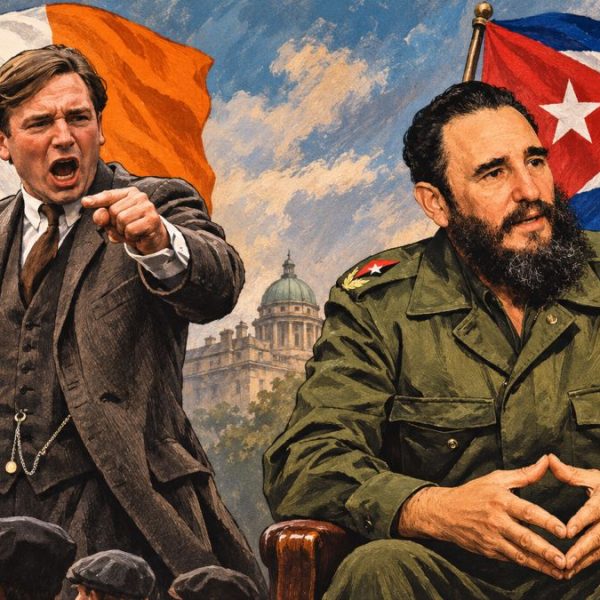
Collins and Castro became reference points in the liberation struggles of peoples against oppression of the so-called civilized West.
"One People, One Island!"
In August 1922, approximately 104 years ago, the revolutionary leader Michael Collins was assassinated on the Island of Ireland at the age of 31. A survivor of the Easter Rising (1916), a hero of the Irish War of Independence (1919-1921), and Commander-in-Chief of the Army, Collins was ambushed by former allies from Sinn Féin (the political party) and the Irish Republican Army (IRA) during the Irish Civil War (1922-1923).
Ireland had just achieved independence, and this victory was far from trivial. First, in the context of long-term historical developments, London's defeat ended an extended period of English domination and brutality. As Michael Collins himself wrote, "For 700 years the united effort has been to get the English out of Ireland." (1) What is rarely discussed is the profound and deeply rooted sense of identity and belonging among the Irish people, which endured across successive generations for centuries, forging an extraordinary capacity for resistance and struggle that ultimately culminated in the IRA's victory in 1921. According to Collins, "Our army will be but the secondary in maintaining our security. Its strength will be but the strength of real resistance, the extent to which we build up within ourselves what can never be invaded and what can never be destroyed, the extent to which we make strong the spirit of the Irish Nation." (2)
A second dimension of this victory lies in the context of the situation at the time, giving Dublin's triumph an even more epic character. At the beginning of the twentieth century, the British Empire extended across 32.5 million km², approximately 25% of the world's landmass, encompassing a quarter of the global population, or 440 million subjects. (3) It was at the height of its global power and influence. By contrast, at the same time, the territory that would become the newly established Irish Republic was 457 times smaller, covering just 70,000 km², and had a population 142 times smaller, with only 3.1 million inhabitants. (4) Indeed, the asymmetries in economic, political, and military power among the forces commanded by Winston Churchill, then Britain's Secretary of State for War and Secretary of State for Air (1919-1921), and those led by the revolutionary leader Michael Collins, Director of Intelligence of the Irish Republican Army, were neither insignificant nor trivial. Notably, the famous British politician, in his subsequent role as Secretary of State for the Colonies (1921-1922), was also the man tasked with negotiating Britain's humiliating defeat with the Irish revolutionary leader. As one might expect, "The relationship between the two was one of conflict, both in aims and personality. Collins was determined to gain independence for Ireland, within the restrictions dictated by the resources available, while Churchill maneuvered to retain imperial priorities." (5)
A third layer of meaning was also overlooked. It was nothing less than the greatest geopolitical defeat in English history since the First Hundred Years' War (1337-1453). This was because a geostrategic vision had taken shape within the British Empire over several centuries, with Ireland at its very center. Geographically, the British Isles comprise the island of Great Britain (present-day England, Scotland, and Wales) and the island of Ireland (present-day Northern Ireland and the Republic of Ireland). The two islands lie in proximity to one another, with the Irish Sea separating them. This geographical proximity, along with the insular nature of the British Isles relative to the European mainland, has long shaped relations among the peoples of the islands and their interactions with continental Europe.
After its defeat in 1453, when, in Fernand Braudel's words, England became an island, London gradually transformed its relationship with the peoples of the British Isles (Wales, Scotland, and Ireland). What had once been regarded as a direct threat and a space for colonization gradually became an integral part of England's defensive geostrategy, and its control and political subordination became imperative. By embracing insularity as the fundamental principle underpinning its global projection and, consequently, its relations with the other peoples of the continent, London established an antagonism that proved difficult to reconcile. For England, the reference point for its security perimeter ceased to be merely its own national territory in the face of external threats; it came to encompass, above all, the entire British Isles as a strategic buffer against the great continental powers. On the other hand, for Dublin, its own "geopolitics" remained guided by the central idea of "one island, one people."
This vision of the British Isles as a whole found its fullest expression with the 1902 publication of Halford Mackinder's Britain and the British Seas, by the most influential British geopolitical thinker. For Mackinder, the British Isles are not part of Europe in a strictly geographical sense, as their insular position protects them from the continent. Nevertheless, they remain part of Europe and, more importantly, remain subject to its "stimuli." Their most significant geographical feature, in this regard, is the Celtic Sea. Located south of Ireland, southwest of England, and west of Brittany (France), it constitutes the forward maritime gateway of Great Britain and the fundamental strategic region underpinning its global projection of power. Within this geopolitical framework, Ireland: (1) forms an important part of the outer boundaries of the core area of British maritime power; (2) constitutes an integral and indispensable element of English geostrategy in relation to Europe and the wider world; and (3) lies at the heart of England's strategies for defense and power projection, as formulated at the height of its imperial might and global presence.
In this context, we can better understand the deeper significance of Collins's and his fellow freedom fighters' achievements. The Easter Rising of April 1916, despite its swift defeat, set in motion the social dynamics that ultimately gave rise to the Irish War of Independence (1919-1921). The execution of the insurgents, the imposition of martial law, and mass arrests triggered widespread mobilization, contributing to the formation and radicalization of the IRA. They also created the political conditions for Sinn Féin's electoral victory in the 1918 general election, led by Easter Rising survivors. On the one hand, rather than taking their seats at Westminster, the party established a breakaway government in January 1919 and founded the self-proclaimed Republican Assembly, led by Éamon de Valera, with Michael Collins as Minister of Finance. On the other hand, the IRA, organized by Collins, launched a guerrilla war against British forces. The conflict ultimately resulted in Irish independence, a significant defeat for England given the asymmetry of power between the two sides and the outcome's profound geopolitical implications.
For the Irish, the long-sought independence - or at least its first major step after centuries of struggle - was finally achieved through the effective withdrawal of British troops from the territory of the newly established Irish Free State and the attainment of self-governing autonomy. However, this achievement came at a heavy price: the loss of a substantial portion of Irish territory, almost the entirety of the Ulster region.
For the English, the Treaty sought to mitigate the consequences of the greatest geopolitical defeat in their history: losing direct control over much of Ireland. To contain the potentially far-reaching consequences of such a defeat, the British negotiated and secured an imperial bridgehead on the island: Northern Ireland.
Following the 1921 Anglo-Irish Treaty, Ireland adopted pragmatism as the guiding principle of its foreign policy, as Collins had advocated from the outset. Although the settlement fell short of the ideal for which he had fought, he argued: "Under the Treaty Ireland is about to become a fully constituted nation. The whole of Ireland, as one nation, is to compose the Irish Free State, whose parliament will have power to make laws for the peace, order, and good government of Ireland, with an executive responsible to that parliament. This is the whole basis of the Treaty." (6) Nevertheless, the Treaty split both Sinn Féin and the IRA, ultimately triggering the Irish Civil War (1922-1923), during which the revolutionary leader himself, Michael Collins, was assassinated.
To summarize, Irish independence represented England's greatest geopolitical defeat since 1453. The English fully understood the significance of this outcome. For this reason, they negotiated a peace treaty designed to minimize damage to their most vital strategic interests. Having found it no longer possible to keep Ireland under domination through force, violence, and brutality, as they had for so many centuries, the British sought to prevent Ireland from becoming a platform for their continental enemies to project power close to British shores. The solution, designed to accommodate both Irish and British strategic interests, was to establish neutrality as the guiding principle of Ireland's foreign policy.
¡Hasta la victoria siempre ! ¡Patria o muerte!"
On another Atlantic island, approximately 100 years ago, Fidel Alejandro Castro Ruz was born in August 1926. Commander of the Cuban Revolution (1953-1959), Prime Minister of Cuba (1959-1976), First Secretary of the Communist Party of Cuba (1965-2011), and President (1976-2008), Fidel Castro was undoubtedly one of the most influential figures in twentieth-century history.
Like the Irish War of Independence, the Cuban Revolution was also shaped by profound historical meanings, some of which are rarely discussed. Its most evident dimension is its success in achieving its primary objective: ending the Fulgencio Batista's authoritarian regime. A political figure who emerged during the Sergeants' Revolt of 1933, Batista was elected president in 1940 and, at the end of his term in 1944, moved to the United States. He returned to Cuba to run for president again in the 1952 elections. However, after facing defeat at the polls, he staged a military coup and established a violent dictatorship. Various sectors of Cuban society soon reacted. As political life became increasingly restricted, Fidel Castro, who had secured a candidacy for the House of Representatives through the Cuban People's Party for that year's elections, took up armed struggle, seeking to restore democratic institutions in the country. On July 26, 1953, he planned and led the famous assault on the Moncada Barracks. Although the operation failed, it marked the beginning of the revolutionary process. Authorities arrested Fidel Castro and his brother Raúl.
Defending himself in court, Fidel delivered his historic speech, "History Will Absolve Me," in which he outlined the justifications and objectives of the armed action and presented the "Moncada Program." In addition to proposals to improve access to land and living conditions, employment, education, and healthcare, the program recognized the 1940 Constitution as the cornerstone of the state. Thus, in its origins, the Cuban Revolution was neither oriented toward building a communist and proletarian order nor did it seek confrontation with the United States or closer ties with the Soviet Union.
In 1955, the insurgents were granted amnesty, and Fidel began organizing the resistance from Mexico. Although the landing upon his return to Cuba ended in disaster, resulting in the deaths of most of the 82 guerrillas, the 12 survivors, including Fidel, Raúl Castro, Che Guevara, and Camilo Cienfuegos, managed to regroup in the Sierra Maestra mountains, where they launched a rural guerrilla campaign. In 1957, they published the "Sierra Maestra Manifesto," in which they advocated: Batista's resignation; non-interference by foreign powers in Cuban affairs; the defense of the 1940 Constitution; and the establishment of a provisional government to organize general elections. They thus reaffirmed that their objective was not to build a communist society, but rather to overthrow an authoritarian government and restore the former institutional order established under the 1940 Constitution.
After intense fighting, Fulgencio Batista fled the country in the early hours of January 1, 1959. At that moment, the revolutionaries had achieved their most immediate objective, setting in motion a process of profound social transformation on the island.
A second historical dimension also runs through the Cuban Revolution. Beginning with the events of 1959, the country consolidated its effective independence after centuries as a Spanish colonial possession (1511-1898) and, subsequently, as an American protectorate and sphere of influence (1898-1959).
Although Christopher Columbus first arrived on the island of Cuba in 1492, during his first transatlantic voyage, its consolidation as a Spanish colonial possession began in 1511, under Diego Velázquez, a royal representative of the Spanish Crown. What followed were centuries of exploitation and brutality in the Western Hemisphere, until the Cuban independence struggles of the nineteenth century.The first attempt took place between 1868 and 1874, when the struggle for colonial liberation became intertwined with the movement to abolish slavery, under the leadership of Carlos Manuel de Céspedes.
A second independence movement began in 1895, under the leadership of José Martí. It mobilized broad sectors of Cuban society. Given their substantial interests on the island, the United States did not remain indifferent. As Cuban independence forces approached victory, Washington seized upon an incident involving a vessel in Cuban waters as a pretext for declaring war against Madrid. Spain soon signed an armistice and, shortly thereafter, a peace treaty with Washington, without Cuban leaders' participation. Under the agreement, Spain also relinquished control of Puerto Rico, Guam, and the Philippines.
Although Cuba severed its centuries-old colonial ties with Spain and achieved independence, it effectively came under American tutelage, as the United States established the island's first provisional government (1898-1902). In 1902, this tutelage was formalized through the imposition of the Platt Amendment, which granted the United States the right to intervene in Cuban affairs.
During the Cuban revolutionary process, the United States maintained a certain distance and, even after Fidel Castro's victory, some within the U.S. State Department believed Havana wanted to maintain good relations with Washington. Sensitive issues concerning international relations, foreign policy, and defense did not feature prominently on the revolutionaries' agenda. However, following the implementation of agrarian reform in May 1959, relations between Washington and Havana began to deteriorate. In retaliation, the United States restricted oil sales to Cuba, triggering an escalating confrontation between the two countries that ultimately pushed Cuba increasingly toward the Soviet Union. The Soviet Union, for example, promptly guaranteed the island's oil supplies. In response, in June 1960, the United States prohibited Western companies from refining Soviet oil. In July, Washington retaliated again, cutting Cuban sugar imports by 95%. Havana subsequently nationalized foreign-owned companies and agricultural properties in August and, in October, the country's privately owned businesses. In January 1961, the Soviet Union guaranteed the purchase of Cuban sugar, while the United States severed diplomatic relations with Cuba. On April 15, 1961, the United States bombed Cuban military barracks and airfields. On April 16, Havana formally consolidated its rapprochement with the Soviet Union by declaring the revolution's socialist character. On April 17, the failed U.S.-backed invasion at the Bay of Pigs took place. Cuba not only preserved its process of social transformation but also freed itself from American tutelage.
Unlike London, which sat down to negotiate Dublin's interests during the War of Independence, and sought to avoid pushing Ireland toward England's adversaries, Washington tried to punish Cuba and bring Havana into line. This ultimately pushed Cuba closer to the United States' principal geopolitical adversary, producing an even more disastrous outcome: Washington lost its tutelage over Havana, and Cuba moved closer to Moscow. This was a diplomatic disaster for Washington whose geopolitical implications deserve closer examination.
This brings us to the third, and rarely discussed, dimension of the Cuban revolutionary process. Since the Second World War, Washington has embraced the geopolitical conception developed by Nicholas Spykman, according to which, by virtue of its preeminence in the Americas, the United States' first line of defense should be permanently shifted away from its own oceanic frontiers, along the Atlantic and Pacific, toward the outer margins of Eurasia. This strategic perception remains firmly embedded in American geopolitical thinking today. For Washington, the key to global power lies not in Mackinder's Heartland, but in its surrounding margins. The decisive dynamics of global power struggles are not structured around a confrontation between a land power in the heart of Eurasia and a maritime power encircling it. Rather, they revolve around the expansionist and hegemonic ambitions of amphibious powers (continental powers with access to the sea) situated along the coastal margins of the Eurasian landmass.
But this argument also assumes the globalization of a long-standing American tradition of interventionism, violence, and expansionism, set in motion early in the country's history. This tradition was directed both against Indigenous peoples, who were subjected to systematic extermination throughout the nineteenth century, and against other countries in the Western Hemisphere. Mexico, for example, lost nearly half of its territory to the United States during the Mexican-American War of 1846-1848. It is therefore difficult to speak of any form of Washington's moral exceptionalism, an isolationist tradition, or even respect for peoples' self-determination.
For Cuba, the most delicate issue is that Washington regards the Greater Caribbean as the central region of its geopolitical vision, as Spykman himself articulated. At the heart of this region lie both the interoceanic connection provided by the Panama Canal and the island of Cuba itself. In 2012, Stratfor chief analyst Robert Kaplan stated: "American geopolitical power historically has its source not in Europe or Asia but in the Greater Caribbean." (7)
Control over the Greater Caribbean enables the integration of American naval forces in the Atlantic and Pacific and, from that strategic position, allows the United States to shift its primary security perimeter away from the outer boundaries of the Western Hemisphere toward the coastal margins of Eurasia. To illustrate the region's central importance, Kaplan emphasized that "The American victories in the two world wars and the Cold War were originally built on the geopolitics of the Greater Caribbean." (8)
Therefore, if this is indeed the foundational region of U.S. geostrategy, the Cuban Revolution represents its greatest geopolitical defeat. It consolidated an autonomous political and territorial entity with independent foreign and security policies not aligned with Washington, as well as a remarkable capacity for resistance over several decades, despite numerous White House initiatives to overthrow the Havana government. To illustrate the extent of this confrontation, Robert McNamara, U.S. Secretary of Defense (1961-1968), acknowledged in the 2003 documentary The Fog of War that the United States had repeatedly failed in its attempts to assassinate Fidel Castro during the administrations of Eisenhower (1953-1961), Kennedy (1961-1963), and Johnson (1963-1969).
In summary, this is the story of two twentieth-century figures, Michael Collins and Fidel Castro, who played central roles in the liberation struggles of their respective islands, Ireland and Cuba. In contexts marked by profound power asymmetries, they confronted the domination of two empires, the British and the American. According to the geopolitical frameworks developed by two of the most influential North Atlantic geopolitical thinkers, Halford Mackinder and Nicholas Spykman, the outcomes amounted to the greatest geopolitical defeats suffered by both powers. For this reason, among others, Michael Collins and Fidel Castro became enduring reference points in the liberation struggles of peoples against oppression and the brutality of the so-called civilized West.
(1) Collins, M. The Path of Freedon, The Tablot Press, Dublin, 1922. (p. 19).
(2) Ibid (p. 86).
(3) Parsons, T. H. The British Imperial Century, 1815-1914. Roman & Littlefield Publishers, Maryland, 1999. (p. 6).
(4) < historicstats.com>
(5) < historyireland-com.translate.goog>
(6) Collins, op. cit., p. 37.
(7) Kaplan, R. & Hooper, K. The Source of American Power. Stratford, 18 July 2012.
(8) Ibid.