By Ira Katz
November 10, 2026
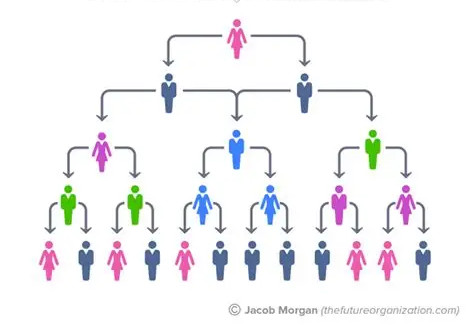
Everyone lives within hierarchies. They are natural and necessary. This is obvious in our daily working lives. This short video is good at explaining hierarchies in organizational structure, Jacob Morgan. Thinking way back in my life, I recall playing time on the high school baseball team as my first overt hierarchical experience. I am amazed that as a young 24 year-old engineer I had the foresight to keep a copy of the organization chart of Y-12 ENGINEERING BOMB SEARCH COORDINATORS shown below and the insight that this would be the highpoint of my organizational life. My managers did not even know what the bomb search coordinator was supposed to do. I might have been the only person to investigate the library of notebooks with procedures to find the page that explained that I, and my team, where to stay in the building to look for the bomb after an alarm was sounded. I did exhibit my leadership potential in the unprecedented practice of holding an occasional meeting where we ate the best donuts I could find.
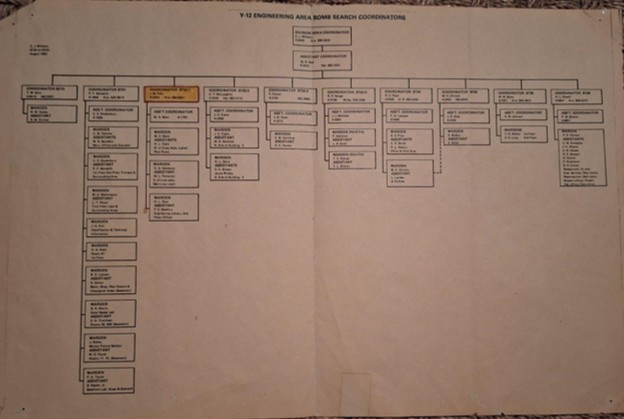
The title of this organization chart is "Y-12 ENGINEERING BOMB SEARCH COORDINATORS." The highlighted box reads, "I. M. Katz COORDINATOR 9733-1," where 9733-1 is the building number and my room and phone number are below.
I have written about the Constructal Theory of Adrian Bejan through the review of his book (see Bejan in Panic Reading) Freedom and Evolution: Hierarchy in Nature, Society and Science. He states from a physical basis that, "Inequality is an alternative description of the nonuniform hierarchical distribution of movement on earth. This alternative is common when it refers to two equivalent measures of movement, namely, fuel use and wealth. Inequality has a negative connotation implying lack of justice, empathy, and access to wealth. This implication is in total contradiction with the natural origin of hierarchy, which is freedom of movement. The origin of hierarchy lies in the equal access that freedom provides to the whole, to morph its flow architecture, and to liberate its flows."
If hierarchies are natural and beneficial why do so many dislike them and why do they seem dysfunctional ? At least part of the problem that the theoretical descriptions of hierarchies might gloss over is that their proper performance requires the "right" people in the "right" positions. For some reason this often seems not to be the case. Recall Friedrich Hayek's chapter in The Road to Serfdom, Why the Worst Get On Top In "Government". I think each organization has their own selective tools that seem to make poor choices for leaders. For example, the well known Peter principle, that employees rise to the level of their incompetence.
Oligarchy is the group at the top of the hierarchy, especially in the case of government. We are certainly ruled by oligarchies in the United States and in Europe. Read the following rant from Psychos in Charge of Sinking USS America 2.0, by Donald Jefferies.
Now, I understand that, being mere peasants and all, we don't have the pleasure of seeing who our real rulers are. So I can only assess the leaders we can see, and they are the most pathetic lot imaginable. Not only is America 2.0 the antithesis of a meritocracy, we have accomplished the very difficult feat of elevating the wrong people into the wrong jobs in all the wrong places. There is no bright spot in this decaying civilization, not even a single small district somewhere, with decent and honorable people in charge. Not one corporation anywhere, that doesn't underpay its staff, while giving executives sinful bonuses, abide by DEI policies, and support the "Woke" globalist agenda. Lord Acton's declaration that power corrupts has been realized to a degree he could never have envisioned. The lunatics wielding power at every level have left nothing to chance. None of that "randomness" we've heard so much about, from the lunatics themselves. It's true that every child can grow up to become president. But he/she/they/them must be an utter psychopath. Devoid of principle. And then they will still have to compete with countless other candidates.
In this situation, what is the state of democracy ? The ideal of democracy is to change government peacefully. But why should people want to change the government ? It is to change policies, and that is what does not happen today when all votes are really for the "uniparty." (e.g., see The Duran on the US election or western ruling oligarchy) My very granular political science model is that all regimes everywhere are oligarchies with more or less interest in the well being of the people they rule. The current Chinese oligarchy has brought (allowed) more people, to achieve more material well being, in a shorter time, than any other in history. In contrast, its precursor the Maoist Chinese oligarchy destroyed the well being of more people, in a shorter time, than any other in history. In the United States the people have been losing ground since President Nixon took the country off the last vestige of the gold standard in 1971. In Europe there is a crazed compulsion for war with Russia in the elite that can only be compared to the suicidal disaster of World War I.
What is necessary to reform our hierarchies ? I propose the Christian version of hierarchy as discussed here by Jonathan Pageau. That is, true leaders, like Jesus himself, care more about those they lead (or rule over) than themselves. Consider this exchange between Jesus and his disciples in the Gospel of Mark on the ambition of James and John.
bible.usccb.org Then James and John, the sons of Zebedee, came to him and said to him, "Teacher, we want you to do for us whatever we ask of you."
He replied, "What do you wish to do for you?"
They answered him, "Grant that in your glory we may sit one at your right and the other at your left."
bible.usccb.org bible.usccb.org Jesus said to them, "You do not know what you are asking. Can you drink the cup that I drink or be baptized with the baptism with which I am baptized?"
They said to him, "We can." Jesus said to them, "The cup that I drink, you will drink, and with the baptism with which I am baptized, you will be baptized; but to sit at my right or at my left is not mine to give but is for those for whom it has been prepared."
When the ten heard this, they became indignant at James and John.
bible.usccb.org Jesus summoned them and said to them, bible.usccb.org "You know that those who are recognized as rulers over the Gentiles lord it over them, and their great ones make their authority over them felt. But it shall not be so among you. Rather, whoever wishes to be great among you will be your servant; whoever wishes to be first among you will be the slave of all. For the Son of Man did not come to be served but to serve and to give his life as a ransom for many."
Only when leaders at every level and situation recognize the truth of this message can government and all of society be reformed.