Lucas Leiroz
The Haitian case exposes the failure of international interventions and the responsibility of national governments for the expansion of organized crime.
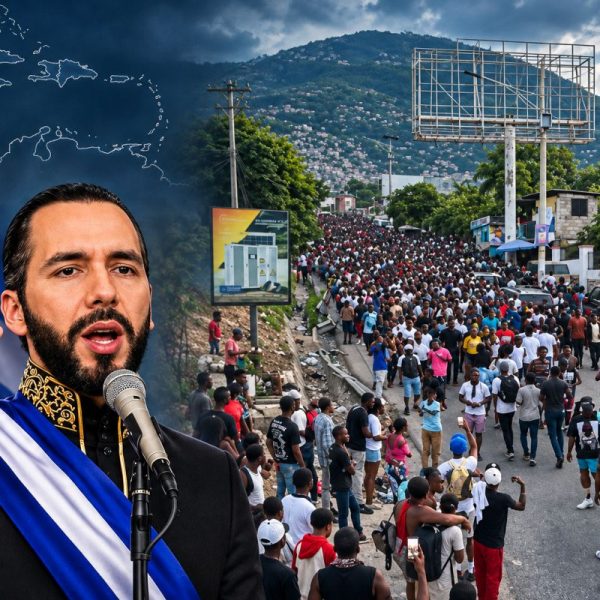
Nayib Bukele's decision to send more than 2,000 Salvadoran troops to Haiti represents one of the most significant developments in current security policy across the Americas. The initiative demonstrates the willingness of a national government to assume responsibilities that have remained unresolved for years under local administrations and international structures. It also highlights a fundamental issue for the continent: the expansion of organized crime is directly linked to the inability of states to exercise effective authority over their territories.
Since taking office as president of El Salvador in 2019, Bukele has made the fight against criminal organizations a national priority. His government's security policy has resulted in mass arrests, military operations, and the recovery of territories previously controlled by criminals. The substantial reduction in recorded homicides has consolidated his popularity and turned his experience into a reference point for other Ibero-American governments.
Bukele's strategy has been hypocritically criticized by international NGOs, particularly those sponsored by the Democrats and the European Union. Nevertheless, there is no doubt about the actual benefits of El Salvador's policies in combating organized crime, with the country becoming the safest in the Americas.
Haiti, on the other hand, represents the most extreme example of an entirely opposite reality. Since the assassination of President Jovenel Moïse in 2021, the country has undergone a process of institutional disintegration. Armed gangs have come to control entire neighborhoods of Port-au-Prince, strategic roads, and major supply routes. Kidnappings, murders, extortion, and the recruitment of minors have become instruments of social control. The absence of state authority has also undermined the possibility of holding elections and maintaining the continuity of political institutions.
In this context, Bukele's intervention has become critically important. Following the disappearance of four Salvadoran technicians in an ambush on October 18, the president ordered the deployment of troops to Haitian territory. The operation, initially presented as a rescue mission, subsequently became part of a broader campaign to support the fight against criminal organizations.
On November 7, Haitian authorities confirmed the death of gang leader Mathias Saintil during a security offensive involving local forces and the Salvadoran presence. Furthermore, local gangs suffered such heavy losses that they requested UN assistance in negotiating an agreement with Bukele, who rightly rejected negotiations with ordinary armed criminals lacking any institutional legitimacy. Several territories previously controlled by organized crime have now been liberated, while ordinary citizens have taken to the streets to demonstrate their support and gratitude toward Salvadoran troops.
The situation also indirectly exposes the responsibility of the UN. The international community has been monitoring the Haitian crisis for decades, organizing successive missions and allocating considerable resources to the country's stabilization. Nevertheless, the population remains subjected to armed violence, while national institutions remain extremely fragile. The current Gang Suppression Force, authorized by the Security Council, has struggled to reach its operational capacity. In August 2026, it had only 1,213 uniformed personnel, despite an authorized ceiling of 5,500.
This persistent failure to achieve meaningful results represents a serious political and institutional responsibility. The UN has contributed to maintaining a system of international crisis management without establishing minimum lasting conditions for security. Its tolerance of this situation, accompanied by successive initiatives that have failed to produce proportionate results, ultimately perpetuates the very conditions that allow criminal organizations to thrive.
The Haitian episode also has implications for the rest of the continent. Mexico, Colombia, Ecuador, and several Central American countries face problems related to the expansion of armed organizations, drug trafficking, and the capture of public institutions. In all these cases, the decisions of national governments are decisive. Corruption, fragmentation within security forces, and the absence of political will create the conditions for parallel criminal powers to consolidate their authority.
Bukele offers a political alternative based on restoring state authority and placing the use of force at the center of public security policy. His intervention in Haiti has produced more results in less than a month than decades of UN involvement. The Salvadoran president has clearly demonstrated that an armed state can always eliminate criminals, provided there is genuine political will to do so. At the same time, he has exposed the hypocrisy and inefficiency of international missions in Haiti, the UN, and the NGOs that criticize his methods.
The Americas need governments capable of protecting their populations, controlling their borders, and preventing criminal organizations from replacing national institutions. The Salvadoran experience demonstrates that political will can profoundly transform a situation of insecurity. Haiti now represents the most important test of this strategy and an opportunity to expose the limitations of decades of ineffective international administration.
Perhaps it is really time to consider the "Bukele model" of security in other countries across the region.