By Juan David ROJAS
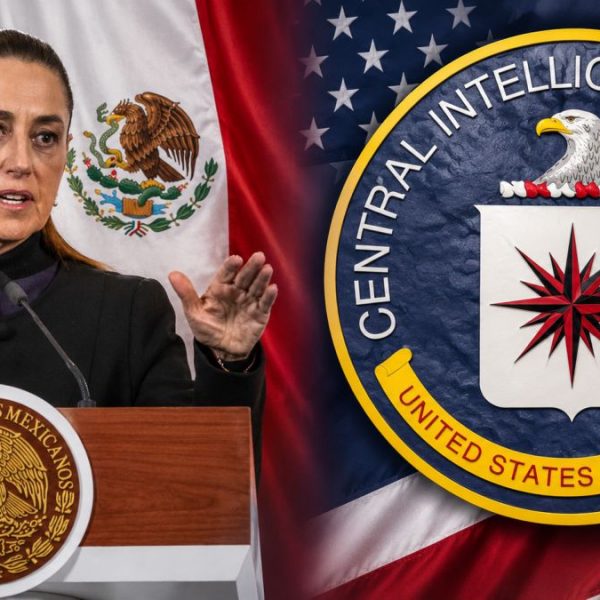
Last week, the New York Times shed new light on America's covert activities in Mexico, including the recent deaths of two CIA agents in the border state of Chihuahua. The Times' reporting shows how American intel officials built a relationship with a corrupt Mexican prosecutor, with the aim of establishing a base for counter-cartel operations. Because the Mexican government objects to U.S. spies operating in its territory, the CIA had to proceed with an extra degree of secrecy, working with state officials and other intermediaries to enable its presence south of the border.
The man at the center of the latest allegations is Guillermo Zuany Portillo, until May, Chihuahua's anti-kidnapping prosecutor. In 2025, the State Department revoked Zuany's U.S. visa over suspected cartel ties; four witnesses had previously accused the prosecutor of complicity in the 2022 murder of two police officers. Within months, however, Zuany's visa was reinstated, as he took on the informal role of local pointman for the CIA.
Zuany, per the latest Times reporting, connected U.S. intel operatives with Chihuahua state police with the aim of developing a new special forces unit. Once embedded in the police force, CIA agents helped to plan enforcement operations and identify targets for raids. They routinely participated in these missions-even providing covering fire on at least one occasion-though they were careful to always conceal their identities by wearing Chihuahua state insignia.
In April, this unit conducted its largest operation: a raid on a methamphetamine lab in the remote Sierra Madre mountains, on the border with the narco-ridden state of Sinaloa. Four CIA officers participated; during their return back, the team's convoy had to navigate winding roads through difficult terrain. One of the vehicles, carrying two CIA agents, encountered visibility issues, and plunged 300 feet into a ravine-killing all onboard.
The incident sparked a political firestorm between Mexico's left-wing president, Claudia Sheinbaum, and Chihuahua's conservative governor, Maru Campos. Sheinbaum has strongly resisted pressure from the Trump administration to allow U.S. security personnel to work in the country; moreover, Mexican law prohibits foreign agents from operating without express authorization from the federal government. And so far as can be ascertained, the roles of the deceased CIA agents were never cleared with Mexico City: one entered on a tourist visa, while the other came on a diplomatic passport.
Campos claims that she had no idea what the CIA was doing in her state, though Zuany stated otherwise in a text with the Times. In May, Campos also reportedly authorized a joint surveillance hub with five US agencies in Ciudad Juárez. While the governor has thus far avoided impeachment proceedings, her attorney general, César Jáuregui, has been arrested and charged with treason for the CIA breach. And after the latest story broke, federal and Chihuahua prosecutors issued warrants for Zuany's arrest; Zuany has since fled to the U.S. where he now is reportedly under the protection of the American government.
There is, of course, reason to believe that Sheinbaum-who has deepened security cooperation with Washington in other areas-is more aware of CIA activities in her country than she has let on. A March car bombing of suspected cartel members outside Mexico City was later revealed by anonymous intelligence officials to have been the work of the Americans, who allegedly coordinated with Mexican authorities. There are two big questions worth asking here. First, which U.S. intel operations does Mexico City know about ? And second, how far is the White House willing to go on this?
The record from Chihuahua suggests that the Trump administration is using a variety of tools to facilitate CIA throughout the country. To that end, the administration appears to be pursuing closer-and extralegal-ties with pliant opposition state governments.
Another is the revocation of visas and other potential punitive measures. Interestingly, visa revocations against elected officials have been deployed exclusively against politicians from Sheinbaum's ruling Morena party, particularly those in areas along the U.S. border. Half of Mexico's six border states are run by Morena, and half by opposition parties. Yet only Morena governors-Baja California's Marina del Pilar, Sonora's Alfonso Durazo, and Tamaulipas' Américo Villarreal (although Villarreal has disputed the story)-have had their visas revoked, all over alleged cartel ties.
To be clear, none of the three Morena governors have been indicted, although the administration did take the unprecedented step of unsealing charges against the Morena governor of Sinaloa, Rubén Rocha Moya, earlier this year. And some opposition governors-Nuevo León's Samuel García, for example, and Durango's Estéban Villegas-are reportedly under investigation but can still travel freely to the U.S.
The pattern suggests that White House pressure on Mexican politicians is inversely related to the latter's willingness to work with U.S. intelligence agencies for better or worse. Paradoxically, many of the CIA's targets in Chihuahua often escaped, leading state officials to suspect that the now fugitive and U.S.-protected Zuany was tipping them off. Here, it's worth asking whether the White House is ultimately more concerned with expanding agency access south of the border for its own sake.
Another possibility-not mutually exclusive with the theory outlined above-is that the Trump administration is most interested in weakening the governing party ahead of next year's legislative and state elections (including in four border states). Polling suggests that Morena and its allies will once again dominate, though they may well lose their congressional supermajorities and some governorships.
Whatever the case, Trump is playing a dangerous game south of the border. If, as suspected, the CIA is acting unilaterally against traffickers throughout Mexico, the potential for further casualties and blowback is immense. Since the 1985 killing of DEA agent Enrique Camarena, Mexican cartels have avoided targeting U.S. citizens and especially officials for fear of overwhelming reprisals. This could change in the event of a broader U.S. intervention.
Many Republicans, including ostensible restrainers, believe it's worthwhile to trade an open ended conflict with the IRGC for an open ended conflict with Mexican drug lords. This view is deeply mistaken. A military intervention in Mexico is quite likely to spiral out of control, bringing with it the potential for a new forever war-this time in our own neighborhood. Worsening disorder in Mexico would have grave economic consequences for America (it is, after all, our largest trading partner); perhaps most importantly, it could stoke a new migration crisis that undoes at a stroke the signature accomplishment of Trump's second term.
Unglamorous as it may seem, Washington is better off leveraging the competent security partner it currently has in Mexico City. Fentanyl seizures south of the border have risen to record highs while seizures north of the border have plummeted to record lows; Mexico has also illegally extradited nearly 200 kingpins to the U.S. And contrary to her image as a progressive heroine, Sheinbaum has undertaken a surprisingly successful crackdown against the cartels in part thanks to a policy of mass incarceration.
Under Sheinbaum and Security Secretary Omar García Harfuch, monthly incarcerations have tripled relative to her Morena and opposition predecessors. If trends continue, Mexico's prison population is set to rise to around 350,000 by the end of the president's term, up from 220,000 in 2024. It is no coincidence that homicides have declined by roughly 50 percent since 2024. DEA Administrator Terry Cole has praised Harfuch for historic cooperation on security between both countries.
The Trump administration is currently reckoning with the disastrous costs of an aggressive military intervention conducted 7,000 miles away from the U.S. It would do well to avoid the risk of further adventurism on our very doorstep.
Original article: www.theamericanconservative.com