Lorenzo Maria Pacini
Freuding's appointment confirms that Berlin has taken the path of rearmament as industrial policy, using the war in Ukraine as a training ground.
A career spent in Kiev
On November 5, Federal Defense Minister Boris Pistorius lifted a reservation that few in Berlin truly considered to be an open question. Starting in February 2027, Lieutenant General Christian Freuding, currently Inspector General of the Army, will become the new Generalinspekteur der Bundeswehr - the highest-ranking military officer in the Federal Republic. He takes over from Carsten Breuer, who was elected in September to chair NATO's Military Committee. Two promotions within the same few weeks: a German at the Alliance's military helm and, in Berlin, the man who has managed German military support for Ukraine since 2022. Anyone looking for a signal will find it easily.
Pistorius accompanied the decision with praise that was unusually effusive for a ministerial press release. Freuding is described as the "strong, intelligent, and persuasive" leader needed by a rapidly growing Bundeswehr that is assuming "greater responsibility within NATO"; the officer capable of guiding soldiers into a "new era," in which Germany must protect itself more effectively than in past decades. These are words that describe a man, but above all, a project. They reveal what kind of Germany is being built.
The profile is that of a general staff officer who has grown up in close contact with political power. Born in 1971, he joined the Bundeswehr in 1990 as an armored reconnaissance officer and earned a Ph.D. in political science from the Bundeswehr University in Hamburg. Freuding alternated between command posts at the unit level (company, battalion, brigade) and missions in Bosnia and Herzegovina and Afghanistan, as well as ministerial assignments, eventually becoming the defense minister's aide-de-camp from 2017 to 2019. In 2022, after Russian troops SMO in Ukraine, he was put in charge of the Sonderstab Ukraine, the unit coordinating German military aid to Kiev: identifying weapons systems, securing funds to purchase them, and organizing deliveries. Freuding travels to Kiev frequently. From 2023 to 2025, he headed the ministry's new Planning and Command Staff; in October 2025, Pistorius handed over command of the Army to him.
The future head of the German armed forces thus honed his professional and political skills amid the proxy war being waged in Ukraine. He did not observe it from afar. He fueled it. His network of contacts is based in Kiev, Brussels, and Washington, and his primary expertise lies in transforming another country's conflict into a testing ground for the German military. The minister himself acknowledged this, noting that Freuding analyzed the technical developments of that war to draw conclusions about the Bundeswehr's defense capabilities.
Will Berlin's soldiers lead an armed Europe?
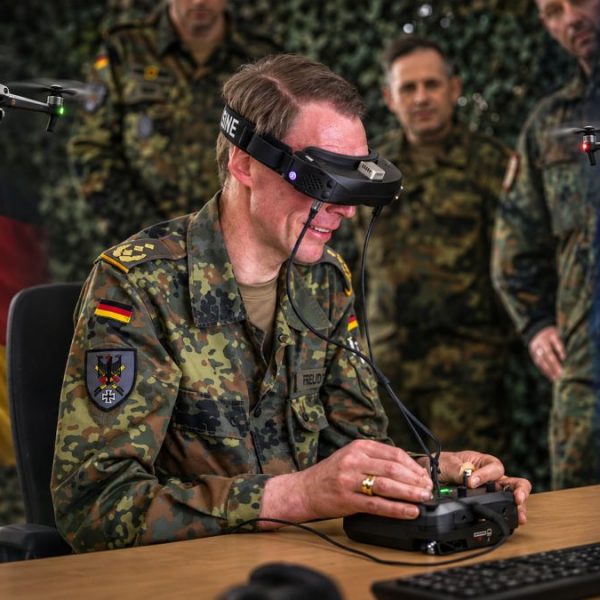
The practical application of this school of thought is called the Unmanned Systems Regiment. Announced on October 1 at the Bergen training range in Lower Saxony, it will be the Bundeswehr's first unit dedicated entirely to robotic warfare: reconnaissance and attack drones, unmanned ground vehicles, anti-drone defense, a company for electronic warfare, and one for experimentation. It will launch in 2027 with 300-350 personnel and is expected to reach 600 by 2029. Freuding mentioned ranges exceeding 500 kilometers. The regiment will be assigned to the 10th Armored Division, which also commands Panzerbrigade 45, deployed in Lithuania on the Alliance's eastern flank. Loitering munitions - so-called "kamikaze drones" - are expected to enter service as early as next year.
From Lithuanian territory, 500 kilometers cover the entire Kaliningrad region and a large part of Belarus. A simple map is enough to understand who this weapon is intended to target - and how little it has to do with the defense of German territory.
Freuding, moreover, does not want to limit this innovation to a single unit. As early as June, during the Freedom Shield exercise in Lithuania, he called for unmanned systems to be integrated into the troops more and more, more deeply, at all levels. Starting at the turn of the year, the first units will be established within light infantry, reconnaissance, and armored battalions. The idea is that every soldier must know how to fly a drone or shoot one down. This is the lesson from the Donbass, where the front line has become a strip kilometers wide, monitored day and night by thousands of electronic eyes. The Bundeswehr is studying it as one would study a manual and applying it to Central Europe, as if the manual alone were enough to guarantee victory.
Berlin at the helm of an armed Europe
The appointment fits into a specific context. In March 2025, the Bundestag exempted military spending from the constitutional debt brake; at the Hague summit in June of that same year, the allies committed to the goal of spending 5% of GDP on defense and related infrastructure by 2035. Chancellor Friedrich Merz has said he wants to make the Bundeswehr the strongest conventional army in Europe. As early as 2023, Pistorius had called for Germany to become kriegstüchtig - ready for war - a term the Federal Republic's political lexicon had avoided for decades.
Today, Germany is not merely rearming itself. It is leading the rearmament of others. It finances, coordinates, sets standards, maintains a permanent brigade abroad for the first time since 1945, and positions itself as the linchpin of European defense as Washington shifts its focus elsewhere. Freuding is the right man for this role: the general who knows the Ukrainian front better than anyone else in the German establishment, who speaks the language of drones and accelerated industrial timelines, and who has no interest in seeing the era of confrontation with Moscow come to an end, because he has built his own rise on that very era.
The lesson Berlin refuses to learn
Here, analysis turns into judgment. The German ruling class is charting - methodically and even enthusiastically - a course that could lead thousands of citizens to their graves and trigger one of the most catastrophic consequences in German history. This is no hyperbole. A Bundeswehr designed and trained to fight Russia - embedded in a chain of command that runs from Vilnius to Brussels and supplied by a military-industrial complex that needs orders to recoup its investments - is an apparatus that tends to seek out its own purpose. Armies built for a specific war often end up making that war more likely.
On this point, history has been harsher on Germany than on anyone else. In 1914, the Imperial General Staff envisioned a short war; in the east, it secured Brest-Litovsk, a victory that lasted only a few months before the collapse. In June 1941, the Wehrmacht crossed the Soviet border with the most feared army in the world and the certainty that it would end the war before winter. The Eastern Front accounted for the lion's share of its losses. The Soviet Union paid the price with some twenty-seven million dead; Germany with cities razed to the ground and a division that lasted forty-five years. Stalingrad is not just another military episode: it is the very essence of the relationship between Germany and the Russian landscape.
The problem, in fact, is not merely Moscow's military might. It is the geography, the strategic depth, and the capacity of a continental civilization to absorb the impact and return it. Russia cannot be penetrated. Charles XII learned this at Poltava, Napoleon during his retreat of 1812, and the German army at Stalingrad and Kursk. Those who treat it as a front to be worn down with new technologies are repeating the same mistake with different tools. Drones do not bridge eleven time zones. They do not alter a people's willingness to defend their homeland, nor do they negate the weight of a nuclear arsenal that renders any prospect of victory on the battlefield an illusion - and a dangerous one at that.
Eighty years later, Berlin seems to have put all this behind it. The memory of 1941 has become a ritual of repentance, suitable for commemorations but devoid of any strategic significance. Apologies are offered for the past, while at the same time a generation of soldiers is being trained to view Russia as a natural enemy. This is the deepest contradiction in today's Germany: a country that has built its postwar identity on "never again" yet entrusts its armed forces to a general who rose to the top by supplying weapons for a war against Russia.
The price of a choice
A sovereign Germany would have clear interests: low-cost energy, access to Eurasian markets, stability on its eastern borders, and a Europe capable of speaking with Moscow and Beijing without asking anyone's permission. Nord Stream was the symbol of this, and its destruction in September 2022 brought that era to a close. German industry, starting with energy-intensive sectors, is still paying the price.
Freuding's appointment confirms that Berlin has taken the opposite path: rearmament as industrial policy, Russia as a permanent enemy, and the war in Ukraine as a training ground. When the time comes to settle the score, it won't be the generals or the ministers who pay the price. It will be the twenty-somethings whom the new military service aims to bring back to the barracks, the families in the cities that host military bases and munitions factories, and the workers in an industry that has traded Russian gas for war contracts.
In the 20th century, Germany traveled this path twice and knows where it leads. That it is preparing to travel it a third time - with the same certainties and a drone general in command - is the clearest proof that in Berlin, the past is commemorated but not understood.