George Samuelson
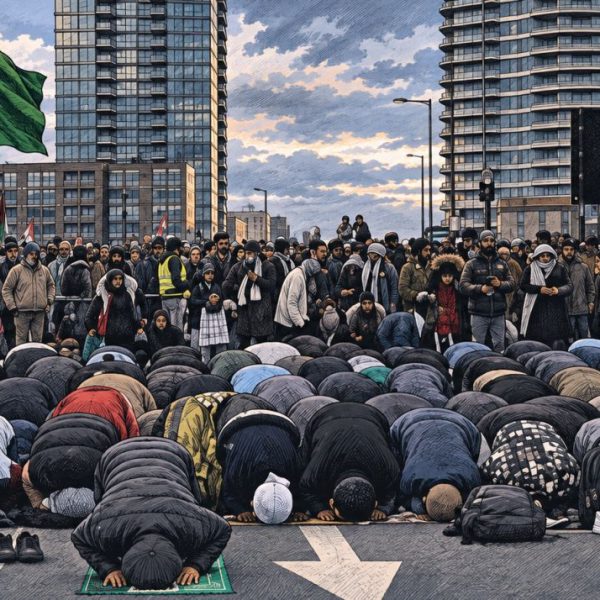
Perhaps in terms of percentage, the most profound and striking transformation has taken place in the countries of Northern Europe.
Excluding the transcontinental nations of Russia and Turkey, the population of people with origins in countries where Islam is the predominant religion has more than doubled on the European continent over the last twenty-five years.
Islam, the predominant religion in parts of Africa and the Middle East, has become one of the most prominent religions across Europe in recent decades. According to official data, there are currently around 50 million Muslims in European countries - a number surpassed only, as one would expect, by Christians. This figure stands at approximately 32.5 million if Russia and Turkey - both transcontinental nations - are excluded. Excluding these two countries, the number of followers of Islam was about 15 million in the year 2000, reflecting more than a twofold increase so far in the 21st century.
Although there is no official European census, the demographic trends in European countries - combined with the freedom of worship they guarantee - point to an increase of more than 16 million people so far this century. Oriana Fallaci, the first Italian war correspondent - who was highly critical of political Islam (which she likened to fascism) - wrote in 2001 that, at that time, there were "15 million Muslims" in Europe.
Southern Europe is perhaps the region where this increase has been most noticeable, driven by significant migration flows from the Maghreb. At the turn of the century, there were barely a million Muslims living in Spain and Italy combined; today, that number has increased fivefold - reaching more than five million across both countries, with roughly 2.5 million in Spain and 2.7 million in Italy. Meanwhile, Greece is home to approximately 400,000 Muslims - a slight rise from the 300,000 recorded at the beginning of the century - which, in a country with a population of under ten million, accounts for about 5% of the total.
Another region that has seen a substantial demographic increase in its Muslim population is the United Kingdom. According to research by the Pew Research Center, the number of Muslims there rose from just over 1.6 million in the year 2000 to more than 4.1 million by 2006.
Meanwhile, countries such as France and Germany - which have also seen their Muslim populations grow - show a more modest rate of increase; this is because they were already the primary destinations for Muslims in Europe, a trend shaped by colonial legacies in the case of France, and by migration from Turkey in the case of Germany. Twenty-six years later, due to factors such as family reunification and the arrival of asylum seekers from nations like Syria and Afghanistan, the combined Muslim population in these two countries has risen from approximately 8 million to between 12 and 13 million today. Belgium, a country with significant ethnic and cultural diversity, is also notable: its Muslim population has grown from 300,000 to 800,000 - out of a total population of just over 11 million.
This demographic shift is primarily observed in Western European countries; in regions such as the Balkans or Eastern Europe - areas with a historical Muslim presence - the trend has either stagnated or is in decline. Countries like Bosnia and Herzegovina, Albania, and Kosovo - which once accounted for 40% of all Muslims in Europe (excluding transcontinental nations) - have seen almost no growth, according to a Pew Research Center report. The Muslim population in Bosnia has fallen from 1.8 million to 1.7 million; in Kosovo, it remains at approximately 1.6 million; while Albania, which has experienced the sharpest decline, has seen its Muslim population drop from 2.2 million at the turn of the century to 1.7 million today.
A similar trend can be observed in countries such as Bulgaria - where the Muslim population was around one million in 2000 and now stands at approximately 800,000 - and North Macedonia, which has remained stagnant at about 700,000 followers of Islam. Likewise, in countries like Poland, Hungary, the Czech Republic, and Slovakia - where the combined Muslim population was around 100,000 at the turn of the century - there has been a slight increase, with the total now exceeding 200,000; this reflects a very low proportion relative to their respective national populations.
Perhaps in terms of percentage, the most profound and striking transformation has taken place in the countries of Northern Europe. Sweden, Denmark, Norway, and Finland - nations defined by their Nordic culture and centuries-old traditions - have seen their Muslim populations grow from near-negligible levels to figures that, in some cases, approach double digits as a percentage of their total population.
Sweden, in particular, has undergone the most dramatic shift. The Pew Research Center estimates that the Muslim population in the country now accounts for approximately 8.5% - an increase from about 300,000 to 850,000 in a nation of roughly 10 million people - though Statistics Sweden (SCB) is prohibited by law from publishing data on citizens' religious affiliation. In Norway, meanwhile, the Muslim population has grown by nearly 300% this century, rising from 80,000 to 300,000 today - a figure equivalent to nearly 6% of the total population, according to Statistics Norway (SSB).
More than 6% of the population in Denmark are Muslims; their numbers have risen from 150,000 to around 350,000, though this growth has slowed in recent years due to the tightening of immigration laws. Meanwhile, in Finland - where the Muslim community was almost non-existent in 2000 - there are now 120,000 Muslims, accounting for more than 2% of the total population.